Even if your legacy system works well, sooner or later, you’ll face the dilemma of its modernization. Certainly, you can rely on your obsolete software or even benefit from it, but you can’t expect a lot from it, especially when it comes to business growth .
As the number of users and the volume of data grow" , your system will experience performance drops. Your servers can’t keep up with workloads. Bugs will cause app crashes and lead to functional failures. You can’t scale up with an outdated tech stack. It means that your technical infrastructure fails to fulfill your business goals.
According to Statista, surveyed companies report that the main drivers of legacy system modernization are improved security, greater efficiency, and lower costs. Some firms choose to upgrade their software to increase its flexibility and integrate it with the latest technologies.
As our clients come to us with requests to revamp their apps, we want to share why legacy application modernization matters and what approaches you can take to increase your technical capabilities while preserving your original business value. Keep reading!
Why Legacy Systems Turn Into a Business Risk
Your legacy platform can bring a lot to the table for your company, but it won't last forever. The longer you delay its upgrading, the more pain points you will create for your business in the future. That’s why we want to explain what business risks you may face with your outdated software.
- Draining your budget: Running obsolete systems is costly, as you need to pay to keep them running and fix technical issues. Since they work slowly, this can negatively impact your business operations and revenues.
- Integration issues: Not all outdated software can interact with newer apps or integrate with modern technologies. As a result, this creates extra challenges, such as poor functionality and inconsistent data.
- Killing agility: Legacy systems aren’t speedy and can’t keep up with new tools. Plus, it’s difficult to add new features to enhance your workflows. You need flexibility, but without legacy system modernization, it’s impossible.
- Security risks: No doubt, you play with fire if you fail to regularly patch and update your system keep it secure and compliant. Certainly, its security level is weak, so you’re open to fraud, breaches, and data leaks.
Legacy software makes your business vulnerable, strains costs, and prevents sustained growth. Plus, you can’t beat your rivals that rely on modern IT infrastructure and the latest technologies.
Key Signs Your Legacy System Needs Modernization
The problem is that many companies postpone modernizing legacy systems because they don’t recognize the early signs that their applications are dying. We want to warn you: the longer you wait, the more issues and risks you create for your business. Here are the key symptoms that you may need legacy system modernization:
- A lagging, buggy platform: If your system slows down, crashes, or struggles during peak workloads, it’s time to modernize to keep operations efficient.
- Can’t be integrated with modern apps: You can’t connect your obsolete platform with new applications that limit its features and functions.
- A rigid and inflexible system: When your platform is built on monolithic architecture and old frameworks, it’s difficult to add features or migrate to cloud services. Monolith vs microservices is a choice that matters for your business growth.
Now you understand that legacy systems are more of a business risk than a backbone for your efficiency. If you notice these early signs of poor application performance, it’s time to speed up modernization.
Types of Legacy Systems
Let’s clarify which platforms and applications can turn into legacy systems. You should be aware of this to understand the risks and threats it poses for your business.
- Mainframe systems: These large, powerful computers are used for heavy data processing in government, insurance, and banking. Why can they become obsolete? They are based on outdated programming languages and monolithic architecture, making them rigid and costly to deploy.
- Web-based applications: These systems involve interaction between a client (a web browser) and a server. Mostly, these apps rely on outdated network standards, so it’s difficult to integrate with modern technologies.
- Monolithic systems: All components of this software are built as a unified codebase, so you can’t modify and update a single service separately, like you can do in modular systems.
- In-house applications: These systems are built by an internal team to better cover a company’s business needs. They aim to control your documents or automate workflows. But soon, they can become obsolete because it’s difficult to update them if key experts are unavailable.
If you have any of these applications mentioned above, at some point, you’ll face the dilemma of legacy modernization. And the main thing is to pick the right strategy that can help you optimize your software work and pave the way for your business growth.
How to Modernize a Legacy System: Core Approaches
We’ve clarified when and why you need to upgrade your legacy system and explained the consequences of using outdated software for businesses. Now we’re ready to share how we modernize our clients’ applications to maintain their efficiency.
Rehosting
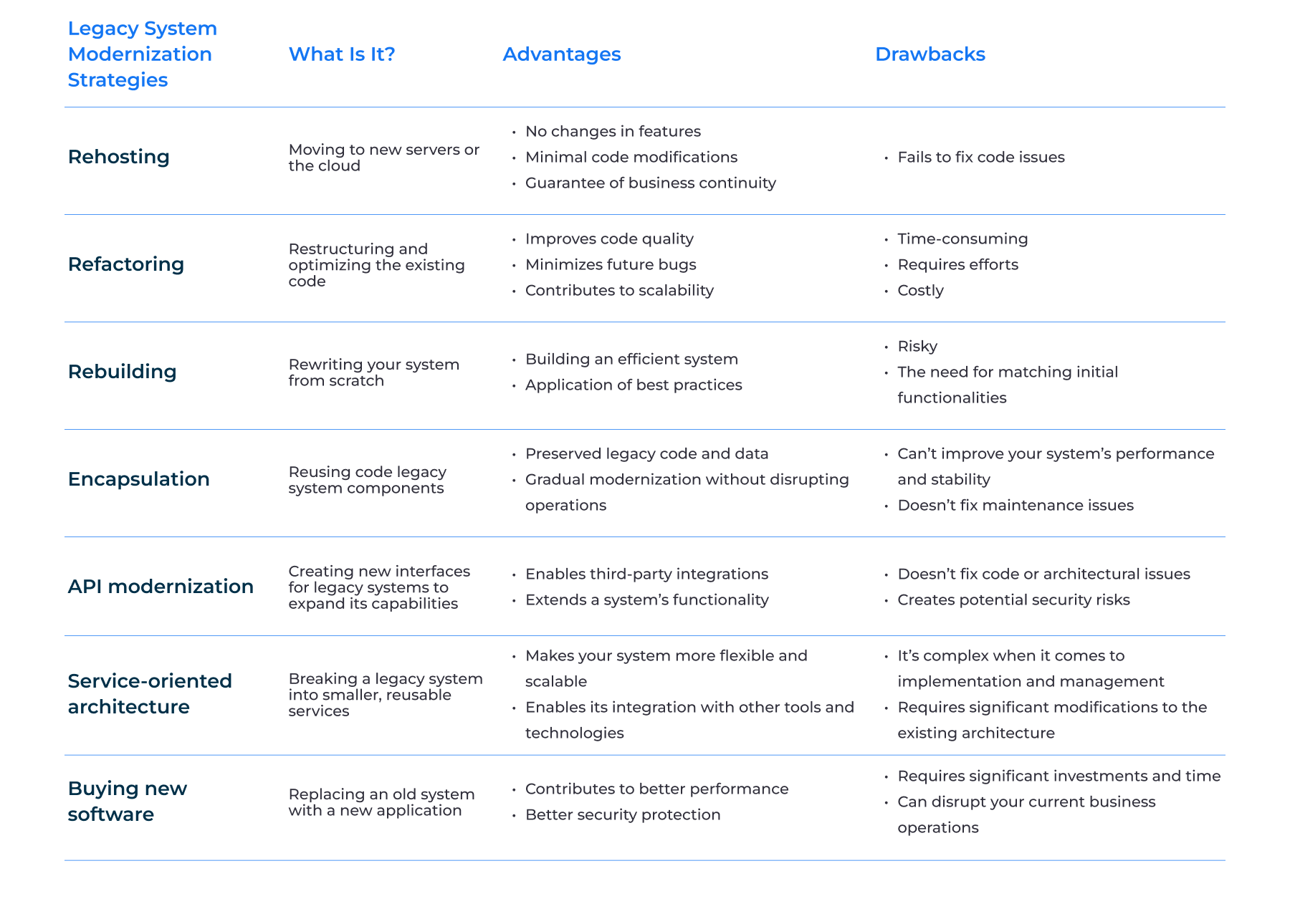
Rehosting, also known as the “lift and shift” strategy, is moving a legacy system to new servers or the cloud without changes to its features or code. Only the hardware is upgraded to modern infrastructure. The legacy app and its core functions remain the same.
Why do we recommend rehosting? This legacy system modernization approach speeds up cloud migration, reduces the need for code change, and doesn’t interrupt your business operations. It's worth noting, however, that this strategy does not address underlying code issues.
Refactoring
Refactoring, also named “re-architecturing,” is the process of restructuring and optimizing the existing code to make it more viable. All this is done to improve code quality but not to change its behavior.
This modernization approach enables your legacy system to work with fewer issues and bugs. Refactoring fits perfectly for companies that need application migration, like the transition from a monolithic to a microservice architecture. So they get viable, optimized code and a robust, flexible system. But it’s important to remember that re-architecting requires additional time and costs.
Rebuilding
Rebuilding is rewriting your legacy system from scratch while keeping its functionalities and requirements. This legacy application modernization approach allows the use of modern code, frameworks, and tools.
The benefits of this strategy are that it helps build an efficient system and enables engineers to avoid past failures and apply best practices. The downsides of rebuilding are that it’s risky and requires extensive testing to align with the initial functionality.
Encapsulation
Encapsulation is the reuse of core legacy system components while removing outdated code. This strategy involves using APIs to connect legacy components with new access layers. As a result, you get a fresh interface for existing parts with saved app’s capabilities.
How can you benefit from this legacy modernization approach? First, you preserve legacy code and data by minimizing risks. Second, your legacy system experiences gradual modernization without a hitch. But the limits of encapsulation are that it fails to improve your app’s performance and stability, and fix maintenance issues.
Application Programming Interface (API)
API modernization is the process of creating new interfaces for legacy systems to enable work with new services and apps. This approach doesn’t change your code but scales your outdated system capabilities.
The advantage of this strategy is that it creates conditions for third-party integrations. Plus, it also extends the functionality of your old system. The drawback of API modernization is that it doesn’t fix code or architectural issues. Plus, this approach creates potential security risks if not properly connected.
Cloud Migration
Cloud migration is moving your legacy system and data to cloud services swiftly or gradually, depending on your business needs.
You should opt for this strategy because it makes your app more agile and flexible and saves your budget. But rehosting (cloud migration?)can be risky for your legacy software in terms of data security and compliance. That’s why you should plan it to transfer your system without a hitch and with benefits for your business.
Service-Oriented Architecture (SOA)
Service-oriented architecture is dividing your system into smaller, reusable components that you can independently rebuild, deploy, and maintain. These services can be improved and updated without affecting the entire application.
The pluses of SOA are that it makes your system more flexible and scalable and enables its integration with other tools and technologies. This approach also has its minuses. It’s complex when it comes to implementation and management. SOA requires significant modifications to the existing architecture.
Buying New Software
Buying new software replaces an old system with a new application. This legacy software modernization strategy involves choosing a solution (SaaS) and replacing it with the current system.
The advantage of this strategy is that it contributes to better performance as a new app leverages modern technologies. Plus, you also receive better security protection. The weakness of this approach is that it requires significant investments and a lot of time, and can disrupt your current business operations.
What You Gain from Legacy System Modernization
As there are still companies that are skeptical about the value of legacy software modernization for their business or are afraid that things may get worse, we want to share what upgrading your outdated system brings to the table.
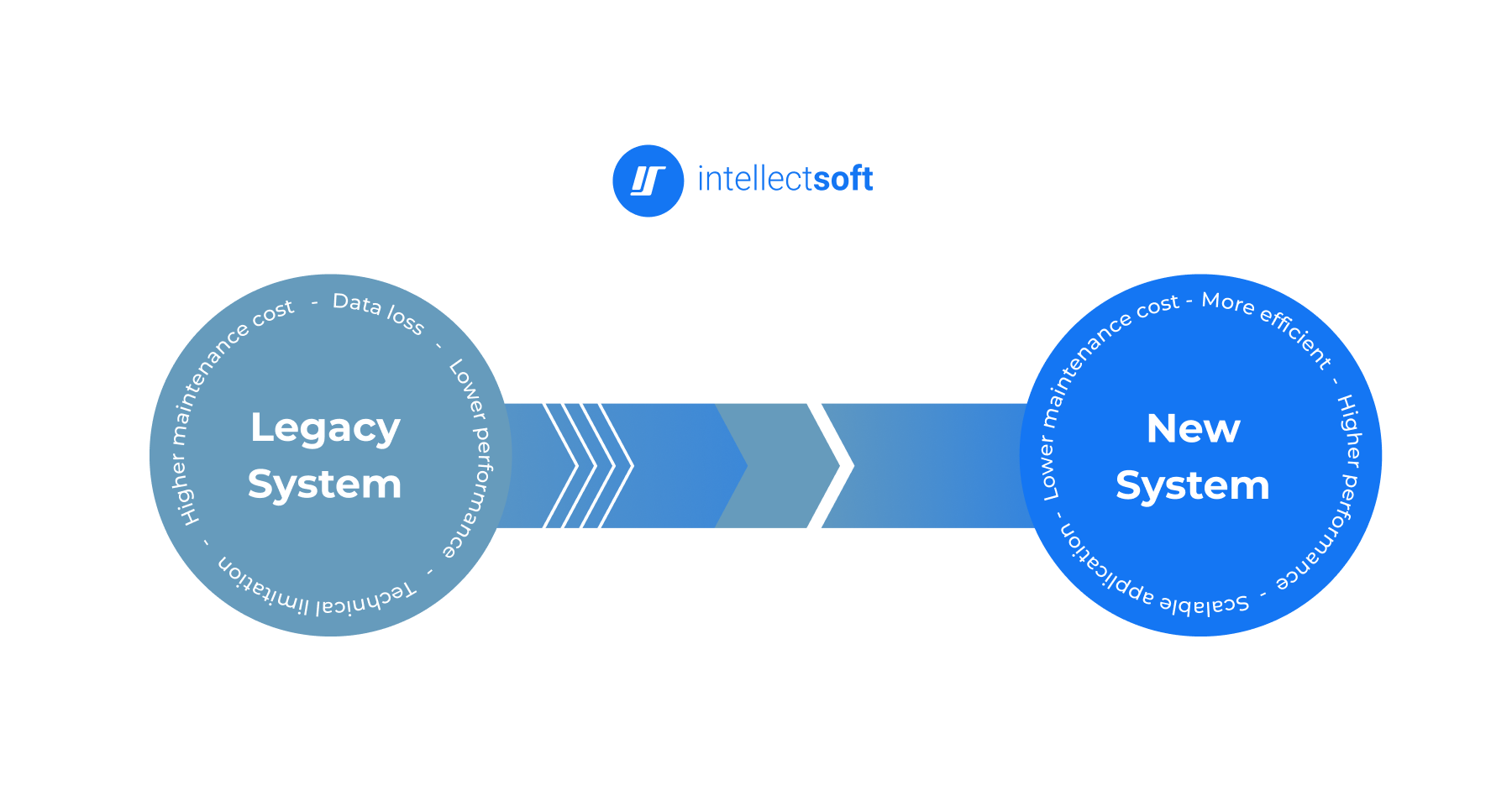
- Your system will be more productive and efficient: Software modernization improves how your app works, minimizes the number of bugs that can crash it, and delivers a more quality user experience.
- You can cut operational costs: With time, any legacy software turns into a costly burden that requires extra budgeting. Re-architecting, reengineering, or refactoring your system allows you to operate more rationally with fewer expenses for technical issues.
- Your system can grow: Legacy software is full of dependencies that make it rigid and resistant to change and integration. Being modernized, your system will become more flexible and able to connect with modern tools.
- You’ll deliver an excellent customer experience: By staying committed to your legacy system, you can’t react swiftly to your clients’ needs. Modernization enables you to innovate, integrate AI and data analytics, and deliver an excellent user experience.
- Your system will be better protected: Without regular security and compliance updates, your system becomes not only obsolete but also insecure and non-compliant. With modernization, you can minimize risks and threats and ensure reliability to your clients and your business.
- You can integrate your app with modern tools: Legacy systems hinder business growth due to poor interconnectivity with third-party software. With modernization, you can add new instruments to your system and make your business more competitive.
All these benefits prove that legacy system modernization is worth trying, as it is a great way to revitalize your software and upgrade it with emerging technologies. This approach is a driving force behind your business efficiency and capacity to compete with others on equal terms.
How AI Helps Modernize Your Legacy System
No doubt, when our clients come to us with a request to modernize a legacy system, they want to do so ASAP. And their demand is justified, as the longer they postpone, the greater the risks their businesses face.
At Intellectsoft, we can speed up the modernization of your system with AI and add new capabilities. Here’s how we can revamp obsolete software into a flexible and intelligent system with the help of artificial intelligence:
- We diagnose and assess your application: To transform your system, we use AI tools to scan it to see weaknesses and gaps. Believe us, AI can identify critical issues in hours, while people can take months to do so.
- We conduct AI-backed refactoring: With AI, we can refactor legacy code faster and integrate it with modern tech stacks. We’re doing all this in real time, reducing server costs.
- We automate additional integrations: We can perform API upgrades and database migrations more quickly by robotizing critical business processes. As a result, in cloud-native ecosystems, legacy software becomes more agile, integrated, and responsive to your business needs.
- We integrate predictive maintenance: With real-time data, AI forecasts when a system will crash before it disrupts workflows. That’s why this is a good way to reduce downtime.
- We ensure self-optimization: We improve a legacy system’s performance with AI-backed load balancing and intelligent caching. All this is done to prevent performance drops and ensure the smooth operation of software.
Despite the fact that the use of AI for software modernization is not visible, as it is mostly used within your system, the results are impressive, as it becomes a driving force for the transformation of a decayed application into an intelligent and dynamic system that moves you toward a competitive advantage.
How Intellectsoft Can Help with Legacy Modernization
Legacy modernization isn’t as easy as it may seem. Before doing it, you need to assess your software to determine what strategies to apply for upgrading. Then, you have to understand how your system behaves and how its performance influences your business.
At Intellectsoft, we can help you modernize legacy systems faster, with minimal disruption. As an AI software transformation company, our legacy modernization initiatives are based on automation and predictive analytics to speed up assessment and optimization of your system. From a few upgrades to full rebuilding, we can improve everything that holds you back and integrate your software with the latest technologies.
Need to modernize your system to increase your business efficiency? Book a free consultation with our experts.
FAQ
How to approach legacy modernization?
At Intellectsoft, we evaluate your current system and its capabilities to determine whether it aligns with your business needs. Then, we select the right modernization strategy to upgrade your system and increase its efficiency. After this, we’re planning data migration to ensure a secure transition of your datasets with minimal downtime. As a rule, we modernize legacy systems gradually to minimize disruptions and test your software at every stage of the improvement process.
What are the 7 R's of modernization?
Rehosting, replatforming, refactoring, repurchasing, retiring, retaining, and rebuilding are the 7 R’s of legacy system modernization. What to choose and what can fit you depends on your software complexity and business needs.
What is an example of legacy modernization?
As we mentioned above, there are many approaches to legacy modernization. For example, our clients ask us to rehost their existing systems in the cloud, without modifying their core functions. When our clients need to improve the maintainability of their systems, we refactor their code.
Why should I modernize my legacy system?
Of course, if you don’t plan to scale your business, are ready to pay more, and accept existing risks, you can use your legacy system. But we’re sure that soon you’ll get tired of this. The lack of updates, high costs, and lack of flexibility and integrations will encourage you to modernize your obsolete software.
What role does AI play in modernizing legacy systems?
AI supports and speeds up the modernization efforts by reducing routine workflows and allowing for faster action. Plus, it helps understand complex codebases, automate parts of code modifications, and accelerate testing. AI also assists with data migration and system monitoring by detecting technical issues and optimizing its performance. In general, AI can’t replace modernization strategies, but it can make them faster, safer, and more efficient.
