AI in healthcare provokes two questions. One is about the rate of AI adoption in clinical settings. The other is about the role and use cases of artificial intelligence in healthcare.
In their 2026 Physician Survey on Augmented Intelligence, the American Medical Association shares that 81% of physicians now use AI in their work. By contrast, in 2023, only 38% of doctors relied on AI healthcare solutions. That’s less than half of today’s figure.
In 2025, the number of licensed AI-based medical devices was 1,300, according to the FDA report. See how fast AI is becoming a part of health care.
How is AI applied in health systems, and what does it bring to the table? First, it supports both clinical and administrative work. Second, algorithms process medical data and records, shifting the paperwork away from doctors. Finally, AI automates mundane tasks, so care delivery is faster and more helpful. But these are not the only benefits you can expect from artificial intelligence.
Of course, these opportunities also come with challenges. And that’s the reason why we want to give you a full picture of AI in healthcare — its applications, advantages, and risks.
What Is AI in Healthcare?
Artificial intelligence in healthcare is the use of algorithms to analyze medical data, detect patterns, and simplify healthcare tasks and decisions. Trained on data and records, AI models help care providers digitize processes and operations. So this leads to faster diagnosis, less manual work, and better patient care.
According to a review published in the Journal of Medical Internet Research, the goal of AI-augmented healthcare systems is not to replace human interaction between a doctor and patient but to make it more fruitful.
Care providers produce tons of data — medical records, lab results, images, and patient information. But how to process this in time for better health outcomes? They have two options: load medical staff down with paperwork or hire extra employees. Both of them are costly. Organizations either get exhausted teams who leave soon, or they invest more to scale their team.
Certainly, they can avoid both scenarios with AI solutions that help teams process data faster, get rid of manual work, and use their resources more efficiently.
The technologies behind AI in healthcare
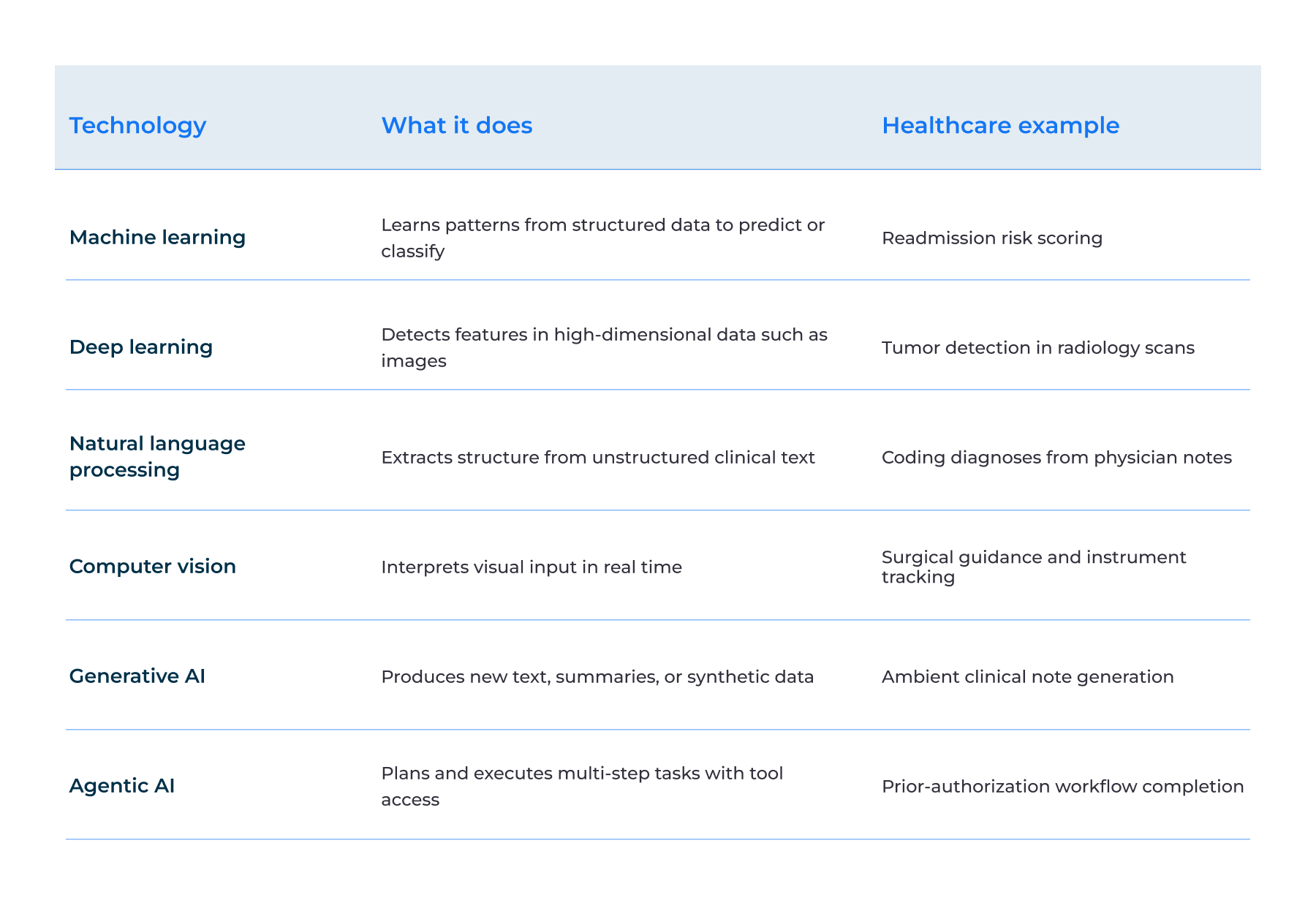
The scope of AI technologies health clinics use is quite broad, as they perform different tasks and functions.
Machine learning and deep learning analyze data and find patterns and trends — so insights are extracted swiftly. Natural language processing works with clinical texts. And this leaves space and time for quality care delivery and shifts focus from admin tasks. Computer vision handles images and video, contributing to disease diagnosis. Generative AI and agentic AI based on AI models help generate reports and complete multi-step tasks.
Why Healthcare Is Adopting AI Now
Healthcare organizations are dealing with more patient data than ever. And it’s not bad, as they can extract insights from it and use them to enhance care delivery. But the main dilemma: data is scattered across different healthcare systems. And instead of fast access when needed, medical staff have to look through many sources to find what they need.
That’s why AI in healthcare industry has become a panacea for messy data and hard-to-reach information. In a 2024 survey published in PubMed, 97% of U.S. healthcare executives reported gaps in patient data management as data volume grows. So it’s hard to bring clinical information together and use it to benefit healthcare.
The workforce is another factor driving AI adoption. According to the AAMC’s report, in the U.S., the number of physicians could shrink by up to 86,000 by 2036. Of course, such forecasts encourage healthcare organizations to look for ways to support clinicians and lighten their workload.
Finally, clinics are integrating artificial intelligence because of cost pressure. Kaufman Hall’s 2024 Physician Flash Report pinpoints that labor expenses cover 94% of total expenses medical teams spend. It’s a large cost item, so it's not surprising that care providers are looking for solutions that don’t involve hiring more staff.
How AI Is Used in Healthcare: Key Applications
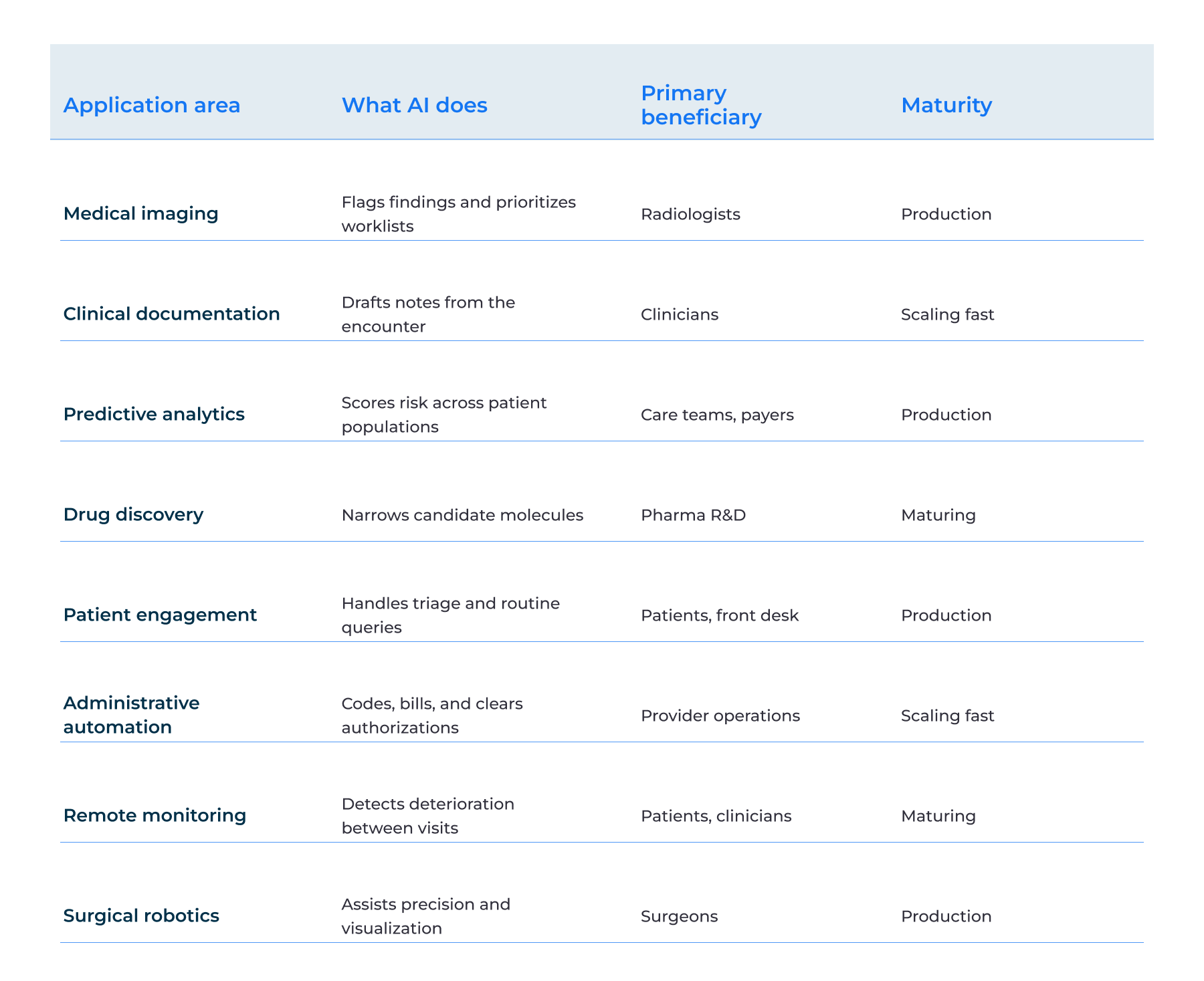
AI in healthcare has many use cases in clinical care, documentation, research, patient engagement, and admin workflows. Some AI usage scenarios can go into production at once, while with others, clinicians move from PoC to a working solution. Let’s go through all AI in healthcare applications!
Medical imaging and diagnostics
Medical imaging and diagnostics belong to areas where AI isn’t a novice. AI tools process X-rays, CT scans, MRIs, and other healthcare images. So radiologists can spot possible problems faster, as well as review particular cases. Plus, AI instruments support healthcare specialists with more specific tasks — measuring organs or tumors, defining urgent cases, detecting abnormal conditions, and more.
Good news: there are already many FDA-authorized AI medical devices for radiology. For example, Aidoc’s BriefCase-Triage can help flag urgent findings on CT scans, while Viz Subdural+ helps analyze images for possible subdural hematomas.
Clinical documentation and ambient scribing
Generative AI takes pride of place in clinical documentation. Ambient AI tools can listen to dialogues between a clinician and patient, turn it into a draft note, and send it for review. This AI use in healthcare saves physicians’ time and lets them commit to patients, without thinking about recording. Add here EHR integration with AI, and doctors will work with documents and medical histories faster with more insights from records.
In 2025, Cleveland Clinic rolled out Ambience Healthcare's platform for documentation, integrity, and point-of-care coding. AI makes draft notes, and the task of clinicians is to review and approve them before adding them to electronic health records.
Predictive analytics and risk stratification
Predictive analytics helps identify patients who are at risk. Relying on clinical data, it notices patterns and behaviors and turns them into insights for care providers. With predictive analytics in healthcare, physicians can start prevention measures to stop disease development and more serious health consequences.
For example, Cleveland Clinic uses Bayesian Health's AI platform to help clinicians diagnose patients at risk of sepsis — all this is done through analysis of lab results, vital signs, and clinical notes in real time. Healthcare organizations opt for predictive analytics services to get more insights from their data, minimize risks, and be aware of major trends.
Drug discovery and development
Let’s place AI on the pedestal of drug discovery and development. The reason: algorithms help scientists process biological data, set goals, and build molecules. Plus, with AI, they can speed up picking new candidates for research and testing.
For example, researchers trained a deep neural network to predict antibacterial activity. They relied on AI to screen more than 100 million molecules. If people did this, it would take too much time. But the model didn’t just complete it swiftly but also identified halicin, a new antibiotic candidate against several bacteria, including Mycobacterium tuberculosis.
Virtual assistants and patient engagement
The number of patients is booming. The same goes for their requests. Fortunately, virtual assistants can lighten the work for healthcare specialists. They answer routine questions, talk with patients, and help with simple processes. Medical chatbots can support both patients and nurses, and that’s the reason why they are in demand among our clients.
For instance, Mass General Brigham researchers tested GPT-4 for responding to patient messages. They found AI and machine learning in healthcare could save physicians’ time and provide patients with more detailed responses.
Administrative and revenue cycle automation
Parts of medical coding, claims processing, prior authorization, and other admin work — all these can be digitized with AI. AI automation in healthcare can cut mundane paperwork, speed up workflows, and free staff to focus on patients.
Let’s take a look at recent research on the potential of AI for coding. Scientists trained an XLNet model on 922 surgical notes to automatically generate CPT billing codes. The model achieved up to 88% class-by-class accuracy. And that’s a good point that proves it’s possible to standardize the process and get rid of manual coding work.
Remote patient monitoring and wearables
What if doctors could monitor patients between visits, not just during an appointment? Indeed, it’s possible. AI used in healthcare analyzes data from wearables, sensors, and connected devices. It can detect changes in health data and flag patients who may need more attention.
In their research, Scientific Reports studied 500 patients after hospital discharge who were using smartphones or wearable devices. Researchers found that predictions of 30-day hospital readmission could be more precise if remotely collected activity data were added. And the outputs were better when devices were combined with ML models.
Robot-assisted surgery
Robot-assisted surgery involves software, cameras, and robotic instruments — everything to assist surgeons during an operation. But can the robot work on its own? No. The surgeon has to control the instruments through a computer system.
According to the FDA, these intelligent systems can help surgeons with certain tasks. First, with algorithms, they can perform minimally invasive procedures. Second, they can work in small or hard-to-reach areas. Third, they can observe the surgical field in 3D. Finally, surgeons have precise control of surgical instruments. But a robotic system cannot perform surgery without direct human control. Anyway such use of AI in healthcare helps surgeons perform operations faster and more efficiently.
Benefits of AI in Healthcare
When discussing the pros and cons of AI in healthcare, it’s logical to start with the advantages of algorithms for clinicians. And today, the number of benefits outweighs risks thanks to advances that AI keeps undergoing.
Earlier detection and better diagnosis
AI can make diagnosis faster and easier. It can check medical images, test results, and patient records in seconds. It can recognize patterns that are easy to miss. So doctors find some conditions earlier. AI also helps them focus on patients who are more vulnerable and need more attention. These benefits of using AI in healthcare encourage care providers to integrate algorithms into their health systems to support both physicians and patients.
More time for clinicians
Intelligent systems can take on some routine tasks that physicians must perform. As a result, physicians deal with less paperwork and can spend more time with patients. For example, AI scribes can listen to interactions between doctors and patients and create notes of these visits in real time. According to the AMA, in 2026, 81% of physicians use AI in their practice — mostly for documentation.
Lower costs and faster operations
Repetitive administrative work, such as coding, claims processing, and prior authorization, distracts doctors from their main responsibilities. Luckily, with AI, all this can be automated. The result? Less manual work, more tasks completed with the same resources. The biggest gain is that AI is integrated into existing workflows, speeding up operations.
Wider access to care
With AI technologies, healthcare support goes beyond traditional clinical settings. Virtual assistants can answer routine questions, while remote monitoring tools can analyze patient data between visits. So patients have more ways to access basic support. And clinicians can monitor larger patient populations.
Faster medical research
With AI, scientists initiate and conduct more research. Algorithms speed up processing large volumes of biological and clinical data. So researchers can easily find targets for testing, screen molecules, and bring more advances into healthcare.
Challenges and Risks of AI in Healthcare
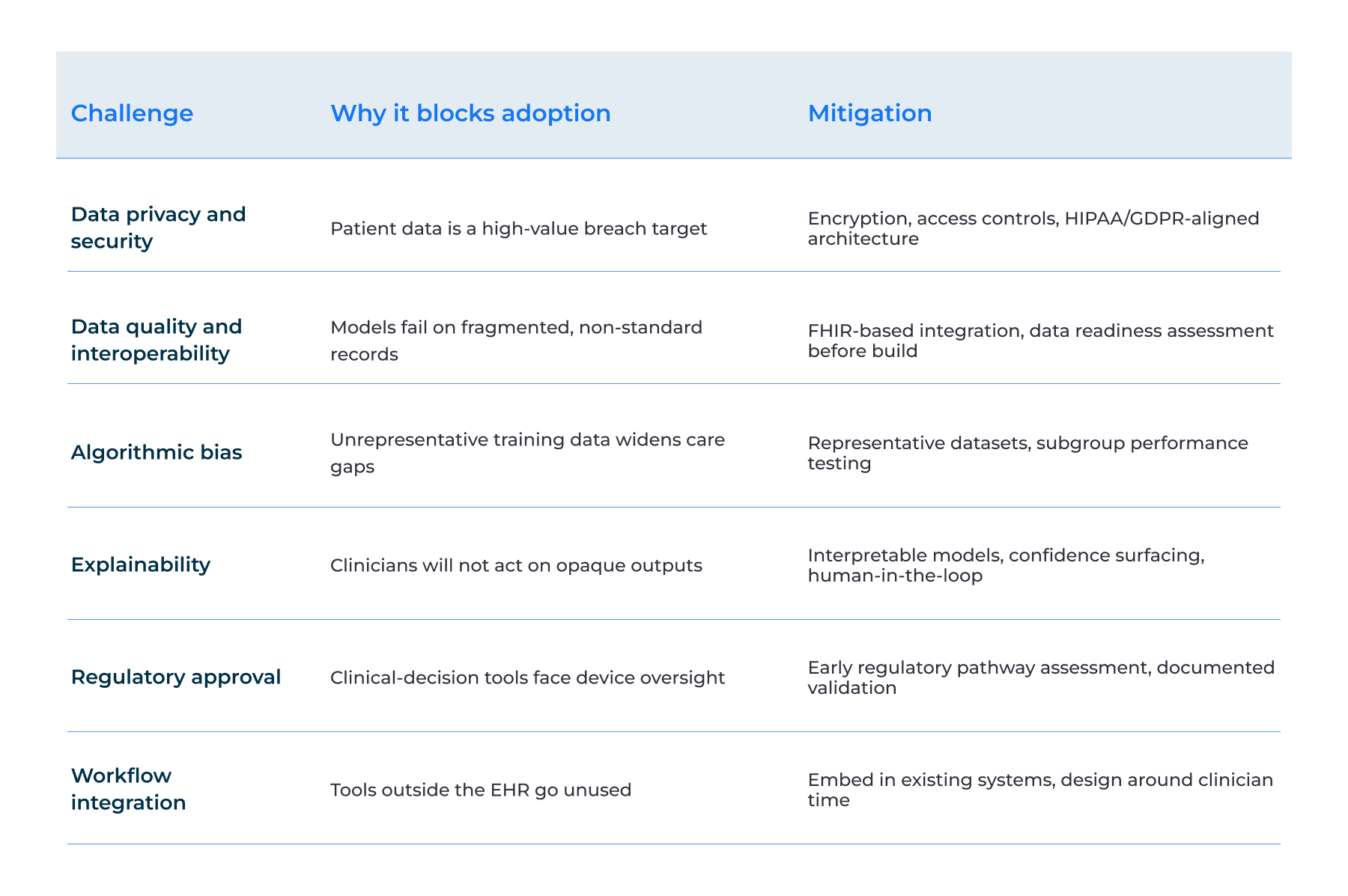
While AI in healthcare brings to the table, its adoption can also be risky and come with technical, clinical, and regulatory challenges. On one hand, healthcare organizations strive to become more fruitful and efficient. On the other hand, they face the dilemma of how to avoid security issues, biased and false results, and poor governance. Let’s see what else can await them on their pathway!
Data privacy and security
What are cons of AI in healthcare? The answer is related, first, to cybersecurity challenges in healthcare. Medical data contains sensitive patient information that should be safeguarded. That’s why AI systems should protect patient data at every stage—with encryption, access controls, and audit logs.
Data quality and interoperability
Data quality determines how AI systems operate. Don’t expect high AI model performance if you train it on messy, chaotic, and raw data. Indeed, data should be prepared before development and follow standards such as FHIR to connect electronic health records and other platforms.
Algorithmic bias
If training data is missing or poorly represents certain patient groups, AI can repeat these biases in results. As a result, it may work less accurately. It’s vital to use diverse data and test AI across different patient groups. This is how it’s possible to detect issues early and deliver fair care.
Sad to say, AI can deliver incorrect or deceptive results. The result: serious clinical consequences from false predictions or diagnoses. So it’s a bad idea to rely on an AI output as a final answer. AI health systems need to be tested. Important clinical decisions should be made after human review of the results.
Explainability and clinician trust
Clinicians should understand why AI generates specific outputs before they can trust it. If an AI system provides answers without arguments, doctors may feel uncertain about relying on it. AI should show the key data, evidence, or confidence behind its outcomes when needed. A doctor should always make the final decision.
Regulatory approval and compliance
AI in healthcare must follow strict rules. In the U.S., the FDA regulates how to develop and use AI-enabled medical devices. Plus, clinicians must also protect patient data under HIPAA, where applicable.
In the EU, GDPR protects personal and health data. The EU AI Act also sets rules for high-risk AI systems used in areas such as medical devices. These rules cover areas such as risk management, data quality, and human oversight. The rules for AI built into regulated medical products are currently scheduled to apply from August 2, 2028. Other high-risk rules are scheduled to apply from December 2, 2027.
Workflow integration
AI should fit into the tools healthcare teams already use. Why? If AI tools create extra work, you shouldn’t implement them to put a burden on physicians.
AI should link with clinical workflows, EHRs, and other healthcare systems. This is a great backbone for reducing manual tasks, saving time, and making AI simpler for medical staff to use.
How to Implement AI in a Healthcare Organization
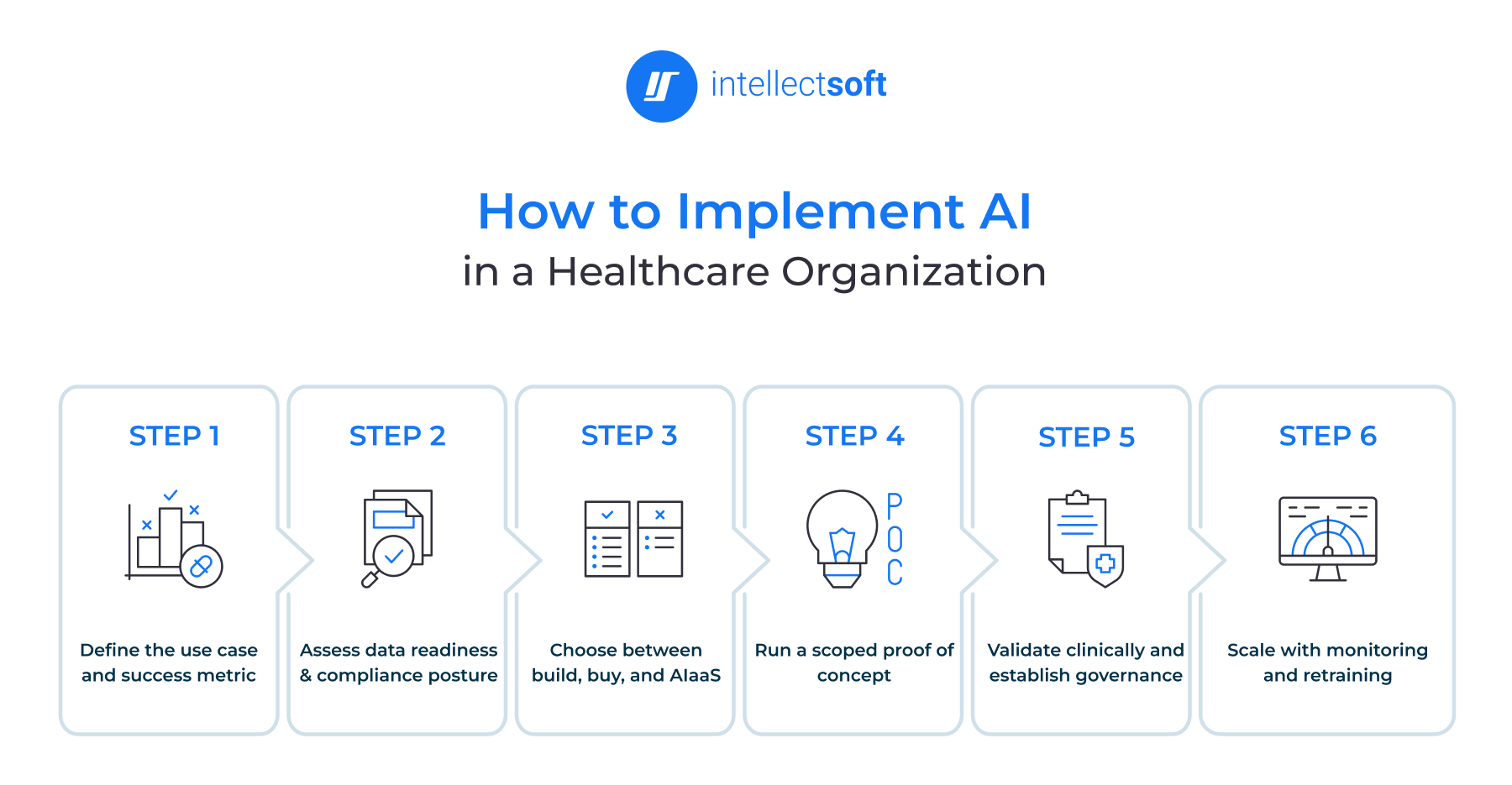
Many healthcare institutions believe that picking an AI tool is the most vital step in implementing artificial intelligence. We keep debunking this myth by sharing a step-by-step approach that helps clinicians avoid mistakes.
Step 1. Define the use case and success metric
Healthcare institutions should start by defining their pain point. The team should define which workflow to enhance, decide who uses AI tools, and know what outputs they can receive. It’s possible to measure AI success with the following metrics:
- Data accuracy
- Error reduction
- Time saved
- Patient wait time
Clearly defined goals and outputs help to understand how an AI solution works and whether it achieves what’s expected.
Step 2. Assess data readiness and compliance posture
Next, it’s a must to check the quality of data — it should be precise, reliable, and reachable. A team should review data sources, formats, and access rights before starting AI adoption. Plus, it’s necessary to define whether patient data are arranged around security and compliance requirements.
Step 3. Choose between build, buy, and AIaaS
Clinicians should decide: create a custom AI solution, integrate an existing AI tool, or use AI as a service. In this decision, they should rely on the following points:
- AI use case
- Level of customization
- Data sensitivity
- Integration needs
- Cost
- Available tech skills
For a common workflow, a ready-made AI solution can be a great option. But if processes are unique, it’s better to focus on custom AI software development. It’s also possible to avoid building the full infrastructure with the help of AIaaS. With it, it’s possible to see how AI reduces costs and optimizes expenses.
Step 4. Run a scoped proof of concept
Before a full rollout, the PoC should test one single use case with real or carefully controlled healthcare data. This is a chance to see whether AI technology in healthcare works accurately and fits workflows and users. A proof of concept should have a narrow scope, success metrics, and a timeline. With these aspects, clinicians can conclude whether the AI system is ready for future scaling.
Step 5. Validate clinically and establish governance
AI used in healthcare is more than tech testing. Clinical experts should accompany this stage and review its outputs for accuracy, value, and safety. Governance should be set up to define the following:
- Who can use the AI system
- When clinicians should be involved
- How decisions are documented
- How risks are mitigated
These controls help health clinics use AI technologies responsibly and understand when to participate in the process.
Step 6. Scale with monitoring and retraining
After AI deployment, AI systems require continuous monitoring. What should health care organizations track?
- Accuracy of results
- Output quality
- User adoption
- Workflow impact
- Changes in the raw data
If the system performs worse, it makes sense to retrain or rebuild an AI model. It’s necessary to scale it up step-by-step, including regular monitoring and governance. The reason is pretty simple: AI integrates across departments and reaches a broader audience.
The Future of AI in Healthcare
Medical futurist Bertalan Mesko once said that AI is the stethoscope of the 21st century. He noted that a simple instrument like a stethoscope was something the medical community did not want to recognize at first. It took several decades for doctors to start using it. The same thing is happening now with AI — one tries to make the most of it while another is afraid of it.
AI technologies, machine learning, and neural networks simplify the lives of doctors greatly. Innovations in medicine make it possible to diagnose diseases more accurately, find medicines faster, and track the condition of patients. An impressive number of novel technologies are being developed now, and more are yet to come! Let’s look at some of them!
Multimodal AI will connect different types of clinical data
Healthcare data comes in many forms: medical images, lab results, clinical notes, genomic data, and patient records. New generative AI models can work with several types of data at once. As a result, this provides healthcare professionals with a complete view of a patient's condition. Not always does a single data source tell the whole story.
Agentic AI will handle more administrative workflows
AI assistants will move from answering questions to completing tasks. Agentic AI can manage workflows — scheduling, referral processing, prior authorization, documentation, and follow-up communications. Instead of suggesting what employees should do, an AI agent could complete a task through several steps, while keeping people involved when needed. With AI agent development, healthcare organizations automate repeated workflows and reduce the admin burden on their clinicians.
Precision medicine will become more scalable
Precision medicine will grow based on broader datasets — a patient's genes, lifestyle, environment, and medical history. All this will lead to more personalized prevention and treatment and better response to patients’ needs. AI in the healthcare industry can analyze big data faster, helping clinicians see patterns that may be difficult to find manually.
Regulation and reimbursement will shape the pace of adoption
The future of AI in healthcare will depend on laws and regulations that currently restrict AI adoption. Regulators need to set up rules for testing, monitoring, and upgrading AI health systems. Healthcare institutions also need to know when they can use and reimburse AI-supported services. The FDA is already on this regulatory pathway with their AI-enabled medical devices.
Turning AI in Healthcare from Pilot to Production
Artificial intelligence in healthcare can yield results when you prepare your data and know which workflows to improve. No doubt, the choice of AI models matters. But whether your data is ready and how well AI fits into your current healthcare workflows matter more. And for this, care providers need an experienced partner to advance artificial intelligence from a pilot to real-world use.
With 18+ years of engineering experience and 35 Fortune 1000 clients, Intellectsoft helps healthcare clients build and integrate AI solutions in their health systems. In healthcare software development, we’re committed to HIPAA, GDPR, and ISO 27001 requirements. So your AI use is safe and reliable, and your patient data is protected.
Want to improve healthcare workflows with AI? Book a consultation with our AI experts.
FAQ
How is AI used in healthcare?
The use cases of AI in health care revolve around both physicians’ and patients’ needs.
- Data and records analysis
- Diagnosis support
- Paperwork processing
- Routine tasks automation
- Screening
- Medical imaging
What are the benefits of AI in healthcare?
More efficient time distribution, less manual work, and better use of medical records are the main advantages of AI in health care. Algorithms allow processes to run faster, help make more fact-based choices, and increase the quality of patient care. What matters is that physicians can delegate routine administrative tasks to AI and focus more on treatment. These pros of AI in healthcare incite health clinics to integrate AI into their workflows.
What are the main risks of AI in healthcare?
Flawed outcomes, biased information, data privacy issues, and security threats — all these risks can threaten the adoption of AI in healthcare industry. When you use incomplete or poor-quality data, be ready for AI to produce false outputs. These disadvantages of AI in healthcare can add to clinicians’ work as they have to check AI-generated results.
Will AI replace doctors?
No, using AI in healthcare won’t replace physicians. It can serve as an assistant for them. Yes, artificial intelligence can analyze data, find patterns, and manage routine tasks. But it can’t make clinical decisions, talk with patients, and take responsibility for their care. Only doctors can do this with benefits for care delivery and health outcomes.
Is AI in healthcare regulated?
Yes, healthcare AI is regulated, depending on its purpose and location. Medical AI products require legal approval. Health care providers must keep data and records private and secure. The solution and its applications should follow legal requirements for security, compliance, and data privacy.
How do healthcare organizations start using AI?
As a rule, organizations start with one clear issue that AI solutions in healthcare can solve. They evaluate their data, security, and regulatory needs. Only after that, they build a small proof of concept to test their idea. If it works well, they’re ready to integrate AI into current workflows and soon scale its use.
