Key Takeaways
- AI as a Service (AIaaS) enables companies to access ready-made intelligent systems based on machine learning, NLP, generative AI, and computer vision via cloud APIs – all without an AI team or IT infrastructure.
- Rational budgeting, high performance, and access to advanced AI models drive businesses to use AI as a Service.
- In 2025-2026, agentic AI platforms and generative AI APIs are booming because of the need for businesses to automate their workflows.
- AIaaS projects can fail not because of the technology, but because of a lack of proven use cases and poor data readiness before launch.
Not all companies can afford to hire AI engineers or buy GPU infrastructure. This is the reality that their budgets dictate, limiting business opportunities.
So, let’s imagine! Your team wants to speed up paperwork and personalize the customer experience. But they have no funds to employ AI experts and build infrastructure from scratch. How to solve this dilemma, not to lose clients and beat rivals?
Luckily, enterprise AI as a Service has become a great alternative for those with limited funding or who want to speed up development of enterprise web applications.
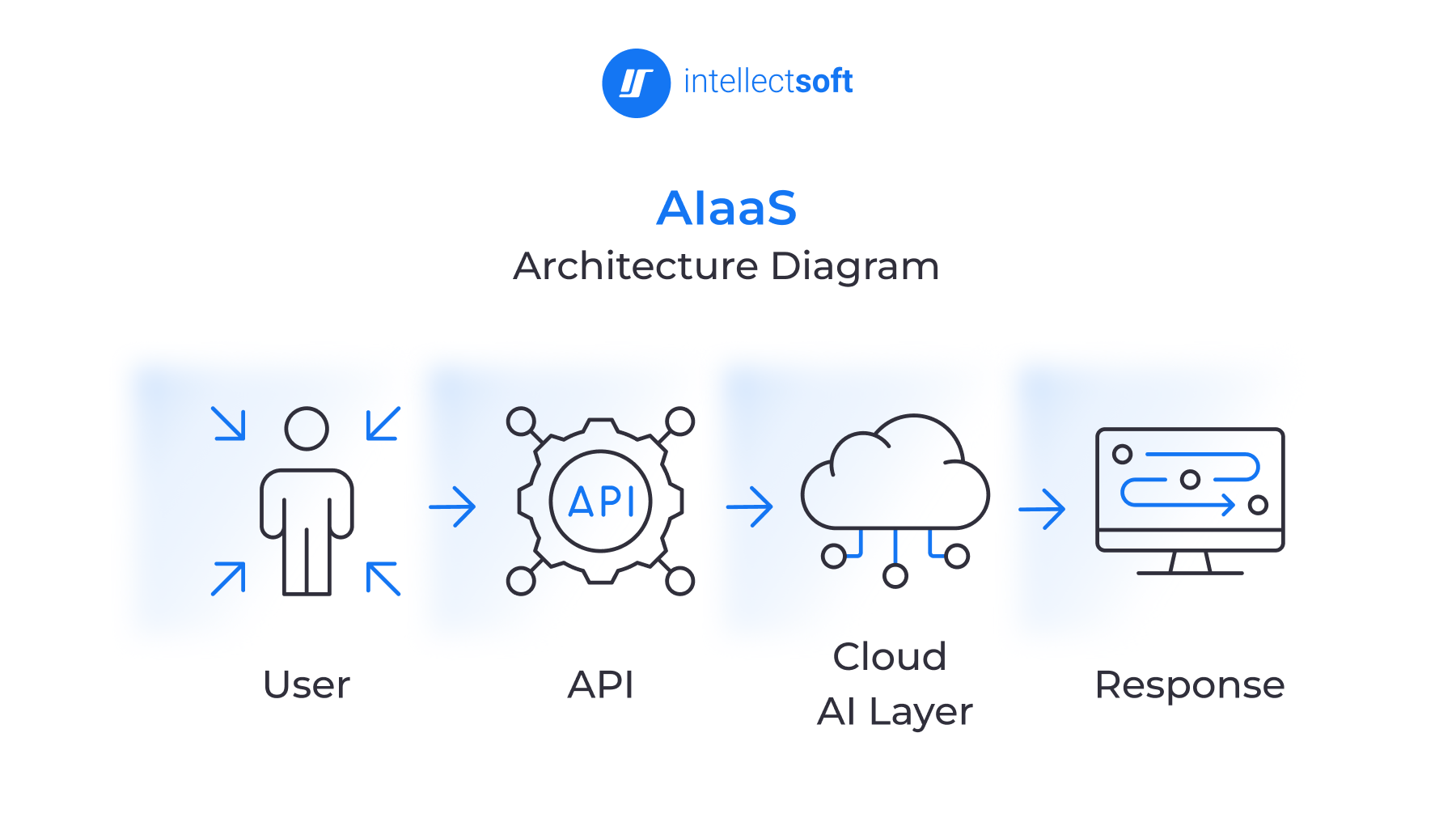
Ready to know more about AIaaS solutions? Here’s exactly what it is and how it works based on Intellectsoft’s approach and expertise.
What Is AI as a Service (AIaaS)?
AI as a service is the delivery of AI tools and capabilities to businesses via cloud platforms, APIs, or SDKs. You don’t need to invest in infrastructure development and an AI team hiring because you can access an AI system on demand and pay for its use.
Why is the demand for it growing? More and more companies are integrating artificial intelligence solutions into their systems and workflow to optimize resources and compress time to market. Plus, they can delegate infrastructure hosting, model management, and updates to the provider while paying only for the resources they use like in cloud computing in software development.
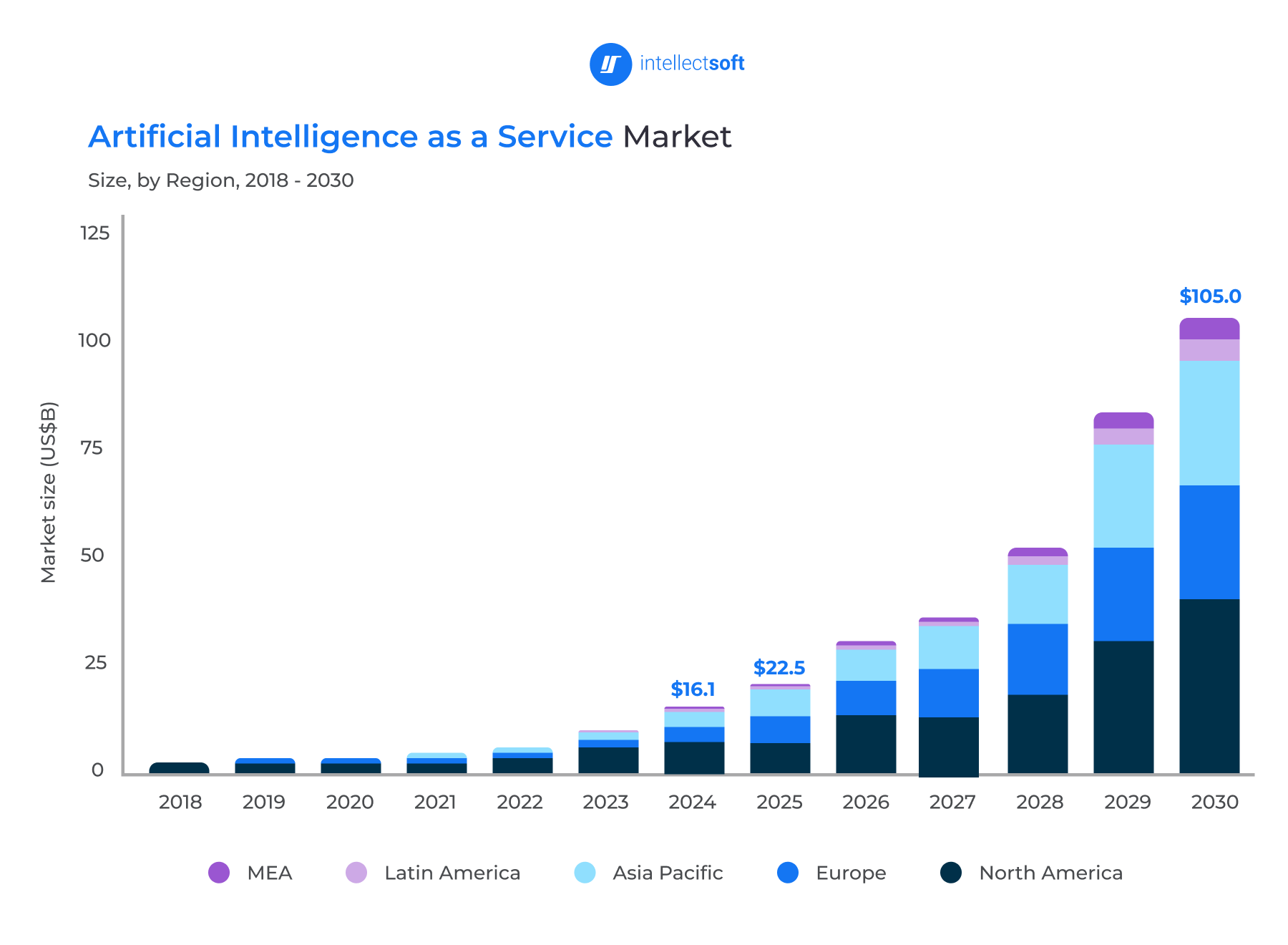
The global AIaaS market will increase by more than 35% over the next decade, reports Grand View Research. It means that AI adoption is picking up steam in the business world, becoming a top technology investment.
Types of AIaaS Solutions and What They Do
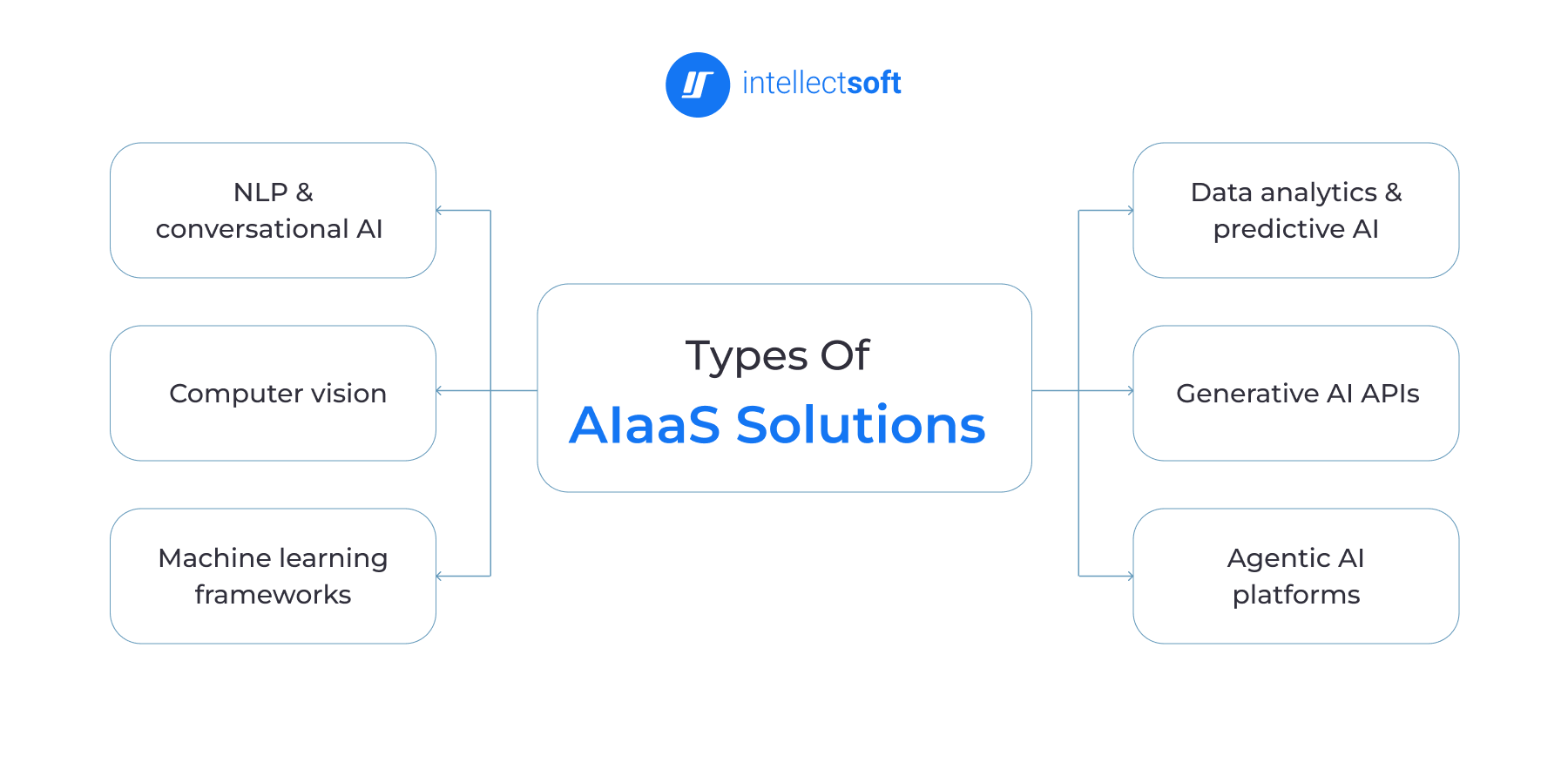
From simple chatbots to advanced AI agents that can work with minimal human intervention – this is the scope of capabilities that AI as a Service offers. No doubt, the choice of the right AI solution depends on your business needs, data, and use cases. But let’s review them to see which one fits you best.
NLP & conversational AI
Your client asks you something in a chat or leaves a review. With natural language processing and conversational AI, your system can catch the message and respond accordingly. You can use this type of AIaaS for chatbots, sentiment analysis, document processing, and more – all this to automate client support and speed up data analysis. Google Dialogflow and AWS Comprehend are popular AIaaS platforms.
Computer vision
You’re uploading a document, scanning pictures, or analyzing a video feed. And then, you need to turn visual information into useful data. Your system can do this with the help of computer vision that is good at image and video analysis, OCR, video analysis, and object detection. So, with it, you can automate routine tasks and make swifter decisions. Azure Computer Vision and Google Vision AI are AI as a service solutions based on computer vision.
Machine learning frameworks
You want to build a model that projects your audience behavior or detects scam. Machine learning models offer ready-made tools for model training, AutoML, deployment, and continuous model management, so you can do this faster and more cost-efficiently. Amazon SageMaker and Google Vertex AI are AIaaS platforms that can assist you in this case.
Data analytics & predictive AI
Today, businesses collect tons of data, but data alone doesn’t work. Data analytics and predictive AI change how you approach data analysis, spot patterns, and detect behaviors. All this can help you extract insights from your data and base decisions on them. IBM Watson Analytics is an AIaaS that helps businesses benefit from their data.
Generative AI APIs
The next type of AIaaS is generative AI APIs that allow businesses to create text, code, images, audio, and multimodal content – all of which is done with the help of pre-trained models. And no less important is that they don’t need to build and train their own systems. The OpenAI API, Anthropic Claude API, and Google Gemini API are the most popular in this category and are used to integrate with products and internal workflows.
Agentic AI platforms
Agentic AI enables autonomous agents to plan and perform complex tasks with minimal assistance. Traditional AI models respond to individual prompts, while agentic AI systems can break complex work into smaller steps, interact with data and tools, and even make decisions. AWS Bedrock Agents, Azure AI Agents, and LangChain Cloud are AIaaS solutions that automate workflows and address a wide range of enterprise needs.
What Are Key Business Benefits of AI as a Service?
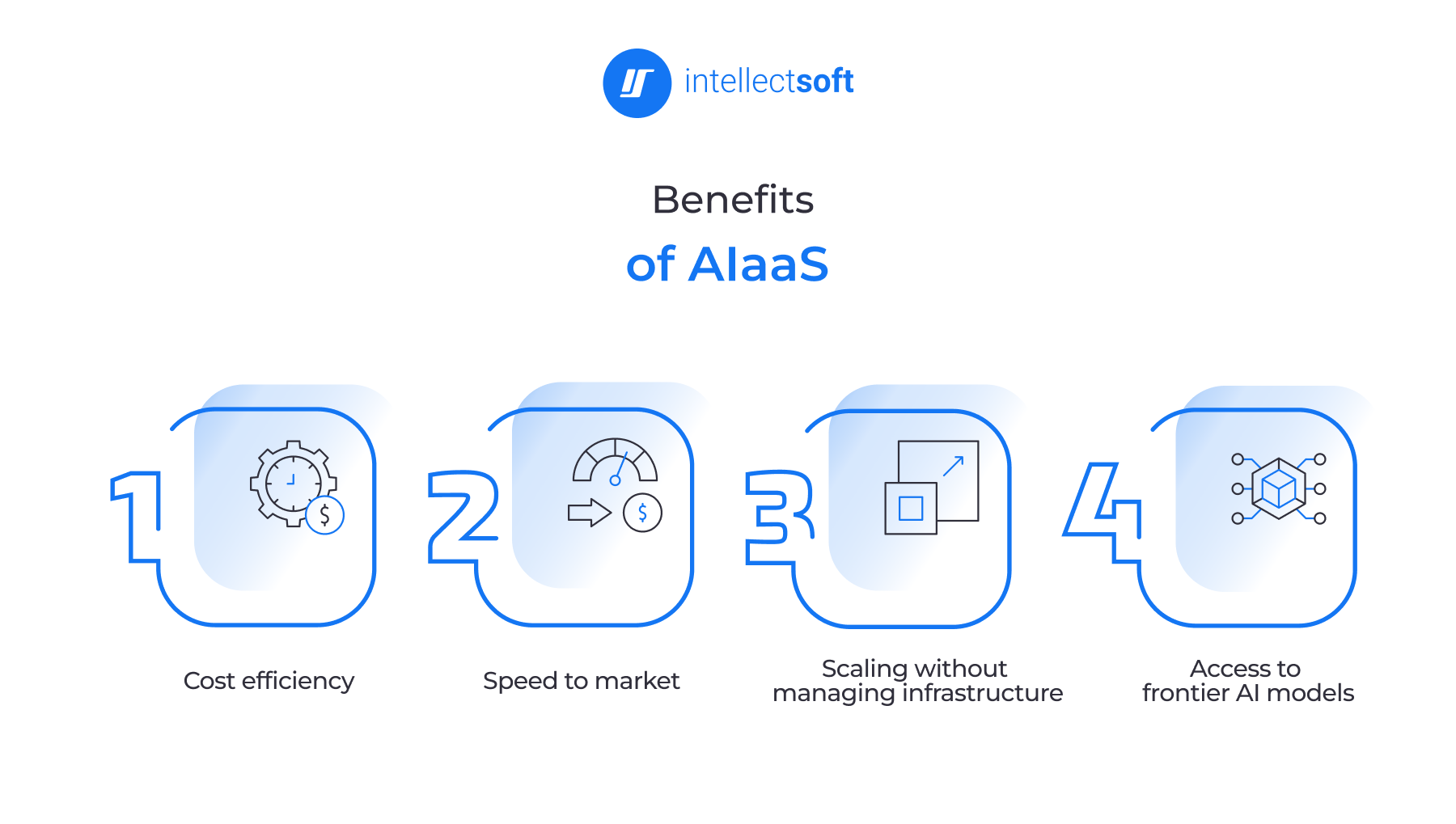
We have already mentioned that enterprise AI as a service helps reduce the costs you would otherwise spend on hiring a team and building infrastructure. Now it's time to look at what other business benefits AI as a service can bring to the table.
Cost efficiency: OPEX vs CAPEX
One of the main advantages of AIaaS is the shift from CAPEX to OPEX. Instead of buying GPU clusters, building data centers, and hiring ML engineers, companies can use AI on a pay-as-you-go basis. GPU compute usually costs around $2–5 per hour on demand, while owning similar on-premises infrastructure can require $500,000–2 million upfront. This is a great way to cut financial risk, make AI easier to adopt, and scale usage based on real needs.
Speed to market
Compressed time-to-market is another benefit you gain from AIaaS. For comparison, a pre-trained NLP model requires only 1–2 days to integrate, while building and training an AI model from scratch can take 3–9 months and require a skilled ML team. Sure, you can move from a mere concept to production much faster and start generating returns sooner.
Scaling without managing infrastructure
AIaaS makes it easy to scale AI resources without investments in infrastructure. For example, during peak time, a retail platform can handle traffic spikes and process 10× more requests without adding extra capabilities. Your team can focus on business processes, while the AIaaS provider manages resources, support, and uptime.
Access to frontier AI models
One of the major AIaaS benefits is that you can access frontier AI models. They are too costly to build on their own. For example, training an LLM at the GPT-4 scale can range from $50M-100M or more. Of course, this investment is unrealistic for most businesses. With enterprise AI as a service, you can access intelligent systems through APIs, paying only per request. This is the reason why AIaaS is a cost-effective AI integration strategy.
AIaaS Use Cases in Different Verticals
AIaaS is no more a prerogative of tech companies. Finance, healthcare, manufacturing, retail, and many other domains are adopting AI as a service to automate their processes and improve customer experience delivery. Let's see how different industries apply AIaaS solutions.
Healthcare: clinical document processing & diagnostics
AI in healthcare speeds up document processing and supports diagnostics. The reasons why clinicians opt for AIaaS solutions are pretty simple. First, they don’t need funding for infrastructure or AI teams. Second, they can delegate record processing to AI to find patients who need ASAP treatment. Google Health built an AI system for fast and accurate breast cancer screening to detect it earlier.
Financial services: fraud detection & credit scoring
AI in financial services uses multiple data sources to detect fraud and evaluate a borrower’s creditworthiness. ML models analyze transaction patterns to identify anomalies and prevent cyber attacks. For example, Mastercard’s fraud detection AI solution Decision Intelligence can evaluate transaction risk in real time and prevent scams before they turn into serious losses.
Retail & commerce: personalisation & demand forecasting
Certainly, AI in retail helps businesses improve ecommerce personalization and set better prices. “In what way?”, you may ask. AI recommendation engines analyze what buyers seek, interact with, and purchase. And then, based on these datasets, suggest products that they are most likely to buy. Retailers use AI to analyze demand and customer behavior, then adjust prices accordingly. For example, Amazon’s recommendation AI-backed engine has contributed to 35% of the company’s sales.
Manufacturing: predictive maintenance
Sudden equipment breakdowns can stop production and lead to significant losses. To avoid this, industrial businesses use AI in manufacturing to spot issues before they cause equipment outages. AI in construction analyzes sensor data and notices unusual behavior that can prove failures. That’s why companies can trim maintenance costs and cut downtime up to 50%. For example, Siemens’ MindSphere tracks how equipment performs and prevents costly disruptions.
Customer service: conversational AI & ticket deflection
Long response times and always-busy support teams can become a problem. Customers hate waiting and can leave when they feel that their needs are not met. To solve this, companies use conversational AI to respond to clients’ requests and resolve common issues without human assistance. AI agents can speed up response time up to 40%. For instance, during the first month, the Klarna AI assistant managed two-thirds of customer service chats.
How to Implement AIaaS: A Step-by-Step Guide for Business Leaders
Once you’ve chosen an AIaaS provider and platform, your next step is AI adoption. With a structured approach, you’ll do this with minimal risks and within your budget and timeframe. Here’s Intellectsoft’s approach to AIaaS adoption.
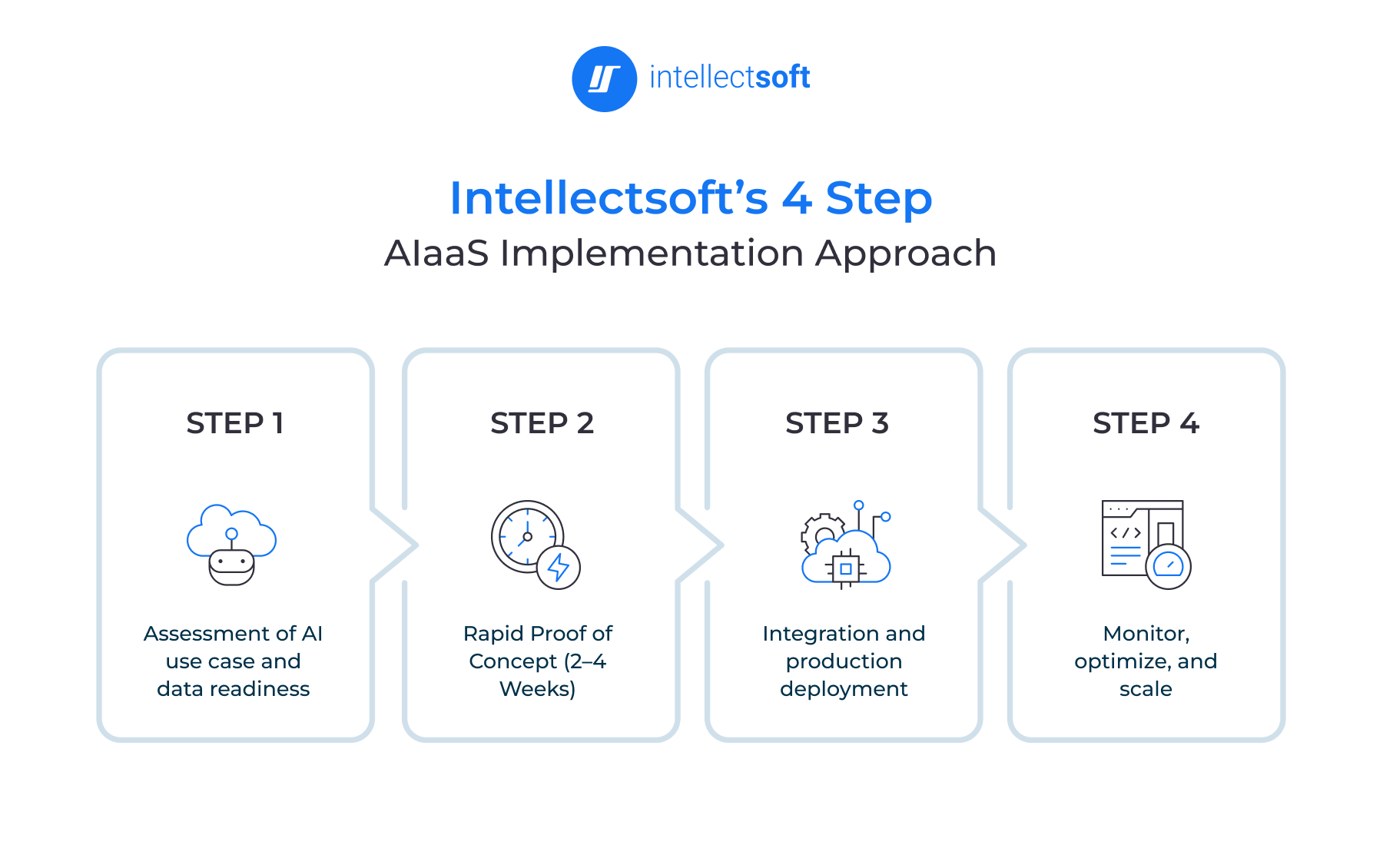
Step 1: Assessment of AI use case and data readiness
Before implementing AI, you should start with your business needs, where artificial intelligence can bring value. Work on your data, its quality, and scope enough for your use case. Plus, establish clear success metrics and business outcomes you expect to achieve. With prepared data, understanding AI use, and a practical roadmap, you’re ready to move further. You should also decide about building an AI model from scratch or refining an existing algorithm.
Step 2: Rapid Proof of Concept (2–4 Weeks)
A PoC is the safest way to validate an AIaaS solution before heavy investment. You need an AI team that can build a working prototype based on your data and integrations to test the business value of your solution. At this stage, you receive a functional PoC, a data readiness report, and a validated or revised use case of AI.
Step 3: Integration and production deployment
When you agree on an AI approach, you can implement AI within existing systems via APIs, middleware, or integration layers. At this phase, teams configure security settings, define who can access the system, and what they can do. Plus, they check out compliance with relevant regulations and set up monitoring tools to monitor system performance. As a result, you receive a production-ready AI integration that fits into your workflows.
Step 4: Monitor, optimize, and scale
AI adoption does not end at release. Ongoing monitoring helps track model performance, how much you need to invest, and what data makes an AI model accurate. As you scale up, you can expand AI capabilities to maximize business value.
Whether you need a working prototype or an enterprise-wide AI strategy — talk to Intellectsoft's AI architects.
What Challenges and Risks Come with AIaaS Adoption?
Sure, AIaaS enables faster releases, lower funding, and access to advanced AI models. Although AI adoption can be tough and risky, that’s the reason why businesses avoid it. Good news: with the right tactics, you can cope with these challenges, so the key is to prepare for them in advance.
Vendor lock-in, customization limits, and model hallucination
Choosing AIaaS, you can play with fire, especially if you fail to keep these risks in mind. First, if your provider uses their own APIs and formats and you decide to switch later, you can deal with vendor lock-in. Second, you can deal with limitations to the degree you can customize your AI model. Finally, you can face model hallucination, where AI can generate incorrect results. But you can fix this through RAG, output checks, and human review.
Data privacy, security, and compliance
AIaaS adoption can be an uphill battle when it comes to compliance and security of your data. The main dilemma is that you need to share your data with third-party AI providers and make it subject to their policies. In this case, we strongly recommend verifying how your potential vendor handles customer, personal, and business data.
OpenAI, Google, and Microsoft offer options to prevent data from being used for model training. Don’t forget to check out whether providers follow GDPR, CCPA, and EU AI Act requirements, especially when working with sensitive data. You can also choose private VPC deployments, private cloud environments, or on-premises AI models to control your data and strengthen security.
Integration with legacy systems
One of the frequent AIaaS challenges businesses face is integrating AI models with legacy systems. Many enterprises still rely on outdated solutions such as ERM, CRM, and core banking systems. They are not designed for cloud-based or AI integrations. It’s possible to connect legacy systems with AIaaS solutions through middleware or API gateways. To reduce risks, we recommend using microservices and adopting an AI-first approach to gradually roll out AI without disrupting the core system.
How to Evaluate and Select an AIaaS Provider
Now that you know the different types of AIaaS solutions, the next challenge is choosing the right provider. First, consider your data environment, regulatory requirements, and integration needs. Second, use the checklist below to evaluate potential vendors and make your final decision.
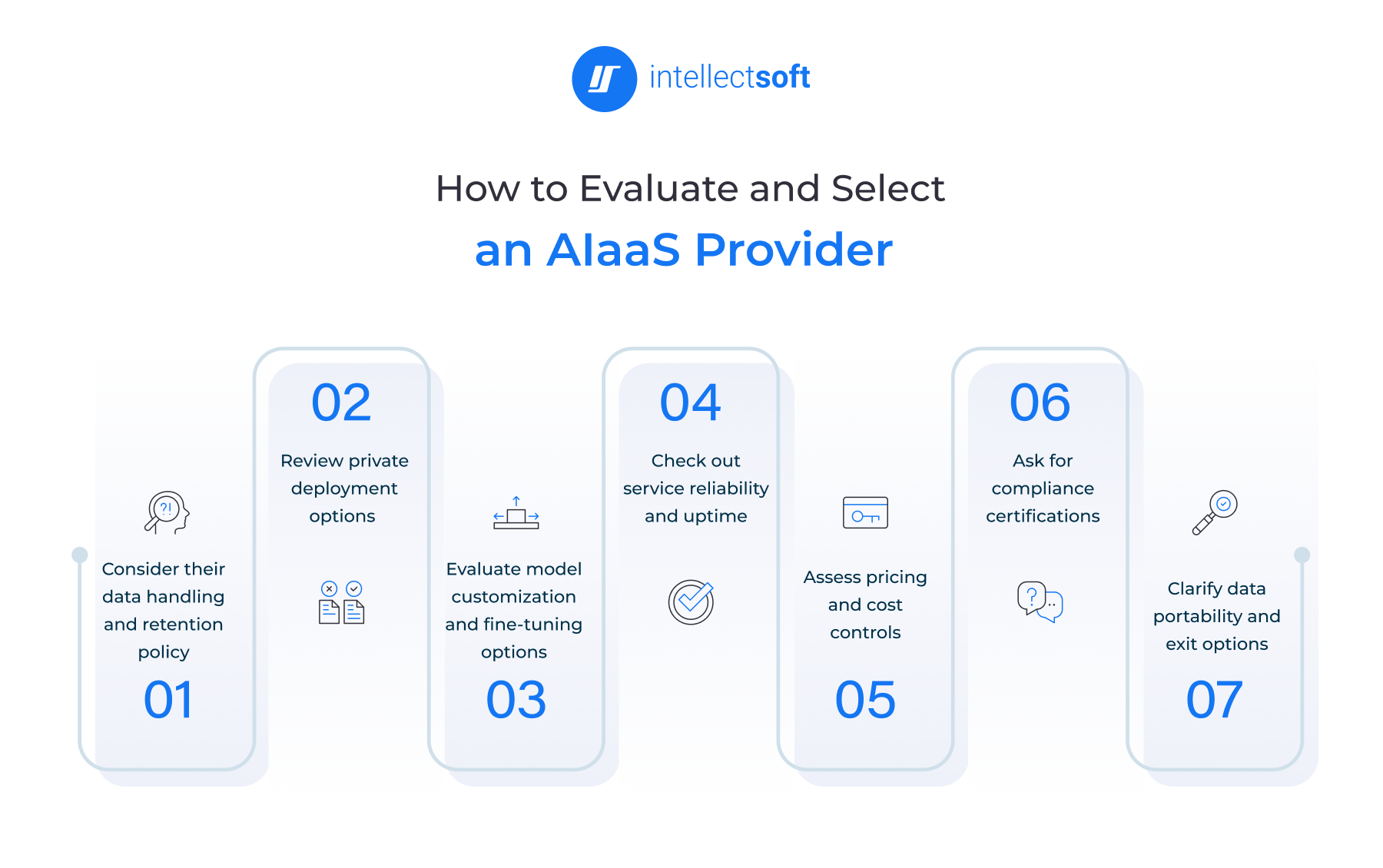
Consider their data handling and retention policy
Check whether the potential provider relies on your historical and current data to train AI models, and whether you can request this option. This matters if your AI solution processes customer PII, sensitive business information, or proprietary data.
Review private deployment options
We strongly recommend checking whether the provider offers VPC deployment, on-premises inference, or private cloud endpoints. Of course, this is a must if you deal with sensitive data and operate in regulated industries, as they provide greater control over security, compliance, and data access.
Evaluate model customization and fine-tuning options
It is important to review the fine-tuning options the provider offers to determine whether the AI model can meet your needs. Also, consider data format requirements and the cost of custom model training to avoid overpaying if cheaper options are available. All of this forms the basis for your future growth.
Check out service reliability and uptime
Before making a choice, you should review providers’ uptime and SLA guarantees. Indeed, it must be at least 99.9% for enterprise-level and mid-sized companies to perform without drops or delays under heavy workload and during peak times.
Assess pricing and cost controls
Don’t forget to check how the provider charges for AI services, whether per API call, per token, or through another pricing model. Ask about cost caps, usage alerts, and budget controls as they help you keep spending under control and avoid irrelevant expenses.
Ask for compliance certifications
If you operate in a regulated vertical, ask your provider for the compliance certifications for SOC 2 Type II, ISO 27001, and GDPR. Plus, if your business is healthcare, consider HIPAA, but if you have a financial organization, ask for PCI DSS. Remember that you expose your business to risk if your provider isn’t law-abiding.
Clarify data portability and exit options
In the end, if you suddenly decide to change providers, check whether it will be possible to export your data, model configurations, and fine-tuned AI models. To guarantee a successful exit, build a clear strategy and contract data portability terms — both are needed to remain flexible and independent.
Is AIaaS Right for Your Business?
Many companies can’t dare to adopt AI technologies because of the lack of an in-house team and high costs. AIaaS removes these obstacles and proves that it’s possible to integrate AI without heavy investment. As a result, businesses can access advanced AI capabilities, paying only for their use.
So, the project that could take months to launch is tested and deployed in weeks or even days.
Who Benefits Most from AIaaS?
- Companies that want to integrate artificial intelligence but do not have an internal ML team.
- Organizations that need flexible and scalable AI resources.
- Teams that want to validate ROI before investing in a full-scale AI solution.
If you're thinking about enterprise AI as a service or AIaaS solutions, we strongly recommend identifying the relevant use case and testing it in real-life settings.
At Intellectsoft, AI architects help enterprises assess, pilot, and deploy AIaaS development services, from strategy and use case validation to production integration. So, you can contact us to reveal where AI can bring the greatest business value.
FAQ
What is AI as a service (AIaaS)?
AI as a service is the delivery of ready-made AI instruments by third-party vendors to businesses through cloud APIs. Thus, they don’t need to hire AI experts and build their own AI solutions, and can pay for the use of pre-packaged tools.
What are the main types of AIaaS?
Agentic AI
Generative AI APIs
Data analytics
ML frameworks
Computer vision
Conversational AI
Is ChatGPT an example of AIaaS?
Yes, ChatGPT falls under artificial intelligence as a service because you can use it in the cloud, not to build your infrastructure or train your model. You simply access the service and pay for what you use.
What are the main risks of AIaaS?
Data privacy issues, biased AI responses, integration challenges, and noncompliance with the GDPR and the EU AI Act are among the major risks of AIaaS. It’s possible to minimize them through proper controls, reliable data, and a step-by-step integration approach.
How much do AIaaS development services cost?
AIaaS pricing is preconditioned by the vendor, the complexity of an AI model, and your scope of use. Most cloud services offer pay-as-you-go pricing, while others have subscription plans or custom enterprise contracts. If you're considering AIaaS development services, a 2–4 week Proof of Concept (PoC) is the most rational way to validate the use case, test the data, and estimate ROI before scaling the solution.
What is the difference between AIaaS and AI infrastructure as a service?
With artificial intelligence as a service, you access pre-packaged AI tools and capabilities through the cloud providers. With AI infrastructure as a service, you receive the servers, storage, and computing resources – all to build, train, and run AI systems. But, indeed, you can use both of them to develop and scale up your AI solutions.