Imagine the situation: You’re a successful healthcare business with a great team of clinicians. But over time, you notice your performance is declining, and your patients are not very pleased. What’s the reason for such a situation?
Your clinicians are overloaded with routine administrative tasks, such as entering lab results and processing documents. So instead of committing more time to patients and their treatments, care providers waste their time on paperwork. Sounds not very optimistic, right?
Bloomberg reports that 63% of organizations have automated their workflows with AI, while 31% are piloting AI projects. AI automation in healthcare has become a necessity that can cut down manual work and improve care delivery.
That’s why more and more clinical businesses are coming to us to build intelligent document processing systems and session and AI-backed software for recording sessions and generating notes.
In this article, we want to reveal the use cases of automation in healthcare and show how important it is to robotize manual tasks and reduce medical staff workload.
Benefits of AI Automation for Clinical Teams
As you can see, the scope of AI automation use cases in healthcare is broad and primarily serves as an assistant to clinicians. Of course, you can’t delegate all your administrative work to AI systems, but you can decrease its burden on your medical staff. Now it’s high time to clarify what you can gain from intelligent automation.
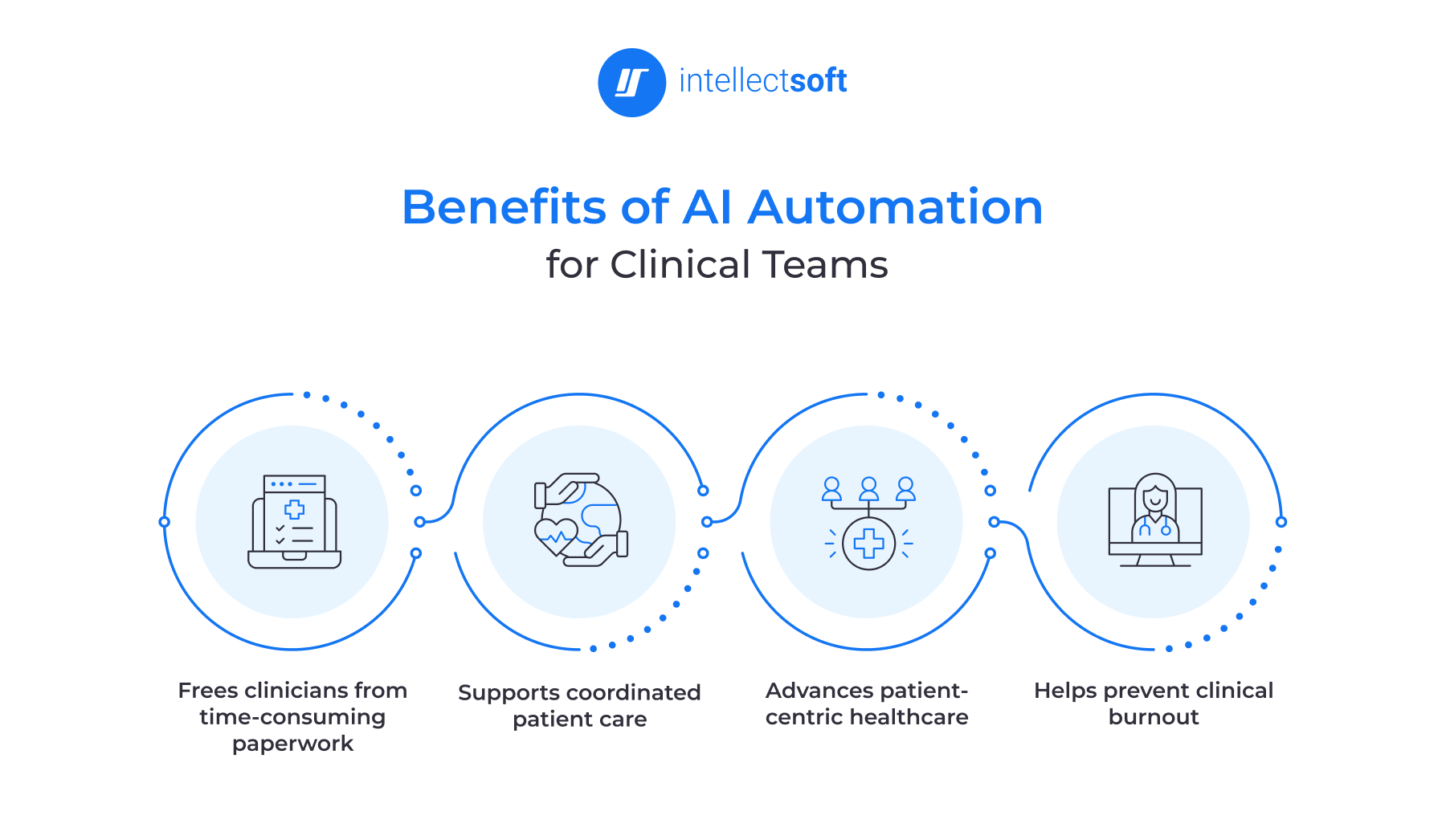
Frees clinicians from time-consuming paperwork
A recent study in The Lancet found that healthcare professionals can spend almost half of their work time managing documentation related to care delivery. What does that mean in practice? First, care providers don’t have enough time to perform their primary functions, like diagnosis and treatment, because they need to make reports and record patient health outcomes. Second, healthcare organizations experience high turnover because their medical staff feels burned out from increased administrative tasks.
With AI in healthcare, it’s possible to prevent these issues or fix them as AI frees clinicians from time-consuming paperwork and repetitive tasks. Intelligent systems can make notes, complete forms, and schedule patients faster and more accurately than healthcare staff can.
Supports coordinated patient care
Care providers and administrators need to process many documents, so they can make mistakes and fail to keep workflows in sync. No doubt, this can negatively affect their cooperation and lead to misunderstandings and conflicts.
It’s possible to make communication documentation exchange across care teams consistent and managed through AI automation. You avoid duplications and delays. Plus, you can share updates in real time, showing that you deliver coordinated care.
Advances patient-centric healthcare
Another benefit for healthcare organizations from AI automation is patient-centric care. Why is it possible with AI tools?
First, clinical teams receive intelligent healthcare workflows that automate routine tasks, leaving more time for care delivery. Second, there are no obstacles for their interaction with patients in forms of note-taking, reporting, and recording. Of course, this contributes to increasing patient satisfaction. Finally, AI leaves time and space for preventive care, as therapists can also communicate and educate patients. All these measures contribute to better health outcomes.
Helps prevent clinical burnout
According to the Journal of the American Medical Informatics Association, physicians overwork because they have to complete their documentation tasks outside scheduled clinic hours. Of course, paperwork burden drains their energy and kills motivation, resulting in burnout.
Today, AI automation has become the panacea for clinical burnout as it cuts hours spent on patient recording, note-taking, and reporting. As we mentioned above, AI enables physicians to communicate more effectively with patients and avoid wasting a lot of time on paperwork.
Certainly, with all these advantages under your belt, you can prevent turnover at your healthcare organization and make your patients feel the center of the universe. Add here the decrease in paperwork, and with this combo, you’ll work with more gains for both medical staff and patients.
Real-World Applications of AI and Automation in Healthcare
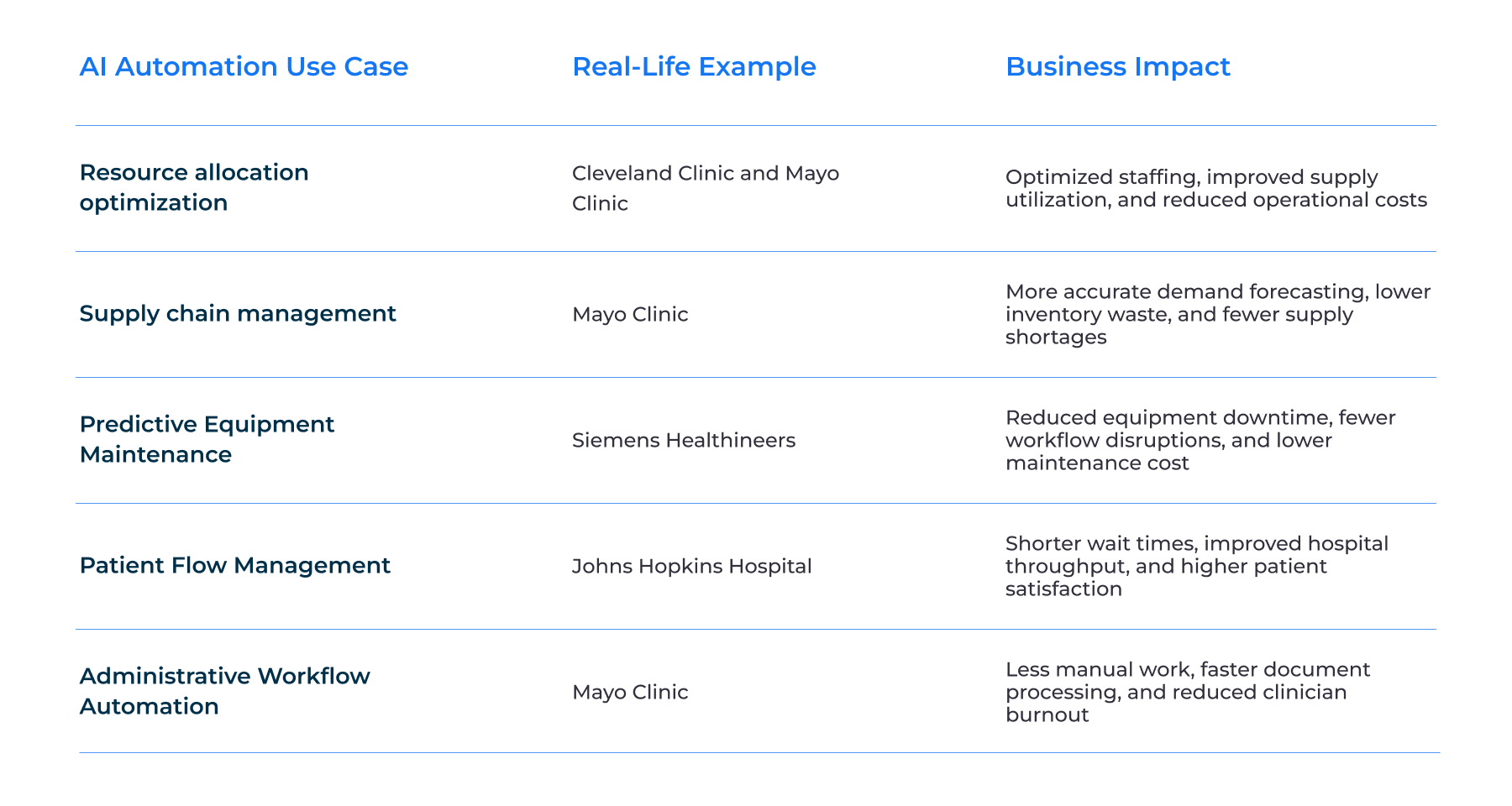
According to recent Gartner forecasts, AI agents could handle 75% of clinical episodes by 2030, affecting the quality of care delivery. And this is just one of many ways organizations can apply AI automation in healthcare. Let’s review core use cases with real-life examples!
Optimization of resource distribution
Healthcare organizations often face a lack of staff, overloaded facilities, and delays in patient care. Add here manual efforts to manage all these issues, and you’ll spend more than planned.
Healthcare AI workflow automation is a great instrument to optimize how you distribute your resources. So you can cut down irrelevant expenses. Plus, with advanced tools, you can predict patient flow and manage supplies more rationally. On that basis, you can also adjust your staffing, tracking, and care-delivery approaches by making them more advanced and efficient.
Take, for example, major health organizations like the Cleveland Clinic and Mayo Clinic! They use RPA and AI-backed inventory management systems to control the allocation and optimization of their supplies.
Supply chain management
Fighting with supply chain disruptions? Dealing with undersupply? Feeling the pressure from rising operational costs? If you can say ‘say’ to any of these questions, you should know that the lack of sync between your systems and too many mundane tasks drag you down.
With AI automation systems, you can forecast demand for medical supplies very precisely and boost supply chain performance. You just need usage patterns, patient needs, and seasonal changes, and intelligent software can automatically reorder supplies. So with AI in healthcare automation, you can keep your resources without overstocking.
For example, Mayo Clinic uses AI solutions to manage pharmaceutical supply chains across several locations. So they know their medication needs and reduce expired drug waste.
Predictive equipment maintenance
Picture this: an MRI machine stops working at a peak time. Medical staff must shift patient appointments and offer alternative solutions. See, a minor maintenance issue can lead to operational collapse and additional expenses.
With AI-backed predictive analytics, you can analyze usage patterns, sensor data, and device performance in real time. With an Ia solution, you can identify potential failures and automatically plan maintenance before they become problems for your company.
Let's take Siemens Healthineers: they have ultrasound solutions powered by practical AI, like ACUSON Origin, ACUSON Sequoia, and ACUSON Redwood, that can help prevent unexpected situations that can disrupt your workflows.
Patient flow management
Of course, patients can’t be happy when they need to wait too long to visit their doctor. Clinicians also feel pressure from jam-packed schedules that require overwork. As staff have to adjust schedules manually, they can make mistakes that influence care delivery.
With AI scheduling systems, healthcare teams can analyze historical patterns, patient behavior, and appointment information. With insights from their data, they plan how to refine the patient journey and provide relevant treatment on time.
For example, Johns Hopkins Hospital offers human-centered care with minimal administrative burden because of its AI initiatives. Plus, intelligent systems help them monitor bed occupancy, cut down wait time, and improve hospital flow.
Automation of administrative tasks
Every day, healthcare companies need to sift through the debris of administrative work. And the problem is that it doesn’t disappear but increases, affecting the quality of care delivery. Instead of talking with patients, clinical teams have to spend hours on data entry, billing, and claim processing.
Fortunately, AI automation can manage repetitive processes effortlessly. You can bravely trust data processing, managing billings, and more to AI-based systems and commit your time to your patients.
PubMed reports that Mayo Clinic has implemented an AI ambient listening and documentation tool to reduce time on medical paper processing. As a result, the use of this AI tool among physicians has increased from 15% to 50%. Plus, clinicians have noticed their time in documentation has decreased by a mean of 0,95 minutes per note.
Looking to hire AI expert for automation in healthcare? Contact Intellectsoft, and we’ll help you digitize repetitive processes.
How Intellectsoft Helps Clinical Teams Automate Routine Work
At Intellectsoft, we deliver AI automation services, and we help our clients integrate generative AI, ML, and intelligent workflows and build AI solutions. All this is done is to digitize manual, repetitive healthcare tasks and advance an organization’s position in the industry. Here are some recent success stories we want to share with you.
How we helped doctors reduce manual paperwork by 70% with Intelligent Document Processing
Our client is a healthcare organization that succeeds in the industry and has a solid team of doctors who need to work with patients and process their medical records.
No time for patients – Busy with paperwork
But despite the strong expertise of their doctors, they were buried in paperwork that took time, which could be spent on diagnosis and treatment. Imagine, doctors had manually re-entered lab values from printed reports into their software, one field at a time. After this, they needed to write summaries based on what they had kept in their mind. The process was slow and error-prone.
That’s why the client came to Intellectsoft with the following objectives:
- To digitize how doctors process and interpret patient lab results
- To speed up document processing
- To build an AI-backed system
Intelligent AI-based document processing
To speed up document workflow management, our team built an intelligent document processing system with the following features:
- Classification of incoming lab reports by type, such as plain images, unstructured PDFs, structured PDFs, OCR PDFs, and audio
- Routing each lab report through the appropriate extraction pipeline
- Cross-validating results before they enter the system
- Multi-biomarker diagnostic analysis
70% less administrative work — 50% faster diagnosis
With an AI-backed document processing system, the healthcare organization has received good clinical automation. The outcomes of this solution are the following. Doctors are less busy with administrative work, and this number can reach 70%. Plus, with smart multi-biomarker analysis, they can diagnose diseases 50% faster.
How we built an AI-backed Clinical Session Recording and Note Generation System that saved therapists up to 3 hours per day
Our client is a behavioral health technology company that builds AI-based tools for therapists, psychologists, and psychiatrists practicing in the U.S.
Forced to choose between a patient and note-taking
While dealing with patients, clinicians had to not only diagnose and treat them but also spend 15-30 minutes writing clinical notes from memory after every session. Or another variant: they had to split their attention between patients and their screen. As a result, that meant nothing like tension and burnout.
The reason why the client came to Intellectsoft was to help their clinical staff and automate note-taking during sessions, and not distract them from talks with patients.
AI-based clinical session recording and note generation
Our AI team built a session recording and AI note generation system that transcribes audio in real time and delivers a structured draft note within 90 seconds of the session ending. This software uses an LLM to extract all required clinical fields during a clinician’s interaction with a patient. Of course, doctors can review, edit if needed, and submit to their EHR in one click.
Reduced documentation time by up to 3 hours per day
With automated clinical session recording and note generation, the healthcare company helped their medical staff by getting rid of repetitive work that required time and effort. Our AI solution has reduced documentation time by up to three hours per day, preventing clinician burnout and increasing the number of patients care providers can see.
Obstacles to AI Workflow Automation and How to Overcome Them
AI workflow automation is a great solution that will pay off. But when it comes to AI integration, not everything looks rosy. That’s why we want to warn you what challenges await you on your way and how to overcome them, and automate with benefits for your everyday clinical practice.
Resistance of healthcare staff to change → Show how AI helps in practice
When patient outcomes are at stake, clinicians tread new technologies carefully. Plus, some healthcare providers may worry that AI could replace them somehow. Finally, they can view AI automation as adding extra tasks and requiring specialized knowledge and skills.
In this case, you need not only to integrate AI but also to reveal it as a support tool for clinical expertise. We recommend conducting hands-on training and demonstrating how automation reduces paperwork and eliminates repetitive tasks.
Scepticism about value of AI systems → Use explainable AI
Before AI adoption, clinical teams prioritize transparency and accuracy of statistical algorithms. They may doubt whether to rely on AI recommendations in their work. Plus, cases about bias and inaccuracies can increase their concerns.
At Intellectsoft, we build AI solutions that offer explainable recommendations, so clinicians can review supporting evidence. Healthcare providers are the final decision-makers as they know clinical standards and can use AI to simplify paperwork.
Lack of integration with existing clinical workflows
If AI solutions complicate clinicians’ work, think twice before integrating them. If your medical staff needs to switch between many systems or learn new tools, AI will add to the burden they already face and turn into a trigger rather than an assistant.
We help healthcare organizations incorporate AI into their systems to ensure a seamless synchronization with EHRs and other platforms. All that is done to assist your medical team and decrease the administrative burden that they need to handle. We can make AI automation a reliable supporter for your clinicians.
Automate Your Clinical Workflows with Intellectsoft
Today, as patient volumes increase, healthcare organizations can’t afford to let physicians spend hours on documentation while patients wait for care. Plus, this can influence your reputation when patients leave you, staying dissatisfied.
One of our artificial intelligence services and solutions is AI automation that helps clinical teams digitize documentation, data processing, scheduling, and other routine tasks. As a result, physicians deliver care more efficiently and have enough time to meet patients’ needs.
With our architecture-centric approach, you can be sure that AI automation won’t disrupt your operations and will instead enable your system to produce more outputs. Our team is diverse and present in APAC, LatAm, and Eastern Europe, so you don't need to worry about time zone alignment or communication.
Need to automate your healthcare workflows? We help you integrate AI without harm to your current processes.
FAQ
What is AI automation in healthcare?
AI automation in healthcare is the process of incorporating statistical algorithms into workflows to robotize routine tasks. Organizations integrate AI to speed up medical document processing, avoid delays, and increase efficiency. They do this to allow physicians to focus on critical tasks and improve patient outcomes.
How does AI automation improve patient care delivery?
Cuts down waiting time
Contributes to more efficient communication between patients and doctors
Delivers instant, personalized follow-ups and instructions
How can I benefit from AI in healthcare workflow automation?
First of all, AI automation can deprive your clinical team of manual workloads of administrative tasks. Then, with AI, you can notice suspicious patterns faster, predict risks, and avoid operational disruptions. All this is needed to perform better in the healthcare industry. Finally, with intelligent systems, it’s easier to advance care delivery, leaving more time for interacting with patients.
What challenges can await me when implementing AI automation in healthcare?
High implementation costs
Patient data privacy and security issues
Patient safety
Integration with legacy systems
Regulatory compliance
