The global talent shortage is projected to reach 85 million unfilled roles by 2030. It puts $8.5 trillion in annual revenue at risk, according to a 2018 Korn Ferry projection. For technology leaders, the squeeze is sharpest at the senior end. Experienced engineers are scarce and expensive in the U.S. and Western Europe, and it may take months to find and hire one. The time spent looking for one could adversely impact the project’s delivery date and product roadmap. The only real option for onshore staff augmentation is offshore outsourcing, which can have its own set of disadvantages, such as limited time zone overlap, poor communication, and less control over the day-to-day operations.
Nearshore IT staffing helps balance cost and control without taking on the risks of offshore development. The model extends the in-house developers with engineers from nearby countries. They work the same hours, same standups, and report to the company’s engineering leads. Recruitment, payroll, and legal processes are managed by the vendor. Cost is similar to offshore resources, and control is retained.
This guide covers the model end to end. It walks through the six-step process, sets nearshore against offshore, onshore, and the other engagement models, breaks down rates by region and seniority, and concludes on how to choose a partner.
What Is Nearshore IT Staff Augmentation?
Nearshore IT staff augmentation is a way for a company to grow its technology team by bringing in software engineers and IT experts from nearby countries that have similar working hours. These added workers follow the rules, tools, and management of the company they work for. They are found, paid, and handled by the company that provides them.
Two traits set the IT staff augmentation services apart.
Geography. Nearshore is the term used to refer to countries within or near the region of the firm, i.e., Latin America for US and Canadian companies, Central and Eastern Europe for Western European ones. The teams typically communicate between four and eight hours a day, and can respond immediately to questions. This is in contrast to the offshore delivery model in which a 10-14 hour difference means that any clarification requested by the client will take a day to receive a response.
Engagement mechanics. Unlike project outsourcing, the company retains management control and delivery ownership in nearshore staff augmentation. The engineers are integrated into the company’s developers: they attend the same standups, work on shared repositories and tools, and report to the company’s leads. The vendor’s role is limited to strategic support, including sourcing, contracts, payroll, and legal compliance. In life, this means the company gets the workers it needs without going through the hard work of setting up a new business and hiring on its own.
Nearshore Staff Augmentation vs. Traditional Outsourcing — Key Differences
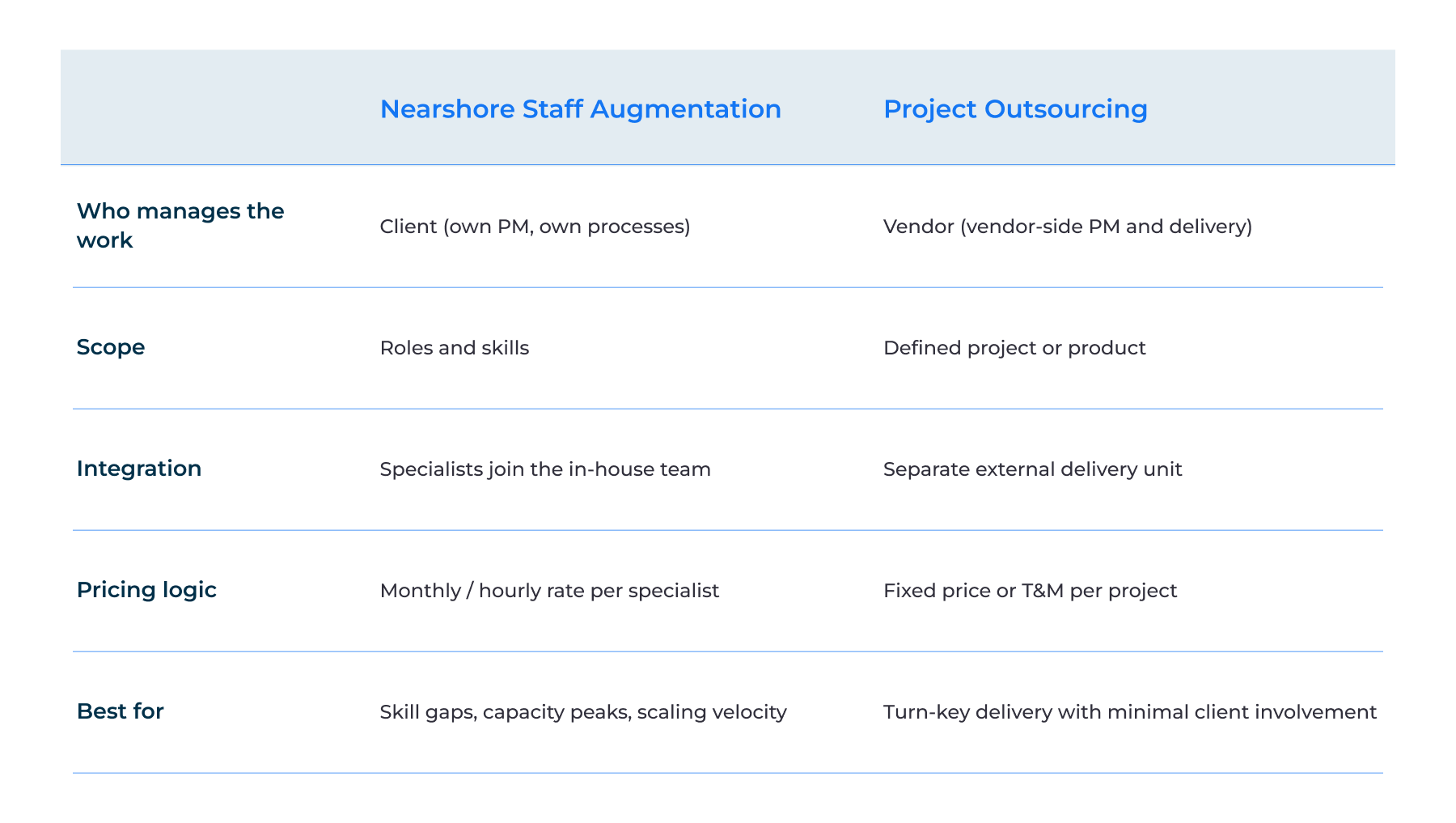
These two ways are often mixed up. The biggest difference is who does the work. In project outsourcing software development, the vendor owns delivery. The company directs the work through its own project managers and turns over a scope or product to the vendor. In nearshore staff augmentation, the company owns delivery, and the vendor supplies engineers who join the in-house team and work under the company's processes. One model buys an outcome; the other buys capacity.
How Nearshore IT Staff Augmentation Works — Step by Step
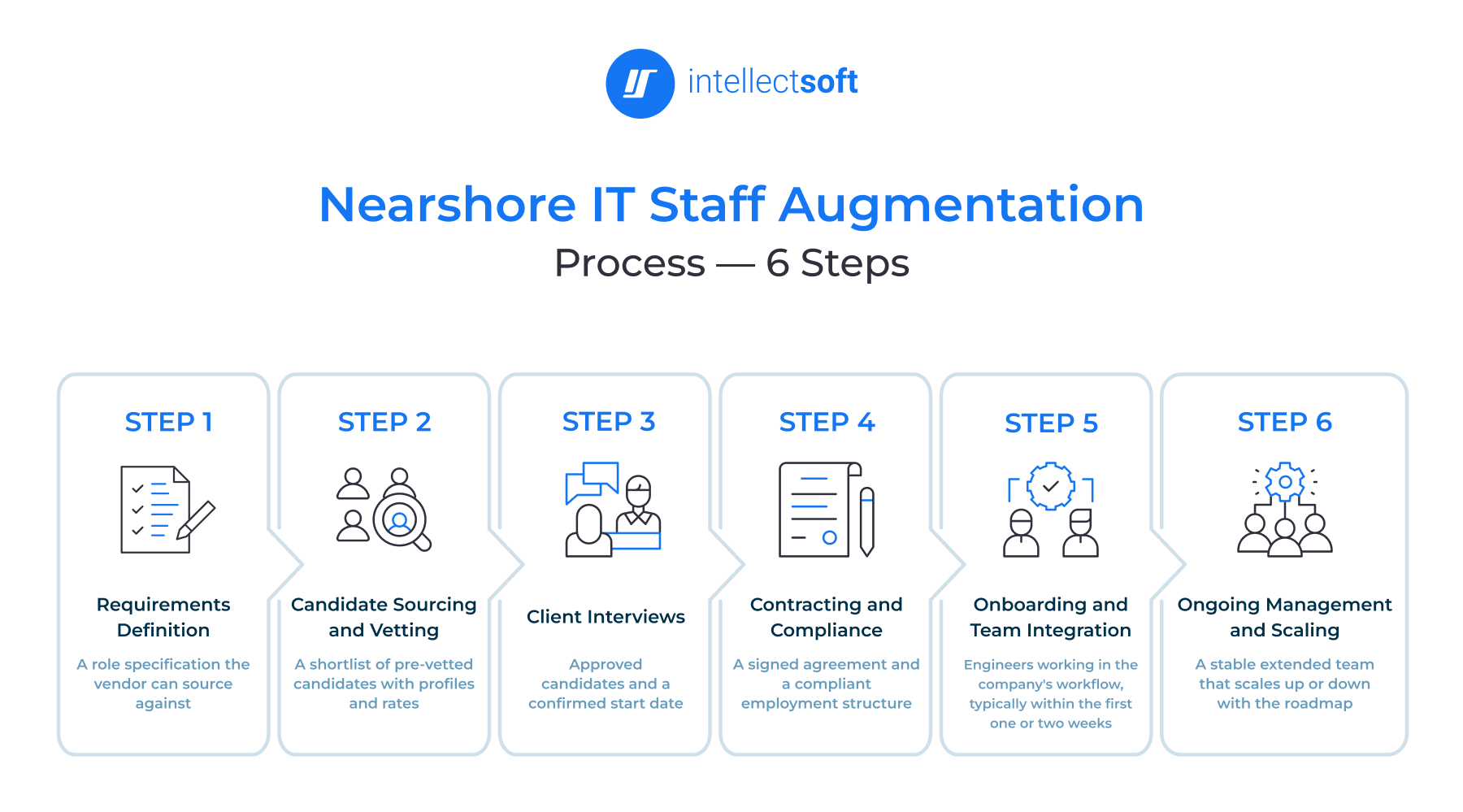
The engagement process is where a nearshore staffing partner proves it isn't a resume-forwarding service. A reliable vendor runs a structured sequence: it defines the roles, vets the engineers, and absorbs sourcing, payroll, and compliance. At the same time, the company keeps full direction over the work.
1. Requirements Definition
For nearshore staff augmentation, the process usually starts with a meeting where the company says:
- what kind of roles they need;
- what kind of technology skills they expect;
- how experienced the people need to be;
- how big the team should be;
- how long the project will take ;
- how often the team will work together.
A good provider will ask questions to make sure they understand. For example, they might ask whether two senior backend engineers are needed or whether the company is trying to grow its architecture team by adding one senior and two mid-level engineers. Output: a role specification the vendor can source against.
2. Candidate Sourcing and Vetting
The provider then looks through their list of workers and other places to find people who fit the job. They check if the people have the skills, can speak English well, and can talk clearly. This is the first stage the vendor fully absorbs: the company sees no CV until it has passed technical vetting. So, the customer gets a shortlist of pre-vetted candidates with profiles and rates.
3. Client Interviews
The company's engineering leads interview the shortlisted candidates the same way they would interview an in-house hire. There are technical rounds, team fit, and working style. The customer decides who joins; the vendor only supplies the pipeline. After that, the customer approves candidates and confirms a start date.
4. Contracting and Compliance
The vendor formalizes the engagement in a service contract covering rates, replacement guarantees, notice periods, and IP ownership, usually paired with an NDA. Employment, payroll, benefits, and local labor compliance stay on the vendor's side. The company signs one contract instead of setting up a foreign entity. The partners move to a signed agreement and a compliant employment structure.
5. Onboarding and Team Integration
Once the contracts are signed, the engineers start working with the company’s code, communication tools, and work areas. They join the meeting with the people already working there. Due to the proximity in time zones, the collaboration is synchronous. The engineers can pair with the company’s developers, attend standups, and code reviews in real-time rather than receiving instructions from the client through an asynchronous handover document. Engineers start work in the company's workflow, typically within the first one or two weeks.
6. Ongoing Management and Scaling
The company maintains direction and delivery day to day. The vendor stays responsible for retention, performance feedback loops, and replacing an engineer if the fit is wrong. The outcome is extended developers that can scale with the company’s needs, responding to the roadmap changes and technical debt reduction initiatives.
Nearshore vs. Offshore vs. Onshore: Key Differences
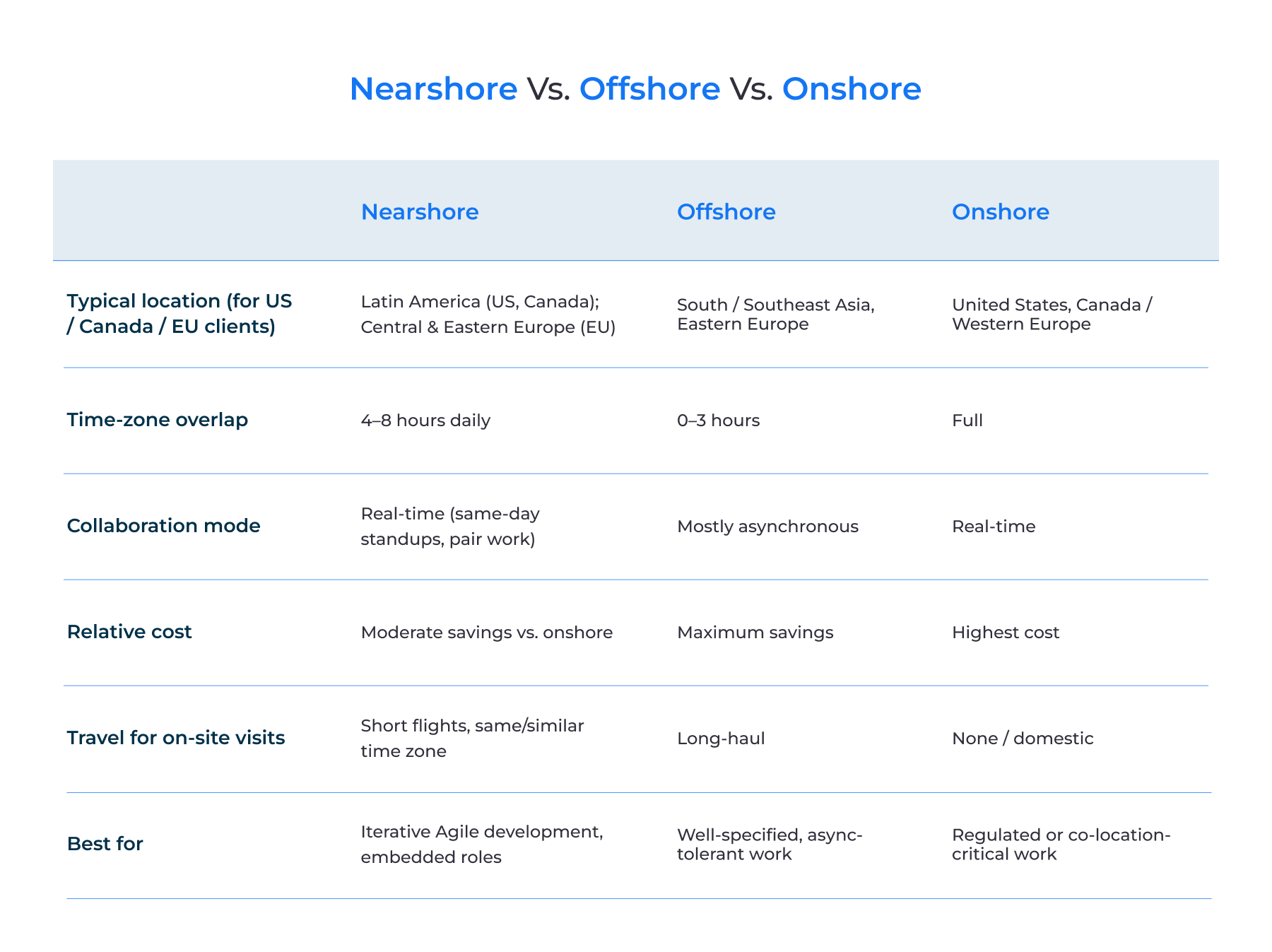
Choosing between the three ways to get workers usually comes down to money, how time zones match, and how often the team needs to work together. These three things are connected: the more the developers need to work, the more it costs. And the more important it is to pick a partner for nearshore staff augmentation that is in the same time zone.
No model wins on all three. Onshore maximizes overlap at the highest rates, offshore maximizes savings at the cost of real-time work, and nearshore staff augmentation sits between the two — which is exactly why tech leaders compare them side by side.
Each model has a clear home ground. Onshore fits heavily regulated or co-location-critical work, where physical presence or data residency outweighs cost. Offshore software development fits well-specified, asynchronous work—maintenance, defined feature backlogs, QA cycles—where a day's lag doesn't slow the roadmap. Nearshore staff augmentation is the middle ground. A lot of development happens in close quarters, where engineers need to sit together at the same standup meetings, work on the same issues, and get things done in the company’s Agile flow.
Key Benefits of Nearshore IT Staff Augmentation
The mechanics show how the model works. The benefits are why tech leaders keep choosing it over local hiring and offshore delivery. Most of them trace back to one structural fact: the engineers work in the company's time zone but sit in a lower-cost labor market.
Real-Time Collaboration in Overlapping Time Zones
The defining characteristic of the nearshore option is the daily collaboration, which typically overlaps by four to eight hours. For delivery, that compounds—iterations move faster, hand-off errors shrink, and no one opens the repository to an overnight surprise commit. Offshore developers can produce excellent code; they just can't produce it in the company's afternoon.
Cost Efficiency Without Quality Trade-Offs
Nearshore rates sit well below equivalent North American and Western European compensation, but above rock-bottom offshore pricing. That premium buys overlap, retention, and access to senior engineers. Average development rates in Latin America and Central and Eastern Europe run at roughly a third to half of comparable US rates. The detailed breakdown by region and seniority is in the pricing section below.
Faster Access to Specialized Talent
Vendors maintain pre-vetted talent pools, so a shortlist arrives in one to two weeks and engineers are productive within weeks. For comparison, Workable's benchmark data puts the average time to fill for engineering roles at 62 days globally, three weeks longer than SHRM's cross-role average [verify primary Workable/SHRM links before publication]. That clock stops at the accepted offer, not at productive output. This helps developers meet to review code and ask questions in real time instead of waiting for the next day. The benefit of being on the schedule is clear when dealing with in-demand skills like AI/ML, cloud, DevOps, and security engineers.
Elastic Scaling Without Long-Term Headcount
Augmented developers scale with the roadmap: up for a release, down after launch, with no severance and no idle payroll in between. That makes the model a form of capacity insurance for companies with uneven roadmaps —and for funding-stage companies that can't commit to permanent headcount between rounds.
Cultural and Language Alignment
Being close usually means cultural alignment and ways of working, which helps avoid problems that can happen when working with teams far away. Also, speaking in another language is vital as it can affect how people communicate.
Full Management Control and IP Security
The company directs the work, owns the deliverables, and applies its own security policies to the augmented engineers. The same access controls, review gates, and audit trails as for in-house staff. The confidentiality and intellectual property ownership are standardized through the NDA and IP assignment clauses, which are typically included in the contract at the start of the engagement. This is in contrast to project outsourcing, in which the degree of visibility into the creation of IP is limited to the contracting parties.
Nearshore Staff Augmentation vs. Other Engagement Models
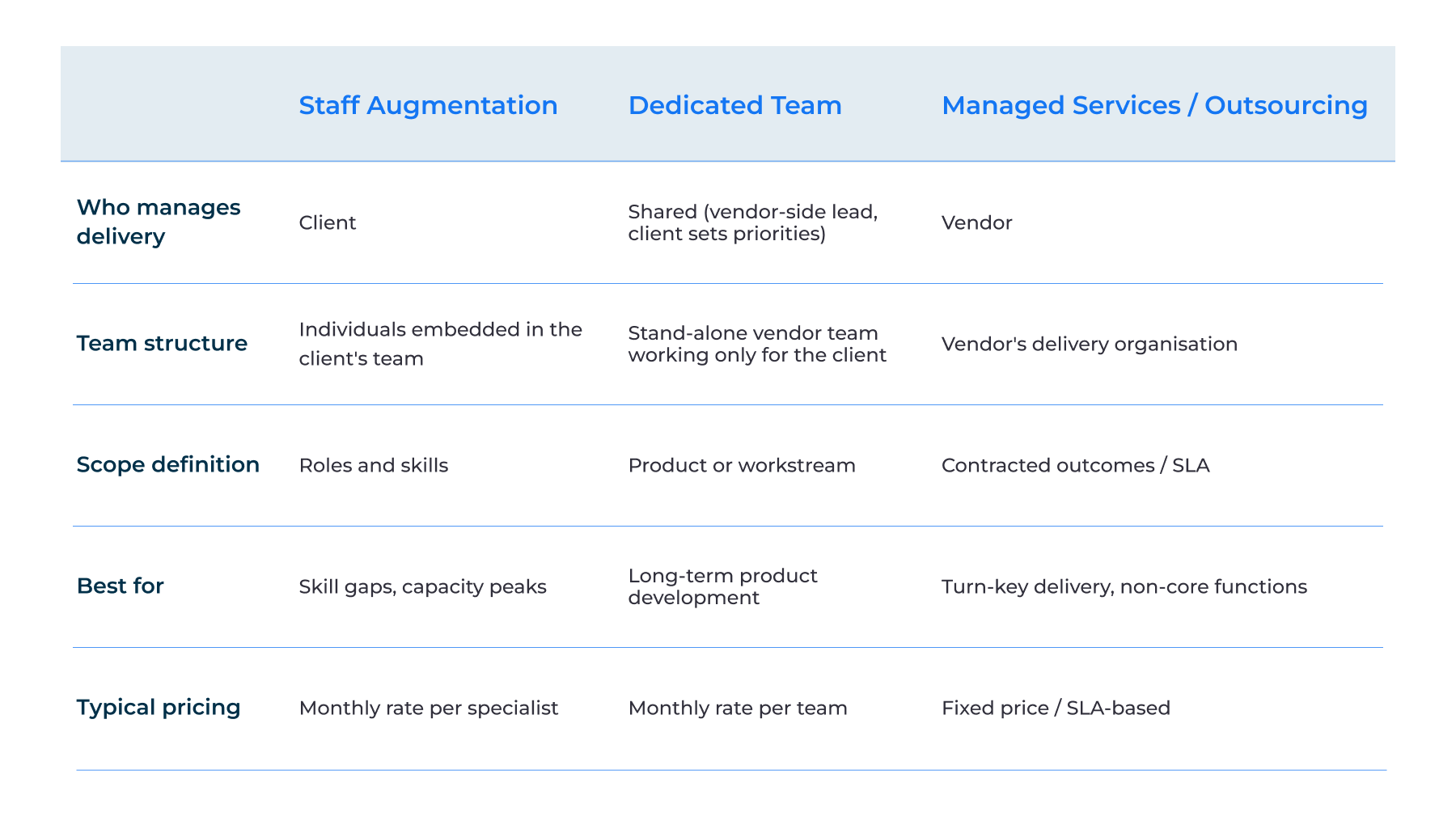
Staff augmentation is one of three common engagement models in nearshore cooperation. How do you know if this is what you need? Well, the right choice depends on two questions: who should manage the day-to-day work, and how well-defined the scope is. Staff augmentation supplies individual specialists who join the client's developers and work under its management. A dedicated team is a stand-alone vendor-side unit working exclusively on the client's product, with priorities set by the client. Managed services, or full outsourcing, hands delivery responsibility to the vendor against contracted outcomes.
There are differences between staff augmentation vs managed services and dedicated team models:
Nearshore IT Staff Augmentation Pricing: Rates and Cost Drivers
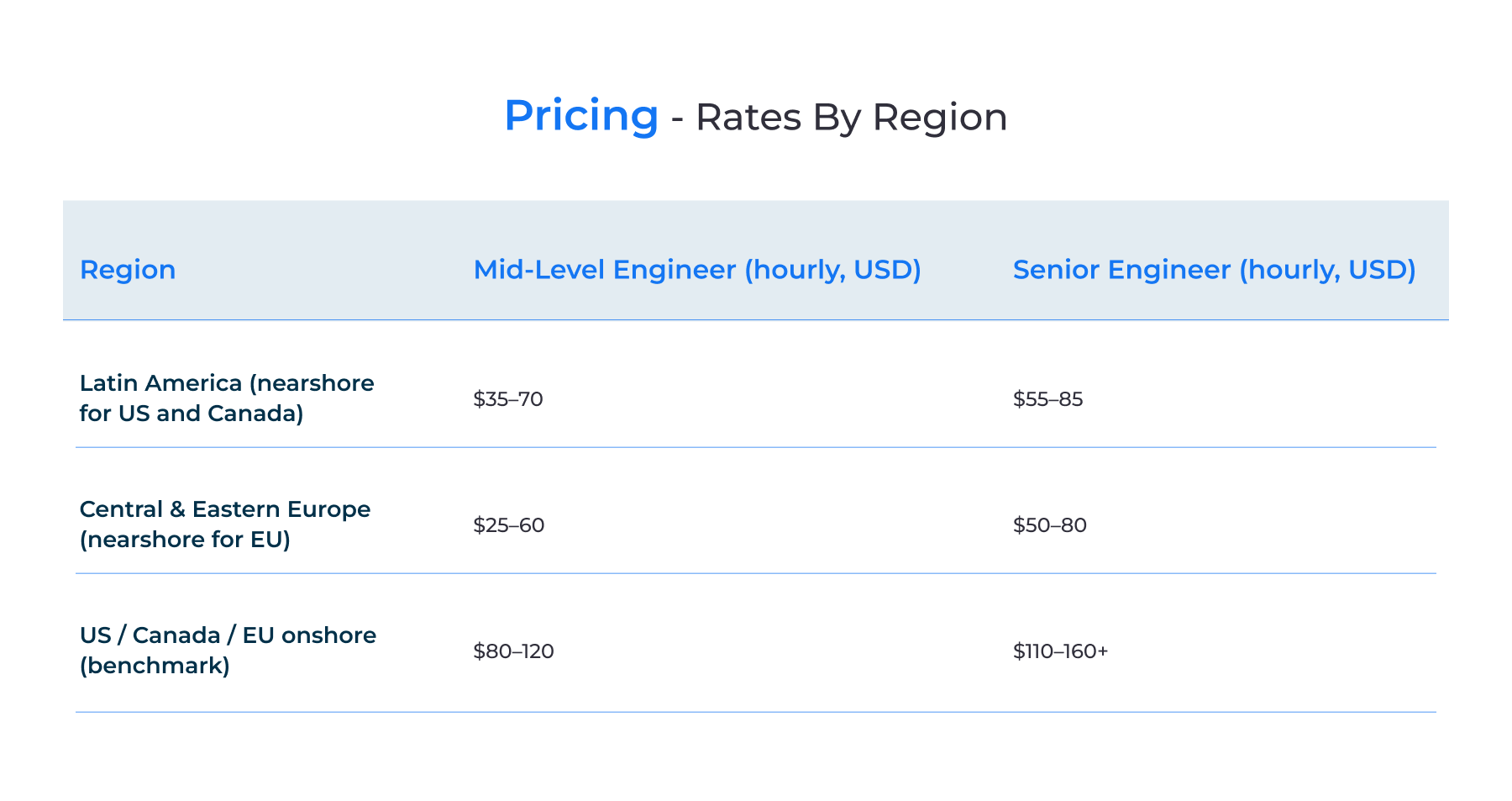
An IT staffing rate is an all-inclusive figure—monthly or hourly—that covers the specialist's compensation plus everything the vendor absorbs. There are recruiting, payroll, benefits, legal compliance, and the vendor's margin. That's why it can't be compared line-for-line with a local salary. The table shows indicative market ranges by region and seniority.
The rates indicated above are indicative: the actual pricing for nearshore staff augmentation depends on the role, seniority, technology stack, country of expertise, and engagement design.
Key Cost Drivers
Seniority and Specialization
Seniority is the single largest rate variable. Experienced engineers, and above all AI/ML, cloud-architecture, and security specialists, command the top of each region's range, while mid-level generalists anchor the lower end. A rate quote without a seniority and skill profile attached is meaningless. So, $55 per hour says nothing until it's clear who, exactly, is behind it.
Region and Country
Rates vary not only between nearshore regions but within them. As a result, mature hubs like Poland or Mexico price above emerging markets in the same region. Country-level factors. Such as local salary benchmarks, taxes, talent competition, move rates inside a single region. Compare vendor quotes at the country level, not the region level.
Engagement Length
Longer commitments typically unlock better monthly rates, because the vendor amortizes sourcing and onboarding costs across the engagement. The trade-off runs the other way for short-term coverage: it costs more per month but carries no long-term obligation.
Team Composition
A senior-heavy mix costs more per hour but ramps faster and needs less oversight. Blended seniority optimizes budget on longer engagements, where mid-level engineers grow into the codebase under senior guidance. This is a lever the company controls. The vendor proposes a composition, but the client decides what mix its roadmap and review capacity can support.
What the Rate Includes
The final driver is what sits inside the rate: recruiting, payroll, benefits, equipment, compliance, and replacement guarantees. Inclusions differ between vendors, so confirm them explicitly. A lower headline rate with excluded services often costs more in total.
That's also why the headline rate shouldn't be compared with a local salary. The all-inclusive rate replaces the recruiting fees, employer taxes, benefits overhead, and replacement risk that in-house hiring carries as separate line items. The fair comparison is total cost of capacity. On that measure, nearshore staff augmentation usually wins well before the hourly rate enters the discussion.
Top Nearshore Regions for IT Talent
"Nearshore" is always relative to where the company sits. For US and Canadian companies, it means Latin America; for Western European ones, Central and Eastern Europe. Two regions, two talent markets, each with its own profile.
Latin America — the Nearshore Hub for US and Canadian Companies
Latin America's talent pool holds roughly two million software developers, led by Brazil with over 750,000 and Mexico with over 560,000. Brazil, Mexico, Argentina, Colombia, and Chile are the region's leading exporters of engineering services.
The time-zone math is the region's strongest card: offsets of zero to three hours from US time zones mean a full shared working day, not a partial one. Typical strengths run to mobile, cloud and DevOps, and fintech engineering—a byproduct of the region's own fintech boom. AI and ML skills are especially needed. Money spent on AI in Latin America was valued at more than $5 billion, growing 20% each year.
Central & Eastern Europe — the Nearshore Hub for European Companies
Poland, Ukraine, Romania, and the Baltic states anchor the region's talent market, built on a deep engineering-education tradition — strong university pipelines in mathematics and computer science that translate into strength in complex back-end, embedded, and enterprise systems.
Offsets of zero to two hours from Western Europe give full-day overlap with EU headquarters, and the region still shares three to four afternoon hours with the US East Coast. This is enough for daily syncs on transatlantic programs. English proficiency is among the strongest in the nearshore world: in the EF English Proficiency Index 2025, Romania ranks 12th and Poland 15th of 123 countries, both in the "very high proficiency" band.
When Nearshore IT Staffing Makes Sense: Common Use Cases
Nearshore staffing earns its place in a specific set of situations, and spotting them early saves months of evaluating the wrong model. Four scenarios cover most engagements.
Scaling Development Capacity for a Roadmap
The most common trigger: the roadmap is bigger than the number of developers, and local hiring cycles would push delivery into the next year. Nearshore staff augmentation adds engineers to existing squads in weeks. So, the roadmap scales without waiting on requisitions, referrals, and notice periods. The company keeps its delivery process and just gets more hands inside it.
Covering Peak Demand
Some workloads are temporary by nature: a product launch, a cloud migration, a compliance deadline, seasonal traffic. Hiring permanent staff for a six-month peak means paying for idle capacity afterward. So, comparing staff augmentation vs in-house hiring, the former covers the peak and rolls off when it passes. The team returns to its baseline without severance or restructuring.
Filling Niche Skill Gaps
Certain profiles, such as AI/ML engineers, cloud architects, cybersecurity specialists, and senior DevOps, are scarce and expensive in every local market. Nearshore vendors maintain pools of exactly these specialists, so a company can add one hard-to-find profile to an otherwise complete team. That's often faster and cheaper than competing for the same person in a domestic bidding war.
Bridging While Hiring Permanently
A senior in-house search takes months, and the roadmap doesn't pause for it. Augmented engineers keep delivery moving during the search. When the permanent hire lands, they hand over a working codebase instead of a backlog. Some companies convert the bridge into a longer arrangement once they see the collaboration work.
Nearshore IT Staff Augmentation in Practice — Case Example
Intellectsoft has several nearshore IT augmentation cases. One of the client case studies is EuroAccident, a Swedish health-insurance provider operating since 1996. The company set out to rebuild its insurance services around a mobile app wired into its existing IT infrastructure. The engineering capacity for it did not exist in-house. Hiring for it meant a long recruitment cycle in one of Europe's tightest markets. So EuroAccident used nearshore staff augmentation instead. It brought in engineers based in Ukraine, Poland, and Romania and put them under its own technical leadership. Intellectsoft carried recruitment, payroll, and compliance.
Everything else stayed where it was: EuroAccident set priorities, ran the process, and owned delivery. This is the workflow we received:
- The time difference ran from zero to one hour.
- Working days overlapped almost completely, so questions raised in the morning were settled the same morning. The app reached release without long review cycles.
- The nearshore staff augmentation team built out the full insurance journey: appointments, claims, children's insurance management, and refunds reduced to photographing a receipt and filling out a short form.
Two integrations mattered most: Sweden's most widespread banking authorization system, for in-app signing, and the country's most popular doctor-booking service. Both required working against EuroAccident's in-house IT staff in real time.
As a result, the customer built stronger relationships with customers and partners, and higher operational efficiency through self-service and automated case processing. EuroAccident got there without adding permanent headcount.
Why Intellectsoft for Nearshore IT Staff Augmentation
Intellectsoft has offered nearshore IT staff augmentation and software engineering services for more than 18 years. Since 2007, we’ve worked with 35+ companies from the Fortune 1000 list, in the US, UK, and Western Europe. The company’s delivery centers in Latin America and Central and Eastern Europe enable it to serve clients on both sides of the Atlantic with engineers in shared time zones. The talent pool spans web and mobile engineers, cloud operations, AI/ML development, QA specialists, and DevOps engineers with a proven ability to operate in regulated environments and enterprise vendor governance frameworks.
Our experience in nearshore software staff augmentation shows up in two places:
- Industry expertise that shortens onboarding. Engineers who have already built for fintech, insurance, healthcare and biotech, dental, travel and hospitality, eCommerce and retail, logistics and transportation, construction, and real estate. They arrive for the projects, knowing the domain's regulations, data constraints, and typical architecture. So, the first sprint goes to delivery, not to explaining the business.
- A proven IT staffing process that removes hiring risk. The vetting, interviewing, and replacement-guarantee sequence is how every engagement runs. That means the company sees only pre-screened candidates, decides who joins, and can swap an engineer without renegotiating the contract.
FAQ
What is nearshore IT staff augmentation?
Nearshore IT staff augmentation is a way for a company to grow its technology capacities. The vendor brings in software engineers and IT experts from nearby countries that have similar working hours. The augmented workers follow the rules, tools, and management of the company they work for. They are found, paid, and handled by the company that provides them. The model combines the cost efficiency of outsourcing with the control of in-house hiring.
How much does nearshore IT staff augmentation cost?
Nearshore staff augmentation rates depend on seniority, specialization, country, and engagement length. Indicative market rates for mid-level engineers range from $40–65 per hour and $55–80 for senior engineers in Latin America, and $35–60 and $50–80 for mid and senior engineers in Central and Eastern Europe, respectively, according to the report by Clutch and academic surveys. The rate is all-inclusive: it covers recruiting, payroll, benefits, and compliance. Intellectsoft provides scoped estimates after a requirements review.
How fast can augmented specialists start?
Vendors with an active bench present candidate shortlists within one to two weeks, and selected specialists begin within two to four weeks of the request. An equivalent senior in-house hire takes months: engineering roles average 62 days to fill globally per Workable's benchmark data, before onboarding even starts [verify primary link — той самий стат, що в benefits]. Onboarding into the client's tools and ceremonies takes days, not weeks, because the time zones overlap.
What is the difference between staff augmentation and a dedicated team?
Augmented specialists integrate into the client's existing crew and are managed by the client day to day. A dedicated team is a stand-alone vendor-side unit with its own lead, working exclusively on the client's product while the client sets priorities. In short: nearshore staff augmentation fills roles; a dedicated team delivers a workstream.
Which regions are best for nearshore IT staffing?
Latin America is the leading nearshore region for North American companies, with zero-to-three-hour offsets from US time zones and strong mobile, cloud, and fintech talent. Central and Eastern Europe is the leading region for European companies, with zero-to-two-hour offsets from Western Europe and a deep engineering-education tradition. The right region depends on the client's headquarters time zone and the skills the roadmap requires.