Key Takeaways
- Healthcare IT staff augmentation: outside specialists, your managers, a fixed end date.
- Best used when a date won't move, like the 2027 FHIR deadline or a go-live that's already been announced to the board.
- The work stays yours. So does the liability for patient data.
- Partner people who'll see PHI need a signed BAA behind them before they log in.
- What delays a start is mostly your own access approvals and training queue.
- If handover isn't planned early, the know-how leaves with the last invoice.
- In the UK, you'll also run into IR35, the DSPT, and UK GDPR transfer rules.
Picture a regional health plan that started shopping for IT staff augmentation services for healthcare this autumn. Its Provider Access and Prior Authorization APIs have to be live by January 1, 2027, under the CMS Interoperability and Prior Authorization Final Rule. Two integration roles have been posted since spring. Nobody qualified applied. The date, of course, doesn't care. That's usually the week healthcare IT staff augmentation goes from a line in someone's slide deck to the actual plan.
Sound familiar? Then this is for you. Maybe you're the CIO, maybe the CTO, maybe the IT director who got handed the deadline. First, we look at when augmenting is worth it and which roles people end up adding. After that comes the bit compliance cares about most, which is letting outsiders into your healthcare IT solutions without exposing patient data. HIPAA for the US. IR35 and the rest of the British rulebook for the UK.
What Is Healthcare IT Staff Augmentation?
Healthcare IT staff augmentation is how a hospital, payer, or health tech company gets extra specialists or analysts for a few months without hiring them. The people come from a partner but join your in-house team. They're in your stand-ups, they report to your managers, and your HIPAA policies cover them too.
The partner deals with recruiting and payroll, and finds a replacement if someone doesn't work out. You tell them what to build on Monday morning. Outsourcing is the mirror image, because there the vendor owns the outcome and runs its own crew. The basics of IT staff augmentation services look about the same in any industry, but the stakes don't.
What makes staff augmentation different in healthcare IT
A few things set it apart from ordinary staff augmentation. Healthcare IT contractors may see protected health information. So HIPAA (and UK GDPR, if the data is British) follows them into every system they log into.
They're also working next to live care. If an interface engine stalls at 2 a.m., lab results don't reach the EHR. That's not a ticket for Monday.
Then there's the domain stuff. HL7 v2, FHIR, X12 claims files. Someone who has never seen an ADT feed can be brilliant and still lose their first two weeks just learning what it is.
When Healthcare Organizations Use IT Staff Augmentation
In practice, most healthcare organizations augment because something specific happened. Here are the occasions.
| Trigger | Typical roles | Typical engagement |
|---|---|---|
| Regulatory deadline (e.g., CMS FHIR APIs) | FHIR and integration specialists, backend developers, QA | Until the deadline plus stabilization |
| EHR implementation, upgrade, or consolidation | EHR analysts, integration specialists, trainers, project managers | Through go-live and hypercare |
| Cloud migration or legacy modernization | Cloud and DevOps specialists, architects, data specialists | Project-based |
| Security program gaps | Security specialists, IAM specialists, SOC analysts | Bridge until a hire, or one program phase |
| Product release peak at a healthtech company | Full-stack and mobile developers, QA, UI/UX designers | Sprint-based; scale up and down |
| Leave, attrition, or a vacant leadership role | Interim IT leaders, senior specialists | Bridge until a permanent hire |
Hiring cycles that do not match project deadlines
You can't fill a role in five months and use it for a project due in three. Recruiting comes first, then the notice period, then ramp-up, one after another. So by the time the new person is productive, the deadline might be behind you. Most of the debate over staff augmentation vs in-house recruitment really comes down to that gap, more than to salary.
Regulatory deadlines
Regulators pick dates without asking your recruiter. On the US side, CMS-0057-F gives impacted payers until January 1, 2027, for most of the required FHIR APIs. Meanwhile, the HIPAA Security Rule update proposed in January 2025 still isn't final because it is now projected for July 2027.
The UK runs on its own calendar. NHS England put out an updated DTAC form, and the old one should not be used from April 6, 2026 onward.
Security workforce gaps
Breaches hurt hospitals and payers more than anyone. In the IBM Cost of a Data Breach Report 2026, the average healthcare breach cost $6.64 million. Healthcare topped the list for the 13th year straight. Hiring the people to prevent that is its own headache. In the ISC2 2025 Cybersecurity Workforce Study, 59% of respondents said their teams had critical or significant skills needs. A year earlier, ISC2 put it at 44%.
A common fix is to bring in augmented staff for one narrow job, like IAM cleanup or night SOC coverage. Meanwhile, the search for a permanent hire goes on. IAM work pays off fast, since a lot of healthcare cybersecurity challenges start with one account that had far more access than it needed.
EHR and system transitions
A go-live needs extra hands for weeks, maybe months. Build, testing, data conversion, and at-the-elbow support all spike near cutover and fall off once you get through a quiet first week. Hire permanently for that spike, and you're overstaffed by summer. Teams modernizing legacy systems in healthcare see the same shape, since old and new platforms usually run side by side for a while.
Product peaks at healthtech companies
Digital health vendors grow in bursts. A hospital signs in March, wants three new integrations by June, and your backlog was full back in February. You add a couple of people for that window. When it closes, they roll off, and your permanent headcount never moved.
Healthcare IT Roles You Can Augment
Almost any technical role can be augmented; what you screen for changes once PHI and care systems come into it.
| Role | What they do in healthcare IT | What to screen for |
|---|---|---|
| Software engineers (backend, frontend, mobile) | Build patient portals, clinician tools, payer and healthtech platforms | PHI handling, audit logging, secure coding |
| Integration and interoperability specialists | Connect EHR, LIS, PACS, and payer systems; build FHIR APIs | HL7 v2, FHIR R4 / US Core, integration engines, X12 |
| EHR and clinical application analysts | Configure, build, and support EHR modules | EHR vendor certification (e.g., Epic), clinical workflow knowledge |
| Data specialists and analysts | Pipelines, warehouses, reporting, quality measures | Healthcare data models, de-identification |
| AI and ML specialists | Clinical NLP, document processing, predictive models | Model validation, bias testing, PHI-safe training data |
| Cloud and DevOps specialists | HIPAA-eligible cloud environments, CI/CD, infrastructure as code | Cloud services covered by a BAA, encryption, logging |
| Security specialists | IAM, vulnerability management, monitoring, incident response | HIPAA Security Rule, NIST CSF |
| QA and test automation specialists | Functional, integration, performance, and regression testing | Testing without real PHI, validation of regulated software |
| Project managers, business analysts, UI/UX designers | Delivery, requirements, clinician- and patient-facing design | Clinical workflow mapping, accessibility (WCAG) |
Software engineering roles
Think patient portals, scheduling apps, the internal tools nurses actually open every shift. Any good developer can write that code. The habits are another matter. We usually ask people to tell us about a time they found patient data where it shouldn't have been, and then we just listen. The ones who've been there talk about a specific log file and who they had to call that afternoon.
Integration and interoperability roles
When a deadline gets close, this is the profile everyone asks for first. They're the ones mapping HL7 v2 feeds and building FHIR endpoints against US Core, often inside an engine like Rhapsody or Mirth. Here's what we keep seeing. EHR integration rarely gets stuck on the spec. It gets stuck on the strange messages real systems send, so look for someone who has fixed production feeds at 3 a.m.
EHR and clinical application roles
EHR analysts build order sets and note templates. After go-live, they're who the nurses call. Many big EHR vendors want their certification for build work, so there aren't many of these people, and they aren't cheap. On a custom build, it's a different hire, and somebody with real EHR/EMR software development behind them beats a badge.
Data and AI roles
We've had data people join a client for a quality-reporting push and spend half their first month on de-identification. Nobody had mapped which columns were identifiers — and that's typical. AI people hit the same wall once they start on NLP or a risk model. They also have to validate before a doctor sees any output. Plenty of teams bring in AI staff augmentation for one pilot, and that's it. Most of AI in healthcare depends on boring data work done first anyway.
Cloud, DevOps, and security roles
We've lost count of the times someone told us their stack was fine because the cloud provider says it's HIPAA-eligible. But it isn't, not by itself. The HHS guidance on cloud computing treats the provider as a business associate that signs a BAA. That's about where the provider's part ends. Your risk analysis and every config choice stay with you, and getting those right is what the cloud and DevOps people are for. Security specialists cover IAM and incident response, usually against the HIPAA Security Rule and NIST CSF.
QA and testing roles
Testers we'd happily work with again never ask for production patient data; they just build fake records that behave like real ones. And they really prove their worth when the EHR vendor ships an upgrade. One patch can break a dozen interfaces that nobody checks until Thursday. If the testing need is bigger than a person or two, it can make more sense to buy QA and software testing as a service.
Staff Augmentation vs Other Engagement Models in Healthcare IT
Here's how the main options compare. Pay attention to the HIPAA column.
| Model | Who manages the work | Who owns the outcome | Vendor’s HIPAA role | Best fit |
|---|---|---|---|---|
| Staff augmentation | You | You | Business associate if its people access PHI; staff follow your policies | Skill or capacity gaps in a team you already run |
| Dedicated team | Shared: vendor team lead, your product owner | Shared | Business associate | A product or platform that needs a stable long-term team |
| Project outsourcing | Vendor | Vendor, against a fixed scope | Business associate | A defined deliverable you do not want to manage |
| Managed services | Vendor | Vendor, against SLAs | Business associate | Ongoing operations: help desk, infrastructure, monitoring |
| Direct hire | You | You | Workforce member, not a vendor | Permanent, core capabilities |
The classic comparison of staff augmentation vs outsourcing weighs price against control. Hospital CIOs we talk to ask a blunter question first. If PHI leaks, who takes the call from OCR? With augmentation, you do. That's the trade for directing the work yourself, and it's why augmented staff go through your training, not just the vendor's. Ongoing operations are a different conversation, closer to staff augmentation vs managed services. And for a product that needs the same faces for two years, we'd usually point you to a dedicated development team with its own lead.
When healthcare IT staff augmentation is the wrong choice
Honestly, it's a bad fit if there's no technical lead on your side. Somebody of yours has to set priorities and review pull requests. If you'd rather the vendor own the result, that's outsourcing. If the role is forever, make it a permanent one. And 24/7 operations are what managed services exist for.
Benefits of IT Staff Augmentation Services for Healthcare
The benefits are fairly narrow. Mostly timing and control, and nobody should promise you half your IT budget back.
Faster access to scarce healthcare IT skills
A staffing partner with FHIR or Epic people on the bench can send candidates while your recruiter is still drafting the job post. That's worth the most for roles you need for six months rather than six years.
Control over PHI and decisions stays in-house
With IT staff augmentation, healthcare teams don't hand over the keys. You still decide the architecture and approve the merges. Nobody from outside gets to decide where patient data flows.
Capacity that follows the project plan
You can add people for build and testing, peak at go-live, and scale down during hypercare. Here, you pay for that curve.
Knowledge transfer into your team
The good ones leave stuff behind when they go. Interface docs, a test suite, a runbook somebody on your internal team can actually follow. Write it into the definition of done from sprint one or don't count on it.
Variable, predictable cost
You get a monthly rate per person and a notice period. No recruiting fees, no severance, no salary for someone with nothing to do once the project wraps. Rates still depend on role and location, and the cost section further down goes into that.
HIPAA Compliance for Augmented Healthcare IT Teams
Let's be clear about one thing. Hiring through a staffing partner doesn't make anything compliant. If you're the covered entity (or a business associate, for vendors), PHI is still your responsibility, whoever writes the code. (None of this is legal advice, by the way, so run it past your counsel.)
Business associate agreements and workforce status
Here's the part that confuses people, since two HIPAA labels can apply at once. If the staffing partner's people handle PHI for you, the partner is a business associate, and you sign a BAA with it. But contractors you directly control can also be part of your workforce under the HIPAA definition in 45 CFR 160.103. Our advice is to treat both as true. Get the BAA signed before anyone gets a login. Then put each augmented person through the same training, policies, and sanctions as your employees.
Minimum necessary access
When we set people up on a client project, access covers that project and nothing in the next department over. Each person has their own account and MFA. We've seen shared logins cause more audit pain than almost anything else, so we just don't. Work runs through managed devices or virtual desktops, which keeps PHI off a laptop sitting on someone's kitchen table. Dev and test get fake or de-identified data whenever we can manage it. The person building a lab interface rarely needs a full patient chart.
Audit logging and offboarding
Keep logs of what augmented staff open, and actually read them now and then, since logs nobody looked at don't help much after a breach. Leaving should be just as boring. We'd write a 24-hour access-removal deadline into the contract, collect the laptop, and rotate any secret the person might have seen. Yes, including that API key somebody pasted into a config file last March.
Offshore and nearshore engineers and PHI
There's no HIPAA rule against offshore access to PHI. Wherever the person sits, the BAA and your security controls still apply. Your other contracts might be stricter, though. Medicare Advantage and Part D sponsors have had to report offshore subcontractors that handle PHI to CMS since 2008, with an attestation about safeguards. And a few state Medicaid contracts ban offshore work completely. So read yours before you start looking at software development in Eastern Europe or anywhere else overseas.
AI coding assistants and PHI
Pretty much every contractor we meet now has an AI coding tool they love. That's fine, as long as the rules were agreed before the first commit. Our version fits in the engagement agreement in two lines. Only approved tools get used, and PHI never goes into a prompt unless that tool is covered by a BAA. Whatever the AI writes is reviewed like anything else.
Breach notification and vendor risk
If a business associate finds a breach, it has to tell you without unreasonable delay, and no later than 60 days after discovering it. Sixty days is a long time in an incident. Remember Change Healthcare? In February 2024, attackers got in through a remote-access portal that did not have MFA, as UnitedHealth's CEO told the Senate. HHS later counted about 192.7 million people affected. One more thing is on the way, maybe. Under the proposed Security Rule update, business associates would have to confirm their technical safeguards in writing every year. That rule isn't final.
Our suggestion: ask every partner how they enforce MFA, and how many hours (not days) they take to report an incident.
Shared responsibility for augmented staff
Who does what should be written down. Here's a typical split.
| Control | Healthcare organization | Staff augmentation partner |
|---|---|---|
| BAA and contracts | Requires the BAA; sets data use terms | Signs the BAA; passes terms down to its people |
| Background checks | Sets the standard | Runs checks before placement |
| HIPAA and security training | Delivers training on your policies | Provides baseline HIPAA training and keeps records |
| Access provisioning | Grants least-privilege access; approves each account | Requests access only for named, approved people |
| Devices and environments | Provides virtual desktops or managed devices | Enforces device and acceptable-use rules |
| Monitoring and audit logs | Monitors and reviews access | Supports audits; reports anomalies |
| Incident reporting | Runs the incident response plan | Reports incidents within the contracted window |
| Offboarding | Removes access on the last day | Confirms device return and handover |
| IP and code ownership | Owns code and work product | Assigns IP under the contract |
UK: IT Staff Augmentation for NHS and UK Healthcare Organizations
UK teams play by different rules. We ran into the same split when writing about healthcare web development in the US and UK, and it matters just as much for staffing.
IR35 and off-payroll working rules
NHS bodies and other public authorities have worked under the off-payroll rules since April 2017. Medium and large private companies joined them in April 2021. The client makes the IR35 call for any contractor who works through their own limited company.
Who counts as "small" is changing as well. The Companies Act limits went up to £15 million turnover and £7.5 million balance sheet, and the 50-employee test stayed put. HMRC's own manual says that for a normal 12-month financial year, the first tax year it touches is 2027/28.
Here's the useful part. If the engineer is employed by the staff augmentation partner and paid through its payroll, the off-payroll rules don't apply to them at all. Still, run your setup past a tax adviser.
DSPT, DTAC, and NHS supplier requirements
Suppliers who touch NHS patient data fill in the Data Security and Protection Toolkit. DTAC is a separate thing, for digital health tech sold into the NHS, and there's a new version of the form now. If you make health IT systems, you'll need a DCB0129 clinical safety case too. Ask a partner which of these they have. Then ask the question most don't see coming. Where do the augmented people show up in that evidence?
UK GDPR and international data transfers
People outside the UK who can see personal data? That's a restricted transfer, even if they only log in remotely. The ICO's international transfers guidance says you need an adequacy decision or a safeguard like the IDTA or the UK Addendum. You'll also do a transfer risk assessment. UK law calls it a "data protection test" now. Update the DPIA before anyone logs in. The Data (Use and Access) Act 2025 is coming into force in stages through 2026, so check what's live on your start date.
How Healthcare IT Staff Augmentation Works: Step by Step
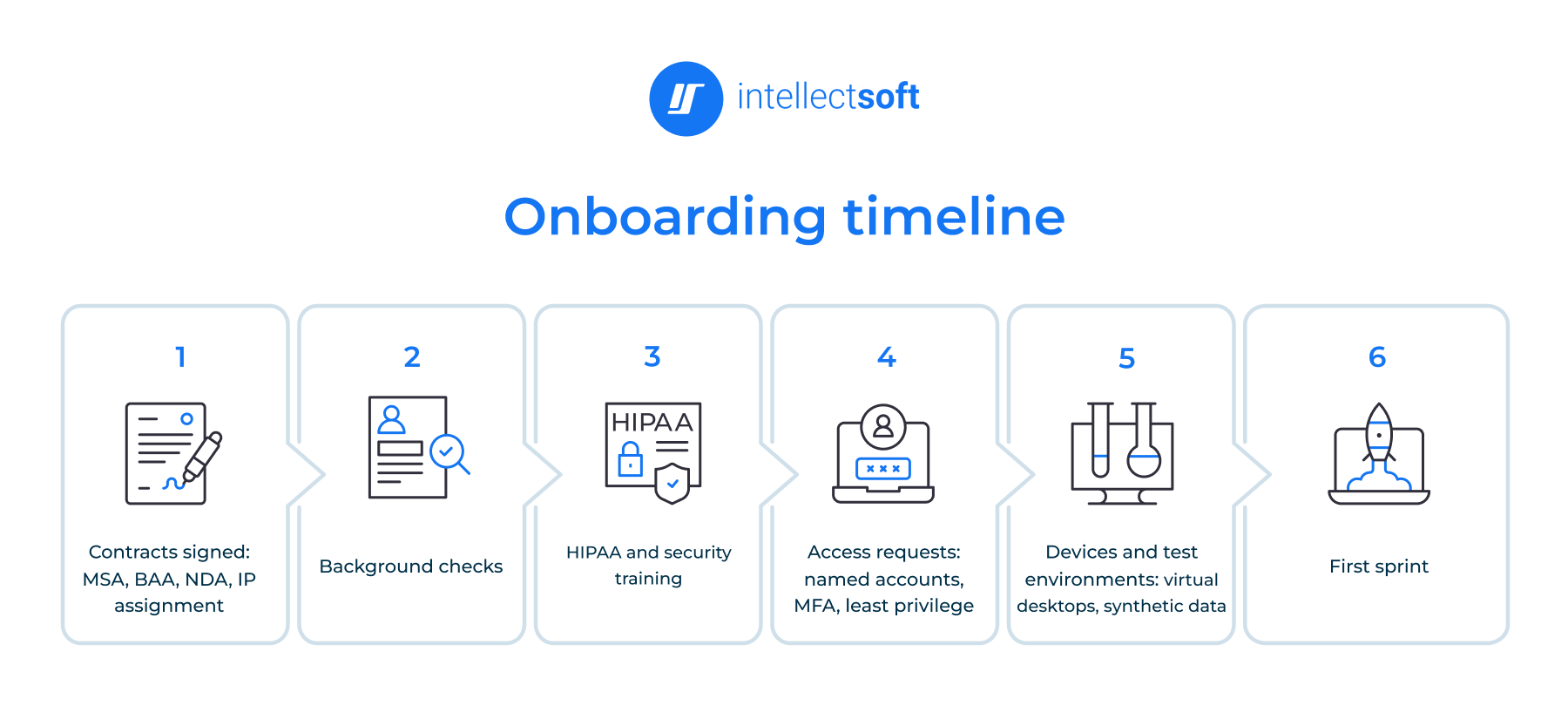
Go back to that health plan with the January deadline for a minute. Below is more or less how we'd run it if we were in the room, assuming the new people will see PHI. Weeks tend to vanish in steps 3 and 5, oddly enough, not in recruiting.
1. Define the outcome, roles, and duration
Her first instinct (everyone's, honestly) is to write "need 2 FHIR devs" in the request. We'd push back a little. What has to work on January 1? Provider Access and Prior Authorization APIs, passing CMS testing. Once that's on paper, the roles are almost obvious: integration people, one tester, maybe an architect two days a week. All of them will see PHI. Note it now, because legal will ask.
2. Choose the engagement model and partner
She has a decent lead developer and sprints that already run on time, which is exactly the situation augmentation was made for. An outsourcer would be overkill here. So she calls three firms. One of them goes fuzzy when she asks for a healthcare reference, and that's the end of that conversation.
3. Sign the contracts before the first interview
Nobody likes this one. Still, before candidates get to see her architecture, legal gets MSA, BAA, NDA, and IP assignment signed. Replacement terms and that 24-hour access cutoff go in too. Costs maybe a week. Saves a lot of awkward emails in March.
4. Screen for healthcare experience
Her lead dev does the normal coding interview, then drops a messy HL7 ADT message into the call. "Walk me through this." Good candidates spot the weird segment in seconds; weaker ones start Googling. He'll also ask what they'd do about patient names showing up in a log, and he actually phones a reference.
5. Onboard with compliance first
This is where it stalls, every time. Training and background checks? Fine, predictable. Access isn't. EHR, integration engine, Jira, two databases, five different approvers, and the database owner is skiing until the 14th. Because her team sent those requests back during screening, the new people lose two days instead of two weeks.
6. Integrate and manage the work
First Monday, the two augmented engineers are just part of the team: same planning, same stand-up, same code reviews. They report to the lead dev. Hours? Nobody really looks. People look at whether the APIs are passing tests. When someone from billing tried to borrow one of them for password resets, the lead said no, politely.
7. Transfer knowledge and offboard
Go-live happens, and things settle for a few weeks. Then come handover sessions and recorded walkthroughs for the internal team that owns the APIs next. Last day is dull on purpose. Access off, laptops returned, secrets rotated.
Challenges of Healthcare IT Staff Augmentation and How to Reduce Them
Most problems with healthcare IT staff augmentation services are the same ones every time, which is good news. You can plan around them.
| Challenge | Why it is harder in healthcare | How to reduce it |
|---|---|---|
| Slow start | Background checks, training, and access approvals across several systems | Start checks and access requests while screening; use pre-approved role access templates |
| Domain ramp-up | Clinical workflows, EHR data models, and payer rules take time to learn | Screen for healthcare experience; pair with an internal expert for the first sprints |
| Over-permissioned access | Broad EHR or database access is quicker to grant than scoped access | Role-based templates; quarterly access reviews |
| Knowledge loss at exit | Interfaces and workarounds live in people’s heads | Documentation in the definition of done; handover before the end date |
| Turnover on the partner’s side | A replacement must repeat onboarding | Agree a replacement time and an overlap period |
| Drift into ticket work | Augmented people end up on support queues | One named owner; scope tied to the outcome |
| Time zones | Go-lives and incidents need overlap | Agree on required overlap hours and on-call rules |
Slow start and domain ramp-up
In week one, these two usually arrive together. We once watched a really strong specialist lose five days. His VPN came Monday, the EHR test login Wednesday, Jira on Friday. Since then, we push every client toward access templates per role. For the domain gap, pairing each newcomer with an internal person for two sprints does most of the work.
Access creep and knowledge loss
Over six months, access creeps. Somebody needed one extra database for a day and never lost it. Quarterly reviews catch that. Knowledge loss works the other way: the person leaves, and so does the only explanation of that weird workaround. No docs in the definition of done means no docs.
Turnover, drift, and time zones
Good people still quit, get sick, or move on. We'd want the replacement window in the contract and a few days of overlap so nobody starts from zero. Scope drift is sneakier. Unless the work stays tied to the outcome, your FHIR specialist ends up resetting passwords for billing by month three. On-call rules for go-live belong in the plan well before cutover week.
How Much Does IT Staff Augmentation for Healthcare Cost?
We get asked for "the rate" a lot, and the honest answer is that a rate card only starts the conversation. These are what actually move the number:
- role and seniority
- scarce skills, such as EHR vendor certification, FHIR, or security
- where the people are located
- engagement length
- required time-zone overlap
- compliance work: background checks, training, and virtual desktops
- the internal time needed to manage the team
How you pay changes the math too. Time-and-materials leaves more risk with you than a fixed monthly rate, and the usual outsourcing pricing models all apply here. When a CFO pushes back on budget, we point at location and seniority mix before anything else. Those let you optimize IT outsourcing costs and still keep every compliance step, which isn't the place to save money.
Comparing staff augmentation with a full-time hire
Healthcare organizations often put a monthly rate next to a salary and call it done. It's not a fair fight, though. You need the full cost of each option, and these two formulas are where we'd start.
Fully loaded cost of a hire = Salary + Benefits and payroll taxes + Recruiting + Onboarding and ramp-up + Equipment and tools
Cost of augmentation = Monthly rate × Months needed + Internal setup and management time
| Input | What to include |
|---|---|
| Hire | Salary, benefits, and payroll taxes; recruiting fees or internal recruiter time; months to hire and months to full productivity; the cost of keeping the role after the project ends |
| Augmentation | Monthly rate per person for the months needed; internal onboarding, access setup, and management time; notice period if you scale down early |
| Time to value | Months until the deadline; months of productive work each option delivers before it |
In our experience, the time-to-value row is what settles it. Take a made-up example where the deadline is six months out. Recruiting a permanent person takes four months, ramp-up takes two, and the project gets roughly nothing from them. Someone augmented, starting after a few weeks of screening and setup, works most of those six months. Per month, the permanent role may look cheaper. Per month of useful work, it usually isn't.
How to Choose a Healthcare IT Staff Augmentation Company
We'd send the questions below to every healthcare IT staff augmentation company on your shortlist, then lay the answers next to each other. Plenty of firms sell staff augmentation services. Healthcare IT buyers should care less about how fast résumés arrive and more about who touches PHI, from where, and under what contract.
| Question to ask | What a good answer looks like |
|---|---|
| Will you sign our BAA, or provide yours? | Yes, as a standard step before any access |
| How do you check healthcare experience? | Domain interviews (HL7, FHIR, HIPAA scenarios) and past projects you can verify |
| Where are your people, and how will they access PHI? | Named locations; access only through your environment or virtual desktops; no local copies |
| What screening and training do your people complete? | Background checks and HIPAA and security training, with records you can audit |
| How fast do you replace someone who leaves? | A stated replacement time and an overlap period |
| Who owns the code and documentation? | You do, under the contract |
| How do you report security incidents? | A defined window shorter than the HIPAA maximum, and a named contact |
| Can we scale down or end early? | Clear notice periods; no long minimum terms |
| UK: how do you handle IR35, the DSPT, and data transfers? | People on the partner’s payroll; DSPT status stated; a transfer mechanism in place |
And a few things that would make us walk away:
- promises to fill any role in 24 hours
- compliance paperwork negotiated from scratch for each customer
- no healthcare references
- vague answers about PHI access
- low rates as the only selling point
How Intellectsoft Provides IT Staff Augmentation Services for Healthcare
We work with healthcare organizations on both sides of the Atlantic, from health systems to small healthtech vendors. Our healthcare IT staff augmentation services can add web and mobile developers, QA, DevOps, and cloud people. Data and AI specialists, designers, and project managers too. Some customers want a single specialist. Others want team extension, a dedicated development team, or AI staff augmentation, and we do those too.
We've stayed mid-size on purpose. It means a senior architect is involved in every engagement, even a two-person one. Our people sit in Eastern Europe, Latin America, and India, so a US or UK team gets real overlap hours rather than handoffs at midnight.
Some customers start with two augmented engineers and later hand us a whole build through our healthcare software development services. We do the BAA and access groundwork before anyone writes code in both cases.
FAQ
What is healthcare IT staff augmentation?
You're borrowing tech people from a partner for a few months. While they're with you, they're on your team in every way that matters, including your managers and your HIPAA policies. The partner deals with their contracts and pay, and swaps someone out if it isn't working. Accountability for patient data never leaves you.
How is healthcare IT staff augmentation different from outsourcing?
Mostly control. With augmentation, you direct the work day-to-day and own whatever comes out of it. An outsourcing vendor runs its own people against a fixed scope and owns the delivery. HIPAA-wise, both vendors are business associates if their people touch PHI, but augmented people also follow your policies and take your training.
Do augmented IT staff need to sign a BAA?
Not one by one. The BAA is between your organization and the staffing partner, and you need it whenever the partner's people handle PHI for you. The specialists themselves, if you directly control their work, can also count as your workforce under HIPAA. That's why they go through your HIPAA training.
How quickly can augmented healthcare IT engineers start?
Faster than a permanent hire, but the partner isn't the main variable. Your own approvals are. Background checks and HIPAA training are predictable. Getting five system owners to approve access isn't, so we file those requests while interviews are still going.
How much do IT staff augmentation services for healthcare cost?
Anyone quoting a number before asking about your project is guessing. Rates swing a lot. Put a senior FHIR specialist with EHR certification in your time zone at one end and a mid-level tester in Eastern Europe at the other. Add compliance setup and the hours your own leads will spend managing. Then put monthly rate times months needed next to a permanent employee's fully loaded cost.
Can offshore engineers work with PHI?
Yes. HIPAA has no ban on offshore access to PHI, and the BAA and your controls follow the person wherever they are. Other contracts may be stricter. Medicare Advantage and Part D sponsors report offshore subcontractors handling PHI to CMS, and some state Medicaid contracts don't allow offshore work at all.
How does IR35 affect IT staff augmentation in the UK?
IR35 is about contractors who work through their own limited company. Under the off-payroll working rules, NHS bodies and medium or large private companies have to decide each contractor's status. People employed by the staff augmentation partner and paid through its payroll are outside those rules.