Key takeaways
- In patient portal software development, back-end work first: logins, permissions, and EHR feeds make up most of patient portal software.
- Three routes (extend Epic MyChart or Oracle Health, buy a platform, or build custom), often mixed.
- US projects shaped by federal information blocking rules, CMS APIs, and Section 504; English ones by the NHS App.
- Repeat logins driven by fresh FHIR data and separate proxy accounts for family.
- Integration, compliance, and enrollment costing more than the screens.
- One weekly-use workflow first, then usage data to pick the next.
Patient portal software development used to sit near the bottom of a hospital IT roadmap. That's changed. In 2024, 65% of people in the US logged in to a patient portal or online record, and 59% used more than one. In England, the NHS App now connects to every acute trust. In March 2026, NHS England counted 8.7 million hospital appointment views, up 93% from a year earlier.
Blame the banks. Once people could move money from a phone, waiting on hold to book a blood test started to feel absurd. Your patient portal doesn't get them to itself, though. It sits next to every other healthcare app and front door they already have.
Below: portal types, the rules that rewrote the brief, core and AI features, EHR integration, US and UK compliance, cost, timeline, adoption. If you're deciding between the EHR vendor's portal, a platform, or your own build (maybe with a partner for healthcare IT solutions), start here.
What Is Patient Portal Software?
Patient portal software is the secure web and mobile app a healthcare provider, payer, or lab gives patients for everything that happens after a visit. Behind a login, they read a result, answer a nurse’s message, settle a bill, or book the next appointment. Caregivers often do the same for them. The healthcare provider, payer, or lab runs it behind a secure login, on the web and in a mobile app. Behind the screens, the EHR supplies most of the data, and scheduling, billing, pharmacy, and imaging systems fill in the rest.
Patient portal development is the whole job around it. Design and build, sure, but also integration and the years of running it that rarely make the first budget. It overlaps with general web portal development. The stakes don't. When a retail portal's login breaks, somebody abandons a cart; in healthcare, it can block a patient from a biopsy result. Every rule from healthcare web development lands on the portal at once.
Types of patient portals
| Type | What it is | Best when |
|---|---|---|
| Tethered EHR portal (e.g., Epic MyChart, Oracle Health) | The EHR vendor’s portal, configured and branded by the provider | One EHR, standard workflows, limited product team |
| Custom (standalone) portal | Your own front end and backend, connected to one or more EHRs and other systems through APIs | Several EHRs, specialty workflows, or the patient experience is the product |
| Hybrid: custom front end on EHR APIs | A custom patient experience; the EHR stays the source of truth | You need a better or branded experience without replacing the EHR |
| Specialty portals | Billing, lab results, pharmacy refills, pediatric or caregiver access, clinical trials | One high-volume workflow is the main pain point |
| UK: services integrated with the NHS App | Hospital or supplier services surfaced inside the NHS App through NHS login and national integrations | Patient-facing services for NHS patients in England |
Patient portal vs. patient engagement platform vs. personal health record
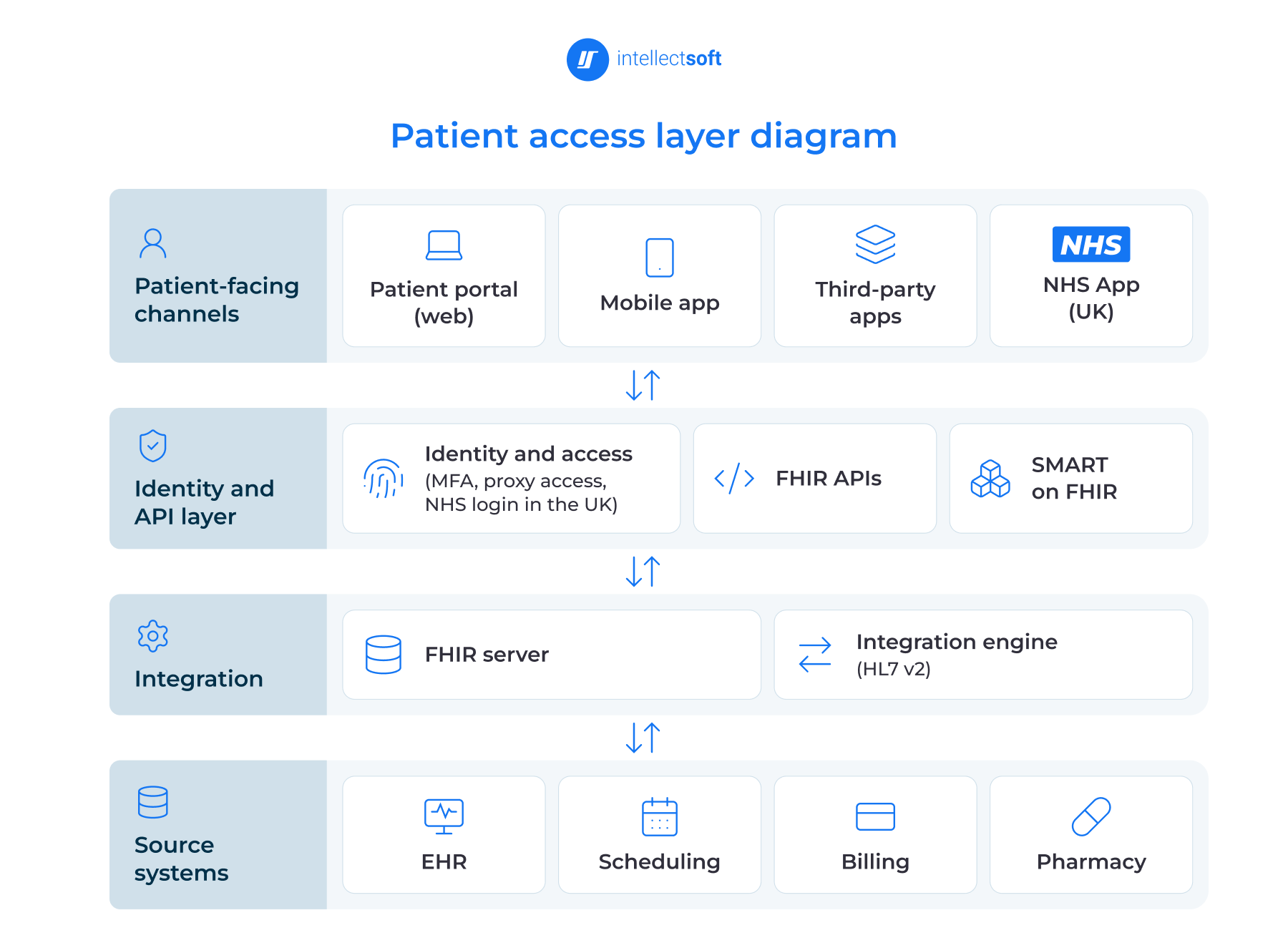
A portal hangs off one provider's records. Add outreach, education, and campaigns, and people start calling it an engagement platform. Personal health records work the other way round. The patient owns one and fills it from every place they've been treated.
Real projects mix these up. Most custom builds we scope end up as a portal with a layer of engagement features bolted to the side.
Why Patient Portal Requirements Have Changed
A patient portal launched five years ago was judged on whether a patient could log in and read a lab value. That bar has moved. Healthcare regulators now care how fast data leaves your systems. Payers publish their own APIs, and in England a national app is absorbing core hospital features.
US: more portals, more apps and enforced data access
Nobody uses just one portal anymore. In 2024, 77% of people were offered online access, per ASTP/ONC Data Brief No. 77. Back in 2022, half of them had more than one portal. Now it's 59%. Apps took over, too: 57% reached their records through one, compared with 38% four years earlier.
Caregiving changed as well. In the same ONC survey, 51% said someone else had accessed their records for them, more than double the earlier 24%.
Then there's enforcement. On September 3, 2025, HHS directed resources to active information blocking enforcement. Certified health IT developers and health information networks face civil money penalties of up to $1 million per violation. Providers face CMS disincentives instead. By early 2026, ASTP had started issuing notices of investigation to health IT developers, as Holland & Knight summarized.
What does that mean for the build? Results and notes go out without unnecessary delay. And the patient portal needs an API that third-party apps can actually call.
US: APIs, apps and digital identity
Payers have a hard date. Under CMS-0057-F, impacted payers must add prior authorization information to the Patient Access API by January 1, 2027.
The voluntary CMS Interoperability Framework pushes in the same direction. It defines CMS Aligned Networks and names patient-facing app categories, including "kill the clipboard" and conversational AI. Identity gets serious too. With an IAL2-level digital credential, a patient should reach their records without opening yet another portal account. The framework's FHIR API, appointment notification, and record locator criteria took effect on July 4, 2026.
Then there's TEFCA. Through its Individual Access Services, a patient can pull their own records across networks with the app of their choice. About 464 million documents crossed TEFCA by the end of 2025, ASTP reports.
So design the patient portal to share data and identity with other apps. Not to keep each patient inside one login.
UK: the NHS App is the front door
The 10 Year Health Plan for England, published in July 2025, makes the NHS App the main digital front door to the health service. You can see the pace already. Every acute NHS trust is connected, and NHS England says 64% of hospital appointments now show in the app. Around half of trusts send push reminders through it.
Under the NHS App integration guidance, suppliers plug in through NHS login. Referrals and appointments go through the Patient Care Aggregator (Wayfinder), messages through NHS Notify.
The direction shifted again in 2026. NHS England plans to deliver five core appointment features inside the NHS App itself. According to reports of the plan, patient engagement portal suppliers won't be needed for them within three years. Through NHS App Direct Integration, trusts will connect their EPRs to the app directly; the first trusts are already in development, NHS England Digital confirms.
The practical rule for England: build hospital and clinic services to plug into the NHS App, not to compete with it.
Core Features of Patient Portal Software
Healthcare feature lists all look alike. Whether people use a portal or abandon it comes down to the plumbing. So these notes come from the build side.
What to launch first and what can wait
| Feature | MVP | Later phases |
|---|---|---|
| Registration, identity proofing, MFA | Yes | IAL2 digital credentials, passkeys |
| Records, results, visit summaries | Yes | Plain-language explanations, record download |
| Secure messaging | Yes | Routing rules, AI-drafted replies |
| Scheduling and digital intake | Yes | Self-scheduling for all visit types, check-in |
| Billing and payments | Yes (statements, online payment) | Payment plans, cost estimates |
| Proxy and caregiver access | Yes | Adolescent and shared-care rules |
| Prescription refills | Optional | Pharmacy integration |
| Telehealth and remote monitoring | Optional | Device data, care plans |
| Notifications | Yes (email/SMS) | Push; NHS Notify in the UK |
| Admin console and analytics | Basic | Adoption dashboards |
Registration, identity proofing and login
Enrollment leaks worst of all, and plenty of patient sign-ups die there. Proofing can happen in person at the front desk or remotely with a document check. Aim for IAL2, because the credential then works elsewhere. Add MFA and passkeys from day one.
Account recovery deserves its own design review. Date of birth plus zip code over the phone? That's a gift to social engineers. Teams in England get a shortcut here: NHS login already verifies patient identity, and you inherit it.
Proxy and caregiver access
Half the people reading medical records aren't the patient. ASTP/ONC data puts proxy access at 51% in 2024. Edge case? Hardly.
Every proxy gets a separate account, scoped to what they're allowed to see, because shared passwords are how proxy access goes wrong. Teen confidentiality is messier. State laws differ, so get the permission model past a lawyer before any developer touches it. In the UK, parents and carers already have proxy links in the NHS App.
Records, results and visit summaries
USCDI is the floor for what the medical record view shows: problems, medications, allergies, labs, notes. Thanks to information blocking rules, results and clinical notes go out without unnecessary delay. That includes the awkward ones. (A pathology report nobody has discussed with the patient yet, for instance.) Add visit summaries, record download, and sharing to another app.
Secure messaging
Building messaging takes a sprint or two. Running it costs clinician hours every single day. Route messages to a team pool, not one doctor's inbox. And tell the patient how long replies take, in plain words. Scan attachments for malware; patients upload some strange files. Notification text should never carry clinical detail; "You have a new message" is enough.
Some healthcare organizations bill the longer threads as e-visits. Billing uses CPT 99421–99423, and MGMA's guide covers the details.
Scheduling, digital intake and check-in
Self-scheduling pulls open slots from the EHR in real time. Cached slots mean double bookings, and after about a week of those the front desk quietly goes back to the phone. CMS calls this "kill the clipboard." In a clinic, that looks like a waitlist, intake forms done at home, and an insurance card photo uploaded the night before. Reminders tend to come from a healthcare CRM that shares the patient record.
Billing and payments
Patient billing portal web development is a common first phase, because finance teams see the return quickly. The first release usually covers statements and online payment through a tokenized PCI DSS processor; payment plans and cost estimates follow. Card data never touches your servers.
Prescription refills
A refill request lands in a clinician queue first. Never the pharmacy directly. Pharmacy choice belongs to the patient. Medication lists sync from the EHR. If a doctor discontinued a drug last month, the patient won't see a refill button for it.
Telehealth and remote monitoring
Video visits launch from the appointment itself. No separate link buried in an email. Glucose meters and blood pressure cuffs at home can upload readings too. The care team picks the alert thresholds, so nurses only see the numbers that need attention. Much of this is ordinary telemedicine app development. So, reuse it.
Notifications
Keep notification content to the bare minimum. US teams get a BAA from every SMS and email vendor before the first send. UK services use NHS Notify.
Admin console and analytics
Staff need role-based admin access, content updates without a release, and audit logs they can actually search. The adoption dashboards are covered in the adoption section below.
AI Features in Patient Portal Software
AI is worth adding to a healthcare portal where it saves staff time. Clinical decisions stay with clinicians. Buyers will ask. The CMS framework lists conversational AI as a patient-facing app category, after all. Here's where it tends to pay off, and where AI development services need the tightest guardrails.
Drafted replies to patient messages
The model drafts a reply in the clinician's inbox. A clinician edits it and hits send. Nothing clinical goes out automatically.
Plain-language results and notes
Picture a lab value with a short plain-language explanation underneath, a link to the original, and a prompt to call the care team. Our bet: fewer patient calls asking what "mildly elevated ALT" means.
Conversational scheduling and navigation
A patient types "Can I come in Thursday?" and the bot offers real slots from live availability. Billing and parking questions go through the same chat. Anything past the bot's depth goes to a person. Running chatbots in healthcare already? That stack can usually stretch.
Intake and document processing
Forms arrive half-filled from the last visit. Upload a referral letter or snap an insurance card, and the fields get extracted for staff to check; nothing reaches the chart unchecked.
None of this works without guardrails. A clinician signs off on anything clinical. We log prompts and outputs as PHI, same as any other record access. Contracts matter too: a BAA with the model provider in the US, a data processing agreement in the UK. Accuracy and bias testing happen before launch, and AI-written text carries a label. Does a feature start hinting at diagnoses? Then read the FDA's clinical decision support software guidance, last updated in January 2026.
Patient Portal Software Development in Practice: A Booking and Intake Platform for UK Dental Clinics
Not every patient portal starts with an EHR. This one started with a dental startup that wanted to take the phone out of booking.
The challenge
A UK dental startup needed one platform for clinics, dentists, and patients. The founders wanted patients to book without calling anyone. A patient would pick a dentist and a free slot online. Clinic staff would then see every request and form in one queue, rather than spread across phone calls and emails.
The solution
We built a white-label web platform for both sides of the appointment. Patients get a responsive mobile version, while clinic administrators work in a panel where access depends on their role. Under it sit React.js, .NET Core 3.1, and AWS, with fully automated CI/CD and a domain-driven design approach.
| User | What they can do |
|---|---|
| Patients | Choose a dentist, book appointments, fill out questionnaires, upload photos, submit and cancel requests |
| Clinic staff (administrators and dentists) | Create administrator and dentist profiles, handle appointments and requests, view patient statistics; access depends on role |
The results
Development took 9 months. Ten clinics now run on the platform. Our team measured about 20% less administrator time per patient, and revenue grew by an average of 8% through better appointment management.
The full story is in our case study on the client management platform for dental clinics.
Patient Portal Adoption in Practice: A Patient Web Portal for a US Healthcare Company
Adoption is the number most portal projects get wrong. This one surprised everybody.
The challenge
The customer, a US company, provides decision-support solutions to consumers and healthcare professionals. Its audience was getting older. Many of those users already managed care through patient portals and electronic health records, so the company wanted one trusted place for health information.
The solution
Episerver CMS sits under the patient portal. That let the customer's own team edit articles, swap images, and change static pages without a developer recompiling the app. On the patient side, the portal pulled together medical articles, drug and symptom references, news, illustrations, videos, and health tips. There was also a drug lookup that worked by symptom, pill shape, color, or imprint. The portal linked into the customer's main website and marketing campaigns. Our team handled the whole cycle, from design and development to testing, deployment, and maintenance.
| User | What the portal gives them |
|---|---|
| Patients | Medical articles, drug and symptom information, news, illustrations, videos, and health tips in one place; drug search by symptom, shape, color, or imprint |
| Content and site owners | Content, image, and page updates through the CMS without code changes or releases |
| Marketing team | A portal connected to the main website and campaigns, supporting branding and targeted advertising |
The results
The portal turned out "extremely popular with patients" and saw "surprisingly-high adoption among older patients." It took work off hospital staff. The case also notes that patients started taking a more active part in managing their health. What we took from the project is fairly simple. Older patients stuck with the portal because they found things quickly and believed the content, and that counted for more than extra features. Read the full patient web portal case.
EHR Integration and Interoperability for Patient Portals
Ask any healthcare team that's shipped a portal where the budget went. Integration, almost always, and mostly because the paperwork started late. Epic and Oracle Health both publish FHIR R4 APIs, and most healthcare networks we talk to run one of them. Through those APIs the portal reads records and books appointments back into the schedule. The lab system is often the odd one out. If it only sends HL7 v2, we route it through an integration engine first. For nurses who open the portal from inside the EHR, SMART on FHIR passes along the patient already on screen.
The slow part is human. App review and API approval at the EHR vendor can drag on longer than several sprints. We put them on the critical path from discovery. In the UK, it's NHS login plus whichever NHS App routes apply. NHS App Direct Integration will change that list for trusts. Teams doing deeper EHR and EMR development work run these tracks in parallel.
Standards and services a patient portal works with
| Standard / service | Market | What it is used for | When your portal needs it |
|---|---|---|---|
| FHIR R4 (US Core / UK Core) | Both | REST APIs for clinical and administrative data | Reading or writing EHR data: results, records, appointments |
| USCDI | US | The minimum data classes patients must be able to access | Deciding what the records view shows |
| SMART on FHIR | US (mainly) | Secure app authorization and launch with patient context | Third-party app access; launching from the EHR |
| HL7 v2 | Both | Event messages: admissions, orders, results | Real-time feeds from systems without FHIR |
| CMS payer FHIR APIs | US | Patient Access API, including prior authorization data by January 1, 2027 | Payer portals and member apps |
| TEFCA Individual Access Services | US | Patient-requested record retrieval across networks | Pulling records from other providers |
| X12 270/271 | US | Insurance eligibility checks | Intake and cost estimates |
| NHS login | UK | Verified patient identity and single sign-on with the NHS App | Any patient-facing service for NHS patients in England |
| Patient Care Aggregator (Wayfinder) | UK | Hospital referrals and appointments in the NHS App | Secondary care booking and appointment management |
| NHS Notify | UK | Messages and push notifications through the NHS App | Reminders and letters |
| PDS / GP Connect / IM1 | UK | Demographics and NHS number; GP records and appointments | Patient matching; primary care data |
Integrating with more than one EHR
We see custom patient portal development pay off fastest in healthcare networks running two or three EHRs, for example after a merger. We'd put one integration layer with a canonical FHIR data model in the middle, so the portal stops caring which EHR answers. Patient matching across those systems needs its own component: usually an enterprise master patient index, or the NHS number from PDS on UK projects. One identity per patient. Each vendor's approval process gets its own plan, since no two behave alike.
Compliance and Security Requirements in the US and UK
On our projects, a person who knows HIPAA or NHS assurance joins the first design workshop. Leaving that review to the end tends to mean redrawing screens a few weeks before launch.
US vs UK requirements at a glance
| Area | United States | United Kingdom |
|---|---|---|
| Data protection law | HIPAA Privacy and Security Rules, HITECH; state privacy and minor-consent laws | UK GDPR and Data Protection Act 2018 (health data is special category data) |
| Vendor contracts | BAA with every vendor that touches PHI (cloud, SMS, video, analytics, AI) | Data processing agreement with every processor |
| Patient data access | 21st Century Cures Act information blocking rules; patient right of access | Subject access rights; NHS App integration standards |
| Identity | Identity proofing (IAL2 under the CMS framework), MFA | NHS login |
| Accessibility | HHS Section 504 rule: WCAG 2.1 AA by May 11, 2027 (15+ employees) and May 10, 2028 (smaller) | WCAG 2.2 AA for public sector bodies, including the NHS; Equality Act 2010 |
| Tracking | No third-party tracking with PHI on authenticated pages | PECR consent for non-essential cookies |
| Buyer assurance | Security questionnaires; SOC 2 / HITRUST often requested | DTAC, DSPT, DCB0129 / DCB0160 clinical safety |
US: HIPAA and the Security Rule update
PHI is broader than most product teams expect. Under HIPAA it covers almost any patient portal screen, right down to an appointment list showing a name. Each vendor that stores or processes it signs a BAA with you. You also keep a written risk analysis and audit logs of who opened each patient record.
The Security Rule itself is mid-rewrite. The proposed rule HHS published in January 2025 reads like a security team's wish list. MFA and encryption would become required rather than recommended. The draft also asks for a current asset inventory, a penetration test every 12 months, and restoring critical systems within 72 hours. It isn't final. HHS's regulatory agenda now points to around July 2027. Still, treat MFA and encryption as required in any new build.
US: information blocking, tracking and accessibility
Results and notes go out without unnecessary delay, and if you lean on an exception, write down which one. Tracking pixels behind the login are how PHI ends up in ad platforms. Take them off every authenticated page.
Section 504 gives organizations with 15 or more employees until May 11, 2027, a date HHS set in May 2026. Anyone smaller gets another year, to May 10, 2028. WCAG 2.1 AA is the bar either way. We'd build to WCAG 2.2 AA to cover both markets.
UK: UK GDPR, NHS assurance and NHS App standards
UK GDPR basics go first. Before any health data moves, there's a DPIA to write, a lawful basis to pick, and an Article 9 condition to name. Then the NHS buyer sends over DTAC. The form is shorter since March 2026, because NHS England removed the questions that repeated the DSPT. If you touch NHS patient data, the DSPT itself is on you.
Two clinical risk management standards apply. On our side, DCB0129 applies while we build the product. DCB0160 then applies to the trust or clinic as it rolls the system out. Going into the NHS App adds two more items: NHS login, and a review against the app's accessibility, usability, clinical safety, and data privacy standards.
Security controls every patient portal needs
| Control | What it covers |
|---|---|
| Encryption | In transit (TLS 1.2+) and at rest, including backups, logs, and exports |
| Authentication | MFA, passkeys, session timeouts, safe account recovery; NHS login in the UK |
| Authorization | Role- and relationship-based access: patient, proxy, adolescent, staff; minimum necessary data |
| Audit logging | Every view, change, and download of patient data, by user and time; immutable and reviewable |
| Vendors and hosting | BAAs (US) / data processing agreements (UK); data residency as required |
| Testing | SAST/DAST, dependency scanning, independent penetration test before launch and annually |
Patient Portal Development Process: Step by Step
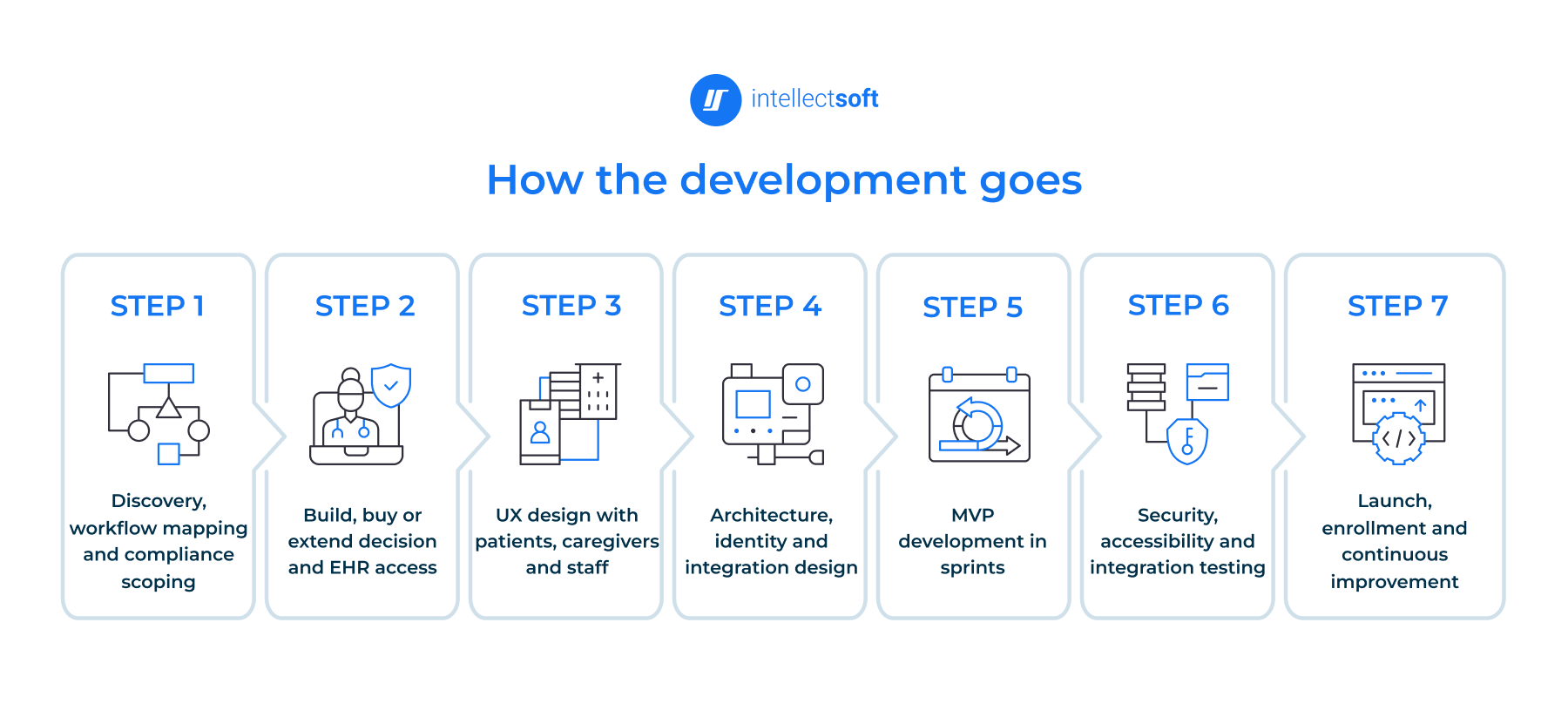
We've marked the compliance work US and UK healthcare buyers will ask about in each step.
Step 1: Discovery, workflow mapping and compliance scoping
Our first workshop is mostly questions. Who will log in: patients, proxies, staff? What goes digital first? Where does patient data travel? US teams begin the HIPAA risk analysis here. UK teams scope the DPIA, DTAC, and DCB0129 work.
Step 2: Build, buy or extend decision and EHR access
Confirm the approach against what discovery found. Request EHR sandbox access the same week and file the vendor app review on day one. Waiting until design is done costs months.
Step 3: UX design with patients, caregivers and staff
We put clickable prototypes in front of older patients, adult children managing a parent's care, and the people at the front desk. They'll find in a minute what the product team missed for weeks. Accessibility and plain language are cheap to add at this point and painful to retrofit. When we run UI/UX design services for healthcare, screen-reader users are part of testing.
Step 4: Architecture, identity and integration design
Identity and proxy model come first, since nearly everything else hangs off them. After that come FHIR and HL7 patterns and hosting (under a BAA in the US, in UK regions for NHS work).
Step 5: MVP development in sprints
We'd rather see one high-value workflow fully working than three half-done. Good first pairings are results plus messaging or booking plus intake. With an MVP development scope that small, real users arrive within months, and their clicks decide the next release.
Step 6: Security, accessibility and integration testing
Before launch, we pay someone to try to break in. Someone else works through it with a screen reader for the WCAG audit. And the whole thing runs against the EHR sandbox. UK teams also need their clinical safety case signed off. We hand these checks to an independent QA and software testing team. Developers rarely spot gaps in code they wrote last week.
Step 7: Launch, enrollment and continuous improvement
Go live in stages. One clinic or service line first. Front-desk staff get a short patient portal enrollment script, and the team watches activation and drop-off in analytics before each release. In our experience, healthcare budgets cut this stage of patient portal development first, and it's where many portals stall.
How Much Does Patient Portal Software Cost?
Patient portal software cost depends far more on healthcare integrations and compliance than on screens. Our web app development costs guide puts healthcare web apps at $100,000–$300,000+. Mid-sized portals usually cost $50,000–$150,000. On our projects, compliance adds another 15–30%, and maintenance takes 15–25% of the build cost every year.
Indicative patient portal cost by scope
| Scope | US | UK | What moves the number |
|---|---|---|---|
| MVP: one workflow (e.g., booking and intake, or results and messaging), one EHR | $50,000–$100,000 | £40,000–£80,000 | Number of roles; one or two integrations |
| Full patient portal with EHR integration | $100,000–$300,000+ | £80,000–£240,000+ | FHIR/HL7 depth, proxy access, billing, telehealth, mobile apps; NHS login (UK) |
| Multi-EHR or multi-organization platform, or a commercial product | $300,000+ | £240,000+ | Several EHRs, payer or national APIs, patient matching, scale |
| Extending the EHR vendor portal | Vendor licensing + configuration | n/a for NHS App services | Vendor pricing; integrations still cost extra |
| Compliance overhead | +15–30% | +15–30% | HIPAA controls and BAAs (US); DPIA, DTAC, DSPT, DCB0129 (UK); penetration testing |
| Maintenance per year | 15–25% of build cost | 15–25% of build cost | Releases, security patches, EHR upgrades, support |
The biggest cost drivers are predictable. EHR integrations top the list. Identity proofing, proxy rules, billing, and telehealth follow, roughly in that order for most of the projects we scope. Adding native iOS and Android apps means a second front end to build and maintain. That's a common reason healthcare app development budgets grow. Accessibility work and data migration from an old portal cost less, but they rarely cost nothing. A custom patient portal development plan should also allow time for EHR vendor approvals, which your team can't speed up. UK projects add NHS login and NHS App onboarding.
After launch, plan for hosting, identity checks, SMS fees, licenses, an annual security test, and someone to answer patients' questions.
These are estimates from our projects, so your own scope will shift them. UK figures exclude VAT.
How Long Does Patient Portal Development Take?
Most patient portals take 4–8 months to a first production release. MVPs land in 2–4 months. Enterprise platforms take 8–18. These timeline ranges come from our web portal development guide, plus healthcare-specific delays.
Patient portal timeline by scope
| Scope | Typical timeline | Extra time for UK / NHS work | What sets the pace |
|---|---|---|---|
| MVP: one workflow, one EHR | 2–4 months | +2–6 weeks | EHR sandbox access; number of roles |
| Full patient portal with EHR integration | 4–8 months | +1–3 months | Vendor app review, identity proofing, proxy rules; NHS login and NHS App onboarding (UK) |
| Multi-EHR or multi-organization platform | 8–18 months | Plan per integration | Several EHRs, patient matching, phased rollout |
Where the time goes
| Phase | Typical duration | Patient-portal-specific note |
|---|---|---|
| Discovery and compliance scoping | 2–4 weeks | Request EHR sandbox and vendor review here |
| UX design | 3–5 weeks | Test with patients, caregivers, and staff; accessibility review |
| Architecture and tech stack | 2–3 weeks | Lock identity, proxy, and integration patterns |
| Iterative development | 3–6 months | Integration runs in parallel, not at the end |
| QA, security testing, and UAT | 3–6 weeks | Penetration test, WCAG audit; clinical safety case (UK) |
| Launch and hypercare | 2–4 weeks | Pilot with one clinic or service line first |
What slows patient portal projects down
In our projects, delays usually come from the same few places:
- EHR vendor access and app review: file in week one of discovery.
- Identity proofing vendor selection: have two finalists before architecture begins.
- Legal review of proxy and adolescent rules: book counsel time in the first month.
- BAAs (US) or data processing agreements (UK): send templates to every vendor in week one.
- Your own security team's review: get their questionnaire before anyone signs.
- NHS login and NHS App onboarding (UK): apply the moment scope is settled.
- Accessibility found late: audit the prototype, not just the release candidate.
We've written separately about how long it takes to build an app outside healthcare. Here, plan around the slowest outside dependency.
How to Drive Patient Portal Adoption
One finding matters more than any feature. When providers encouraged them, 87% of people used a portal in 2024, ONC found, against 57% of those who got no nudge.
So adoption is mostly an operations problem for healthcare teams. Ask at check-in. Most people are holding a phone anyway, so the activation text can go out before they sit down. If a daughter or son came along, set up their proxy access then and there. Offer the portal in the languages your patients speak at home; an English-only version loses those families. Front-desk staff do better with one sentence they repeat at every visit than with a stack of leaflets on the counter. In the UK, NHS login gives people one sign-in across services.
Track these from launch day, against your own baseline rather than someone else's benchmark.
Patient portal KPIs to track
| KPI | What it shows |
|---|---|
| Activation rate (accounts activated ÷ patients invited) | Whether enrollment works |
| Monthly active users | Whether patients come back |
| Self-scheduled appointment share | Load taken off the phone line |
| Digital intake completion rate | Paperwork removed before the visit |
| Online payment share and days to payment | Billing impact |
| Message volume and response time | Care team workload and service level |
| No-show rate | Effect of reminders and self-rescheduling |
| Proxy accounts | Caregiver reach |
Common Patient Portal Development Challenges
Six problems show up across healthcare projects again and again. None is a technical mystery.
- Low adoption. Launch day comes, and the patient portal sits empty. Enrollment at check-in fixes most of it, along with staff who mention the portal at every visit.
- EHR vendor approval delays. We've seen finished builds wait on app review for weeks. File it during discovery.
- Proxy and adolescent access rules. Rules shift by state and by family situation. Legal approves the permission model before anyone codes it.
- Message overload for clinicians. In an MGMA poll, 70% of medical groups reported more portal messages in 2024. Routing rules help. So do published response times and AI-drafted replies.
- Patient data leaking into analytics. Pixels behind the login quietly ship PHI to ad platforms. First-party analytics does the job without the leak.
- Duplicate portals and accounts. Patients already juggle several logins. In the UK, the risk is building what the NHS App already provides or will soon absorb. Check NHS England's roadmap before scoping any appointment feature.
Good patient portal development solutions plan for all six up front.
Patient Portal Software Development with Intellectsoft
Intellectsoft has been doing healthcare software development since 2007: patient-facing portals, EHR and EMR systems, healthcare apps. We open every engagement with an architecture sprint. A portal's identity model and integration layer are painful to change later, so they get decided first. A senior architect stays on the project from discovery to launch.
Two appear in this guide: a booking platform used by ten UK dental clinics and a US health portal popular with older patients.
Our patient portal software development services cover discovery, UX, FHIR and HL7 integration, healthcare compliance work for HIPAA or the NHS, and support after launch. As a patient portal software development company, we stay mid-size on purpose. That keeps senior people close to each project. If you're weighing a patient portal development company against your EHR vendor's portal, we'll say which fits, even when it's the vendor's.
Our patient portal development services also include audits of existing portals that aren't getting used.
FAQ
What is patient portal software?
Patient portal software is the logged-in website and app that a healthcare provider, payer, or lab gives its patients. Typical uses: checking lab results and medical records, messaging the care team, and moving an appointment. Caregivers can get proxy accounts with the same access. Most of the data comes from the EHR.
How much does patient portal software cost?
Based on our published figures, patient portal software cost for a full build with EHR integration usually runs $100,000–$300,000+. An MVP with one workflow costs less. In our projects, compliance adds 15–30%, and yearly maintenance runs 15–25% of the build cost. Healthcare integrations move the number most.
How long does patient portal development take?
Most portals reach a first production release in 4–8 months, while a one-workflow MVP can go live in 2–4. Enterprise or multi-EHR platforms usually take 8–18 months. Delays tend to come from EHR vendor approval, identity proofing, and legal review of proxy rules, so we start all three in discovery.
Should we build a custom patient portal or extend our EHR's portal?
Extend the EHR vendor's portal if you run one EHR with standard workflows and a small product team. With several EHRs, specialty workflows, or a patient experience you sell as the product, build custom or put a custom front end on EHR APIs.
What makes a patient portal HIPAA compliant?
No agency certifies software as HIPAA compliant, so you prove it. Auditors look for encrypted PHI in transit and at rest, MFA, and access limited by role. They'll also ask for audit logs, BAAs with every vendor, a documented risk analysis, and your latest penetration test. Third-party trackers shouldn't appear on any logged-in page.
How does a patient portal integrate with the EHR?
Most portals do it over the EHR's FHIR R4 APIs. The portal reads records and writes back appointments or messages. If a system predates FHIR, its HL7 v2 feed goes through an integration engine first. SMART on FHIR lets clinicians open the portal from inside the EHR. Request API access early; each vendor reviews apps separately.
How do patient portals work with the NHS App in the UK?
In England, hospital and clinic services are built to run inside the NHS App. Each needs NHS login and has to pass the app's checks on accessibility, usability, clinical safety, and data privacy. Appointments go through the Patient Care Aggregator and messages through NHS Notify. And NHS England keeps moving core appointment features into the app itself.
What tech stack is used for patient portal software development?
The healthcare builds use React or Angular in TypeScript, on a .NET, Java, or Node.js backend. Clinical records live in a FHIR server, other data in PostgreSQL or SQL Server. Hosting is AWS, Azure, or Google Cloud, under a BAA or in UK regions. Our web application development services use OAuth 2.0, OpenID Connect, and SMART on FHIR.