Key Takeaways
- By outsourcing web development, you get not only a full-stack tech team, but also save time and money on hiring them in-house.
- A standards website costs between $5,000 and $25,000, while a complex web app can reach up to $100,000+. An Eastern European team's hourly rate is premium, $40–$85.
- For a project with a defined scope, you need a fixed price; for one with changing requirements — time-and-materials, and for sustained partnership — a dedicated team — the choice of the right engagement model depends on your project.
- Most outsourced web projects go over budget because they skip a discovery phase at the start, have an unclear scope, or choose the wrong architecture.
- IP protection is vital: the contract must share code ownership with the client, sign an NDA to protect user and business data, and set strict access rules for the code storage.
A SaaS company earning $2 million in annual revenue finally won the client they had been chasing for 4 months. It was a great chance, but there was a catch. The customer needed a new web system with AI integration in just 8 weeks.
Their in-house staff was absolutely swamped. And hiring extra developers required time and effort. So the SaaS firm decided to outsource web development company.
The decision was right. But they picked the vendor in a hurry. That’s why it turned out the provider was not who they claimed to be. The project was doomed to failure due to poor communication and delays.
The verdict on that situation: the essence of the problem isn’t outsourcing. They were doing it without a clear strategy or focus on the quality of their software development outsourcing services.
That’s why, in this guide, we want to help companies avoid similar mistakes. For this, we’ll share how to outsource web development with steps, tips, and criteria for evaluating potential vendors.
What Is Web Development Outsourcing – and When Does It Make Sense?
Web development outsourcing is when a company hires an external crew to build, maintain, or scale its web product and doesn’t involve their internal engineers.
Web development company outsourcing is used to quickly access relevant expertise and achieve significant budget savings. In-house recruiting can have hidden charges for benefits, hiring, and onboarding. As a result, for a senior developer, you’ll spend about 2,7 times their base salary.
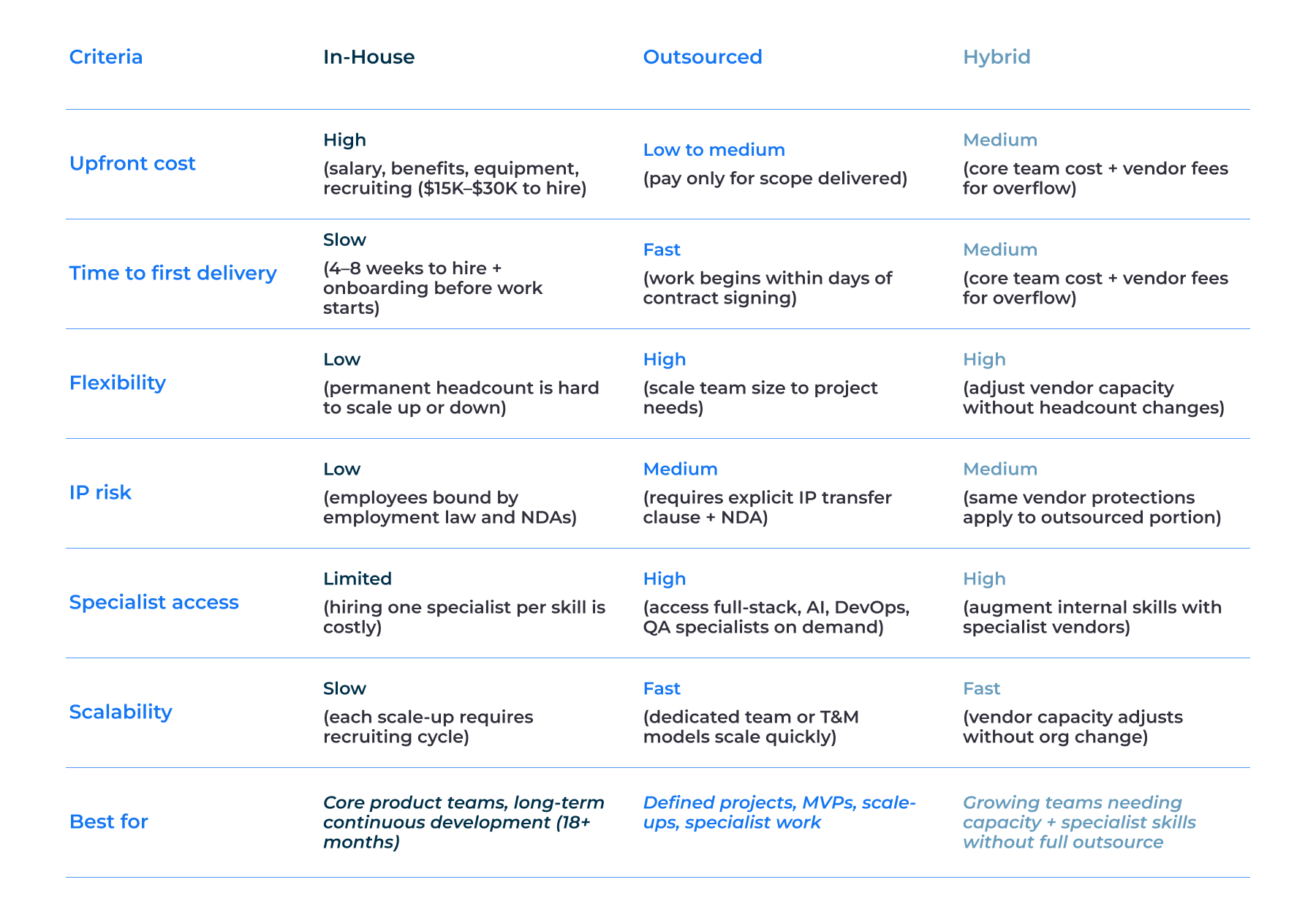
Outsource vs in-house vs hybrid: quick decision matrix
Indeed, many web app development services can be outsourced, including front-end, back-end, full-stack development, web apps, e-commerce platforms, CMS solutions, QA, and ongoing support. The table below contains a hybrid and in-house vs outsourcing comparison and helps shed light on the situation:
Web Development Outsourcing Models: Which One Fits Your Project?
Unfortunately, there isn’t a universal outsourcing model that works for any project. The right choice depends on how you define your needs, how long it will last, and how much effort you’re ready to invest in team management. To help you pick out, we’ve prepared a simple breakdown of different models.
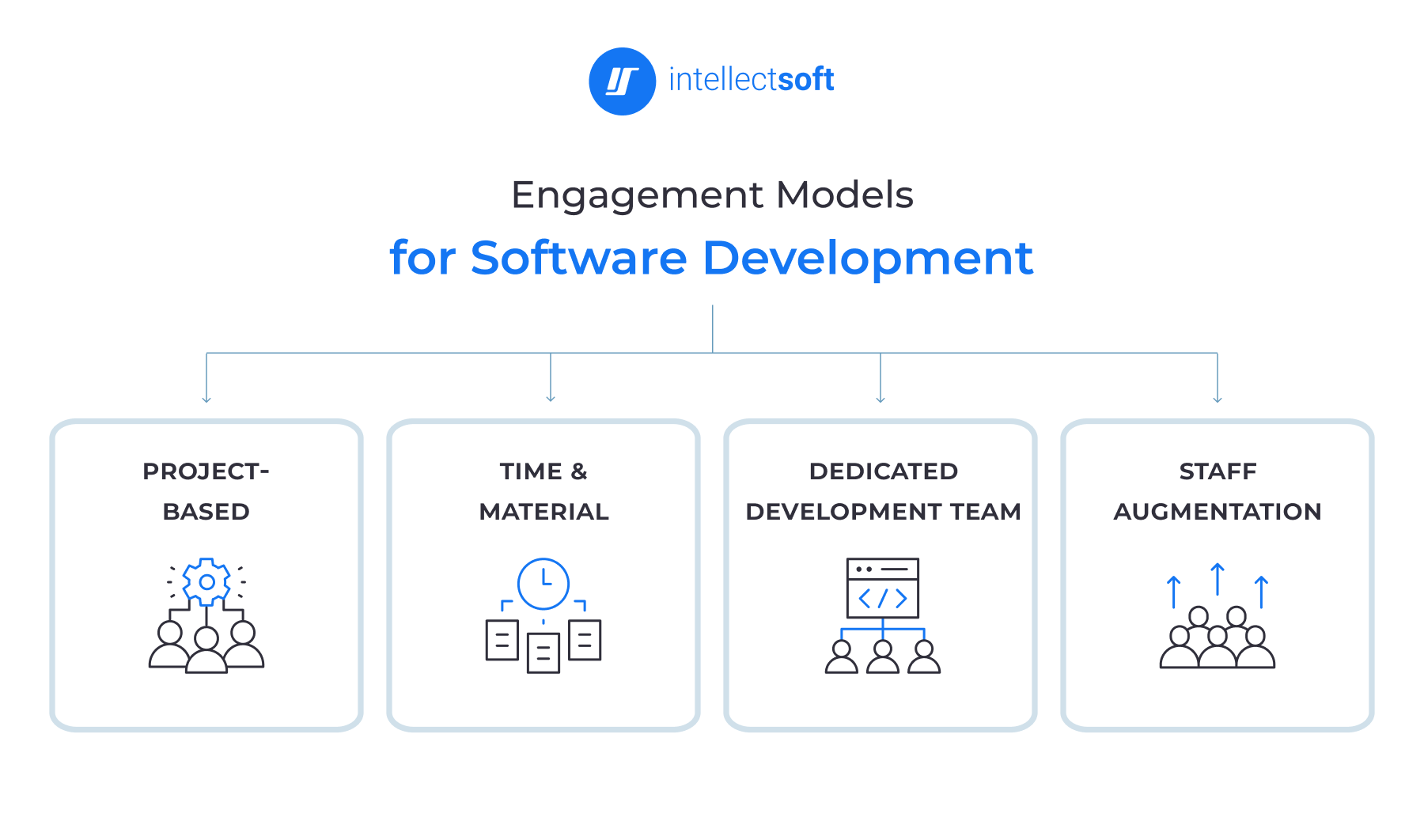
Project-based (Fixed price)
A fixed-price project is an outsourcing pricing model in which you agree on the scope, timeline, and cost for the full work in advance. It suits projects with clear requirements, such as MVPs or e-commerce websites. The reason: you can set the budget up at the start. Of course, updates during website development are possible, but they involve extra estimates and costs.
Time & materials (T&M)
T&M is an outsourcing approach where you don’t have a fixed project price. Instead, you pay only for the actual time and resources spent on development. Your staff works in sprints, and the scope can change if your business scales. This is the best option for web apps with changing requirements, long-term products, and projects that need a sustained discovery. T&M is a flexible model, but you need to regularly monitor the budget and key priorities.
Dedicated development team
A dedicated development team is an engagement model in which you get a long-term, reliable team that works exclusively on your product. The web outsourcing company manages their crew, and project control is on you. That’s a wise choice to hire dedicated development team, especially if you need a SaaS product or an enterprise solution that needs continuous development. No doubt, you’ll need to stay involved, but in return, you’ll get a stable, reliable, and flexible system.
Staff augmentation
IT staff augmentation is when you scale up your internal team by adding external developers and managing them as if they were in-house. You hire specialists through a vendor, but ownership and control remain with your team. You can pick this model if you need to fill specific skill gaps, manage capacity spikes, or support your in-house experts. Management is on your side, but you get full control over the work.
How Much Does It Cost to Outsource Web Development?
The key question is not the cost of IT outsourcing web services. The real question is whether outsourcing web development is more cost-effective than building an in-house team.
Salary is the only cost item that comes to mind. But add here recruitment, onboarding, and bonuses – and boom… you’ll get an astronomical sum. We broke down hourly rates by region to help you plan your budget for your custom software development.
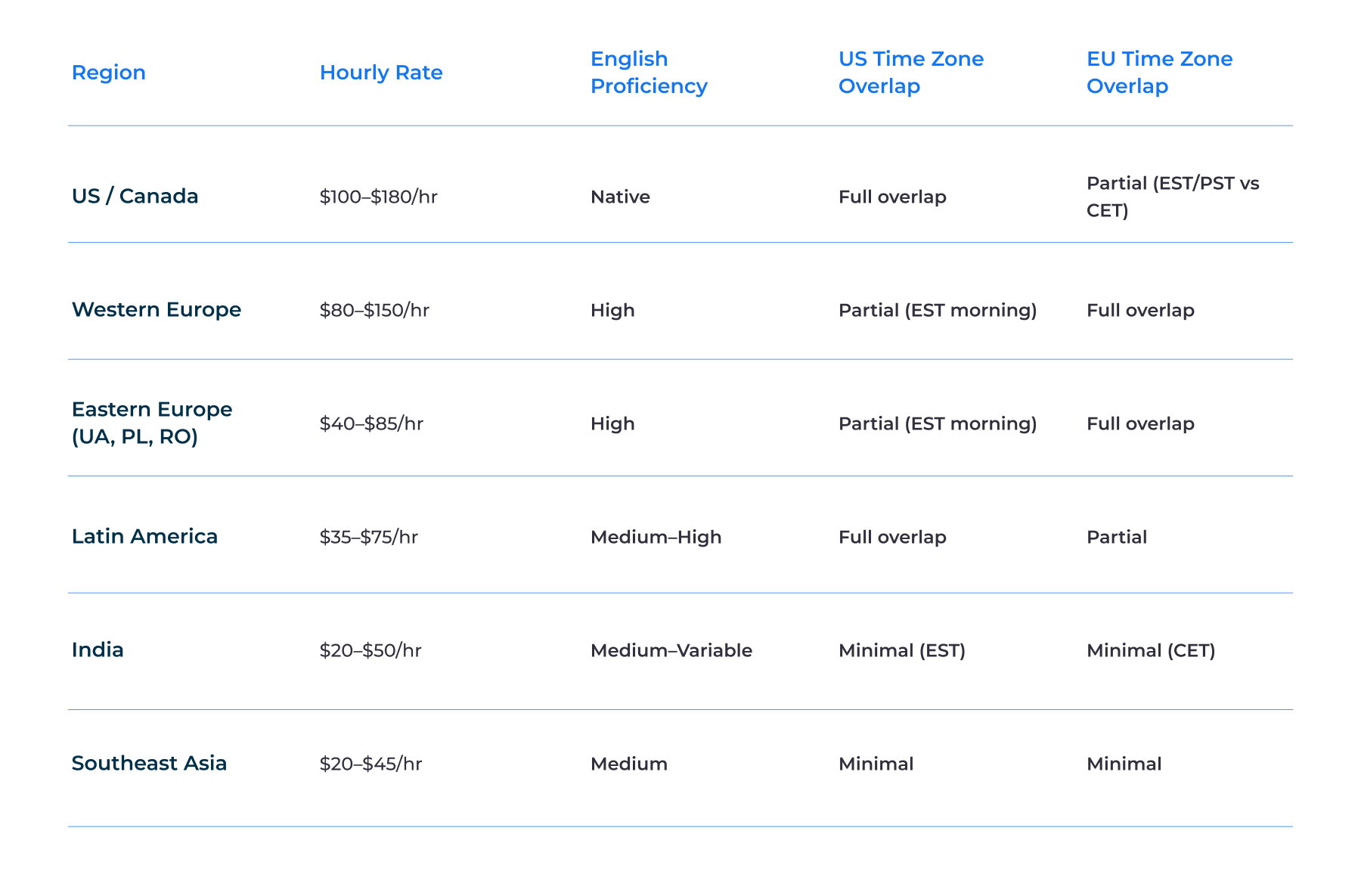
Hourly rates by region
Geography, experience level, and delivery model – these are factors that strongly affect hourly rates for web development. Yes, it’s difficult to calculate the budget exactly according to them. But we offer the table with typical market rates across different regions. So you can see what is within your budget.
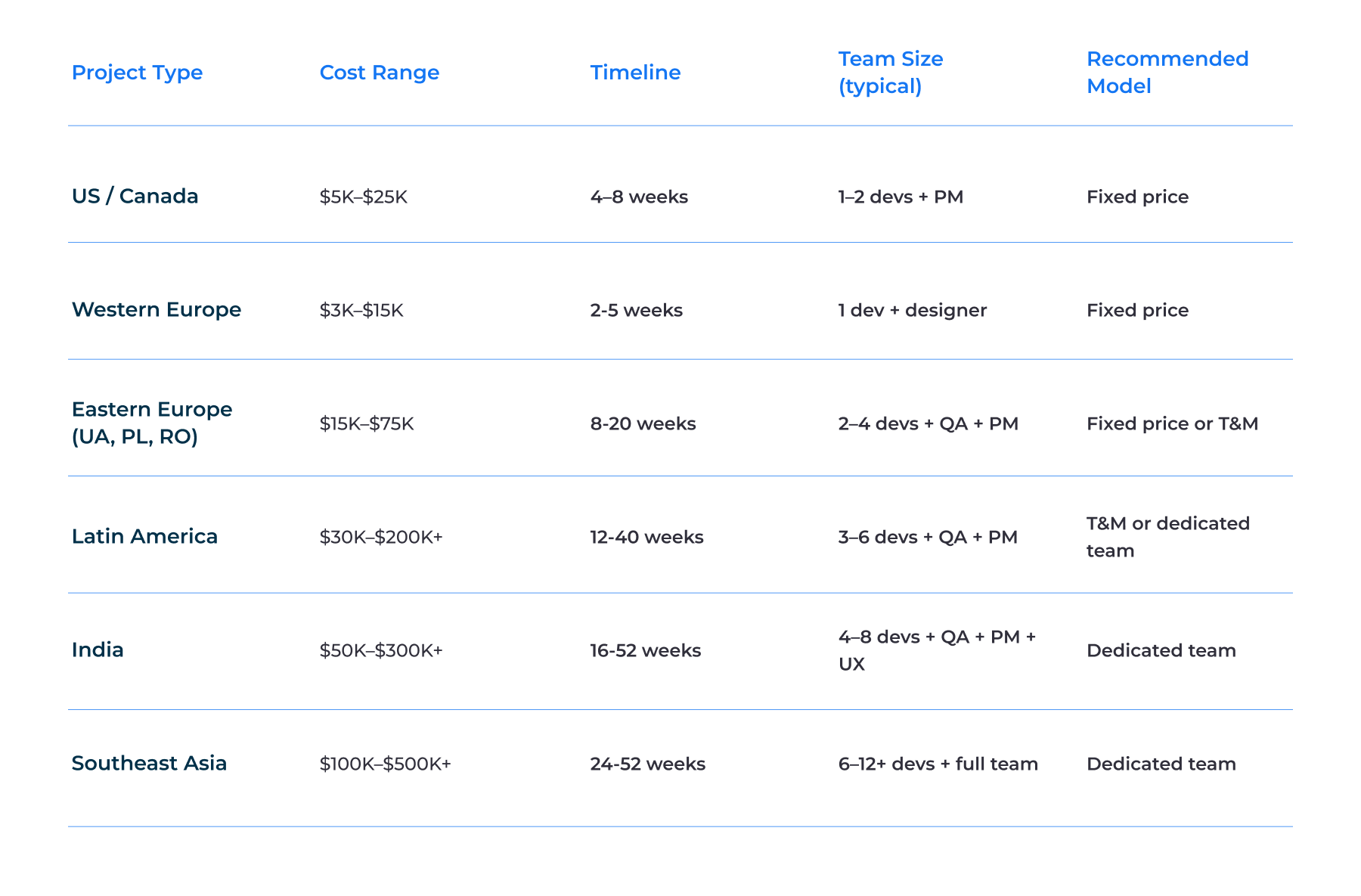
Project cost ranges by type
Your web solution type also affects how much you’ll invest in the development. If this is a complex system with many integrations, your budget should be large. That’s why we prepare the table with website development cost ranges for common web development projects.
Hidden costs to plan for
You’ve found a reputable provider with rates lower than the market average. Web application development starts, but soon you realize the final price is much higher than expected. Testing comes as an extra charge. Post-launch support is not included either.
Unpleasant surprises, right? Especially if you weren’t warned about them before the start. Here’s a list of hidden web app development costs that some vendors may not mention, but we always inform our clients:
- Project management time: You hired a vendor to save time, but that doesn’t mean you can stay aside. Even if you get a fully managed team, find 5-10 hours per week on reviews and interaction.
- QA and testing: Testing is a must for high-quality software. As a rule, it covers 15-20% of the project budget. Make sure QA is included, and you don’t need to pay extra at the end.
- Infrastructure and hosting: Web development billing doesn’t always cover cloud services, such as AWS, Azure, or GCP. That’s why, before signing the contract, make sure this cost item is within your current budget.
- Documentation and handoff: The base project scope doesn’t always include technical documentation. Architecture documentation, API guides, and deployment instructions — all this should be included in your budget.
- Post-release support: In the contract, you need to mention a warranty period for bug fixes and improvements after your product launch. The guaranteed time should be at least 30 days.
- Knowledge transfer: Things may happen that you decide to change vendors or delegate web development to your in-house team. For this, ask for extra time for code reviews, documentation checks, and knowledge transfer.
- Change requests: Even with a fixed-price project, this won't save you from hidden costs. For instance, you may need to add a new feature. That’s why set aside 10-15% of your budget for unplanned changes.
How to Outsource Web Development – Step by Step
Two companies decide to outsource web development. One launches on time and stays within budget. The other faces delays, unplanned expenses, and rework. What’s the difference between them? They made distinct decisions before starting development.
The great news: you can avoid these issues if you better plan the development process. Having built more than 200 web solutions, we want to share the eight steps we follow with our clients to achieve a successful partnership.
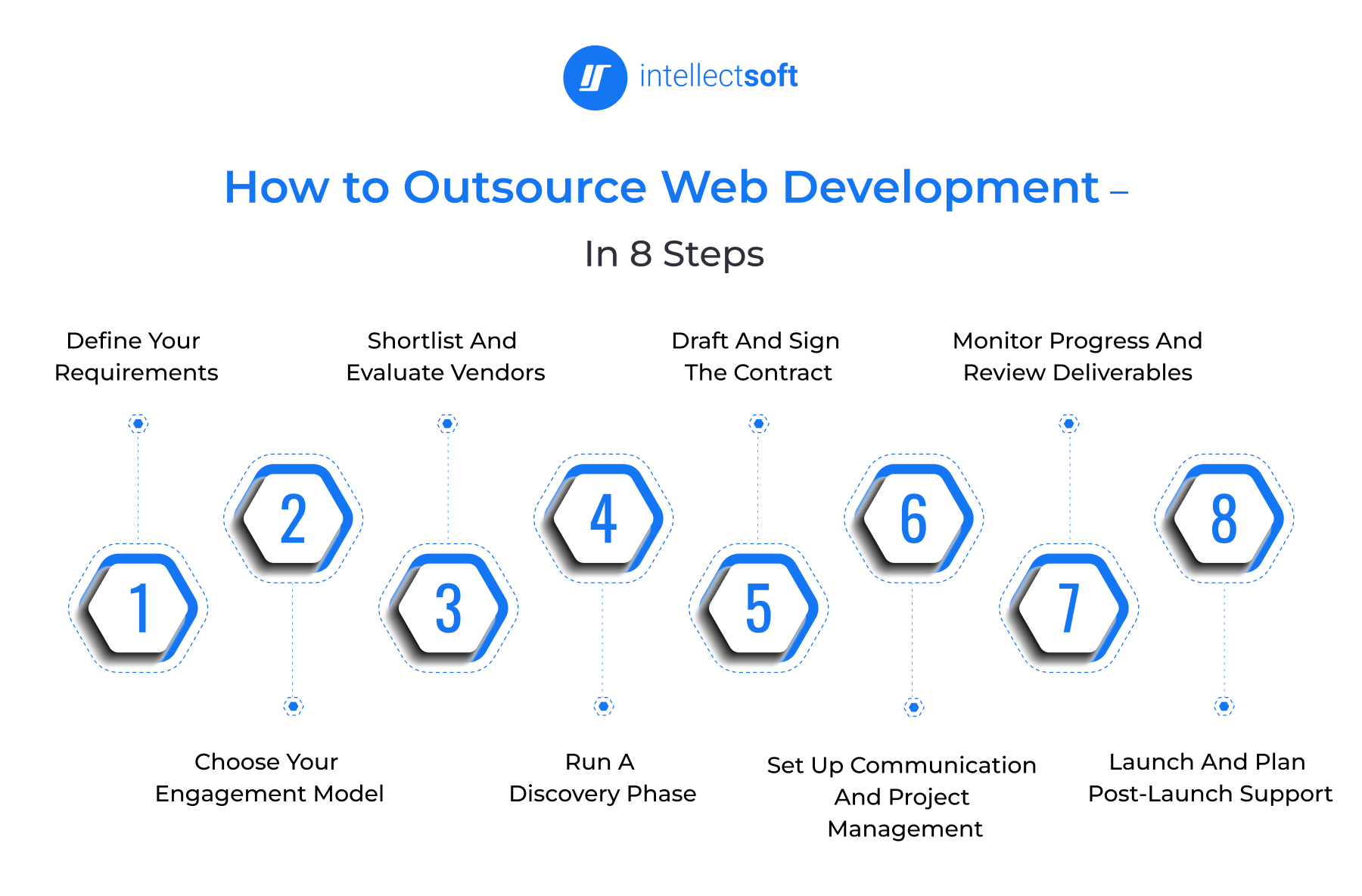
Step 1: Define your requirements
Before you begin your development journey, take time to define what you want to build and the business needs you want to cover. List your key features, budget, timeline, integrations, and success criteria – all of this is needed to share with your potential vendor. You should remember that the clearer your requirements are, the more accurate the estimates will be and the fewer hidden costs you’ll reveal in the process.
Step 2: Choose your engagement model
It’s high time to decide how you want to team up with your vendor. If your scope is well-defined, choose a fixed-price model. If you plan to modify something, the best option for you is Time & Materials. But if your product requires long-term development, request a dedicated team. Plus, we strongly recommend starting with a discovery phase if you’re not sure about the final result. Your choice of engagement model affects your team structure, budget, and delivery process.
Step 3: Shortlist and evaluate vendors
Don’t be in a hurry and don’t choose the first vendor you find. We understand your euphoria, but stay reasonable and create a shortlist of 3–5 companies to compare them using your project requirements. Look at their experience with similar projects, tech expertise, team structure, and communication style – all of this will lead to more confident decisions. If you’re still having doubts, ask for client references and detailed proposals.
Step 4: Run a discovery phase
Of course, you can skip a discovery phase and jump into web development. But indeed, the discovery phase can save you time and money later. At this stage, you can verify your requirements and define user journeys. Plus, this is a great opportunity to choose the right tech stack and consider the risks. Yes, you’re postponing development for 2-4 weeks. But better to wait and do it wisely rather than make costly mistakes. It's a great idea to book the first business technology consulting to clarify the key moments.
Step 5: Draft and sign the contract
Now it’s high time to draft and sign the contract. And this step is more than a formality. It protects both sides and helps prevent disagreements later. That’s why your contract should define the project scope, payment terms, code ownership, warranty period, change request process, and exit terms – all of which help regulate relationships with your vendor. Pay special attention to IP ownership and confidentiality clauses. Better consult with your legal team before signing.
Step 6: Set up communication and project management
Before starting development, agree on how you will team up with new staff: the tools for project management, communication, documentation, and progress tracking. It’s a good idea to define meeting schedules and escalation paths. All of this helps avoid confusion and keep the project on track.
Step 7: Monitor progress and review deliverables
To evaluate your project's success and see results, don’t wait until the project’s end. It’s risky. Request access to the PM board to track progress across all stages in real time. It’s on you to review and approve work at the end of each sprint. This is the best way to fix problems at the beginning, not to turn them into a poor-quality product.
Step 8: Launch and plan post-launch support
Product release is not the end of the project. Before launch, you need to discuss how your product is supported, fixed, and scaled. And who will assist with this task? You should know that in the event of crashes or drops, your problems will be resolved promptly.
How to Choose the Right Web Development Outsourcing Company
Let’s imagine the situation! Two companies start the same project. One chooses the right vendor and delivers on time. The other picks the wrong outsourcing partner and deals with delays and rework. But how to understand whether you’ve chosen a great provider if the number of them is skyrocketing?
The reality is that most outsourcing issues are obvious before development, during vendor selection. The main thing is to know the red flags and notice them while picking, not while working with an outsourcing vendor. Hope our criteria make your choice less painful.
10 questions to ask before hiring a web development partner
- What is your experience in our industry? Pay attention to relevant projects, not just years in business. Industry-related experience helps teams catch on to challenges and requirements faster.
- What technologies do you specialize in and why? A good provider should explain their choice of technologies and tools for your project. But if they promote their preferred tools, run away.
- How is your team structured for a project like ours? You need to know who will be involved in your project and what duties they perform. Of all people, you need to understand who builds, tests, and manages your project.
- Who will be our project manager, and how available will they be? Clear communication is a must for successful teaming up. So ask how often you will receive updates on project progress.
- Can we speak with clients who completed similar projects? That’s a great idea to ask for client references, as they can say more than a portfolio. Pay attention to communication, delivery quality, and long-term support.
- How do you handle scope changes during the project? It’s okay to change requirements. The vendor should be ready for estimating and approving new scope of work.
- What does your discovery phase include? Requirements, architecture, risks, timelines, and delivery planning – all of them are the main aspects of a discovery phase.
- How do you handle IP and code ownership? Your contract should indicate that you are the owner of all project deliverables after payment.
- What post-launch warranty do you provide? Ask how long the provider will fix in-scope bugs after release and what support options are available afterward.
- What happens if we decide to switch vendors? You need the partner with a clear handoff process, including documentation, code transfer, and knowledge sharing.
Security, IP Protection & Legal Essentials Before You Start
You’ve found the right partner, agreed on the budget, and are ready to share your product idea. But before you start web development, check that basic protections are in place. This can save you from serious legal problems later.
- Code ownership: All code, architecture, documentation, and other deliverables must belong to you. So you need the contract with all these points mentioned. Without a clear IP transfer clause, code ownership can become an issue in the future.
- NDA protection: Before sharing requirements, you should sign a mutual NDA. It should cover source code, business logic, user data, integrations, and commercial information – all that should be protected.
- GDPR and data compliance: If you handle EU user data, it’s a must to check out whether your vendor has GDPR certification. You should also sign a Data Processing Agreement (DPA), as this is the way to regulate how data is used and protected.
- Repository access: Give outsourced developers only the access they need in tools like GitHub or GitLab. Also, agree in advance on how access is removed when someone leaves.
- Code escrow: Imagine your vendor goes out of business in the middle of your project. If you plan a long-term partnership, storing your code with an independent third party is the guarantee that you can still access it and continue development if needed.
Why Companies Choose Intellectsoft for Web Development Outsourcing
You’ve found talented developers. Our congratulations! But that’s not the only criterion for choosing the right outsourcing web development company. Indeed, you need a team that understands your needs and builds quality software. Plus, these people should know how to manage risks and scale a product when your business grows.
That’s why companies choose to outsource web developers from Intellectsoft. We help projects move faster, stay on track, and avoid costly surprises – thanks to our skilled engineers and a proven delivery process.
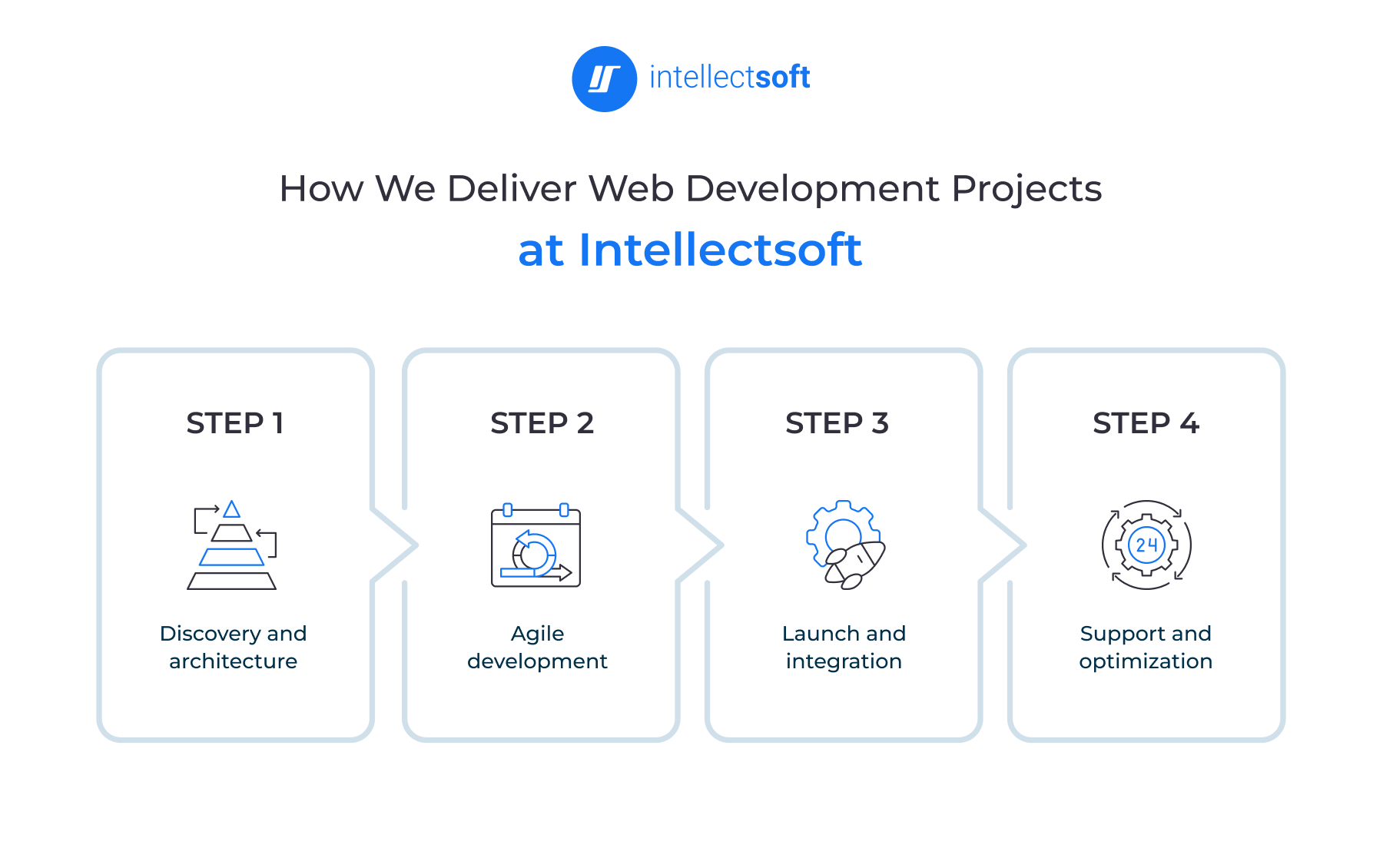
Step 1: Discovery and architecture – first we discover, then we build
Our outsourced web development team starts with a structured discovery phase. We don’t skip it, as this is the stage where we align technical requirements with business needs. As we are engineered to scale, we are focused on high-quality architecture. How can you move forward without a robust, flexible foundation and the right tech stack?
Step 2: Agile development – we work in sprints and deliver step by step
We work in short, controlled sprints with regular demos and feedback loops. To keep quality, our QA carries out continuous code quality review. We involve stakeholders to ensure we’re moving in the right direction. Client’s needs are at the heart of our software development.
Step 3: Launch and integration – we release without downtime
Before release, we run performance testing, security reviews, and final system validation. All this is needed to avoid system crashes. Plus, our clients expect seamless integration with existing apps, and we deliver it because we care about balanced, synchronized work. The goal here is to guarantee stability and launch with no disruption to business operations.
Step 4: Support and optimization – We keep your product stable and fast after launch
After your product release, we guarantee continuous monitoring, upkeep, and support. Should you require additional upgrades or further scaling of your solution, our dedicated web development team is always ready to help. Your product is in reliable hands to stay fast, reliable, and robust.
Seeking a web outsourcing team? Talk to our experts, we’ll help you pick the right engagement model and delivery setup for your product.
FAQ
What does it cost to outsource web development services?
Your outsourcing budget rests on the project complexity, scope, and vendor. The rough estimates: $5,000–$25,000 for a standard website and $30,000–$200,000+ for a custom web application. The hourly rate for software development in Eastern Europe ranges from $40 to $85.
What is the best country to outsource web development?
Your project's needs and requirements can define which location to choose for outsourcing. If you strive for premium-quality services and a shared time zone, Eastern Europe (Ukraine, Poland, and Romania) is a great option. But if you need a maximum economy, opt for India. Latin America software outsourcing will be your perfect choice if you expect nearshore alignment.
How do I protect my IP when outsourcing web development?
How do I protect my IP when outsourcing web development?
Before sharing project details and your data, sign an NDA and include a clear IP transfer clause in the contract. Plus, you should also control access to the code database and define the offboarding process when you finish.
What is the difference between outsourcing and staff augmentation?
In web development outsource, you hand over a project or function to an external company that manages the team and delivery for you. In staff augmentation, you scale your in-house team with extra developers. And you’re responsible for managing their work.
How long does it take to deliver an outsourced web development project?
Basic websites – 4-8 weeks
Web applications – 3-6 months
Enterprise platforms – 6-18 months
Discovery phase – 2-4 weeks
What web development services does Intellectsoft offer?
As a web development outsourcing company, Intellectsoft offers a range of web development services: custom web application development, e-commerce solutions, enterprise portals, UX/UI design, AI-integrated web development, dedicated development teams, staff augmentation, and ongoing maintenance and support.
