Key Takeaways
- Think of healthcare inventory management systems as a running ledger: what's on each shelf, which lot, and when it goes bad.
- A med-surg floor, an OR, and a GP practice don't lose things the same way, and healthcare software has to know that.
- If nobody scans at the point of use, the inventory counts are fiction by week three.
- Rules differ by country: DSCSA, DEA and UDI in the US, CD registers and GS1 codes for NHS trusts.
- In our experience, a messy item master sinks more healthcare inventory management projects than any hardware choice.
- A custom build for one unit starts near $75,000, or roughly £60,000, and grows from there.
Care providers in the US and UK are turning to healthcare inventory management software for one plain reason: guessing at the shelf has become expensive.
In 2025, US healthcare facilities spent 9.9% more on medical supplies and 13.6% more on drugs. Total expenses, by comparison, rose 7.5%, per the AHA's Costs of Caring report. Drug shortages add another layer for healthcare buyers. ASHP and the University of Utah counted 227 active drug shortages in the second quarter of 2026, the third quarterly rise in a row.
The UK numbers are newer. On NHS Supply Chain's own estimate, more than £1 billion of product sits on NHS shelves. Its in-trust inventory management program, now live in 19 trusts across 83 locations, had saved £15.3 million by April 2026. Waste and overstock drove most of it. Each trust also gets back roughly 700 clinical hours a year. At one trust, operations canceled for lack of kit fell from several a month to one in seven months.
Most healthcare facilities still can't see their own shelves. They find out when something runs out, or when it quietly goes out of date in a back room. Below, we look at the problem the way a healthcare software development team would: features, compliance, integrations, and budget.
What Is Healthcare Inventory Management Software?
Healthcare inventory management software keeps a running record of what a healthcare provider owns and where it physically sits. Expiry dates too. When a nurse pulls the last pack of 4-0 sutures, the software notices and reorders before anyone has to go looking. Three classes of inventory move through it: medical supplies, medications, and equipment. Nobody witnesses a gauze count, yet a fentanyl count needs a second signature and an infusion pump mostly needs to be found. Generic stock tools, built for retail rather than healthcare, miss all three. Inventory management software for healthcare is built around those rules, not bolted onto a warehouse app. In NHS trusts, much of this sits alongside NHS Supply Chain ordering and the trust's finance system.
Inventory management vs supply chain management software
| Aspect | Inventory management | Supply chain management |
|---|---|---|
| Main question | What do we have, where, and is it safe to use? | What do we buy, from whom, at what price? |
| Scope | Storerooms, units, pharmacy, OR, clinics, point of use | Sourcing, contracts, purchasing, distribution, payment |
| Key records | Quantities by location, PAR levels, lot and expiry, usage per patient | Item master, contracts, POs, invoices, vendor performance |
| Main users | Nurses, pharmacy staff, OR and storeroom teams | Supply chain, procurement and finance teams |
If your gaps sit in the right-hand column, you're shopping for healthcare supply chain management software instead.
Why Hospitals and Clinics Invest in Healthcare Inventory Management Systems
Medical supplies and drugs took more than a fifth of spending at US healthcare facilities in 2025, according to the AHA's 2026 Environmental Scan as reported by Becker's. Most of that money passes through shelves nobody counts in real time. Here's where better hospital inventory management pays back first.
Fewer stockouts and less hoarding
A nurse who finds an empty bin twice will start a private stash of supplies. Multiply that across a unit and the official counts stop meaning anything: spend climbs while recorded usage looks flat. Live counts in a hospital inventory management setup break that habit. Hoarded packs drift back to the shelf over time, and PAR levels finally reflect what the unit uses.
Less waste from expired products
Short-dated stock rarely announces itself. Most teams find it at the quarterly count, long after the date passed. Expiry alerts move that moment up by weeks. With first-expired-first-out picking turned on, the handheld scanner tells whoever is restocking exactly which lot to pull. For implants, a lapsed date means disposal and sometimes a delayed case.
Accurate charge capture and cost per case
Every billable implant or tray that leaves a shelf without a scan is revenue the healthcare provider never sees. Point-of-use capture ties each item to a patient encounter or procedure. Billing picks it up from there. Finance gets something rarer too: case costs built from what was actually opened, not from a surgeon's preference card that hasn't been updated since 2019.
Audit-ready records
How long did your last biennial DEA inventory take? In the UK, the pressure point is different: the controlled drugs register, which CQC inspectors ask to see. Recalls never wait for a convenient day. With the inventory management system as the source of record, lot history and discrepancy reports are one query away. Recall response shrinks from a ward-by-ward search to a list of locations.
Clinical time back to patient care
In one emergency department study, point-of-use storage cut nurses' time away from the bedside from 16 minutes to two minutes per eight-hour shift. That gain came from shelving alone. Inventory management software adds the other half: nurses stop counting bins by hand, and storeroom techs restock from scan data instead of walking every aisle. And those minutes go back to patients, which is the point.
Types of Medical Inventory Systems by Care Setting
A med-surg unit, a cath lab, and a vaccine fridge in a clinic all hold inventory, yet each one loses it differently. That's why medical inventory management software usually ships as modules per setting rather than one screen for everyone. The table shows how medical inventory systems split by setting.
| Area | What is tracked | Typical flow | Key system |
|---|---|---|---|
| Units and central supply | Med-surg consumables, IV sets, PPE | Storeroom → unit PAR → point of use | MMIS item master |
| Medications (inpatient) | Drugs by lot and expiry, controlled substances | Wholesaler receipt → cabinet restock → returns | Automated dispensing cabinets |
| OR and procedural | Implants, tissue, instrument trays, consigned stock | Preference card → case pick → usage capture | Surgical documentation module |
| Clinics and ASCs | Consumables, vaccines, in-office drugs | Reorder point → distributor order → weekly count | Distributor ordering feed |
| Equipment and assets | Pumps, monitors, beds, wheelchairs | Locate → clean → service → back to pool | CMMS |
Hospital inventory management systems for units and central supply
Hospital inventory management systems model supplies in three places: the central storeroom, a PAR location on each unit, and the point of use. Overnight, a tech scans each bin against its PAR. Central supply prints the pick list from those scans, so carts reach the unit before the 7 a.m. handoff. Two-bin units skip the count: an empty front bin is the signal. None of it works without the MMIS item master, since every pick line needs a valid item number and a price. In NHS trusts, that night-time scanning is often somebody else's job entirely: a top-up team that walks the wards against agreed stock levels.
Hospital pharmacy inventory management software
Medication stock can't wait for a monthly count, so the pharmacy module keeps a perpetual inventory that moves with each dispense and return. Most mornings, a wholesaler tote shows up. Staff scan it against the electronic invoice, restock automated dispensing cabinets on the units, and pull back anything unused. Two lists get watched closely. Short-dated vials can still move to a busier unit, while shortage items need a substitute mapped in advance. Controlled substances follow stricter rules, covered under core features. The link you can't skip is the cabinet interface, because without it, counts drift by the hour. UK trusts usually link it to electronic prescribing (EPMA) inside the EPR.
Operating room and procedural inventory
The surgeon's preference card sets the back table, and the case cart gets picked against it the night before. Implants and tissue need tighter tracking: lot, serial number, UDI, and the patient who received them. Much of this stock is consigned or bill-only, so the facility pays only after use, and a missed scan breaks the PO trail. Smart cabinets earn their keep here, logging a $4,000 implant the moment it leaves. Get the surgical documentation link wrong and the whole trail falls apart at audit. UK operating theatres run the same trail through Scan4Safety point-of-care scanning.
Clinics and ambulatory surgery centers
An ASC or a five-site clinic group rarely has anyone in materials management. Ordering falls to whoever has time, usually an office manager. So the inventory management software has to stay simple, with a reorder point per item and orders sent straight to the medical distributor's catalog. For multi-site healthcare inventory management, shared views matter more than features, because one location's overstock is another's shortage. Vaccines raise the stakes. Practices enrolled in the CDC's Vaccines for Children program must log fridge temperatures with digital data loggers, and expired doses have to be reported. Integration that can't wait: the distributor ordering feed. In GP practices, the same pressure sits on vaccine fridges, with stock ordered through ImmForm for national programs.
Medical equipment and asset tracking
One unit hides three infusion pumps while another can't find any. Meanwhile, biomed is hunting for the one that's overdue for service. Good medical equipment tracking shows location, cleaning status, and maintenance dates on one screen, plus any open recall against the model. Location data comes from tags and fixed readers, the same plumbing behind most IoT in healthcare projects. RTLS, usually BLE or infrared, gets it down to room level. Skip the CMMS feed and the screen will show a pump as available while biomed has it tagged out for repair. In UK trusts, the work sits with EBME teams, and recalls arrive as manufacturer field safety notices via the MHRA.
Core Features of Healthcare Inventory Management Software
Every healthcare software vendor deck has the same slide of features. Fine. Hospital inventory management software that works and software that only demos well look identical on that slide. The difference lives a layer down, in the data model and the rules nobody bothers to draw. That layer is what we'll walk through.
Item master and location hierarchy
Start with the boring part. Locations nest from facility to department to storeroom, then down to a single shelf or bin. Items carry units of measure, and a sloppy conversion turns a received case of 10 boxes into 10 gloves. From day one, the count is wrong. GS1 codes help (GTINs on products, GLNs on locations). Keeping the item master clean is a separate fight, and it usually belongs to your healthcare supply chain management software.
PAR levels and automated replenishment
An IV start kit flies off the shelf in the ED and barely moves on a rehab floor. That's why PAR sits on the bin. Some units count. Others swear by two-bin kanban, where scanning the empty bin's label is the reorder. Either way, requisitions get created by the inventory management system without anyone typing them up. Then there's recalculation. A PAR set at go-live is stale by flu season. Good builds suggest new levels from recent usage and leave the yes or no to the unit manager.
Barcode, RFID and point-of-use capture
Good news first: most items already ship with a GS1 barcode, so a cheap handheld does most of the work. The catch is parsing. GS1-128 and DataMatrix labels pack lot and date into the same symbol, and a scanner setup that only grabs the product code throws that away. RFID? Worth it for implants and specialty drugs, mostly inside smart cabinets. Tagging cheap consumables rarely pays back. The scan that matters most happens at the point of use, where the item meets the person in the bed and a charge. NHS teams will know this as Scan4Safety: GS1 product codes, location codes, and wristbands, scanned where care happens.
Lot, expiration, and recall management
Capture lot and expiry at receiving. Retrofitting means opening every box. After that, first-expired-first-out picking is mostly configuration, though the alert windows deserve real thought for each location. Ninety days' warning is fine for a sleepy clinic shelf. In a busy ED, it's noise. Recalls are where you find out whether any of that data was worth collecting in the first place. Good lot tracking pays off here. Match the notice by lot or UDI, and you get shelves to clear plus a list of people who already received the product. UK trusts reuse it for MHRA field safety notices and National Patient Safety Alerts.
Medication inventory and controlled substances
Drugs bring extra fields: NDC, lot, date, plus the cabinet or vault they're sitting in. Schedule II is the strict end. Counts run perpetual, down to the tablet, and cabinets get reconciled every day against what the inventory management system believes went in. Honestly, discrepancies are where most builds fall short. Each one needs a workflow with a reason code and a witness, and it shouldn't close until both are in. Get that right, and the DEA biennial inventory becomes a report you print. (Bedside barcode checks are another product entirely, usually called medication tracking software). In the UK, Schedule 2 drugs need a CD register with a running balance, kept for two years after the last entry. Most Schedule 3 drugs join them under the 1973 safe custody rules, and an electronic register has to cope with both.
Cycle counts and audit trails
One wall-to-wall count a year still passes for hospital inventory management in plenty of places. It catches almost nothing. ABC classification spreads the effort: count the expensive or high-risk A items monthly, and let gauze wait a quarter. Each inventory count spits out a variance report. Underneath sits the audit log, which has to be append-only and record who changed which quantity, when, and on what device. Let an admin quietly edit history once, and surveyors will doubt every record you show them.
Analytics, forecasting and AI
Ask a healthcare materials manager which reports they open on Monday and you'll hear the dull ones. Spend per case is usually first. Then a list of items nobody has touched since spring. Short-dated items and shortage warnings come next, the latter pulled from the FDA drug shortage database and your distributor's allocation notices. Where does AI fit? Later than vendors suggest. Train a demand model on two years of messy data, and it simply learns how your nurses hoard. Clean item IDs and a couple of flu seasons of history come first, same as in any predictive analytics in healthcare project.
Mobile apps and alerts
Storerooms always seem to end up in basements, where Wi-Fi goes to die. Offline mode isn't optional, then. The app should queue scans and sync on reconnect without posting anything twice. In healthcare inventory management, alerts need roles too. Charge nurses care about low medical supplies on their own unit. Recalls across sites go to materials management, and nobody wants every short-date ping in the building.
Compliance Requirements for Medical Inventory Management in the US and UK
A US healthcare system and an NHS trust can run the exact same storeroom and still answer to different rulebooks. This part covers what the software has to handle for healthcare inventory management. Compliance itself? That's a call for your lawyers.
US vs UK rules at a glance
| Area | United States | United Kingdom |
|---|---|---|
| Medicines traceability | DSCSA — electronic, interoperable tracing; small dispensers exempt until November 27, 2027 | No pack-level verification: EU FMD safety features stopped applying in Northern Ireland from January 1, 2025; packs carry a “UK Only” label |
| Controlled drugs | DEA, 21 CFR 1304 — initial and biennial inventory, exact counts for Schedule I–II | Misuse of Drugs Regulations 2001 — Schedule 2 register with running balance, kept 2 years; Safe Custody Regulations 1973; CD Accountable Officers |
| Medical devices | FDA UDI on device labels; capture at receipt and implant | MHRA — UK MDR 2002; post-market surveillance rules for devices placed on the GB market from June 16, 2025; GS1 GTIN usable as UDI; implant registries |
| Product and location data | GS1 barcodes common but voluntary for most supplies | NHS eProcurement Strategy: GS1 product and location codes and PEPPOL messaging; Scan4Safety point-of-care scanning |
| Recalls | FDA recalls | MHRA field safety notices; National Patient Safety Alerts |
| Data protection | HIPAA when usage data links to patients; BAA with vendors | UK GDPR and Data Protection Act 2018; DSPT for suppliers with access to NHS patient data; Cyber Essentials |
What US rules require from inventory software
| Regulation | Who it applies to | What the system must support |
|---|---|---|
| DSCSA (FDA) | Manufacturers, wholesalers and dispensers, including hospital pharmacies; small dispensers exempt until November 27, 2027 | Receive and store transaction data electronically (EPCIS), verify product identifiers for suspect product, quarantine, keep records for 6 years |
| DEA — 21 CFR 1304 | DEA registrants holding controlled substances | Initial and biennial inventory; exact count for Schedule I–II, estimated count for III–V unless a container holds more than 1,000 units; records at the registered location; loss and theft reporting (DEA Form 106) |
| FDA UDI | Device labelers; hospitals use UDI to identify devices | Capture UDI (device identifier plus lot, serial, expiry) on receipt and at implant; match recalls to patients |
| FDA recalls | All providers | Find recalled lots across every location and patient within hours |
| HIPAA | Covered entities when usage data links to patients | Role-based access, audit logs, encryption; business associate agreement with any vendor hosting patient-linked data |
| Accreditation and state pharmacy rules | Hospitals and pharmacies | Documented storage checks, expiry checks and counts under Joint Commission standards and state board of pharmacy rules |
At the receiving dock, every drug shipment now arrives with EPCIS transaction information. Your healthcare inventory management system stores it against the packages actually received, and it has to retrieve it quickly if a product turns out to be suspect. Small dispensers got another extension, to November 27, 2027, though most healthcare systems won't qualify.
UDI is the device-side equivalent. Capture the device identifier and lot or serial at receipt and again at implant. Recall matching then becomes a lookup, not a chart review. Both rules reach further upstream than inventory management, and the trading-partner plumbing behind them belongs to healthcare supply chain software.
Once a scan ties an item to an encounter, the record counts as PHI. Any vendor hosting it signs a business associate agreement. Inventory management software can support compliance with all of these, yet the healthcare organization is the one inspectors hold accountable.
UK: NHS eProcurement, GS1 and Scan4Safety
Back in 2014, the Department of Health wrote GS1 codes and PEPPOL messaging into the NHS Standard Contract through its eProcurement Strategy. Suppliers, meanwhile, were told to load their catalogs into a GS1-certified datapool. Scan4Safety pushed the same codes all the way to the bedside, which is where the software requirements get specific. First, GTIN and GLN fields. Scanning has to cover product, place, and wristband, and orders should leave through the trust's procurement platform as PEPPOL messages. One caveat: those targets date from 2014–2016. Check what your trust enforces today before you scope the build.
UK: controlled drugs, MHRA and data protection
Controlled drugs registers under the Misuse of Drugs Regulations 2001 and storage under the Safe Custody Regulations 1973 were covered in core features. Devices are the MHRA's territory. When a field safety notice lands, the inventory management system needs to find every affected medical device by lot or serial. Implant records also feed registries such as the National Joint Registry. Then there's UK GDPR. Usage records tied to a named person call for a DPIA before go-live. Any supplier that can reach NHS-held records also has to complete the DSPT every year. One spec mistake keeps showing up: FMD pack scanning, which has applied nowhere in the UK since January 1, 2025. Leave it out of the requirements.
Integrations: Connecting Inventory to ERP, EHR and Pharmacy Systems
| System | What it holds | Data exchange | Typical integration |
|---|---|---|---|
| MMIS and finance platform | Item records, contract prices, purchase orders, GL codes | Item and price updates in; requisitions and receipts out | REST API or interface engine |
| EHR / EPR | Encounters, orders, clinical documentation | Usage per encounter out, for charge capture and case costing | HL7 v2 or FHIR |
| Dispensing cabinets | Drug counts per drawer, overrides, returns | Restock pick lists out; cabinet counts back in | Vendor API |
| Supplier and distributor ordering | Medical-surgical catalogs, availability, shipping notices, invoices | POs out; acknowledgements, ASNs and invoices in | EDI (850, 855, 856, 810) in the US; PEPPOL in the UK |
| Surgical documentation | Preference cards, case schedules, implant records | Case picks out; implant lot and UDI back in | HL7 v2 or vendor API |
| CMMS | Service history, recalls against device models | Location and availability out; service status in | REST API |
| BI and analytics | Spend, usage and waste reporting | Usage, spend and waste feeds into a healthcare data warehouse | Scheduled extracts are fine here |
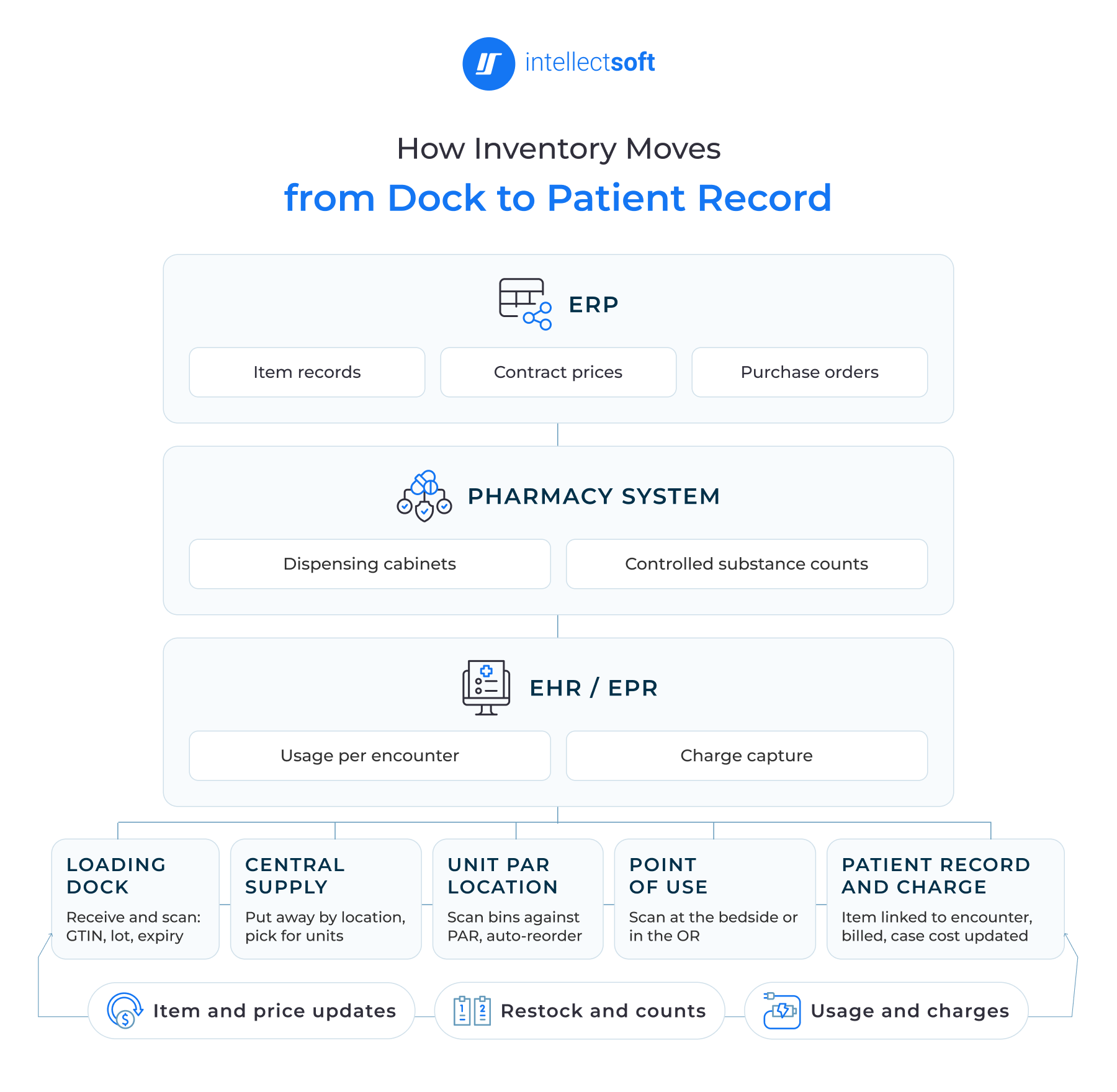
Every integration starts with one rule: each field gets exactly one owner. Most interface fights start when two platforms both think they hold the truth. In healthcare inventory management, the usual split is simple. The ERP owns item records and contract prices, because finance negotiated them. Quantity and location belong to the hospital inventory management system, down to the bin. Usage against an encounter sits in the EHR, so charges and case costs reach the right chart. Write the split down before anyone drafts an interface spec. In our experience, most EHR integration problems trace back to two platforms quietly editing the same field.
How records move matters as much as who owns them. Nightly CSV drops from the ERP look cheap at go-live. Then a new medical-surgical item gets added at 4 p.m., and nurses spend hours scanning something the inventory management software won’t recognize until morning. An API or a proper integration layer keeps changes flowing within minutes, and it logs every failed message for a retry. Reporting is the exception. Spend and waste trends can wait a day, so scheduled extracts into a healthcare data warehouse work fine. On the clinical side, expect HL7 v2 feeds for now and FHIR for newer interfaces. Supplier links run on EDI in the US and PEPPOL in NHS trusts. If your clinical record is home-grown or heavily modified, this work overlaps with EHR and EMR development more than most budgets expect.
How to Build a Healthcare Inventory Management System: Step by Step
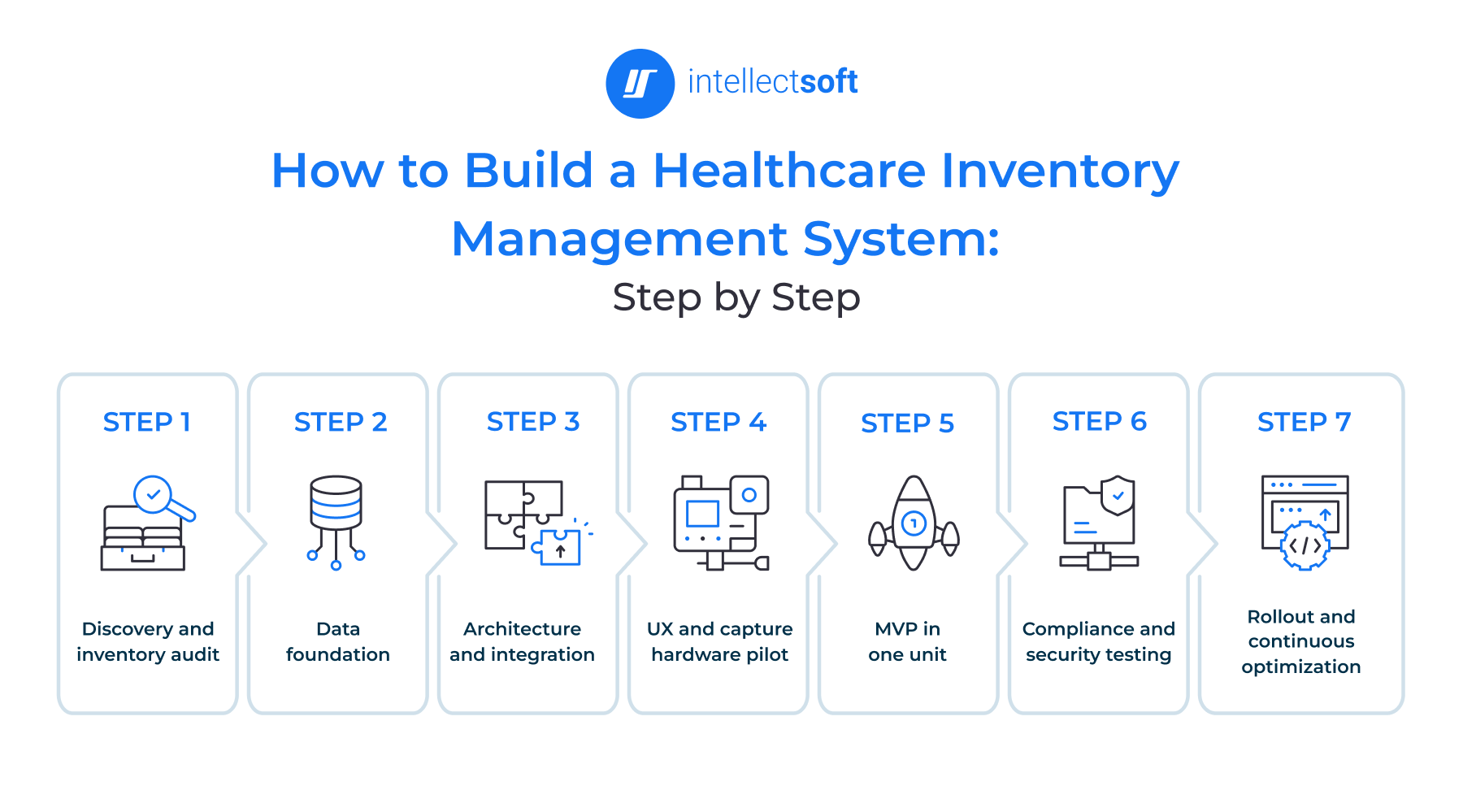
Step 1 — Discovery and inventory audit
Every hospital inventory management project should start at the loading dock. Follow one box of syringes until it's opened at a bedside, and note every place someone writes a number down by hand. Inventory accuracy and empty-bin calls give you a baseline. Finance knows what lapsed product cost. Flag every regulated item as you go, from controlled substances to implants and tissue, since they'll need stricter workflows. UK teams should open the DPIA now and check whether storerooms already carry GS1 location codes.
Step 2 — Data foundation
Most hospital inventory management projects stall here, and nobody likes hearing it. Duplicate item records and missing GS1 identifiers have to be fixed before go-live. So do units of measure, because a box the finance platform calls one unit and the nurse calls fifty will break every PAR. Build the location hierarchy in the same pass. Long-term item master governance sits with supply chain management and its tools.
Step 3 — Architecture and integrations
Decide, field by field, which system owns the truth. Prices and contracts usually stay in the ERP, and usage against an encounter belongs in the EHR. On-hand quantities are the inventory management software's job. If two systems disagree about one box of gloves, which number does the charge nurse believe? Nobody can say. Integrations come after that. Dispensing cabinets and supplier ordering go first, mostly because when they fail, the whole unit hears about it.
Step 4 — UX and capture hardware pilot
Scanners look identical in a demo. They don't at 3 a.m. in a storeroom with bad light and a nurse with gloves on. Bring a few models onto the night shift, stand next to the person using them, and time the scans yourself. Anything slower than a couple of seconds gets quietly abandoned. RFID is touchier. Metal shelves and cabinet walls swallow reads, which you'll only learn by trying. Medication-room staff deserve a separate session.
Step 5 — MVP in one unit
Pick one unit for the MVP. A busy med-surg floor works, and so does a single OR suite or the main drug room. That's where hospital inventory management system choices get tested. Run it for 8 to 12 weeks, then compare inventory accuracy, stockouts, and waste against the Step 1 baseline you took. If the numbers don't move, find out why before adding a second unit.
Step 6 — Compliance and security testing
Compliance testing starts with the reports a healthcare inspector would ask for. US builds need DEA inventory reports and DSCSA lookups that actually match what's on the shelf. NHS buyers add CD register checks and DSPT evidence. Pen tests and access reviews are routine. The more revealing exercise is a mock FDA or MHRA recall on a lot nobody warned the team about. Does the audit trail keep up? Teams that skimp on QA and software testing here usually pay for it in the first audit.
Step 7 — Rollout and continuous optimization
After the pilot, hospital inventory management teams should recalculate every PAR from real usage. The levels you guessed at go-live will be wrong, sometimes badly. Then expand, one site or healthcare setting at a time, and keep tracking the same three numbers. Analytics can switch on after a few months, while forecasting waits until the healthcare inventory management system holds a couple of years of clean history.
How Much Does Healthcare Inventory Management Software Cost?
Budgets for medical inventory software swing wildly, mostly because "inventory" can mean one clinic shelf or forty sites. The ranges below come from our broader breakdown of custom software development cost, mapped to the scope a healthcare build usually lands in. Some teams never need a build at all. A vendor module works well when workflows are standard, and the custom software advantages and disadvantages mostly come down to how far yours sit from standard.
Indicative cost by scope
| Project scope | US cost | UK cost | Timeline | Main cost drivers |
|---|---|---|---|---|
| Single-setting MVP (one unit or clinic group, barcode, ERP sync) | $75,000–$145,000 | £60,000–£115,000 | 3–5 months | Number of locations; one or two integrations |
| Hospital-wide system (PAR, point of use, EHR + ERP, pharmacy) | $145,000–$350,000 | £115,000–£280,000 | 5–9 months | Pharmacy and OR workflows; EHR charge integration |
| Multi-facility platform (RFID, controlled substances, analytics, forecasting) | $400,000–$2M | £320,000–£1.6M | 9–18 months | Facilities, RFID scope, AI (+10–20%), data migration |
| Ongoing costs | 15–25% of build cost per year | Same share | — | Hosting, support, rule updates, hardware refresh |
What moves an inventory management system between those rows? Each healthcare setting adds its own workflow, so units plus OR plus medication rooms is roughly three projects sharing one item master. Integrations come next. A modern platform with a decent API takes weeks, while an aging interface engine full of HL7 v2 feeds can swallow a whole quarter. Capture method matters as well. Scanning alone keeps the build lean, while tag-based capture drags in reader placement and weeks of extra testing.
Controlled-substance workflows are rarely cheap. Witness steps and discrepancy handling look small on a whiteboard and grow fast once auditors review them. More facilities mean more location trees to build and more go-lives to staff. And migration from a legacy system is the cost everyone underestimates, because nobody knows how messy the old item records are until someone opens them.
Hardware sits outside these figures. Scanners, tags, fixed readers, and smart cabinets are budgeted separately from the inventory management software itself, often from a capital line rather than IT. In hospital inventory management projects with many ORs, smart cabinets alone can rival the software spend.
All figures are indicative ranges for healthcare inventory management software, not quotes. UK figures exclude VAT.
Common Challenges of Hospital Inventory Management Systems
Most hospital inventory management systems don't fail at launch. They fade over six months, as scans get skipped and the counts on screen drift away from the shelf. The same handful of problems show up in almost every healthcare inventory management project, US or UK. Each gives off an early warning, if anyone's watching.
| Risk | Warning sign | How to prevent it |
|---|---|---|
| Dirty item master | Duplicate items, wrong units of measure, unmatched invoices | Clean and govern item data before go-live |
| Staff skip scans | System usage lower than charted usage | Two-tap scanning, scan-to-chart, pilot with nurses |
| Shadow inventory and hoarding | Stockouts in the system while closets are full | Reliable PAR levels, visible stock, count hidden locations |
| Legacy ERP integration | Manual CSV imports, overnight sync | Integration layer and a clear system of record |
| RFID read accuracy and tag cost | Ghost reads, missing items, tag spend above savings | RFID only for high-value items; pilot tag types first |
| Controlled-substance discrepancies | Open discrepancies at shift change | Perpetual inventory, enforced resolution workflow, alerts |
| UK: missing GS1 data | Products without GTINs, locations without GLNs | Use the GS1 datapool and NHS catalogue; label locations before go-live |
Dirty item master
You'll spot this one in accounts payable before anyone on the floor notices. Invoices stop matching purchase orders. Then the same suture turns up under three item numbers, and somebody receives a case of 12 as one each. Every downstream report in the inventory management system inherits the mess. The fix is unglamorous: clean and govern item records before go-live, and give one team the authority to say no to new duplicates.
Staff skip scans
Compare two numbers each week: items the inventory management system says were used, and items nurses charted. If the second keeps beating the first, people are skipping scans. It's rarely laziness. More often the scanner lives in the wrong room or needs four taps when two would do. Scan-to-chart workflows help, because one scan then updates the inventory and the clinical record together. Piloting with nurses catches most of this early.
Shadow inventory and hoarding
The screen shows an empty bin. Meanwhile, a clean-utility closet down the hall holds forty of the same item behind a door nobody scans. That's shadow inventory, and it means trust in the PAR levels has already gone. Reliable replenishment is the cure. Count the hidden spots once, so PAR math starts from what's really in the building. Then keep bins full, and hoarded supplies lose their purpose.
Legacy ERP integration
Ask how item changes reach the inventory management system today. If the answer involves a CSV someone exports at 6 p.m., you've found the problem. Overnight batches mean a new item or price change won't show up until tomorrow, and on a busy unit that's a long time. A middleware layer between the finance platform and the inventory management software solves most of it. So does a written rule about which system owns each field.
RFID read accuracy and tag cost
Tags misbehave on wards. Metal shelving bounces the signal around, and liquids soak it up. Leave a cabinet door open, and the next bay starts showing ghost reads. The other warning sign shows up in finance reports when tag spend outruns the savings it was supposed to deliver. Tags belong on implants and other high-value items worth tracking individually. Pilot two or three tag types in a real storeroom before anyone orders thousands.
Controlled-substance discrepancies
The sign is a list of open discrepancies at shift change that nobody owns. Each one is a compliance problem waiting for an inspector. They pile up when the software lets staff close a count without explaining the gap, or when alerts land in an inbox no one reads. Perpetual counts help. So does a workflow that blocks closure until there's a reason code and a witness, and escalates anything still open after a set time.
UK: missing GS1 data
Scan4Safety assumes every product carries a GTIN and every location a GLN. Reality is patchier. Smaller suppliers still ship lines without GTINs, and older wards may never have been given location codes in the first place. Start with the GS1 UK datapool and the NHS Supply Chain catalog. Then walk the building with a label printer and label every storeroom, shelf, and theatre bay with a GLN before go-live. Location tracking stays guesswork until then.
Case Study: RFID Tracking of Hospital Equipment
Challenge
In this RFID hospital equipment tracking case study, the client is a US-based provider of identification products for healthcare providers: wristbands, labels, and tracking hardware. Its customers run large, busy medical centers full of expensive medical equipment. The problem sounds simple. Staff need to find a medical device fast, then check whether it's due for maintenance before it goes back into use. Searching ward by ward wasn't an option.
Solution
The client already had a working ecosystem of devices. A handheld wand located units by their tags, and fixed readers picked up assets in a given area. A dedicated scanner and printer looked after the tags. Intellectsoft built an Android app that slotted into this setup as a support tool for day-to-day asset management. Alongside it came a web portal. There, each unit has a record with its description, current status, and full history, and teams can design custom label templates for their own assets.
Result
Every connected device is now easy to find. For the client's healthcare customers, that means devices reach the right unit when they're needed, instead of after a search. Maintenance status sits in the same record, so staff can see whether a device is due for service before they use it. That's the pattern we'd recommend to any healthcare team. Tags on high-value equipment, one shared record behind them.
Healthcare Inventory Management Software Development with Intellectsoft
We've spent 18+ years on custom software development, and healthcare work keeps teaching us the same lesson: the shelf decides whether a system succeeds. Not the demo. Our healthcare teams deliver in both the US and the UK, for clients that include 35 Fortune 1000 companies. DEA reports and CD registers are familiar ground for us. If you're scoping healthcare inventory management software, we'd start with a storeroom walk and a hard look at your item master. The asset tracking project above shows how we plug into hardware a client already owns. Our healthcare software development team can then extend what you have. Or, if nothing fits, build a medical inventory management solution from scratch as part of our custom software development services. Tell us where the counts go wrong, and we'll tell you what it would take to fix them.
FAQ
What is healthcare inventory management software?
It's the system that keeps count of everything a healthcare provider stores and uses, from gauze and IV supplies to implants. Every item carries a location, a lot, and a date. Scan one out, and the inventory count drops. Once a bin dips below its PAR, a reorder goes to central supply or the distributor without anyone filling in a form.
What is the difference between inventory management and supply chain management software in healthcare?
One watches the shelf, the other handles the buying. Inventory management software answers the nurse's question: what do we have, and can we use it? Contracts and vendors belong to healthcare supply chain tools. In hospital inventory management, the two meet at the item master and rarely anywhere else.
What features should hospital inventory management software have?
Honestly, the boring ones. Ask any materials manager, and they'll mention a clean item master before they mention dashboards. PAR levels should update from actual usage. Scanning has to happen where the item is opened, at the bedside or in the OR. Lot-level recall matching and witnessed controlled-drug counts come next. Forecasting can wait.
How does a medical inventory system use barcode and RFID?
Barcode tracking handles nearly everything, and RFID is kept for the expensive stuff. Most GS1 labels already encode product, lot, and date, so one scan at receiving or at the bedside captures all three. Tags are pricier per item. That's why they end up on implants and specialty drugs, usually in smart cabinets that read a whole shelf in one pass.
What should a medication inventory management system track?
Track every drug by NDC, lot, expiry, and exact storage spot, whether that's a cabinet drawer or the vault. Controlled substances go further. Counts are perpetual, and a discrepancy can't close until someone gives a reason and a witness signs. US sites pull the DEA biennial inventory from it, and UK trusts keep their CD register there too.
How much does it cost to build a healthcare inventory management system in the US and UK?
Somewhere between $75,000 and $2 million, which is why scope matters more than any average. A single-setting MVP sits at $75,000–$145,000, a facility-wide build at $145,000–$350,000, and a multi-facility platform from $400,000 up. UK equivalents run roughly £60,000 to £1.6 million before VAT. Hardware is extra, and so is AI (another 10–20%).
Which UK rules apply to medical inventory management in NHS trusts?
Four sets, roughly. On the buying side, the NHS eProcurement Strategy expects GS1 codes and PEPPOL ordering. Scan4Safety then takes those codes to the bedside. Controlled drugs answer to the Misuse of Drugs Regulations 2001, and storage rules for them go back to 1973. Devices are the MHRA's job. Suppliers touching NHS-held records add UK GDPR and the DSPT.
Can healthcare inventory management systems integrate with EHR and ERP systems?
Yes, and most healthcare inventory management systems struggle without both. The EHR is where scanned usage turns into a charge against the right encounter, which is why that link usually ships early. Prices, contracts, and purchase orders sit with the finance and purchasing platform instead. Before anyone writes an interface, agree on which fields the inventory management system owns.