Key Takeaways
- Public websites get most of the attention. The money in healthcare web development goes somewhere less visible: portals, video visits, clinician and payer tools.
- In the US, paperwork comes first. Every vendor that touches PHI signs a BAA. Most providers have until May 2027 to reach WCAG 2.1 AA.
- Before go-live, an NHS trust checks three documents: DTAC, a current DSPT, and a DCB0129 safety case.
- FHIR carries most EHR traffic in both markets. SMART on FHIR handles app launch in the US; NHS login handles identity in the UK.
- Most builds we scope land at $80,000–$300,000+ (£60,000–£240,000+). Then add 15–30% for regulatory work and 15–25% a year to run it.
- Ship one workflow. Expand later. Kick off vendor approvals on day one of discovery.
Some 65% of Americans logged into a patient portal or online medical record in 2024. The UK figures are higher still. The NHS App passed 42 million registrations, and in July 2026 alone people signed in almost 80 million times. So demand isn't the open question. Capacity is: can a hospital's or payer's web apps carry that load and still clear a vendor-risk review? Usually it's one line in a larger healthcare IT solutions budget. This guide sticks to the web development healthcare organizations need now. Expect app types and market rules first, then EHR connections. Cost and timeline too, with honest numbers.
What Is Healthcare Web Development?
Healthcare web development works on browser-based software systems that handle health data. The users of such systems are broad – ranging from patients and payers to clinicians and front-office staff. Portals and telehealth platforms are the most frequent requests in this space. Clinician dashboards and digital intake flows belong here too. A hospital's marketing website usually doesn't. The requirements explain why. Any app reading from Epic, Oracle Health, or EMIS has two go-live prerequisites. One is a defined integration path; the other, a complete audit trail. In the US, there's a HIPAA security review on top. UK buyers want UK GDPR compliance, and they'll expect NHS assurance as well, typically DTAC and DSPT. Then comes the cost nobody budgets for. Web development for healthcare continues after launch: monitoring, patching, and re-assessment for as long as the app is live. In practice, that makes it a healthcare software development project with a browser front end.
Types of Healthcare Web Applications
Healthcare web applications at a glance
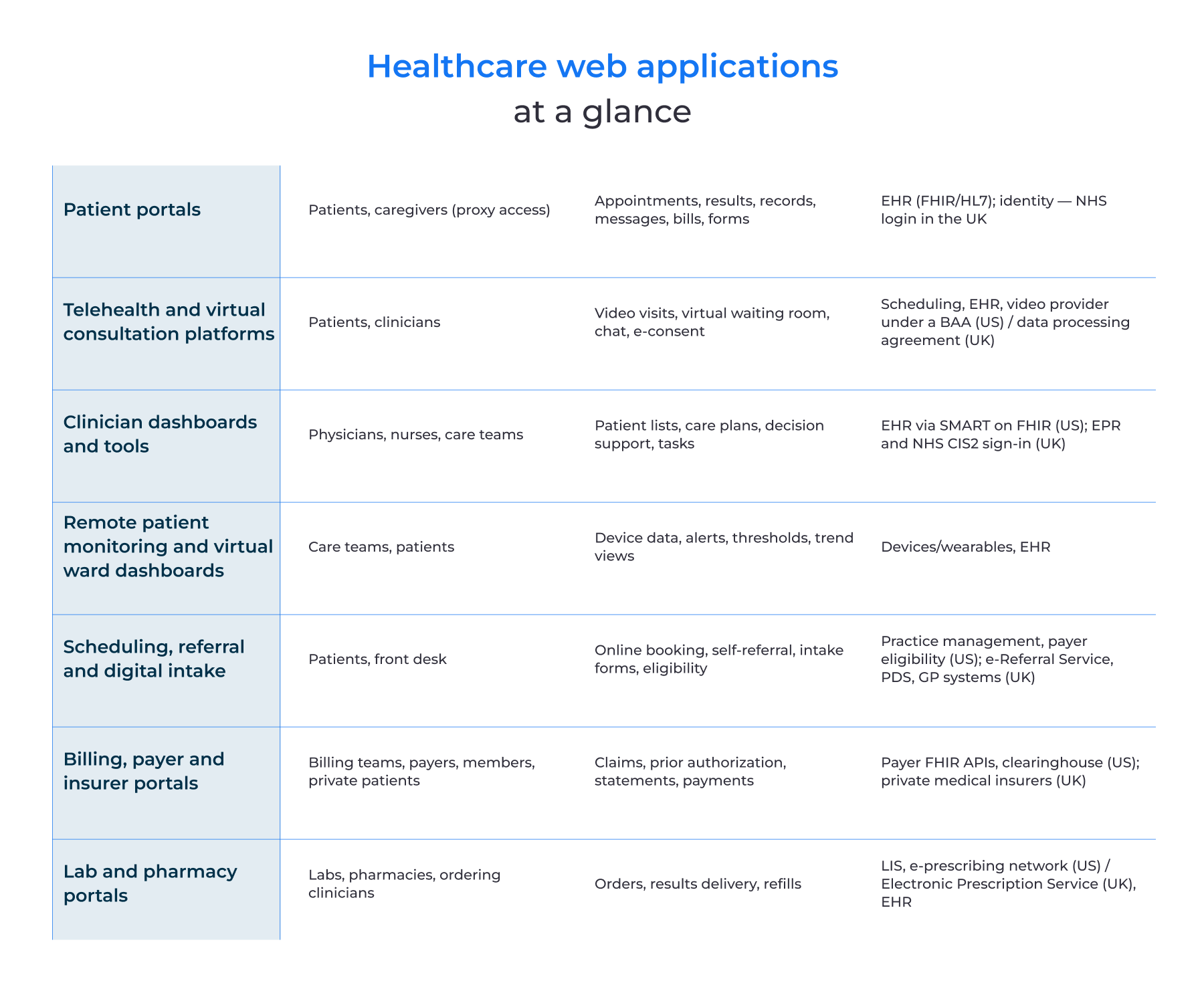
Few healthcare organizations run only one of these. A typical hospital has a portal and a video tool sharing a single login, plus a referral app on the same EHR feed. Native apps from a broader healthcare app development program sit on top. Here's what each type really involves.
Patient portals
Portal screens account for a small share of the development budget. Booking and results pages use patterns refined over a decade, and proxy access takes most of the spend. Permissions for a parent managing a toddler's account differ from those for an adult son caring for his father. Each case brings its own legal checks. Then there's the EHR feed: in US builds, usually FHIR from Epic or Oracle Health with an old HL7 v2 interface still attached. UK portals default to NHS login. Users expect to avoid yet another password. Put those two together, and you'll see why web portal development estimates often come in higher than expected.
Telehealth and virtual consultation platforms
Plenty of US clients open scoping with one question: will our existing Zoom account do? It can. The condition is a plan under which Zoom signs a business associate agreement. In most telemedicine app development projects, video is licensed. The vendor contract therefore matters more than the code. UK buyers want the same cover. For them, it's a data processing agreement under UK GDPR, and hosting location usually comes up before features do. Booking, chat, and the waiting room are routine work. Writing visit notes back to the EHR takes far longer.
Video care grew fast. With it came legal and ethical questions that product teams can't ignore. State licensing is a frequent obstacle. Take a doctor licensed only in Ohio: if the patient joins from Florida, that visit is off-limits. DEA flexibilities for prescribing controlled substances remotely run out on December 31, 2026, unless extended again. Then there's the room itself. Someone else may be listening, or the patient's condition may change mid-visit. Our standard answer is a location check at booking. Recorded consent and an emergency callback number cover the rest. British providers look to the GMC and CQC for the equivalent rules.
Clinician-facing web apps and dashboards
Nurses stop using tools that pull them out of the EHR, often within weeks. It happens more than vendors like to admit, and training is part of the problem, since staff have almost no time to learn something new. The proven fix is SSO from the EHR and role-based home screens, backed by short in-app walkthroughs. A sandbox with synthetic patient records helps too, especially for night staff who can't attend daytime sessions. After that, one champion per ward handles the rest. We followed the same thinking on an AI document processing system for a clinic. Lab reports, photos, voice notes from between appointments: it reads them all and proposes possible diagnoses. A doctor confirms every single one.
This is the purpose of SMART on FHIR. US teams launch dashboards from inside Epic or Oracle Health with a single sign-in. User, patient, open chart: the app picks all of it up on launch. NHS trusts use smartcard or authenticator sign-in through Care Identity Service 2 (CIS2), with data pulled from the trust's EPR. There's a regulatory line to watch. Recommend a diagnosis or treatment, and the FDA or MHRA may view the feature as a medical device.
Remote patient monitoring and virtual ward dashboards
A good monitoring dashboard is judged by what it hides. Put a few hundred people on blood pressure cuffs and glucose meters, and within a week you'll have thousands of readings. The care team needs maybe five. Per-person thresholds sort signal from noise. Device connectivity is harder. Older phones fail Bluetooth pairing more often than you'd expect. Cellular hubs lose signal in rural homes. Wearable vendors also change their APIs with little warning. Absorbing that churn is where IoT in healthcare meets web engineering. In the US, CPT codes 99454 and 99457 pay for reading days and clinician minutes, so expect buyers to ask how you log both. An NHS virtual ward patient is formally admitted, only at home. A missed escalation there is as serious as one on a hospital ward.
Scheduling, referral and digital intake platforms
Healthcare front desks lose hours every week to booking and intake. In the US, the booking engine pulls live slots from the practice management system. Eligibility gets checked in that same call to the payer. UK builds carry heavier back-end work. We usually connect to the NHS e-Referral Service and the Personal Demographics Service (PDS), plus GP systems like EMIS or TPP SystmOne. Each has its own onboarding. Intake answers often flow into a healthcare CRM as well. One number from our own work: for a UK dental startup with 10 clinics, Intellectsoft's booking platform cut admin time per patient by 20%.
Billing, payer and insurer portals
US payers are counting down to January 1, 2027. That's when the CMS Interoperability and Prior Authorization Final Rule reaches Medicare Advantage, Medicaid, CHIP, and federal exchange plans. Prior auth, provider access, and payer-to-payer APIs, all on FHIR, need to run in production by then. That is substantial engineering. Members never see it. They expect to check a claim and pay a bill online. Provider billing, meanwhile, still runs through clearinghouses and X12 transactions that haven't changed much in decades. Britain is different. Healthcare there is free at the point of use. Billing portals are a niche, aimed at self-pay patients and insurers like Bupa and AXA Health.
Billing portals must satisfy three sets of rules at once. In the US, that's HIPAA plus PCI DSS for card payments, with No Surprises Act estimates on top. UK projects add FCA-regulated insurers to the mix, which means more reviewers and a longer sign-off. A certified payment processor helps. It keeps card numbers out of the app entirely.
Lab and pharmacy portals
US product teams often miss one side effect of the Cures Act information-blocking rules, and patients notice it first. Lab results can hit the portal before the ordering clinician has seen them. So every value needs a reference range. It also needs a two-line explanation in plain language, for example, "slightly high, no action needed, your doctor will follow up." Without it, reception receives a wave of calls the next morning. We have seen this on live projects. Lab portals sit on the laboratory information system (LIS). Pharmacy portals mainly handle refills. In the US, prescriptions mostly go out over an e-prescribing network. Controlled substances need DEA-compliant two-factor sign-in on top. England uses the Electronic Prescription Service for that job.
Patient-facing websites that connect to your web applications
Technically, the public healthcare website is a separate product. Most users still begin there. They click "Book now" or "Sign in," or they open a pre-visit form, and each handoff carries the app's legal obligations with it. In the US, medical websites run by organizations that take federal health funding must meet WCAG 2.1 AA. That's HHS's Section 504 rule, with a May 2027 deadline for larger organizations. Tracking pixels are the second risk. They can leak PHI to ad platforms without anyone noticing, which is exactly how several US hospital lawsuits started. On the UK side, websites need PECR cookie consent. NHS bodies follow public sector accessibility rules on top of that. Our advice is to plan the website and the app as one custom web development project, which saves rework later.
Core Features of Healthcare Web Applications
Nearly every healthcare build we scope ends up with the same six features, whatever the app type. In a demo, all six look fine. Live medical records, and the auditors who check them, are the real test.
Identity, roles and proxy access
Healthcare security reviewers start with login. Clinical staff already manage many separate logins. Integration with their existing SSO, with MFA enabled, avoids adding another. Portal sign-up needs identity proofing first. According to ONC, proxy access grew from 24% in 2020 to 51% in 2024. Caregiver roles now need the same design effort as patient roles. Your role model now needs separate permissions for parents and adult children. Legal representatives get their own, each with an expiry date. UK teams have a head start here, since NHS login already covers the public and NHS CIS2 covers staff.
Secure messaging and notifications
Message storage is settled in the first architecture workshop. Messages stay on your servers. Encryption covers attachments too. Email and SMS carry only a notification of a new message. No clinical details. The same applies to push notifications, since a lock screen is visible to anyone nearby. A shared team inbox keeps replies moving when a clinician is on leave. Reply-time commitments should be agreed before launch. Revising them after the first complaint is difficult.
Scheduling and digital intake
We pull availability live from the practice management system or EHR every time a patient opens the calendar. A cached calendar eventually produces double bookings. Intake scope tends to grow. Cardiology wants one set of questions. Dermatology wants another, and each answer maps to its own EHR field. Insurance card photos require OCR that staff can trust, and on one clinic project, Intellectsoft's AI document pipeline removed manual typing from intake completely.
Records, results and document access
Every records feature starts with one decision. Cache or live fetch. Whatever you choose, the EHR stays the source of truth. Caching makes pages load faster; it also gives PHI one more place to sit outside the EHR's controls. Results bring timing rules too. Under the Cures Act, US teams can't hold them back, since unnecessary delays may count as information blocking. PDFs need their own handling. Discharge summaries often arrive as scans. So do imaging reports and the occasional referral letter from an outside medical specialist. Record the source of every file at upload, or support will spend its mornings tracing them.
Video visits
Few teams build video for medical consultations from scratch. It's a procurement decision, so we put three points to every vendor before anything gets signed. First, will it sign a BAA or a UK data processing agreement? Second, where do its servers run? Third, can it hold a call on patchy 4G in a hospital car park? With those answered, our engineers move on to the workflow around the call. Interpreters join mid-call, consent gets captured, and visit summaries file themselves into the medical record.
Audit logs and admin consoles
Audit logs rarely feature in product demos. Auditors review them first. Every view of medical information needs a record of who looked, when, and from where, and so does every edit, export, and print. HIPAA expects this. DSPT assessors want proof. They expect tamper-evident logs with multi-year retention. Support staff also need a proper admin console. With it, they can unlock accounts or fix proxy links without touching the database directly. Those admin actions get logged as well.
Healthcare Web Development in Practice: AI-Powered Document Processing for a Clinic
Here’s how it played out on a clinic project, described in full in our AI document processing case study.
The challenge
The clinic’s staff copied lab values by hand from printed reports into its software. The work was slow, and every manual transfer carried a risk of transcription errors. Doctors wrote patient summaries from memory, so their quality depended on one physician’s knowledge on a given day. There was a further gap. Medical research moves faster than a busy clinician can follow, and rare but treatable conditions sometimes went unnoticed.
The solution
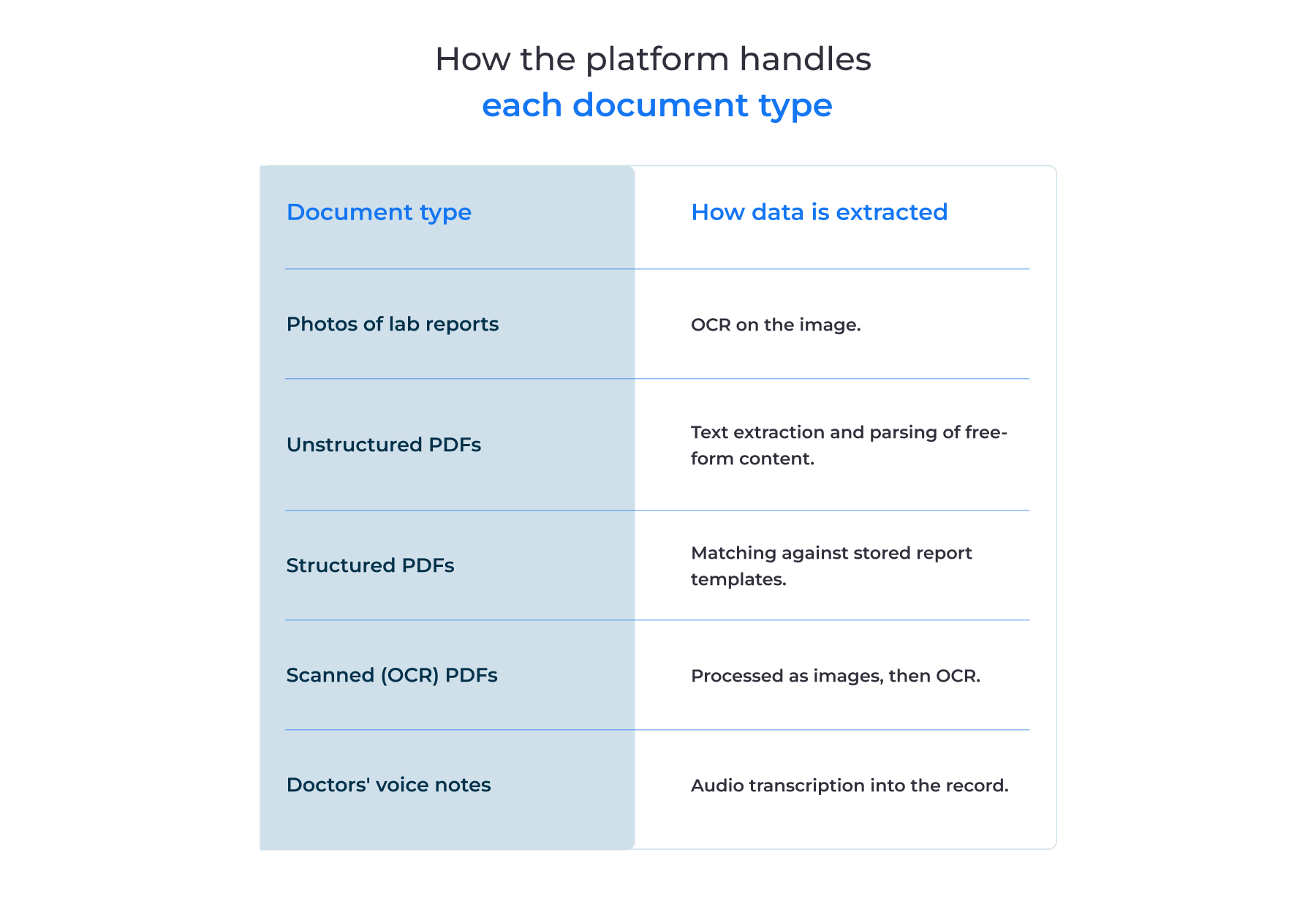
Intellectsoft built a multi-modal document processing system for the clinic. Every incoming file is classified first. The system then applies an extraction method that matches the file type, so a blurry phone photo and a template-based PDF are handled differently. Intake runs automatically. After extraction, the platform compares the values with known clinical patterns. A rare biomarker combination gets flagged as a possible diagnosis. Nothing reaches the patient record without a doctor’s review. In some cases, the flag led to further tests or a specialist referral.
The scanned PDFs needed separate handling. They look structured, but their internal layout can’t be trusted, so the system reads them as images.
How the platform handles each document type
The results
- 95% accuracy in data requests.
- 98% less time to answer.
- 40+ domain-specific questions the system was trained on.
Lab values no longer go through manual entry. Unlike a human, the system doesn’t forget medical knowledge over time. The clinic also credits it with prompting specialist referrals that might otherwise not have happened.
Compliance and Security Requirements in the US and UK
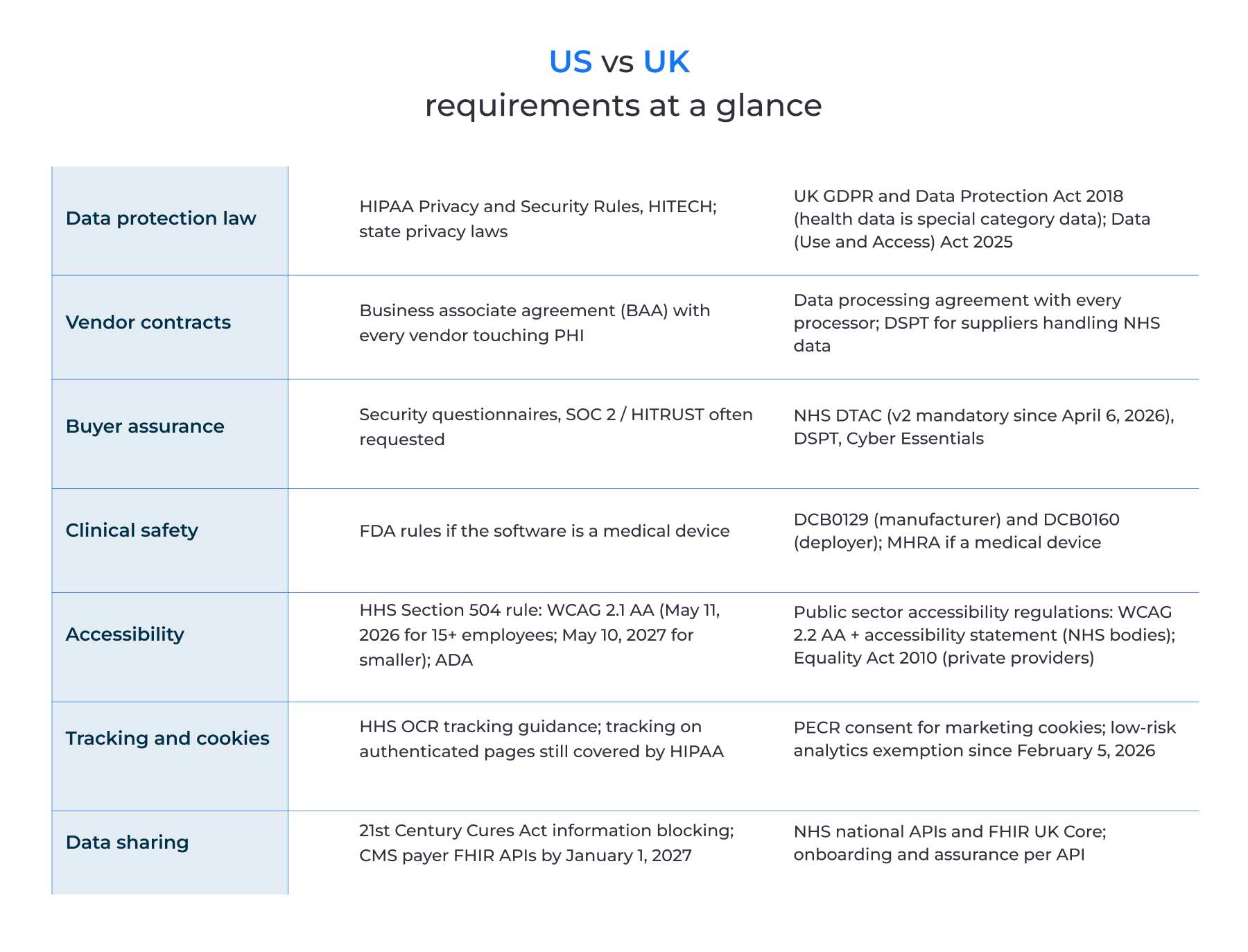
HIPAA compliance is usually the first topic a buyer raises. It is also the narrowest. The vendor-risk questionnaire follows. Some run past 200 lines, and every answer needs something real in the build behind it. Below is what a healthcare web development project must support in each market, as an engineering checklist. Final legal calls stay with your counsel.
US vs UK requirements at a glance
US: HIPAA and HITECH
HIPAA scope depends on one question. Does protected health information (PHI) pass through your app on behalf of a covered entity? A yes answer brings the app under HIPAA. Creating it counts. Storage and simple transmission count too. The 2009 HITECH Act also applies, with higher fines and mandatory breach notification. Two parts of HIPAA affect engineering teams most. The Privacy Rule governs access to records. Technical protection, including access control, encryption, and backups, falls under the Security Rule.
Contracts cause more development delays than code. Every vendor touching PHI owes you a signed business associate agreement (BAA). That includes the cloud host and the video vendor. The same applies to the SMS gateway and to any analytics script added to the portal later. One missing signature. The liability stays with your organization.
Then there's timing. HHS proposed a major update to that rule back in January 2025. Mandatory MFA and encryption. A written asset inventory. Pen tests every year. It still isn't final. OCR's own agenda points to July 2027, so on paper encryption and MFA remain "addressable." We treat both as required. Retrofitting MFA into a live portal costs far more than shipping with it.
US: tracking pixels and analytics
Ask a marketing lead and a privacy officer about pixels. Their answers usually differ. OCR published its bulletin on online tracking technologies in December 2022 and revised it later. Its target was pixels and session-replay tools, which can send PHI to Meta or Google. The American Hospital Association sued. In June 2024, a federal judge in Texas ruled largely for the hospitals in AHA v. Becerra. The guidance was vacated for public, unauthenticated pages. There, an IP address plus a visit to a condition page isn't PHI on its own.
Behind the login, nothing changed. Tracking there that touches PHI still counts as a HIPAA disclosure. Our default is strict: no third-party pixels past the sign-in screen. Need analytics anyway? Pick a vendor that signs a BAA, or move tracking server-side and strip identifiers first. The public website needs the same attention, since plaintiffs' firms monitor it closely.
US: accessibility and information blocking
Most US healthcare providers accept Medicare or Medicaid funding. That puts them under HHS's Section 504 final rule, which sets WCAG 2.1 AA for web content and mobile apps. The original deadline was May 2026. Small organizations had until 2027. Then a May 2026 interim final rule pushed both dates back by a year, giving organizations with 15 or more employees until May 11, 2027. Smaller ones? May 10, 2028.
Information blocking is about access. Under the 21st Century Cures Act information blocking rules, making it unreasonably hard for people to get their own records electronically has consequences. Developers face penalties. Providers face disincentives. In plain terms, portals and APIs have to release results and notes promptly. For new builds, we go straight to WCAG 2.2 AA. It's a superset of 2.1, and since UK public sector monitoring already tests against 2.2, one target covers both markets.
UK: UK GDPR and the Data Protection Act 2018
UK GDPR treats health information as special category data. One legal basis is not enough. You need two. A lawful basis under Article 6, and a separate condition under Article 9. For NHS bodies, that's usually public task combined with Article 9's health and social care condition. Private providers lean on contract instead. Before go-live, you'll write a DPIA, which is mandatory at this scale. You'll also pay the ICO fee and sign Article 28 contracts with every processor.
Hosting rules are less strict. They still matter. National NHS guidance allows some offshoring, yet most trust buyers expect UK hosting by default. Arguing the point slows procurement. Also watch the Data (Use and Access) Act 2025. Several of its amendments have applied since February 5, 2026, including recognized legitimate interests and new rules on automated decisions.
UK: NHS DTAC, DSPT and clinical safety
Selling to the NHS starts with DTAC. This standard NHS assessment starts with clinical safety and data protection. Technical security and interoperability follow. The final section, on usability and accessibility, gets close scrutiny from assessors. Version 2 arrived on February 24, 2026, and from April 6 trusts stopped accepting the old form. It's about 25% shorter. Its MFA and secure-by-design questions are stricter.
Any supplier with access to NHS patient records and systems completes the DSPT annually. Many trusts request Cyber Essentials certification in the same procurement round. Clinical safety requirements often surprise US teams. DCB0129 says the manufacturer (that's whoever builds the web app) needs a named Clinical Safety Officer. A hazard log and a safety case are also required. DCB0160 puts matching duties on the deploying NHS organization. NHS England reviewed both standards this summer, and feedback closed on September 11, 2026. The current ones apply until then.
UK: accessibility and cookie rules
Who pays for the build changes the accessibility rules. NHS-funded builds come under the Public Sector Bodies Accessibility Regulations. They require WCAG 2.2 AA plus a public accessibility statement, usually linked from the website footer. For private clinics and hospital groups, the relevant law is the Equality Act 2010. The Act sets no WCAG level. It requires reasonable adjustments. WCAG 2.2 AA is the easiest way to prove you've made them.
Cookie rules eased slightly this year. Since February 5, 2026, PECR hasn't required consent for analytics cookies used purely for statistics. There's a condition. The exemption holds only if visitors are informed and can opt out in one step. Marketing pixels still need opt-in. The UK has also had its own pixel incident. In May 2023, The Observer found 20 NHS trusts sending visitors' browsing details to Facebook through the Meta Pixel. Some of that data came from pages about specific conditions and appointments. It's the closest UK match to the US hospital cases.
Security controls every healthcare web application needs
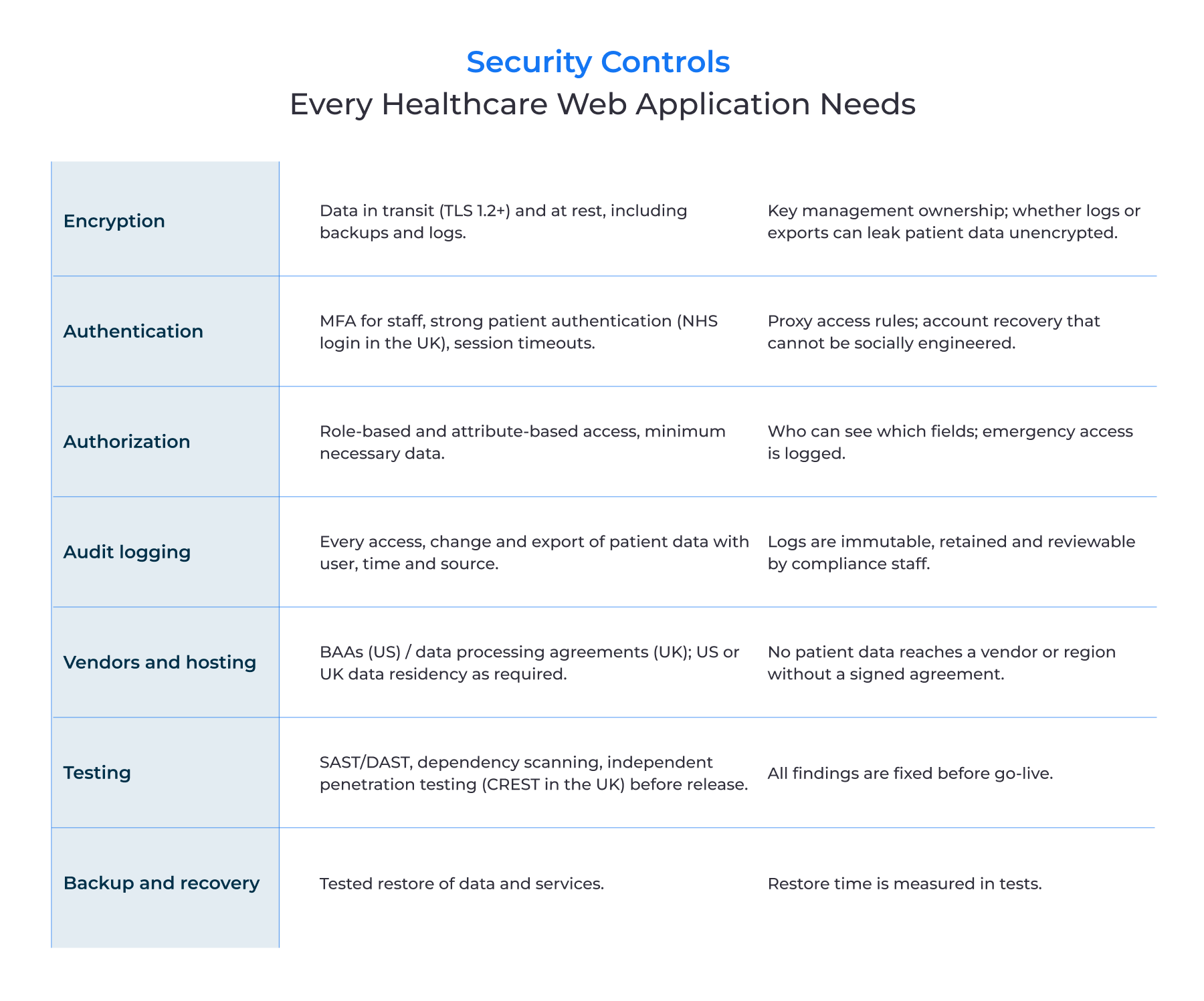
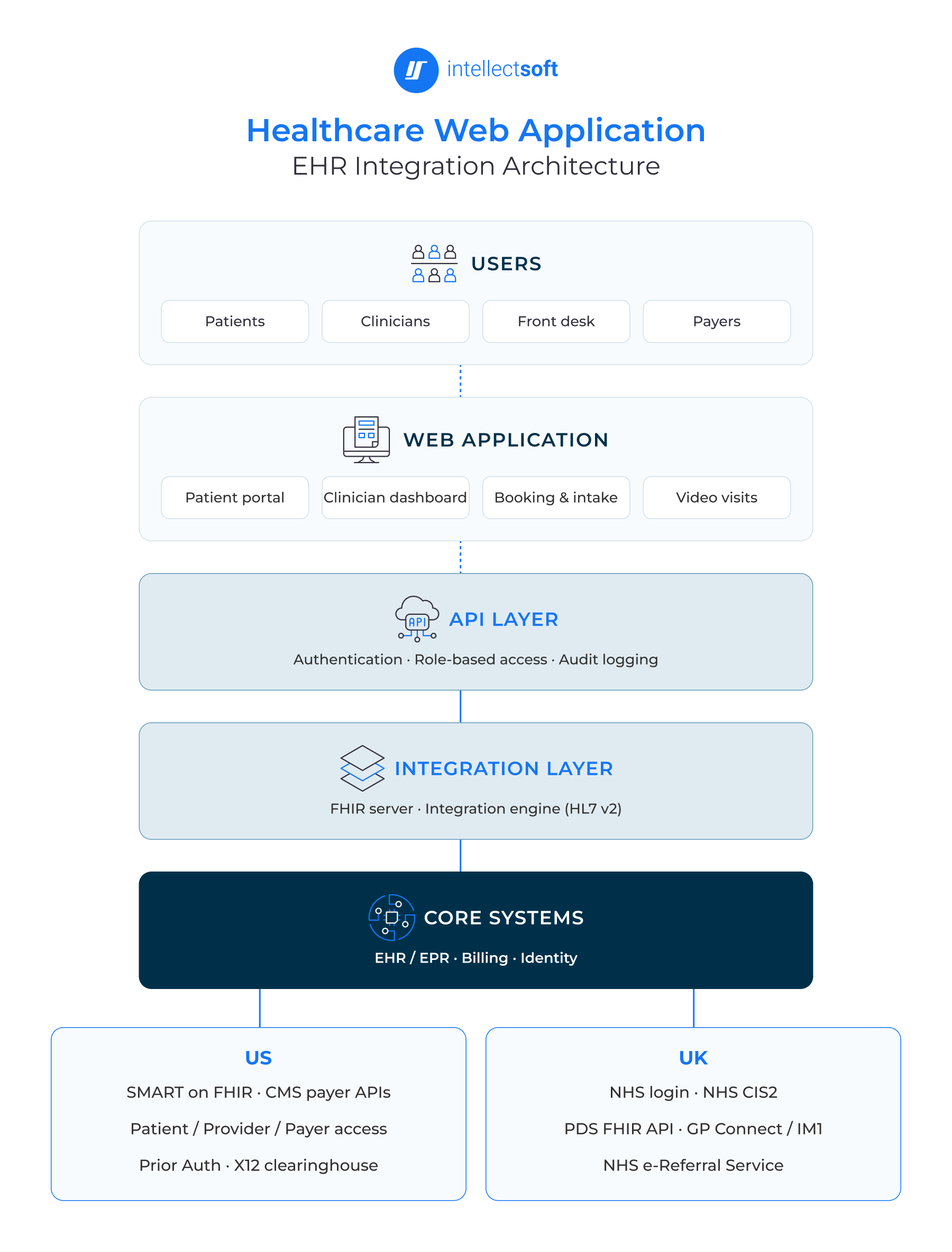
Interoperability: Connecting Web Apps to EHRs in the US and UK
Health data standards and national services
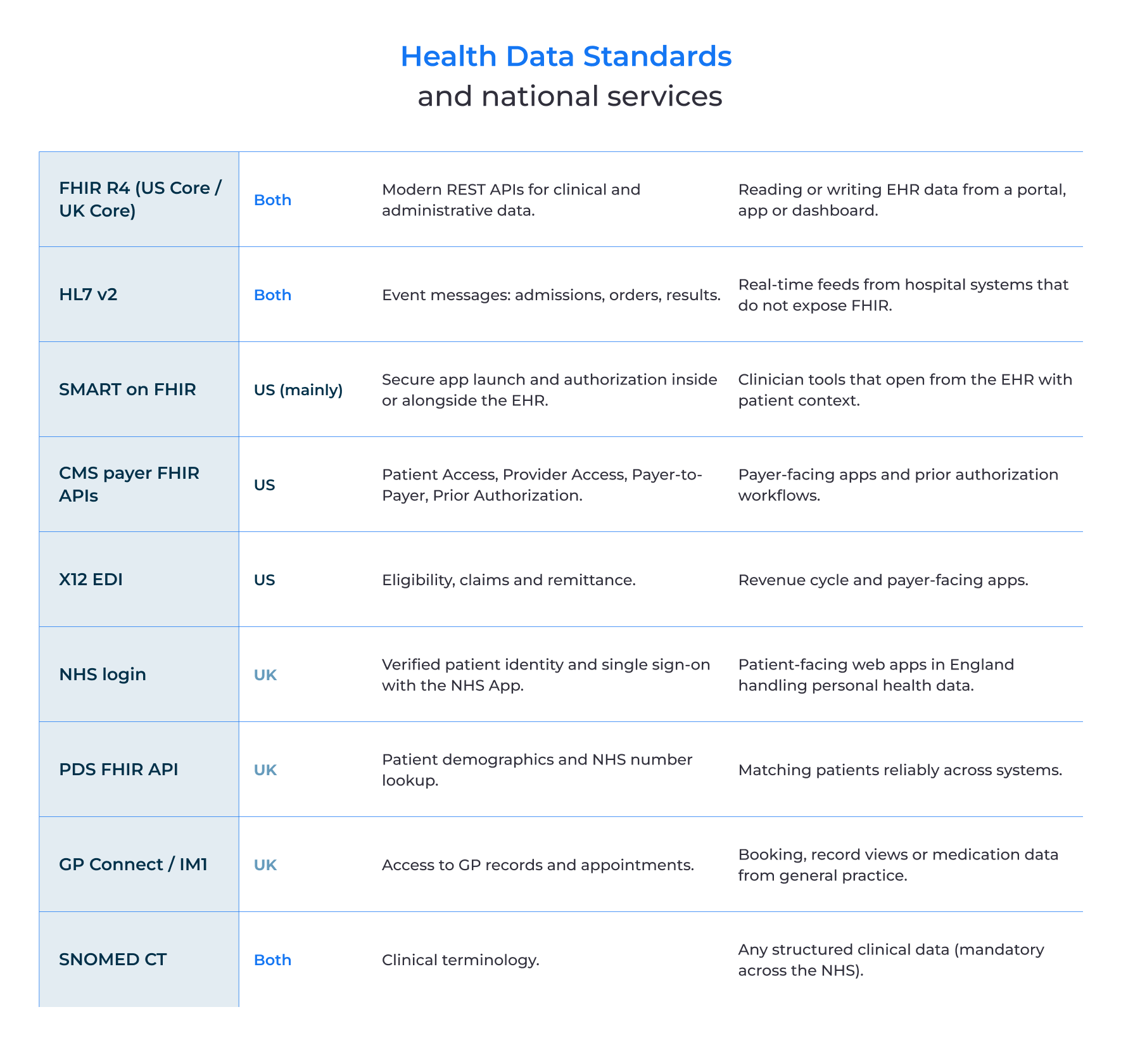
For clinician-facing tools, US projects add SMART on FHIR. From a button inside Epic or Oracle Health, the app launches with the clinician's session and the open chart. The bottleneck is the EHR vendor's own review, which on a small app can outlast the build itself. Payers face a separate deadline, set by CMS-0057-F. By January 1, 2027, impacted payers must have four FHIR R4 APIs running in production. Those are Patient Access, Provider Access, Payer-to-Payer, and Prior Authorization, each with its own implementation guide.
England follows a different model. Many services you'll connect to are run nationally by NHS England. NHS England onboards every production app before NHS login, the PDS FHIR API, GP Connect, or IM1 will accept its calls. Onboarding means conformance tests and a stack of documents. Plan for several weeks. Our teams file the first forms during discovery, long before the first line of code. One last scoping note: reading a record is a web project. Changing it moves into EHR and EMR development, which gets planned and priced differently.
Tech Stack for Healthcare Web Development
Healthcare web application stack by layer
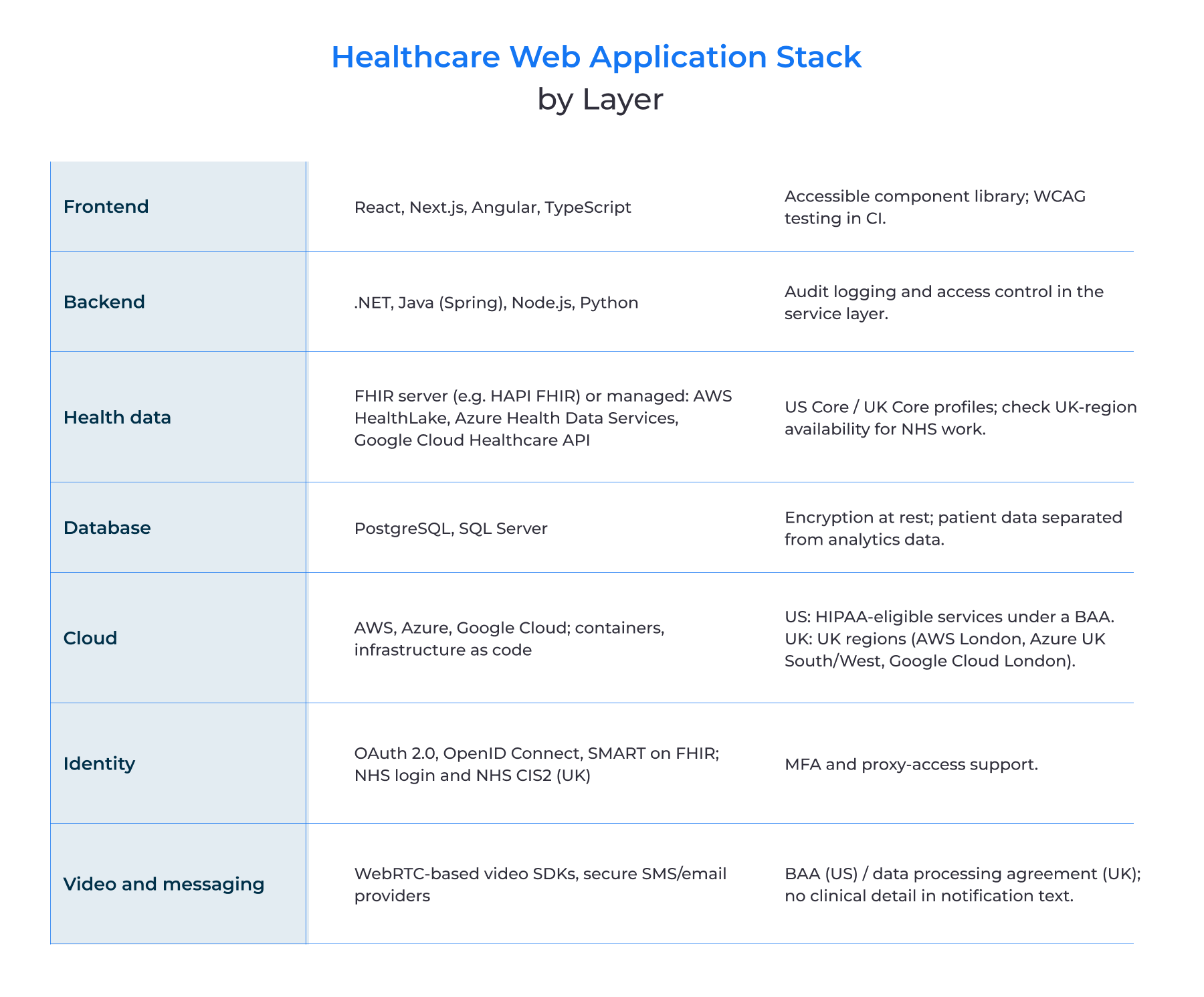
The React-or-Angular question comes up on nearly every medical web development project, and our usual answer is whichever framework your team already knows. Either will pass a hospital's vendor review, and so will .NET or Node on the back end. The decisions you can't easily undo sit lower in the stack. In US projects, each cloud service that handles PHI must be HIPAA-eligible and listed under the provider's BAA. Several AWS and Azure services fall outside that list, so we verify eligibility before adding them to the architecture diagram. NHS work looks simpler on paper. UK regions only, backups and logs included, from day one. Migrate later, and you're redoing the DPIA and explaining yourself to the trust's information governance team, which adds weeks. Identity and the FHIR layer deserve the most time. A clumsy proxy-access model or a broken SMART launch shows up months later as screens you have to rebuild. So settle both during architecture. A useful test for any provider of web application development services: ask them to explain these two decisions before they mention a framework.
Medical Web Development Process: Step by Step
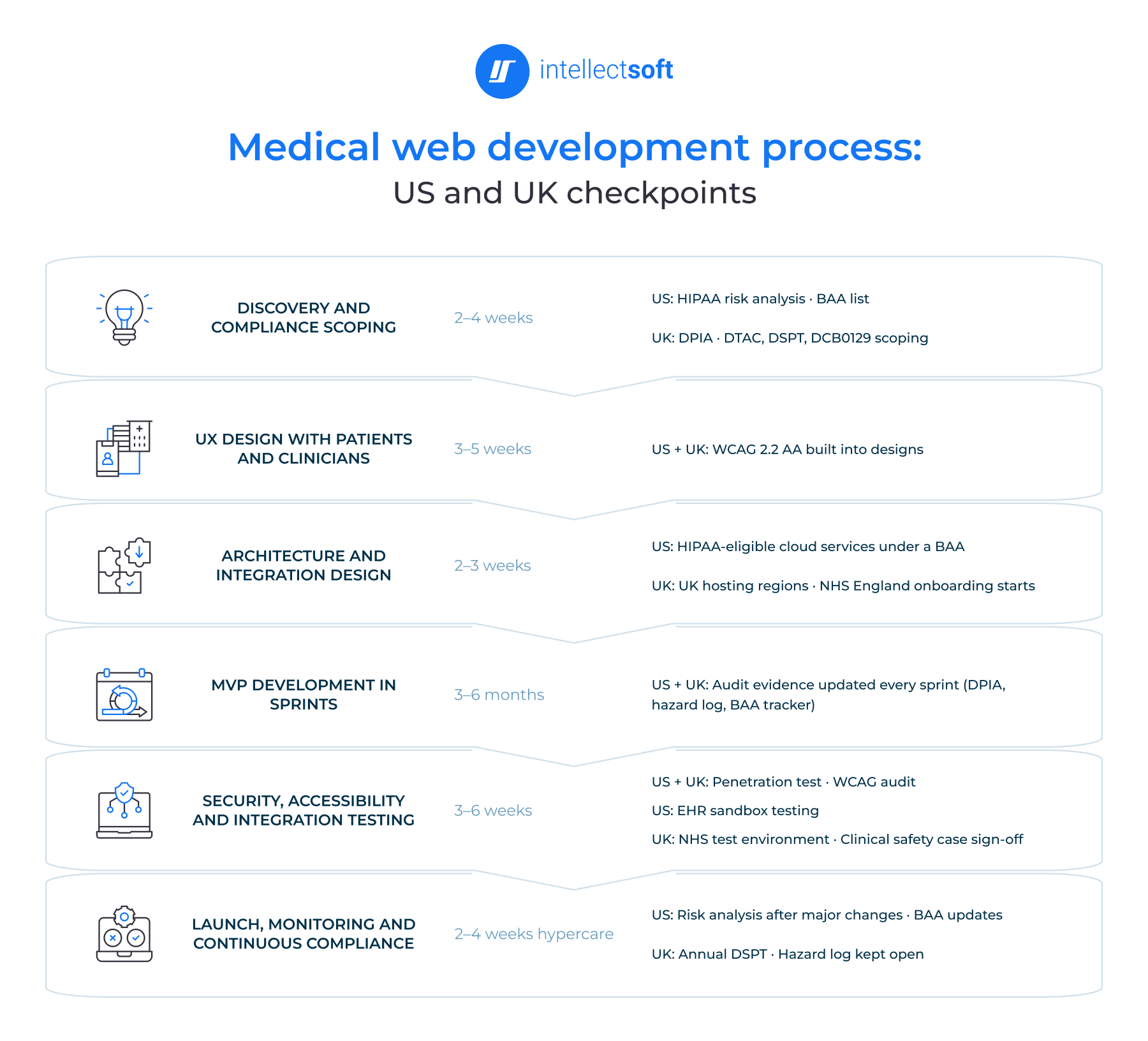
To make the steps concrete, we use a common brief: a booking and results portal for a clinic group with twelve sites. Nothing unusual about it. Most medical web development work looks very similar.
Step 1 — Discovery and compliance scoping
Discovery starts with interviews with current staff. Twenty minutes into one session, a practice manager mentioned that Fridays follow a different schedule. Billing then remembers a nightly export nobody ever documented. A doctor explains how she wants abnormal results flagged.
All of it touches PHI. So all of it gets mapped. For a US client, the map becomes a HIPAA risk analysis and a BAA list. On UK projects, the same map feeds the DPIA and sizes the DTAC, DSPT, and DCB0129 work. Only then do we put a number on paper.
Step 2 — UX design with patients and clinicians
Next, prototypes go in front of real healthcare users, and we always try to include a patient in her late seventies using an old iPad. Add a son booking for his mother through the clinic website. Then a receptionist with two phones ringing. Feedback is direct. "Where's the back button?" comes up on almost every project, usually within the first two minutes of the session.
Clinician sessions happen between shifts. Some last twelve minutes. Contrast ratios, screen-reader labels, and focus order are fixed at this stage as well, because the same corrections cost several times more after an audit. For organizations without in-house healthcare UX researchers, external UI/UX design services cover this gap.
Step 3 — Architecture and integration design
The next development sprint produces no feature code at all. Some clients find this frustrating. It pays off anyway, because hosting, identity, the FHIR layer, and HL7 v2 feeds all get decided here, along with audit logging and roles.
For the US portal, we go through the diagram box by box and check HIPAA eligibility. The UK build stays in UK regions. NHS England onboarding also starts that week, because its schedule is outside the project team's control. The output is a short architecture document that developers and auditors both read.
Step 4 — MVP development in sprints
We run development in two-week sprints. Each sprint closes with a clinician testing new features directly. The first portal release is deliberately narrow. Booking and results for one patient group, over a single EHR connection.
Some stakeholders consider that scope too small. It reaches production faster. Developers still build other workflows. Feature flags keep them disabled until clinical sign-off. The DPIA, hazard log, and BAA tracker are updated every sprint as well. As a result, the final month is free of documentation work.
Step 5 — Security, accessibility and integration testing
Testing has its own line in the development budget. It is usually larger than clients expect. An independent firm runs the penetration test. Buyers will ask to see that report. Someone on our team also does a full pass with just a screen reader and a keyboard. Automated scanners miss many issues.
Interfaces are tested against an EHR sandbox (US) or an NHS England test environment (UK). Load testing follows. What does 8 a.m. on the first Monday of flu season do to the booking page? UK launches need one more signature. The Clinical Safety Officer has to sign the safety case. Everything else can run in parallel if you bring in a specialist QA and software testing partner.
Step 6 — Launch, monitoring and continuous compliance
The first site gets a week on its own. If no critical issues appear, the next sites follow, usually two or three at a time. From then on, the development team monitors operational metrics: uptime, errors, and failed logins. It also tracks stalled interface queues and unanswered messages.
Regulatory work never really stops. In the US, the HIPAA risk analysis is revisited after major changes, and the BAA list stays current. UK teams renew the DSPT every year and keep the hazard log open for the portal's entire life. Budget for this from the start. It catches more buyers off guard than the build ever does.
How Much Does Healthcare Web Development Cost?
Cost is the first question in almost every conversation about new healthcare development work. Most healthcare web applications land between $80,000 and $300,000+ (about £60,000–£240,000+), and regulatory work typically adds another 15–30%. These ranges are consistent with our wider breakdown of web app development costs, where healthcare sits next to fintech among the most expensive verticals.
Indicative cost by scope
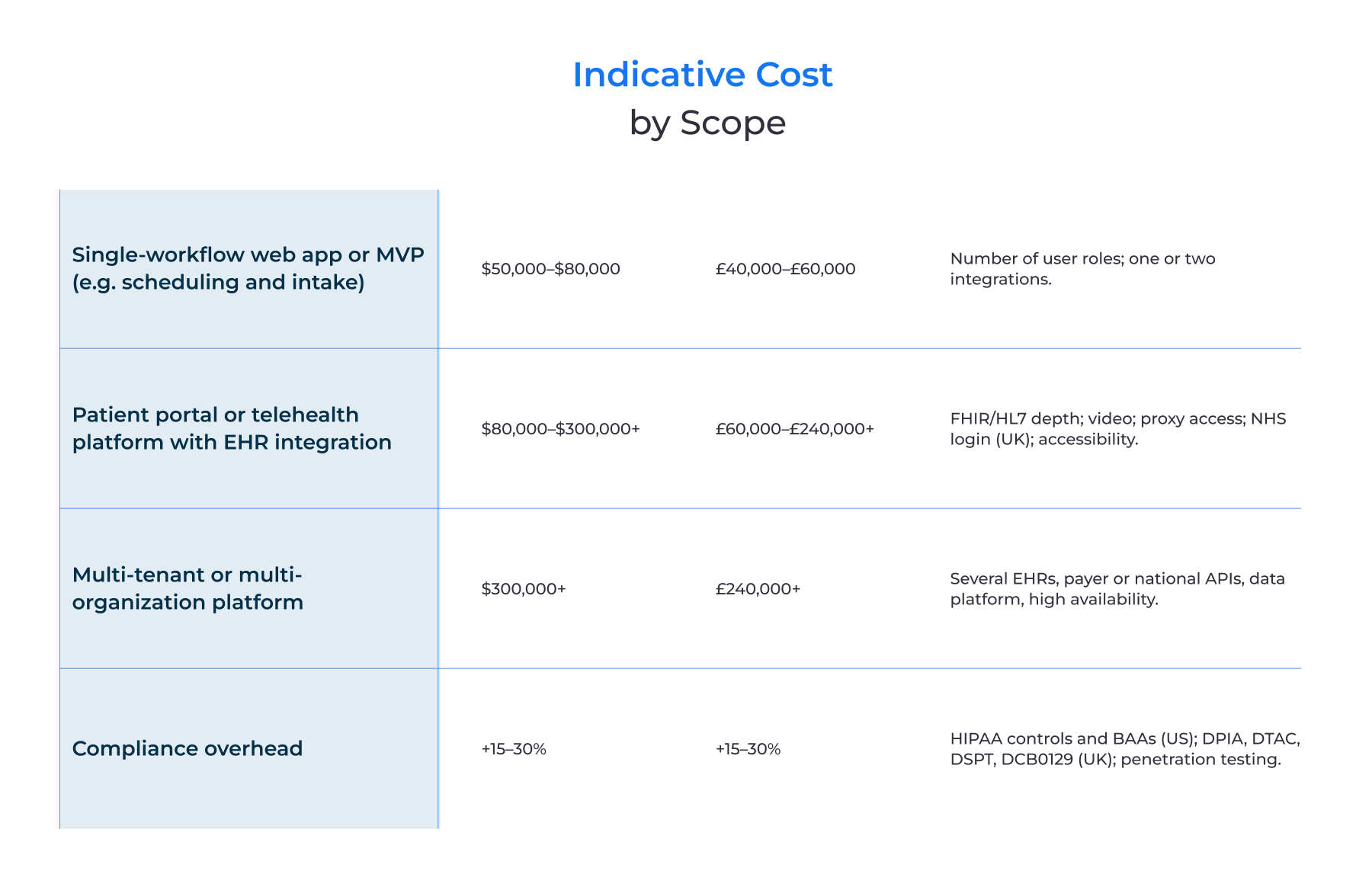
Integrations do most of the work in pushing a project from the low end of the range to the high end. One FHIR link to Epic is a very different job from three EHRs plus a payer API. Add a stack of HL7 v2 feeds, and the gap widens. User roles come second. A portal built only for patients costs less to build than one that also serves proxies, clinicians, and billing staff. Video brings vendor fees and a long tail of edge-case testing. Proper accessibility takes real design and QA hours. And data migration is underestimated in healthcare development all the time, since moving ten years of medical records out of a legacy system is slow. Rebuilding the public healthcare website at the same time? Price it separately.
UK builds come with extra line items. NHS England onboarding for NHS login, PDS, or GP Connect takes weeks, and those weeks are paid team time. Then there's the evidence work: DTAC, the DSPT submission, and the DCB0129 safety case. It needs people who've done it before. In practice, that means developers who know the onboarding process and a qualified Clinical Safety Officer.
Go back to the twelve-site clinic portal. A US version with one EHR, booking, results, and proxy access would likely land in the middle row. Add video and a second EHR, and it climbs toward the top of that range. The last row is a separate category. Once a platform serves several hospitals on shared infrastructure, the work becomes enterprise web application development, with tenant isolation and stricter governance from day one.
Time is an underestimated healthcare budget driver. A week spent waiting on an EHR vendor review still keeps a whole team on the payroll. The same goes for onboarding queues, which is why scoping those dependencies early saves real money.
Then there's the bill after launch, which surprises more buyers than it should. Hosting, monitoring, and yearly penetration tests come first. Add maintenance and UK DSPT renewals, and the total typically reaches 15–25% of the build each year. Healthcare web development budgets that leave this line out tend to get revised in year two.
All figures are indicative planning ranges and do not constitute a quote. Real numbers depend on scope, team location, and the systems you already run. UK figures exclude VAT.
Common Healthcare Web Development Challenges
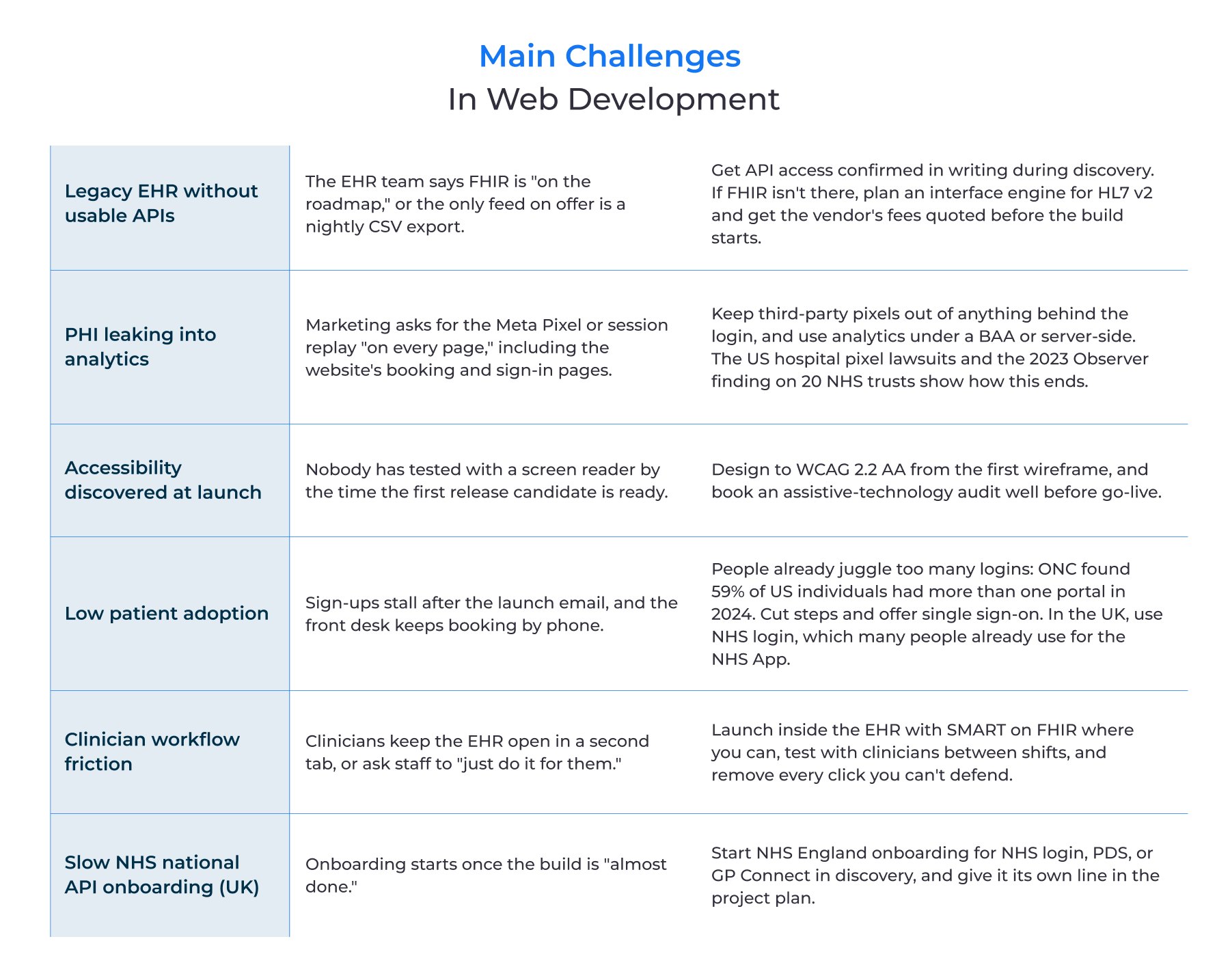
Healthcare development projects rarely fail because of code. They stall, usually on one of six recurring problems, each with warning signs that show up weeks early. Here they are, as they appear in medical web development, with the signal to watch and the fix.
Main challenges in web development
How Long Does Healthcare Web Development Take?
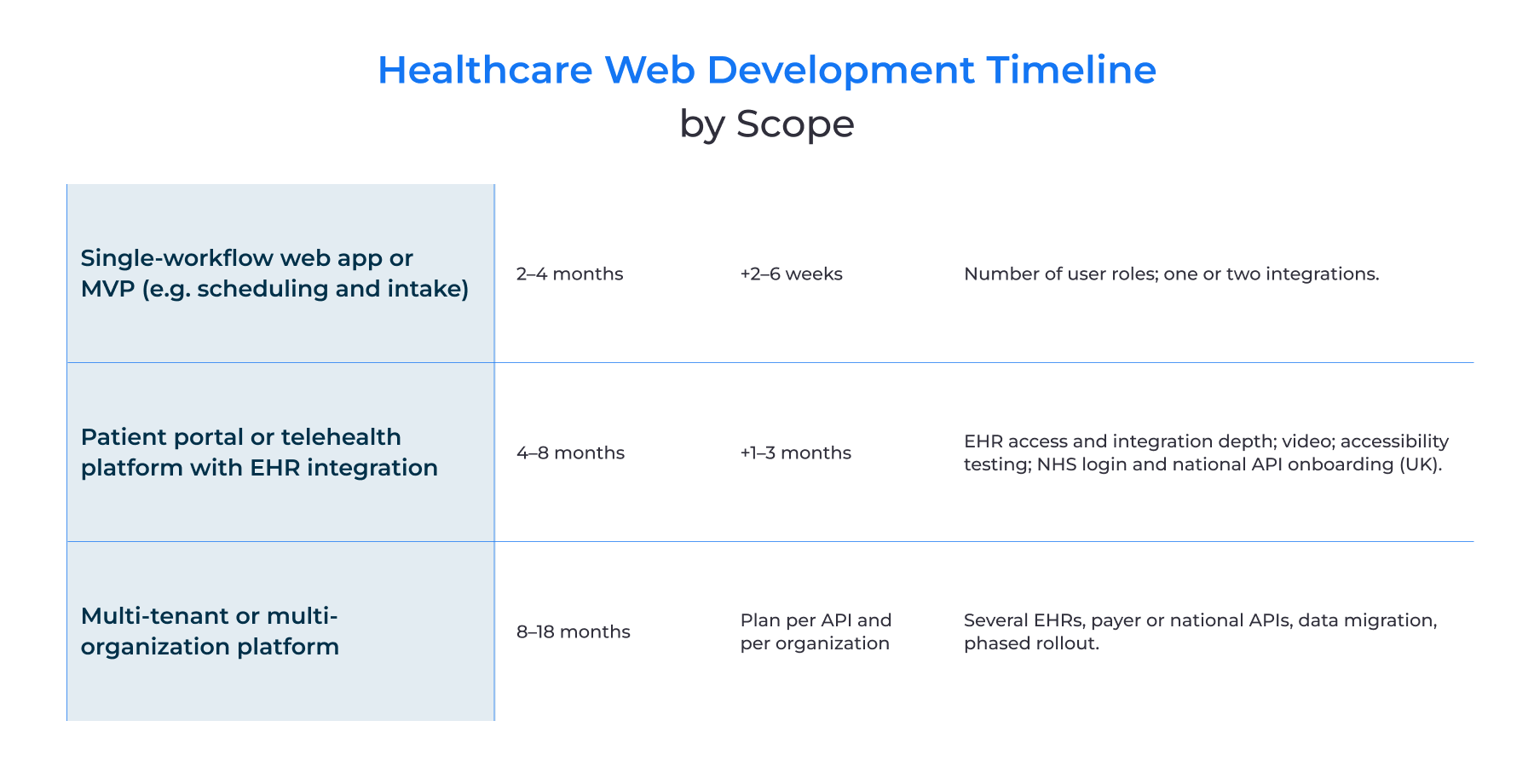
A six-week estimate for a portal with EHR access usually means scope has been cut. Realistic numbers look different. Most healthcare web applications need 2–8 months to a first production release, and enterprise platforms need 8–18. By complexity, a basic build takes about 2–4 months and a mid-complexity one 4–8. NHS projects add a few weeks. In our experience, approvals slow healthcare web development far more often than engineering does.
Timeline by project scope
Healthcare web development timeline by scope
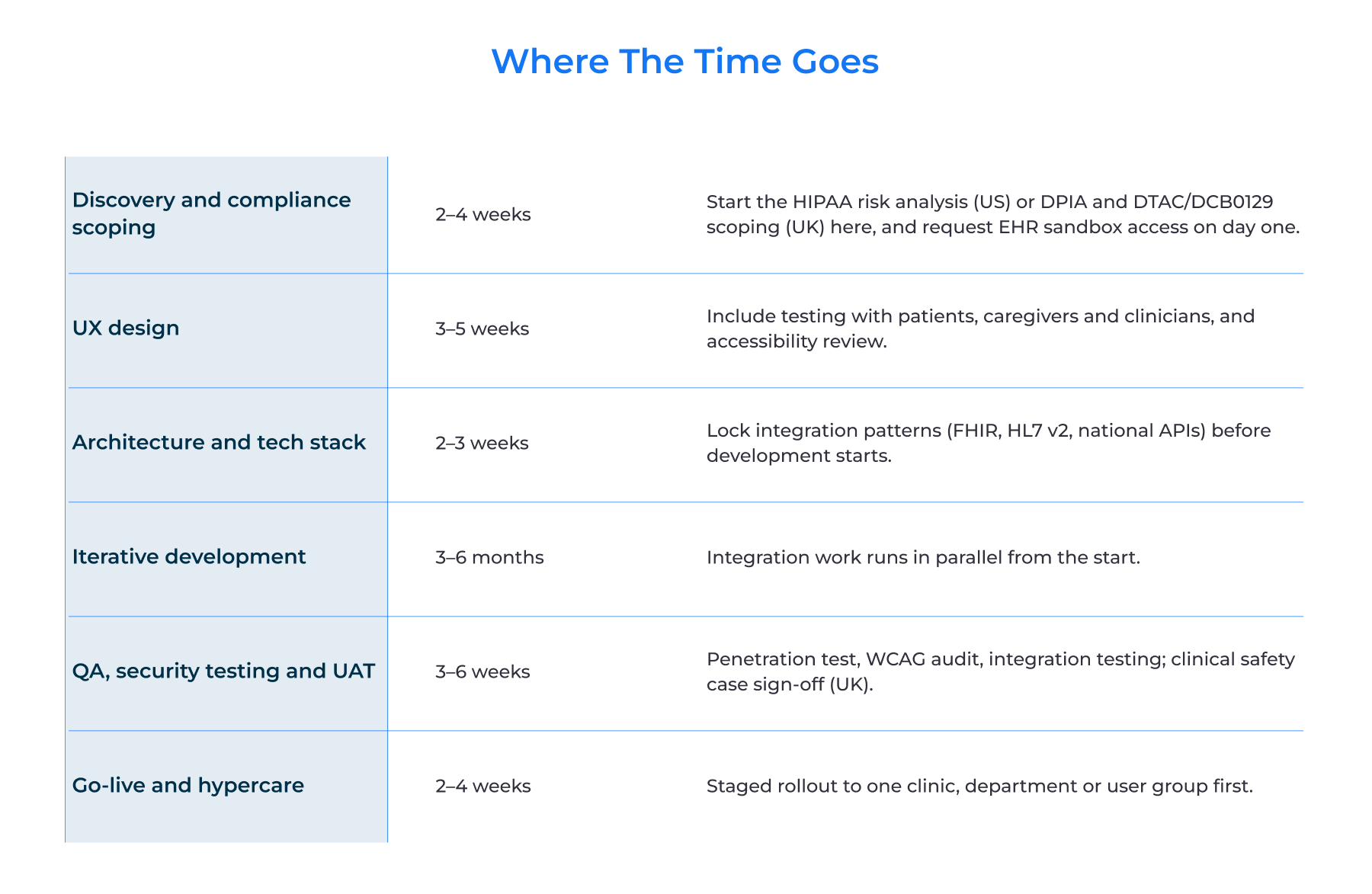
Timeline by phase
Where the time goes
What slows healthcare web projects down
On a project like the twelve-site clinic portal, the lost weeks usually come from five places.
Sandbox access is first. Epic, Oracle Health, and UK EPR suppliers each run their own approval process, so the request belongs in week one. Contracts come second. BAAs in the US and Article 28 processor contracts in the UK can bounce between lawyers for weeks. That's why counsel should see templates before the vendor list is locked.
Procurement comes next. Hospitals and other healthcare buyers have their own vendor-risk process, and ten-page questionnaires are normal. We keep a pack ready for it (policies, the latest pen test report, the architecture document). On recent projects, it cut a month of correspondence to two weeks.
UK projects also depend on NHS England. National API onboarding moves at its own pace, and so does DTAC and DSPT evidence. Give it a named owner.
The remaining two delays come from the client side. We've seen workflows stall because the only clinician allowed to approve them worked nights. Naming a deputy in week one avoids it. Accessibility gaps found a week before launch are the other risk to the release date. In a prototype, the same fix takes an afternoon.
The rule of thumb for development teams remains reliable. Start regulatory paperwork and EHR connection work in discovery, ship a single workflow first, then expand. Projects run this way rarely miss their first release date.
How to Choose a Healthcare Web Development Company
When choosing a healthcare web development company, judge the precision of its answers first. Any agency can mention HIPAA on a sales call. A team that has actually shipped portals and clinician tools names systems, documents, and people without hesitation. Use the questions below in the first or second meeting. Response speed tells you as much as content.
Questions to ask a healthcare web development partner
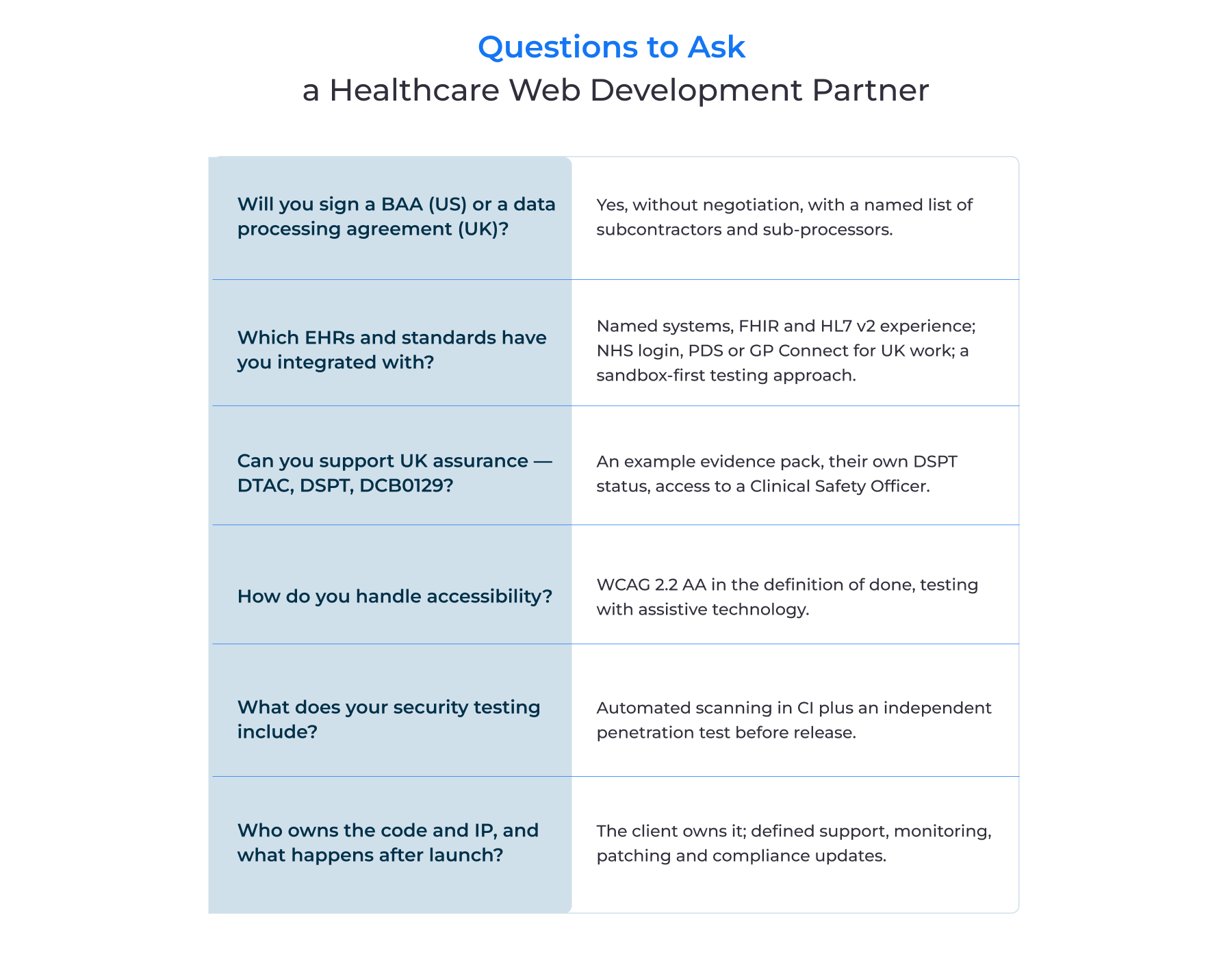
Some answers should end the search early. Hesitation over the BAA is one. So is a team that can't name one EHR. Accessibility pushed to a post-launch audit is another, and so is "post-launch support" with no scope or response times attached. A solid healthcare web development service comes from medical web developers who've already passed a hospital's vendor review. Ask about past projects. They'll tell you what went wrong as readily as what went right.
Healthcare Web Development with Intellectsoft
Intellectsoft has been building custom software and web applications for more than 18 years, including for 35 Fortune 1000 companies. Our healthcare work covers self-service portals, EHR and EMR systems, and healthcare apps for clients in the US and the UK. Most of what this guide recommends comes straight from those projects.
One example. A US company that builds decision-support tools for consumers and healthcare professionals wanted one place where people could manage their health. Its readers skewed older. Every screen had to work for people who dislike small fonts and clever menus. We built it end to end. We also maintained it after launch. Users come for the medical articles and videos and return for the drug lookup. A user enters a pill's shape, color, and imprint, and the portal identifies the drug. There's also symptom search for people who don't know the name of their condition. The client's editors manage content in Episerver, and the portal ties into the company's medical website and campaigns. Adoption among older adults exceeded expectations. Hospital staff reported a lighter workload, too, and the full story is in our patient web portal case study.
Projects like this one shaped how we deliver healthcare web development services today. Architecture and regulatory scoping come first. One workflow goes live early, and a senior architect stays with the project through launch and beyond. We apply the same approach across our wider healthcare software development and web application development services.
Planning a portal, a clinician tool, or a booking platform? Book a consultation on custom healthcare web development. Whether it's a first MVP or custom web development for healthcare at enterprise scale, we'll start with your constraints.
FAQ
What is healthcare web development?
It's software development for healthcare organizations, delivered in a browser. Think portals or video visit tools. Clinician dashboards and booking flows for medical practices count as well, while a hospital's marketing website is a side topic at best. Most of the difficulty sits around the code. You'll deal with an EHR connection, HIPAA or UK GDPR, and a hospital vendor review that can outlast the build.
How much does healthcare web development cost in the US and UK?
Plan on $80,000–$300,000+ for most healthcare web applications in the US, or roughly £60,000–£240,000+ in the UK before VAT. A narrow MVP can come in closer to $50,000. Regulatory work typically adds 15–30%. From year two, running costs usually reach 15–25% of the build each year.
How long does it take to build a healthcare web application?
Two to eight months to a first production release is normal for a healthcare portal or clinician tool. Enterprise platforms take 8–18 months. NHS projects need a few extra weeks for onboarding and assurance. In our experience, EHR vendor approvals cause the longest waits.
What makes a healthcare web application HIPAA compliant?
Two things: safeguards in the code and paperwork around it. The code side means access controls, encryption, audit logs, and backups you've actually tested. On paper, it's a written risk analysis and a BAA from each vendor whose systems see PHI. One trap catches many healthcare teams. OCR may treat a tracking pixel behind the login as a disclosure of PHI to the ad network that owns it.
Which NHS standards does a healthcare web application need to meet in the UK?
DTAC usually comes up in the first NHS procurement call. Assessors look at clinical safety and privacy first, then technical assurance, interoperability, and accessibility. Most trusts won't sign without it. The DSPT applies every single year to anyone with access to NHS records. DCB0129 covers whoever builds the app; DCB0160 covers the trust running it. UK GDPR rounds out the list, together with WCAG 2.2 AA for the website and app and, usually, NHS login.
What is FHIR and why does it matter for medical web development?
FHIR, short for Fast Healthcare Interoperability Resources, comes from HL7. Through it, health systems pass records to apps over the same REST APIs web developers already know. For medical web development, its impact is significant. Epic, Oracle Health, and a growing number of UK systems support it, so nightly file transfers are no longer the only option. And US payers have a CMS deadline for FHIR APIs in 2027.
What should you look for in a healthcare web development company?
Look for specific answers. A reliable partner signs a BAA or Article 28 contract without delay and names the exact EHRs it has integrated with. For NHS work, expect DTAC evidence, the company's own DSPT status, and access to a Clinical Safety Officer. Vague answers on accessibility or penetration testing are a red flag.