Key Takeaways
- Understanding “how does AI reduce costs in business” comes down to four main mechanisms: automating routine work, predicting failures, optimizing resources, and delivering insights for swift decisions.
- With AI-assisted engineering, AI agent integration, and automation, Intellectsoft helps companies save up to 30-50%.
- One-time optimization is a great option, but AI systems drive steady cost savings because they are learning from new data.
- The budget needed for AI integration varies from $500 per month for ready-made tools to more than $1 million for complex intelligent systems.
- AI solutions fail to cut irrelevant expenses because of the wrong focus of businesses on technologies instead of planning and preparing reliable data.
- An AI Proof of Concept (PoC) is a safe way to test an AI idea before scaling up investment to verify applications and predict potential ROI.
Imagine the situation! The CFO is confused while reviewing the fintech agency's quarterly results. The company has already tried everything from outsourcing to process refining. But costs were going through the roof. Support teams are snowed under repetitive requests. Data analysts are still preparing reports by hand. And operational costs are skyrocketing.
So the questions that are on executives’ lips: Can artificial intelligence help companies save money? If so, how does AI reduce business costs, and where does maximum economy come from?
Indeed, enterprise AI is a great remedy to the pain points mentioned above. It can take over routine work, speed up processes, and help teams perform better with the same resources. But the real advantage is that AI solutions don't just cut costs once; they automate workflows, contributing to steady savings.
In this article, we’ll focus on AI cost reduction, break down the most effective ways AI can help you cut expenses, and what that looks like in practice.
Why AI Cost Reduction Offers More Than Traditional Optimization
No doubt, traditional cost-cutting methods like outsourcing, ERP integration, or Lean initiatives can cut your expenses and add to your budget. But the savings and benefits usually stop its existence after the initial improvements are made.
That's where generative AI changes the situation. Tools like GitHub Copilot and ChatGPT are built on this technology. And unlike traditional software that acts according to fixed rules, they steadily grow as they learn a lot from your historical and current data. So, AI cost reduction offers more opportunities to save up and improve performance.
Take, for instance, a healthcare company! With AI development services, their clinical team can automate 30% of their repetitive tasks, such as note-taking and form completion. As the intelligent system learns from new datasets, it can automate up to 50% of their manual operations, such as reporting and providing recommendations.
AI reduces costs with the help of the following capabilities:
- Automation removes repetitive manual tasks like document processing, note-taking, reporting, or summarizing
- Prediction helps spot issues before they turn into serious losses for your business
- Optimization improves how budgets, resources, and schedules are used and shared
- Augmentation helps employees work faster with the help of AI agents and make fact-based decisions
So, see AI cost reduction is a win-win strategy where budget optimization is more than a one-off event. This is a valuable approach that creates ongoing savings.
5 Ways AI Reduces Costs in Business Operations
According to Gartner, 54% of infrastructure & operations leaders are adopting AI to cut costs. Plus, our clients from healthcare, fintech, construction, and retail come to us to optimize expenses. So, it’s obvious that companies want to be more fruitful and efficient and operate within their planned budgets. So, how does AI reduce costs in business? Here are the main approaches we use to help businesses.
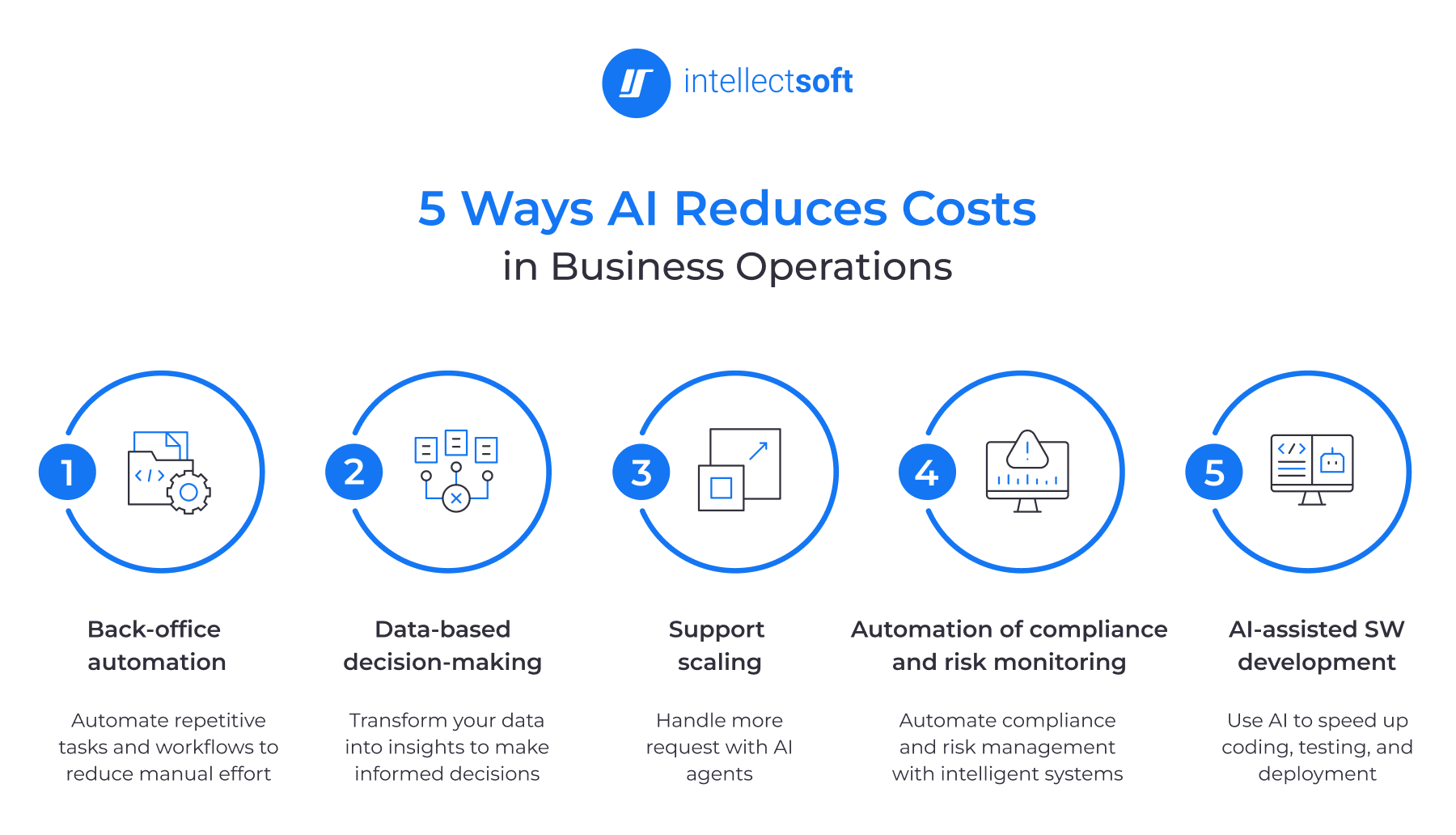
Automating routine back-office tasks
Our team works with RPA, OCR, and LLMs to create smart systems for mid-sized companies and enterprises. So, they can delegate their routine duties and mundane responsibilities to AI. With our AI solutions, businesses can instantly process documents, create reports, and derive valuable insights.
How automation takes place depends on your vertical. In fintech, firms can use statistical algorithms to verify client documents and categorize transactions. How does AI reduce costs? Tasks handled by smart software save time, which you can invest in strategic initiatives.
AI automation and RPA in healthcare are the backbone of excellent care delivery, as intelligent systems can perform routine paperwork instead of clinicians. Plus, they can be reliable assistants to doctors, responsible for taking notes and making recommendations based on them. With automation, you can expect not only higher staff performance but also better health outcomes.
If you want to lower administrative costs, you can opt for AI in medical coding. It can analyze doctors’ notes and automatically suggest the correct billing codes.
With AI powered tools, every domain has cost-saving potential. Up to 60-70% of repetitive duties can be automated. Here, we should also mention that employees can work up to 40% more fruitfully when they don't need to handle back-office tasks. So, indeed, with AI, they are more open to creativity and strategic decisions.
Making faster decisions with intelligent data search
In business, one of the main cost items is the time employees spend searching for information. The problem is that data is scattered across different sources: documents, dashboards, and databases. That’s why teams have to switch between systems and cannot always find what they need ASAP.
According to Gartner, large enterprises lose about $12.9 million per year due to employees spending too much time searching for information. Poor data access can cost an arm and a leg.
Intelligent knowledge systems based on Retrieval-Augmented Generation (RAG) solve this problem by providing natural-language access to data. With RAG, systems can connect to data sources, allowing employees to ask questions.
One related case is when Intellectsoft helped UK startup Skroote implement advanced search functionality for a multi-million-user base. Our team integrated ChatGPT into their platform, so users can handle complex queries and receive personalized content recommendations.
To ensure intelligent data search, we also build AI copilots for business analytics that connect to company data, documents, and dashboards. Employees can simply ask a question and get the information they need in seconds, rather than spending hours searching for it. How can AI reduce costs? It saves time, and in business, time is money.
Scaling support services with AI agents
As your company grows, be ready for a boom of support requests. Who will handle them? Of course, you can hire more people and add to your operational costs. Or you can downsize costs by integrating AI agents and avoiding recruiting processes.
AI agents can become a solid backbone for customer and employee support services as they can answer questions and solve routine issues. You can be sure that AI agents can process 40-60% of requests, taking the load off the support team. So, see this is a proven cost reduction strategy for your business.
As we mentioned above, AI copilots can also become a tower of strength for your in-house team by providing instant access to knowledge databases. So, your employees can get the information they need in seconds, without searching and waiting. According to Nielsen Norman Group, AI-assisted support specialists can process 13,8% more inquiries per hour than support people without AI agents.
If you wonder how AI in healthcare is transforming the industry or affecting other verticals, we have on-point stories to share. At Intellectsoft, we built a conversational analytics platform for a U.S. enterprise to ensure employees had access to the necessary data and enable them to extract practical insights from reports up to 10x faster.
Automating regulatory compliance and risk monitoring
In fintech, healthcare, and insurance, compliance is one of the main cost items that require time and resources to monitor laws and documentation. And this is a must to follow legal regulations to avoid fines and other risks.
According to the recent report from Thomson Reuters, 73% of organizations plan to use technology to automate legal tasks and optimize expenses. The reason for this is pretty simple: they understand that AI and RPA can simplify their life and fill the budget hole.
Take, for instance, AI in fintech, where it can automatically check customer documents and detect suspicious transactions. This helps companies not only reduce manual workload but also lower compliance budgets and avoid costly mistakes with fintech AI solutions.
Machine learning in healthcare ensures compliance with regulations such as HIPAA and flags insurance fraud. So both the medical staff and compliance team can focus on patient care without worrying about legal issues and security threats.
With AI, companies do two things at once: they automate compliance-related tasks and cut the costs they spend on manual reviewing. While people can make mistakes, AI automation does a good job at performing accurate and consistent audits. Plus, intelligent software monitors compliance and risks non-stop, allowing businesses to stay safe and law-obedient.
AI-assisted software development
The way developers code your system influences how much you pay. As our clients come to us seeking to save both time and money, we use AI in software development. AI automates repetitive coding tasks, testing, code reviews, and debugging, while our senior developers lead all stages of the software development lifecycle.
You can involve intelligent systems at any stage of development and can be sure that everything will go without disruptions if skilled specialists orchestrate the process. The cost reduction is significant. GitHub reports that engineers using AI coding assistants can complete tasks 55% faster. McKinsey estimates that AI can reduce software development and delivery costs by 50%.
At Intellectsoft, we offer AI-assisted engineering to compress time-to-market and reduce development costs. The most important thing is that we don't compromise on the quality of your product. We first design a robust software infrastructure and then integrate AI to speed up development. With our architecture-centric approach, you can be sure your AI platform is secure and ready to scale.
AI Cost Savings Benchmarks Across Key Business Functions
No doubt, corporate leaders need more than a list of AI applications. They need structural information on the budget economy to build their unique case. And the question they usually ask: “How does AI reduce costs?”
The table below, based on our ICP and clients’ expertise, offers possible cost-reduction benchmarks across five core business functions. NB: These ranges are not absolute and depend on your data and the maturity of AI integration.
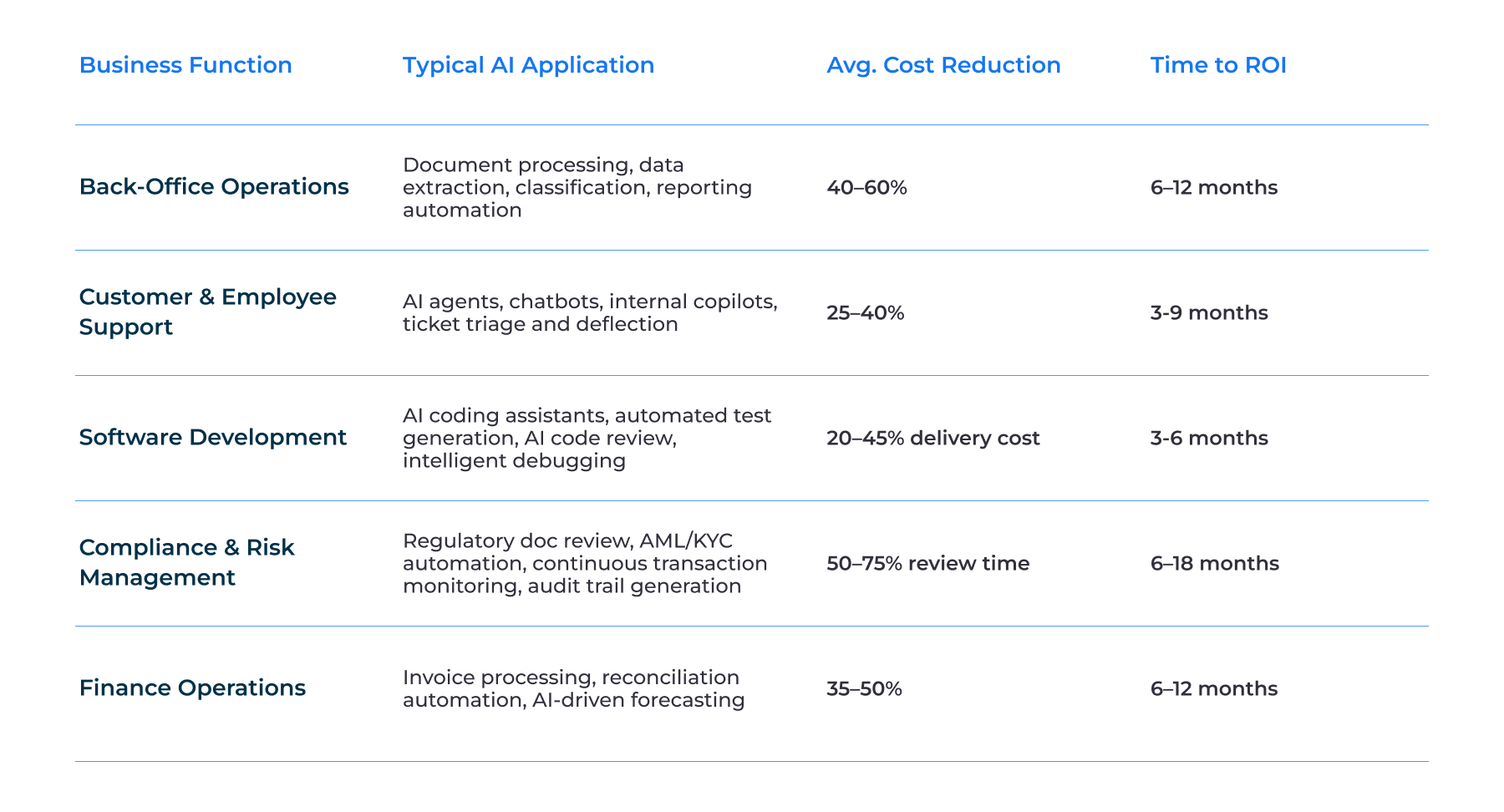
To sum up, the highest-ROI areas are almost the same across industries. As the table shows, they are defined by high volumes of repetitive, rules-based work and access to clean, historical data that AI systems can learn from.
When both are in place, AI can not only save costs but also drive returns. On the other hand, when data is spread across systems or processes, you can’t expect high returns from AI automation.
Take Western Union's AI-powered operations transformation as an example. The company cut manual work and sped up decision-making by integrating artificial intelligence in customer service, compliance, transaction monitoring, and back-office operations. The main thing is that you can gain savings and returns when you decide to improve the entire workflow with AI, not just separate tasks.
What Does It Cost to Implement AI and How to Calculate Your ROI?
Enterprise leaders have concerns when it comes to AI implementation. They need to know not only how much AI costs but also whether this investment can bring savings and efficiency gains over time. One of the metrics we recommend considering is the gap between implementation costs and the value created over the next 24–36 months. We hope this will help you implement AI with strong financial outcomes.
AI investment tiers: what to expect at each level
Of course, AI implementation costs depend on data quality, integration complexity, model (AIaaS or managed AI), and geography of delivery. That’s why here we offer approximate ranges which can be used as planning estimates.
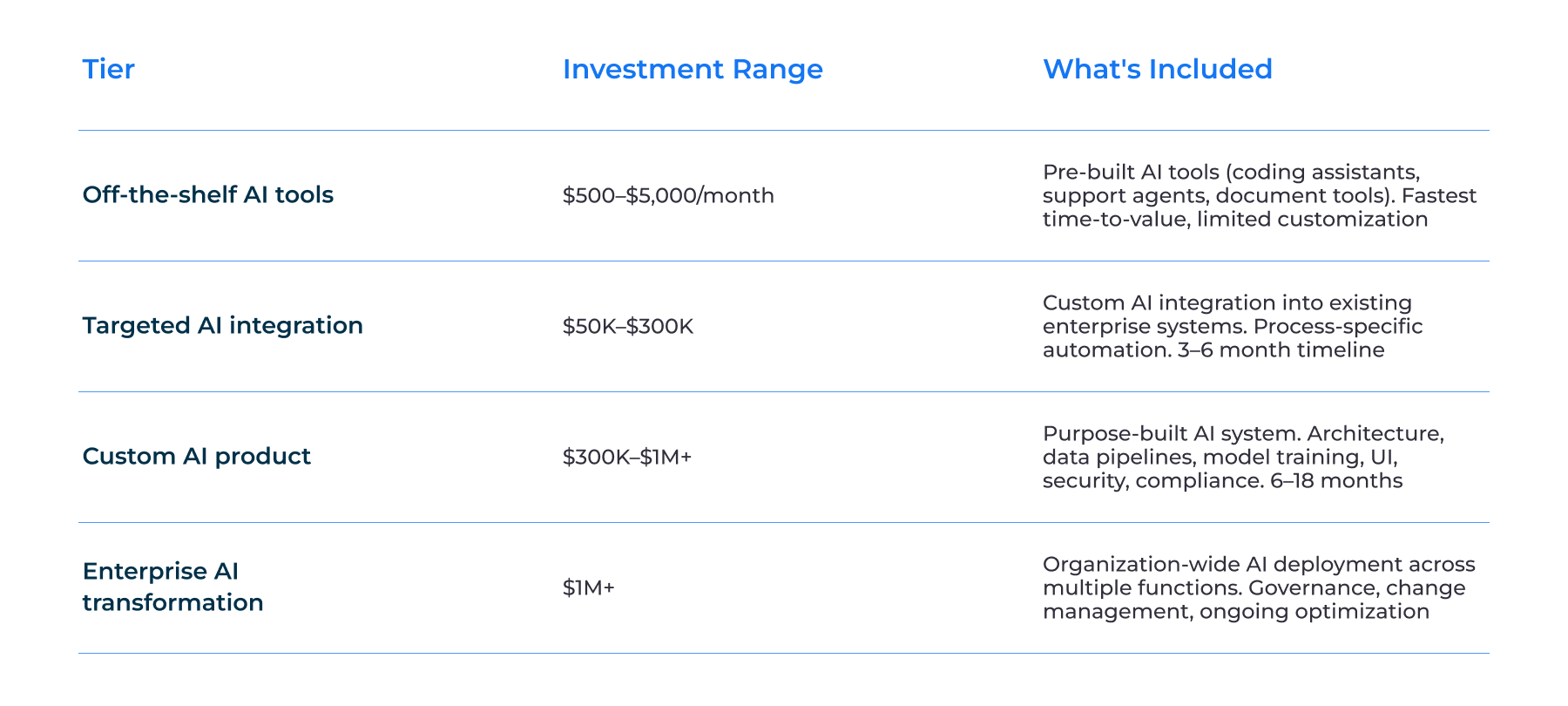
- Off-the-shelf AI tools ($500–$5,000/month). If you’re a novice at AI adoption, you can try ready-made solutions such as document processing tools or support agents. This is the fastest way to get returns with minimal setup, but limited customizations can drag your business down.
- Targeted AI integration ($50K–$300K). Whether you need to automate customer support or advance analytics, you can integrate targeted AI into your current system.
- Custom AI product ($300K–$1M+). A custom AI solution is secure, compliant, and well-built. But be ready that you may need more than 1 year to implement it.
- Enterprise AI transformation ($1M+). You can deploy AI across multiple business functions and departments to modernize processes and automate large-scale workflows – all is done to bring long-term business value.
A simple ROI framework for enterprise AI
If you understand how artificial intelligence can add value to your business, this is one of the guarantees that you can gain from AI integration. We want to warn you that general industry estimates can’t give you a picture of your returns. That’s why here’s the four-step framework that can help you calculate ROI before making a heavy AI investment:
Step 1: Identify the cost center
First of all, choose the process or workflow you want to improve with artificial intelligence. Then, try to calculate how much it costs your business in employee time and manual work, and in revenue losses due to delays. With these numbers, it will be easier to measure the financial outcomes of AI later on.
Step 2: Estimate AI impact
Second, we recommend you rely on industry benchmarks and similar AI projects to understand how much you could save. Plus, consider the lower end of the expected range, as this helps you build realistic expectations.
Step 3: Calculate net ROI
Third, you can use the formula below to calculate your returns from an AI investment over a 12-month period.
ROI (%) = (Annual AI Savings − Total Implementation Cost) ÷ Total Implementation Cost × 100
For example: A compliance automation project saves $400,000/year and costs $200,000 to implement
→ ROI = ($400,000 − $200,000) ÷ $200,000 × 100 = 100% in year one.
Step 4: Validate with a PoC before making a heavy investment
Before moving to full AI deployment, we recommend running a 4-6 PoC, using your operational data. With a proof of concept, you can understand where AI can bring value in your business setting. Plus, this is the best way to reduce risks and confirm expected returns before a bigger investment.
Why AI Doesn’t Always Save Costs
Based on our experience with 300+ enterprise AI and digital product deliveries, we’ve seen that businesses often have the false belief that integrating AI algorithms will automatically lead to substantial cost savings. But the reality is different, and failures do happen. That’s why we want you not to repeat our clients’ mistakes and share the most common reasons AI doesn’t always cut operational expenses in practice:
Starting with technology instead of business needs
Many companies start AI integration with picking tools. “We need to build a chatbot,” or “We want to integrate GPT-4 into our system.” This is how their requests sound. When we ask why they need this or that solution, they say that they want to cut expenses. But indeed, they don’t understand how to do this with AI because they fail to identify which areas overconsume their budget. As a result, integrating new virtual assistants requires additional investment.
Overestimating data readiness
AI integration can turn into an additional expense if you fail to prepare your data. If your data is inconsistent, incomplete, or spread across multiple systems, you won’t be able to create an AI model and train it effectively. The problem is that some companies expect a model trained on fragmented data from legacy systems to perform the same as one trained on clean, structured data. As a result, poor data readiness can disrupt project timelines and extend delivery from 6 months to 18 months.
Pushing a PoC directly to production
Some businesses think that a proof of concept is something that can work and run in production. If you skip the MVP stage and move a PoC into live operations, be ready for it not to work as you expected. Instead of getting intelligent software, you’ll get a fragile system that can’t scale up and crashes under heavy-traffic load. What does it mean for you? Of course, you need to invest more in refactoring.
Treating AI as a one-time deployment
The reason AI fails to save costs is that companies treat it like a traditional software release. So, they deploy AI models once and then forget about them. But indeed, statistical algorithms work efficiently when regularly monitored, retained, and refined. Plus, machine learning models degrade as data, behavior, and conditions change, so you need to upgrade them accordingly.
How to Reduce Operational Costs With AI: Intellectsoft's 4-Step Approach
Now that you know how you can save costs with AI technologies and the reasons why it can add up to your budget, it’s high time to share how Intellectsoft approaches AI implementation with returns for your business and without irrelevant funding.
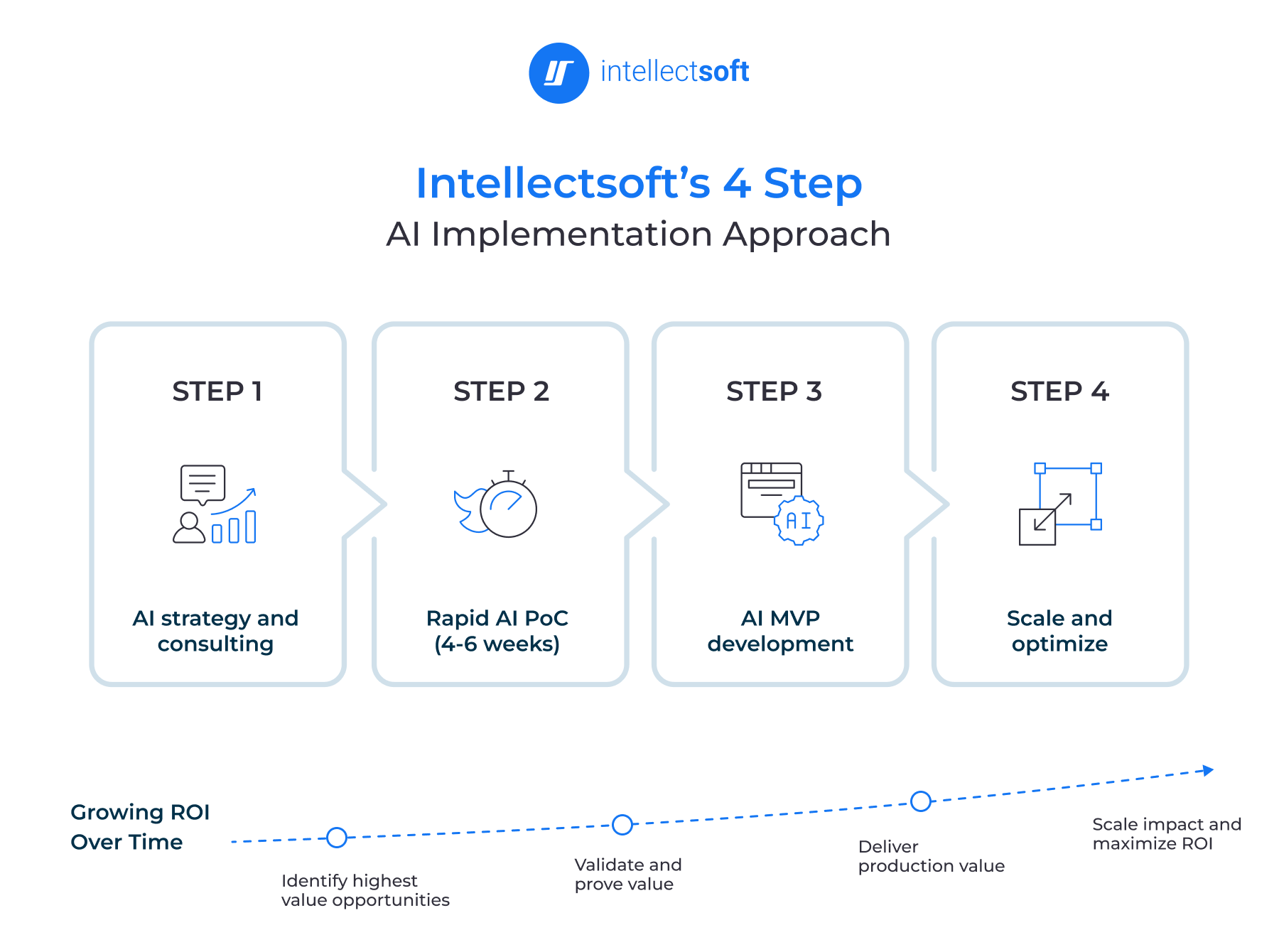
Step 1: AI strategy and consulting
Intellectsoft works with your team to identify your highest-value AI opportunity, define the right scope, and frame a clear hypothesis to test. Plus, we provide business technology consulting to help reduce IT costs, as this is one of the main priorities for most of our clients. This is the foundation that makes every PoC provide you with an answer and help you avoid irrelevant expenses. At this stage, you receive a practical implementation roadmap with prioritized use cases, cost estimates, and recommendations for data preparation - all this is done with our IT strategy consulting.
Step 2: Rapid AI PoC (4-6 weeks)
As an AI development company, we design and develop a working AI prototype in 4–6 weeks. The output gives you actual evidence to secure stakeholder or investor buy-in, minimize risk before a full build, and compress your time to market. At this phase, we test PoC, using your business data, current systems, and operational requirements.
Step 3: AI MVP development
Once your PoC has proven the concept and secured buy-in, we build the production-grade MVP (3–6 Months). This is a fully functional AI product ready for your users, with the architecture for growth that can operate reliably in a real enterprise environment. This solution is scalable, secure, and can integrate with other systems, so you can be sure that it will bring both returns and cost savings.
Step 4: Scale and optimize
Once your solution is deployed, we continue to monitor its work, connect it to data sources, and feed it with new data when they appear. As the AI system matures, it delivers long-term business value. So, companies may want to add new automation features, integrate into new workflows, and expand use cases that increase savings.
Not sure how to save costs with AI? Get personalized IT consulting from Intellectsoft!
FAQ
How can AI reduce costs?
Automating the manual work, predicting risks before they result in losses, and optimizing how you use resources – this is how AI can cut day-to-day expenses.
See how much you can minimize spending:
Up to 50% lower costs through automation of manual processes
Up to 40% lower losses through the prediction of risks, fraud, and failures
Up to 30% greater efficiency through optimization of scheduling, staffing, and resource distribution
How much can AI save costs in business?
Of course, we can’t provide exact numbers, as the amount of AI cost reduction depends on the business function, data quality, and the maturity of the AI implementation. However, here are the savings ranges our clients have achieved:
Back-office operations: 40–60%
Customer & employee support: 25–40%
Software development: up to 45% in delivery costs
Finance operations: 35–50%
Compliance & risk management: up to 75% in review time
What is a realistic ROI for an AI implementation?
From AI integrations, you can expect budget cuts within 6-8 months. If these are large custom AI systems, you’ll feel the economy within 18-36 months. You can estimate return on investment with this formula: ROI (%) = (Annual AI Savings − Total Implementation Cost) ÷ Total Implementation Cost × 100
It can help you calculate possible returns, and you can make a decision about further investments.
How long does it take to see cost savings from AI?
Ready-made AI tools: 1-3 months
AI integrations: 6-12 months
Custom AI systems: 12-24 months
If you need faster results, we advise you to automate large-scale, repetitive workflows.
What is the difference between an AI PoC and an AI MVP?
An AI PoC is developed to test an AI concept in a specific operational setting to check out whether it can bring returns. An AI MVP is a market-ready solution built for real users, steady growth, and long-term business value.
What AI services does Intellectsoft offer for cost reduction?
We help companies cut down expenses through the following services: AI Strategy & Consulting, Rapid PoC Development, AI MVP and Product Engineering, AI Integration, and Intelligent Search & Knowledge Systems. With our artificial intelligence services and solutions, you can automate workflows, boost performance, and make faster decisions.
