Key Takeaways
- Supply spending rose 9.9% in 2025 and drug spending 13.6%, while total expenses grew 7.5%.
- Good healthcare supply chain software doesn’t stop at the shelf. It follows a stent all the way into the case.
- Most healthcare systems we talk to already own a finance suite. They’re usually short on point-of-use capture and implant tracking.
- Lot, serial, and expiry data aren’t optional anymore, thanks to DSCSA and UDI in the US and national barcode rules in England.
- Budget for integrations first.
- Pilot one workflow on one unit (OR implant capture is a good bet) before a second site sees it.
Before anyone budgets for healthcare supply chain software, the 2025 numbers are worth a look. According to the AHA’s Costs of Caring report (March 2026), supply expenses grew 9.9% last year and drug expenses 13.6%, against 7.5% for total expenses. Shortages haven’t eased either. ASHP counted 227 drugs in active shortage in the second quarter of 2026. In the UK, the NHS spends about £8 billion a year on medical equipment and consumables, according to the National Audit Office (January 2024). Underneath it sits a visibility gap. Many healthcare organizations can’t say what’s on their shelves, which patient got which item, or what runs out next week. Closing that gap is the software’s job, along with the healthcare IT solutions around it.
What Is Healthcare Supply Chain Software?
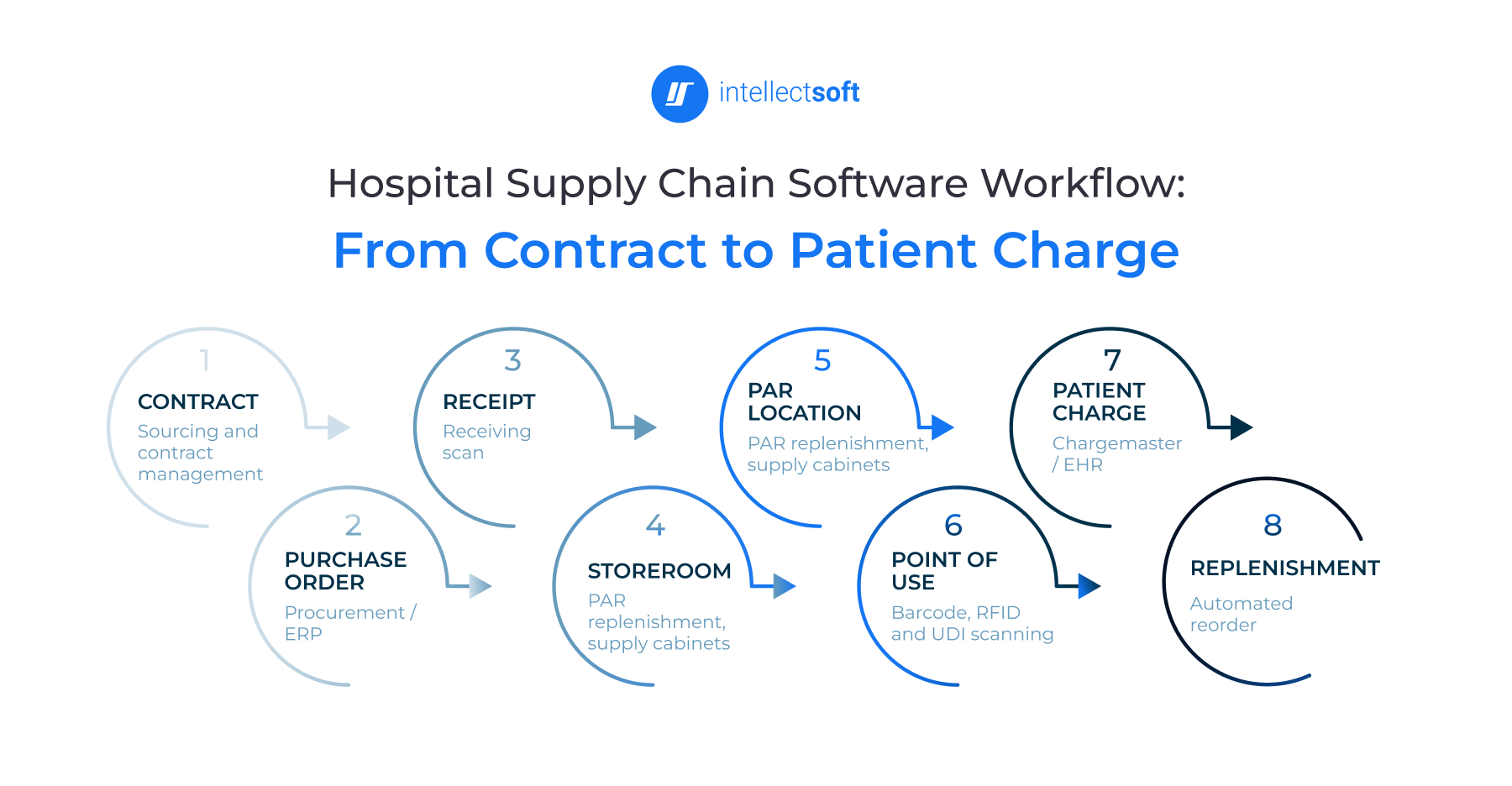
Healthcare supply chain management software follows everything a hospital buys for care, from med-surg supplies and implants to drugs and infusion pumps. Its job starts at the contract. After that, the item gets ordered, checked in at the receiving dock, and parked on a shelf until the PAR level drops. A regular warehouse system covers all of that. Then it gets messy. On the unit, a nurse opens the package for one specific patient, usually in a hurry. Somebody has to capture that charge. The lot number also needs to stay on file, because recalls tend to land months after the case is closed. In practice, hospital supply chain software rarely replaces the ERP. It covers the gap between the ERP (what was bought) and the EHR (what was actually used, and on whom). Revenue leaks right there. Among the other types of healthcare software, this is the one wedged between finance and the clinical floor.
Generic supply chain software vs healthcare supply chain software
| Aspect | General supply chain | Healthcare supply chain |
|---|---|---|
| Main users | Warehouse, logistics and purchasing teams | Supply chain teams plus nurses, OR staff, pharmacists and biomedical engineers |
| Product data | SKU, quantity, location | GTIN, UDI, lot, serial number, expiry date, unit of measure, contract price |
| End point | Delivery to the customer | Use on a specific patient, documented in the EHR (EPR in the UK) and billed or costed |
| Regulation | Trade and tax rules | US: DSCSA for drugs, FDA UDI for devices, HIPAA. UK: GS1 and PEPPOL under the NHS eProcurement Strategy, MHRA device rules, UK GDPR |
| Key integrations | ERP, WMS, carriers | ERP, EHR/EPR, chargemaster, supplier EDI or PEPPOL networks, NHS Supply Chain catalogue (UK), dispensing cabinets, RFID |
Why Hospitals Invest in Supply Chain Software
Start with the money. Medicare Cost Report data analyzed by Definitive Healthcare in November 2025 ranks medical-surgical supplies as the second-largest hospital expense. Pharmacy comes third. The AHA puts 2025 growth at 9.9% for supplies and 13.6% for drugs, against 7.5% for total hospital expenses.
Then there's the time lost to shortages. In Premier's 2024 survey, 67% of providers said they spend 10 or more hours a week working around supply problems. Nearly 40% canceled or rescheduled cases over shortages at least quarterly in 2023. Drugs carry their own risk, too: ASHP found that 48% of new shortages in 2026 involve a medicine with a single manufacturer.
So why software, and not another round of contract talks with the GPO? It's mostly a visibility problem. A supply chain team often can't say what's on the shelf in the OR core or what got opened during yesterday's cases. Expiring lots are worse. ERP reports tend to lag by a day. Often the first sign of a stockout is a call from the OR asking where the trays went. SCM software closes part of that gap with scans at receiving and at the point of use. The system count then matches the bin.
NHS trusts have an extra pricing problem. The NHS spends about £8 billion a year on medical equipment and consumables, per a January 2024 NAO report. Trusts buy roughly £3.4 billion of it outside NHS Supply Chain. In 2022–23, one trust paid £490 for a hip replacement stem, while NHS Supply Chain listed the same part at £258. Medicines aren't spared either. DHSC logged 687 supply issue notifications between January and June 2026.
For what changed once trusts started scanning at the point of care, see the Scan4Safety results in the compliance section below.
Case study: RFID asset tracking for hospital equipment
Mobile equipment has the same visibility problem as consumables, with a much higher cost per unit. Infusion pumps drift between floors. Nurses spend part of a shift looking for one, while biomed teams track service dates in spreadsheets. Intellectsoft tackled both issues for one of its clients, an identification solutions provider.
Client. A US identification company. It’s among the global leaders in its field, and its wristbands and RFID tags turn up across leading healthcare organizations.
Challenge. Ward staff lost time hunting for mobile equipment. Then they had to check by hand if each unit was due for service. The client already made the RFID hardware for this job, from handheld wands and readers to tag printers. Nothing tied those devices together yet.
Solution. We built an Android app and a web portal that read RFID tags as well as barcodes. Each unit gets a record with location and history. A biomed tech can tell at a glance if a pump is safe to send back to the floor. Admins can design custom barcode templates themselves.
Result. Staff find equipment quickly now, and assets reach the right place at the right time. For the client, the app became a cornerstone of its IoT offering for healthcare asset and maintenance management.
Types of Healthcare Supply Chain Software
Few healthcare organizations buy every module from one vendor. Most end up stitching medical supply chain software together around the ERP, one gap at a time, over several budget cycles. The table below maps each module to its users and to the systems it can't run without.
Hospital supply chain software modules at a glance
| Module | What it covers | Main users | Key integrations |
|---|---|---|---|
| Sourcing, contracts and value analysis | GPO (US) or NHS Supply Chain framework (UK) and local contracts, price compliance, physician preference item decisions | Supply chain, value analysis committees | ERP, GPO contract data (US), NHS Supply Chain catalogue (UK) |
| Procurement (procure-to-pay) | Requisitions, POs, receipts, invoice match | Buyers, AP | ERP, supplier EDI |
| Item master data management | One clean record per product: GTIN, UOM, price, charge code | Supply chain data team | ERP, chargemaster, EHR |
| Inventory and PAR replenishment | Stock by location, PAR levels, two-bin Kanban, low unit of measure | Materials management, nursing | ERP, cabinets, RFID |
| Point-of-use and charge capture | Scan supplies and implants used on a patient in the OR, cath lab or bedside | OR staff, nurses | EHR/EPR, chargemaster (US), patient-level costing (UK) |
| Implant, bill-only and consignment tracking | Rep-delivered implants, POs after use, consigned stock | OR, supply chain, AP | ERP, EHR, supplier |
| Pharmacy inventory and DSCSA traceability | Drug receipt, verification, transaction data, dispensing stock | Pharmacists | Wholesaler data, pharmacy system, ADCs; DSCSA data (US only) |
| Asset tracking, recalls and expiry | Locate equipment, find recalled lots and expiring stock | Biomed, risk, nursing | RTLS/RFID, UDI, EHR |
Sourcing, contract and value analysis software
Prices are fixed here (or should be). The GPO hands a US health system most of its contract pricing before anyone in the building opens a requisition. Local deals cover what’s left. When a surgeon wants a new spine screw, the value analysis committee digs into that same contract file and twelve months of usage.
With physician preference items, expect pushback from the OR. NHS trusts face a different rulebook, since much of their spend runs through national frameworks and buying on-framework at the agreed price is expected.
Procurement and procure-to-pay
A nurse manager requests three cases of IV start kits. It turns into a PO. Out it goes to the distributor as an EDI 850 (an 855 comes back as confirmation). When the boxes land, receiving logs them and AP matches the invoice. Most ERPs cope.
Exceptions eat a buyer’s afternoon. One invoice lands $3 over contract, and a pallet shows up that nobody logged at the dock. Each one needs a named owner. Good procurement software assigns it to a buyer’s queue automatically, while a shared team inbox sits unread after five. First-pass match rate shows if it works.
Item master data management
Every other module reads from the item master, which is why most healthcare teams underestimate how much damage a bad one does.
Start with duplicates. They split usage history across two records, so demand forecasts come out low. Units of measure cause the rest: a case of 10 catheters loaded as one "each" will starve a PAR location or flood it. No barcode identifier on file? Then the bedside scanner beeps at a nurse with a patient waiting, and the item never makes it onto the case. Somebody has to own this. At most healthcare organizations, it’s a small data team, sometimes a single analyst, keeping the record in line with the ERP and the chargemaster.
Inventory and PAR level replenishment
Most nursing units restock against PAR levels. A tech counts the shelves with a handheld, and the system builds the refill from the gap. Two-bin Kanban removes the count altogether, because a nurse simply scans the tag on an empty front bin.
Shelf space is the other fight. With low-unit-of-measure delivery, the distributor ships by the box, so cases don't pile up in corridors. Large IDNs often build a consolidated service center (basically their own distribution warehouse) to restock every site from one place. Supply cabinets report usage back (RFID shelving, in newer builds).
Point-of-use and charge capture
Staff scan supplies the moment a package opens, in the OR or at the bedside. Inventory drops by one. It also posts a charge to the patient's account through the chargemaster, and for US health systems recovered charges usually make the business case.
NHS trusts don't bill patients per item. The scan still matters there, just for patient-level costing and traceability (private providers in the UK do charge item by item).
Implant, bill-only and consignment tracking
Most implants never touch the receiving dock. A rep carries the trays straight into the OR, and purchasing raises the PO only after the case closes. Supply chain calls this bill-only. Lose the lot and serial number and two problems follow: the implant can't be traced, and its price never gets checked against contract.
Consigned inventory belongs to the vendor until it's opened. In theatre, NHS trusts working under Scan4Safety scan every implant against the patient's wristband before it goes in. Hips and knees? Those records also reach the National Joint Registry.
Pharmacy inventory and DSCSA traceability
Pharmacy keeps its own inventory, usually in a different system from med-surg. Each wholesaler delivery arrives with DSCSA transaction data that has to be captured, and anything suspect gets its product identifier verified. Then it goes to the unit cabinets. For dose-level tracking on the floor, many teams add dedicated medication tracking software on top of it.
The UK has no pack verification at all. Great Britain switched it off in 2021; Northern Ireland held out until January 1, 2025. That leaves the barcode on each pack to drive expiry checks and recalls, which most pharmacy systems already read at goods-in. Shortages come through DHSC notifications.
Asset tracking, recall and expiration management
On a busy med-surg floor, finding one free infusion pump can eat a good chunk of a biomed tech's morning. RTLS and RFID tags cut that search down to a room number. When a manufacturer issues a recall, risk managers match the UDI or lot against equipment, then use the medical record to find affected patients.
Expiring inventory gets flagged weeks ahead. Same idea as IoT in supply chain tracking in logistics, just with more beeping.
Core Features of Hospital Supply Chain Software
A demo runs on clean data and strong Wi-Fi. Hospital supply chain management software has to work without either, usually on a night shift with float nurses who’ve never been trained on it.
Barcode, RFID and UDI scanning
Take the DataMatrix square on a box of sutures. Each field in that square starts with a two-digit code in brackets, like (17) for the expiry date. Parse them wrong, and the expiry lands in the lot field. Some older orthopedic kits still carry HIBCC labels, which means the scanning app needs a second barcode parser for them.
RFID is a separate cost conversation. It pays off where one item costs thousands (implant cabinets, loaner trays that leave between cases). On cheap consumables, barcodes are plenty.
Real-time inventory visibility across sites
A lot of ERPs still update inventory overnight. By then the OR has usually found the empty shelf on its own (often mid-case). Cabinet pulls and point-of-use scans should reach the inventory ledger within seconds, whatever the ERP does overnight.
Locations go down to the bin. A buyer looking at twelve sites and a charge nurse on 4 West read the same numbers at very different zoom levels. Log transfers there too.
Automated replenishment and purchase orders
Hit the reorder point and a draft PO appears, already pointed at the contracted item. Not the last thing someone in procurement clicked. One PO per distributor per day. Small orders under about $500 can go out on their own, with nobody involved at any point. Bigger ones wait for a buyer, who has to pick a reason code before releasing them. Buyers mostly work the exceptions.
Supplier collaboration and EDI
Big distributors still run on X12 EDI. Their orders start as an 850 and end with an 810 invoice, with an 855 and an 856 in between. Smaller manufacturers may have no EDI at all, which is what a supplier portal is for. Reps live on their phones.
In England, that whole cycle runs over PEPPOL instead, as the NHS eProcurement Strategy requires of trusts and their suppliers.
Mobile apps for clinical staff
Circulating nurses log implants mid-case, in gloves. Two taps is the budget. Go past it, and the scan gets skipped, then reconstructed from the op note days later (if at all).
Basement ORs and lead-lined cath labs are Wi-Fi dead zones. So scans cache on the device and sync whenever the signal comes back, sometimes an hour later. Check the battery on whatever device you pick. Nurses stop carrying scanners that die before lunch.
Analytics, demand forecasting and AI shortage alerts
Ask a supply chain VP which report they open first, and it’s usually cost per case by surgeon. PAR usage and the 60-day expiry list come next. Machine learning helps with forecasting. With two years of usage and the OR schedule as inputs, a model can warn that 7 mm screws will run out next Thursday. Feed it FDA and ASHP shortage lists.
If a healthcare organization can fund only one AI project in supply chain, this is the one we’d pick. Technically, it’s ordinary predictive analytics in healthcare.
Audit trails and compliance reporting
Say a scrub nurse scans the wrong hip stem and voids it ten minutes later. Both scans stay in the log. Nobody should be able to quietly tidy up the record, not even a supervisor with admin rights.
How long do you keep all of it? DSCSA sets six years for drug transaction data. For implants, plan on longer than that, because a knee replacement could outlast any retention policy you write today.
Recalls are the real test. The report has to turn a lot number into a list of patients before the risk manager finishes reading the FDA notice.
Compliance and Data Standards
Each rule below turns into something the software must store, or prove to a compliance auditor later. This isn’t legal advice. Treat the table as a product requirements list, and recheck each source before go-live because several dates shifted during 2026.
Requirements healthcare supply chain software must support
| Regulation or standard | Who it applies to | What the software must support | Status and deadlines |
|---|---|---|---|
| US: DSCSA (enhanced drug distribution security) | Manufacturers, repackagers, wholesale distributors, dispensers incl. hospital pharmacies | Package-level electronic transaction data, product identifier verification, suspect product handling, 6-year record retention | Exemptions ended for manufacturers (May 27, 2025), wholesalers (Aug 27, 2025), large dispensers (Nov 27, 2025); small dispensers (≤25 pharmacists/techs) exempt to Nov 27, 2027 |
| US: FDA UDI rule | Device labelers; hospitals as users of UDI data | Capture and store the full UDI; link implants to the patient record; search by lot for recalls | In force; UDI of implantable devices is part of USCDI for EHR data exchange |
| Both: GS1 standards (GTIN, GLN, EPCIS) | Whole supply chain | Parse GS1 barcodes; exchange traceability events in EPCIS | Industry standard used for DSCSA data exchange and UDI (US) and mandated by the NHS eProcurement Strategy (UK) |
| US: HIPAA | Any data that links a product to a patient | Access control, audit logs, encryption, BAAs with vendors that handle PHI | In force |
| UK: GS1 and PEPPOL (NHS eProcurement Strategy) | NHS trusts in England and their suppliers | GS1 identifiers for products, locations and patients; PEPPOL for orders and invoices; point-of-care scanning (Scan4Safety) | Department of Health policy since 2014; Scan4Safety evidence report published July 2020 |
| UK: MHRA medical device rules | Manufacturers; hospitals as users of device data | Capture GTIN, lot, serial and expiry from GS1 barcodes now; be ready for UK UDI | Draft Medical Devices (Amendment) Regulations 2026 (published May 8, 2026) would make UDI compulsory; no in-force date yet |
| UK: medicines after FMD | Hospital pharmacies | No national pack verification; GS1 barcode capture for stock, expiry and recalls | FMD safety features disapplied in Great Britain since 2021 and in Northern Ireland since January 1, 2025 |
| UK: UK GDPR and DSPT | Any data that links a product to a patient; suppliers with access to NHS patient data | Lawful basis and DPIA, UK data residency, annual Data Security and Protection Toolkit (DSPT) assessment; Cyber Essentials often requested by NHS buyers | In force |
US: DSCSA for hospital pharmacies
Under DSCSA, a hospital pharmacy counts as a dispenser. Manufacturers lost their exemption from the enhanced drug distribution security rules on May 27, 2025. Wholesale distributors followed in August. Large dispensers went next, on November 27. Small dispensers (25 or fewer full-time pharmacists and techs) have until November 27, 2027, according to the FDA’s exemptions page, updated August 26, 2026. Most hospital pharmacies are too big to qualify.
So what lands at the pharmacy dock now? Package-level transaction data, sent by the wholesaler with every shipment and usually formatted as EPCIS files the pharmacy system must ingest. The system has to match that data, pack by pack, against what’s physically sitting in the tote. Six years of retention. Anything suspect sits in quarantine until a pharmacist verifies its product identifier with the manufacturer.
US: UDI and implant documentation
The FDA’s UDI rule puts the labeling work on manufacturers. Hospitals inherit a different job. When a cardiologist implants a pacemaker, the full UDI has to end up in the chart, scanned rather than typed. Certified EHRs must also keep an implantable device list built on UDIs
Hand-typed UDIs go wrong. One wrong digit in the lot and the recall letter goes to someone else. A scan captures the device identifier plus the production data in one pass. The SCM system can then pull the device description from the FDA’s GUDID database instead of relying on whatever the rep wrote down.
US: HIPAA where supply data meets patient data
A box of stents on a shelf isn’t PHI. Scan one into a patient’s case during surgery, and the supply record now ties a product to a named person. From that point, HIPAA applies, and encryption and audit logs stop being optional. Vendors hosting it sign a BAA.
SCM systems rarely get the security budget that clinical systems get, even when the two are wired together. Attackers know it. Our healthcare cybersecurity overview walks through where these systems usually get breached and what closes the gap.
UK: GS1 standards, PEPPOL and Scan4Safety
In 2014, the Department of Health published the NHS eProcurement Strategy. It set GS1 as the coding standard for trusts in England, with a single network for electronic orders and invoices. Even wristbands use the same identifier format as a box of gloves.
A national pilot followed, run in six demonstrator trusts. Over two years, those trusts released 140,000 hours of nursing and clinical time, according to the July 2020 evidence report. Inventory savings came to nearly £5 million a year. The most striking number came from Leeds Teaching Hospitals, where a product recall used to take 8.33 days. With scanning in place, it took under 35 minutes. Scotland runs a separate Scan for Safety program on the same barcode standards, with its own health boards in charge.
UK: MHRA UDI reform and medicines traceability
For devices, change is on the way. On May 8, 2026, the MHRA published draft Medical Devices (Amendment) Regulations that would make UDI compulsory for devices sold in Great Britain. They’re still proposed, with no confirmed in-force date. That said, most devices on a hospital shelf already carry a UDI barcode from the US or EU rules. Software built today should store the full identifier now rather than wait.
Medicines are simpler. FMD pack checks are gone everywhere, Northern Ireland included. Traceability now rests on the barcode printed on each pack, and on whatever inventory data the pharmacy has managed to keep clean. Skip the scan at goods-in and no recall search will ever find that pack.
UK: UK GDPR and DSPT
Product data becomes personal data once it’s linked to a person. At that point, data protection law applies, and a trust’s information governance team will usually ask for a DPIA first. Any supplier with access to NHS patient data and systems completes the Data Security and Protection Toolkit every year. Expect hosting questions as well. Trust buyers mostly want data kept in UK data centers, and many ask for Cyber Essentials Plus.
Integrations: ERP, EHR and Supplier Networks
Ask a team that has shipped one of these projects where the hours went, and the answer is usually integration. The scanning app nurses see is the small part. Behind it sits a mesh of integrations, and each one breaks in its own way when a field changes upstream. EHR integration tends to take the longest to approve. Every message that touches the chart has to clear a clinical informatics review, and at many health systems that committee meets once a month.
Then there’s the item master. Healthcare supply chain management software can only be as accurate as the item master it shares with the healthcare ERP. Say the ERP lists a catheter by the each and the SCM system counts it by the box. Then every PAR level is wrong from day one. So decide early which system owns which field. In most health systems, the ERP keeps price and GL coding, and the SCM platform owns locations and barcode data. Integrating both ways without a clear owner just copies errors faster.
Systems hospital supply chain software connects to
| System | Data exchanged | How it connects |
|---|---|---|
| ERP (e.g., Workday, Oracle, Infor) | Item master, POs, receipts, invoices, GL coding | Vendor APIs, integration platform, scheduled files |
| EHR (e.g., Epic, Oracle Health) — EPR in the UK | Case schedules, preference cards, supplies and implants used per patient | HL7 v2, FHIR, vendor APIs |
| Chargemaster / revenue cycle (US); patient-level costing (UK) | Charge codes for billable supplies and implants | HL7 v2 charge messages |
| Supplier networks | POs, acknowledgements, ship notices, invoices | X12 EDI (850, 855, 856, 810) via an exchange such as GHX (US); PEPPOL (UK) |
| Dispensing cabinets, smart shelves, RFID | Usage and stock events | Device vendor APIs |
| Pharmacy wholesalers | DSCSA transaction and traceability data (US) | GS1 EPCIS |
| NHS Supply Chain (UK) | Catalogue, contract prices, orders, deliveries | NHS Supply Chain ordering channels and catalogue data |
Build, buy or extend
Build, Buy or Extend: Choosing Supply Chain Management Software in Healthcare
Most healthcare organizations already own something, usually a finance suite plus a few point tools bolted on over the years. The decision is about the gaps.
Build, buy or extend
| Option | Best fit when | Trade-offs |
|---|---|---|
| Buy a suite | Standard processes; the ERP or a hospital SCM vendor already covers the workflow | Licence cost; limited fit at the point of use; roadmap owned by the vendor |
| Extend the ERP | The ERP stays the system of record, but point-of-use, implant tracking, mobile or analytics are missing | Needs strict integration and item master discipline |
| Build custom | Distributors, medtech and healthtech companies, consolidated service centers, or unique multi-site workflows | Highest upfront cost; full ownership of code, data and roadmap |
Buying works best when a health system’s workflows look like everyone else’s. Packaged supply chain management software for hospitals has had twenty years to get requisitions and contract pricing right. It struggles in the OR. Scanning screens built for a stockroom rarely survive a surgeon asking for the next size.
Most mid-size projects take the middle route. Finance and contracts stay put, and new modules grow around them where the gaps hurt most. A portal for manufacturers’ reps often comes first. Plenty of smaller manufacturers still don’t run EDI, and reconciling their phone orders by hand eats a buyer’s afternoon. Technically, that portal is closer to the work of a healthcare web development firm than to deep supply chain engineering. The tricky part is the item master.
Custom healthcare supply chain software makes sense when the software is the product. A distributor or a medtech company selling to healthcare providers has to own its data model, because that model is what it sells. Consolidated service centers, too. Plenty of hospital supply chain solutions on the market began as somebody’s internal tool.
NHS trusts add one more filter. Most buy software through public frameworks under the Procurement Act 2023, in force since February 24, 2025. Without a legal route to buy it, even a strong custom build stalls. Check the framework before scoping.
Before signing, ask:
- which workflows the ERP doesn’t cover today
- whether UDI, lot, and expiry can be captured by scan at the point of use
- how DSCSA transaction data is received, stored, and searched
- the EHR integration path, including who builds and owns each interface
- offline support for mobile scanning in ORs and basement storerooms
- who owns the data, and what the exit terms look like if you switch
- for trusts in England, UK GDPR, DSPT, and GS1/PEPPOL support
Healthcare Supply Chain Software Development: Step by Step
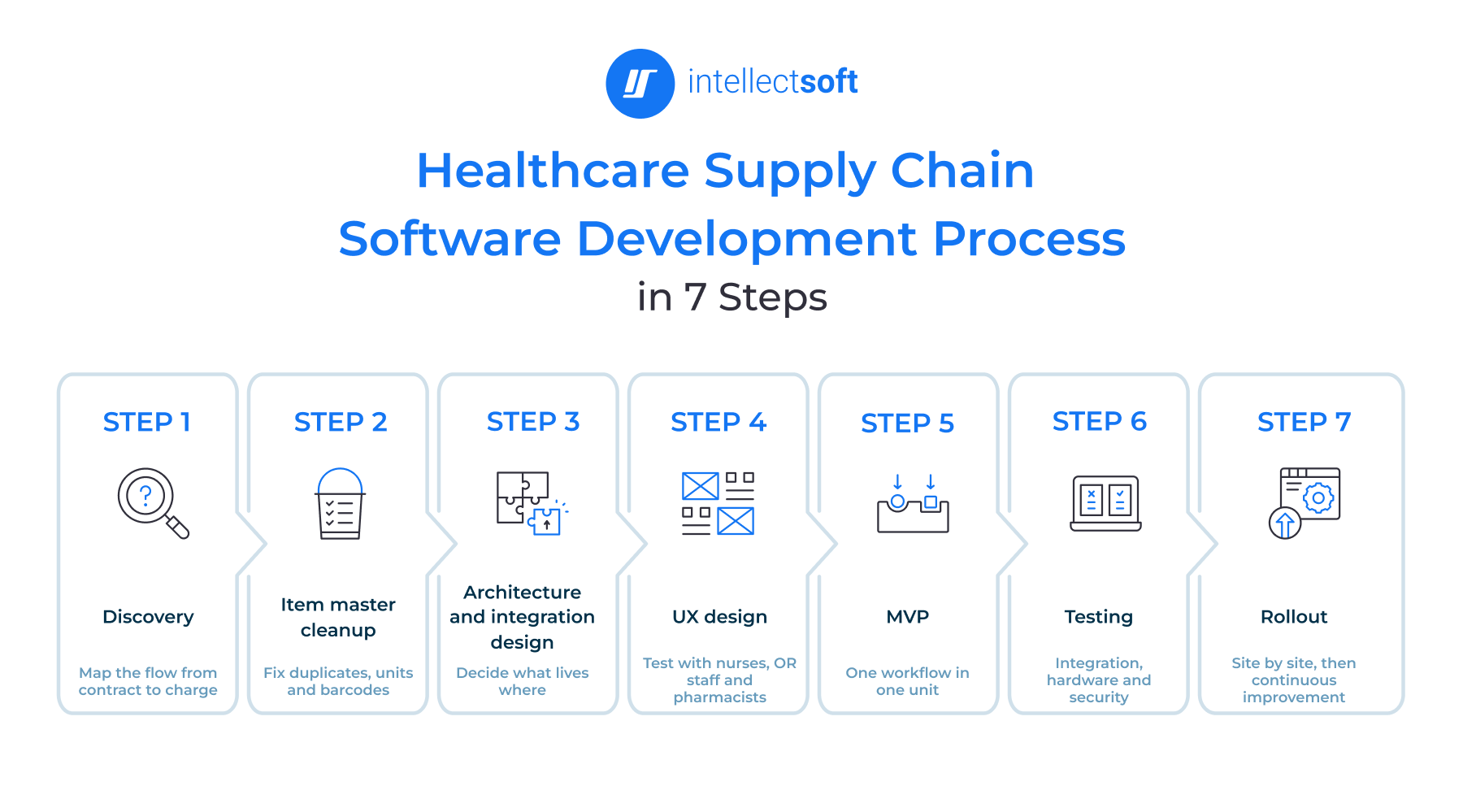
Late projects in healthcare supply chain software development tend to share a story. Screens come first. The data problems surface in month six, after the budget for fixing them is gone. The order below flips that.
Step 1 — Discovery: map the flow from contract to charge
Pick one product category, say cardiac stents, and follow it from the GPO contract all the way to the line on the patient’s bill. Walk it in person. Stand in the cath lab during a case and watch where the scan gets skipped. Before any design work starts, record a baseline for stockouts per month and for expired waste in dollars. Finance will watch the charge capture rate. For trusts in England, discovery also scopes the DPIA and the DSPT evidence the trust will ask for.
Step 2 — Item master and data cleanup
Cleanup starts before anyone writes code. Pull the item master and a year of purchase history, and the problems surface in a predictable order. Duplicates first. Then broken units of measure, then items with no barcode identifier at all. It’s dull work, but on go-live day it decides if the scanner finds anything. Agree on who owns each field. Clean data with no owner drifts back within a quarter, and the development team ends up fixing the same records twice.
Step 3 — Architecture and integration design
Now the team decides what lives where. In most designs, the finance system keeps price and GL coding, and the new platform owns locations and scan events. Interfaces get specified message by message. Charges usually travel over HL7 v2. Distributor traffic runs on X12, and each trading partner tends to bend the standard in its own small way. What happens when an interface goes down at 3 a.m.? Settle it in design.
Step 4 — UX design with nurses, OR staff and pharmacists
Before drawing anything, designers should spend a full shift in the OR, ideally on a day with a long joint replacement list. Watch a circulating nurse open package after package while the surgeon waits. Every extra tap in the prototype gets measured against that pace. Pharmacy is different. They want dense screens and fast search by lot number, with keyboard shortcuts for the people who live in the system all day. Teams without in-house designers often bring in UI/UX design services for this stage.
Step 5 — MVP for one workflow in one unit
Start small. Pick a unit with a champion, a charge nurse or OR manager who’ll defend the pilot in meetings. Implant capture in a single OR suite makes a good first workflow, and so does PAR replenishment on one med-surg floor. Run it for six to eight weeks against the Step 1 baseline. If implant charge capture doesn’t move, find out why before anyone asks for a second site. Narrow scope keeps mistakes cheap.
Step 6 — Integration, hardware and security testing
Testing happens on the scanners and RFID readers the floor will actually use, not on a developer’s phone. Feed it real labels, torn and smudged ones included. UDI parsing and DSCSA transaction data each need their own validation set, built from labels and files the health system actually received. Then comes UAT with clinical staff on a real shift. In England, also check GS1 location codes and Scan4Safety data flows against what the trust already scans. Bring in QA and software testing help early.
Step 7 — Site-by-site rollout and continuous improvement
Go live one site at a time. Each new site brings surprises of its own, like a different cabinet brand or a storeroom nobody ever mapped. Keep a small team on call for two weeks after each go-live. Then the work turns into tuning. PAR levels get reset once real usage data comes in, and forecast models get retrained every quarter. Report the Step 1 KPIs monthly. The development work doesn’t stop at go-live either, because the second site always wants something the first never needed.
Tech Stack
Most of this stack is ordinary enterprise tech, chosen to match what the healthcare provider’s IT team already runs.
Healthcare supply chain software stack by layer
| Layer | Common choices | Healthcare-specific requirements |
|---|---|---|
| Mobile scanning | Native iOS/Android, rugged scanner SDKs | Offline mode; GS1 barcode parsing |
| Web front end | React, Angular, TypeScript | Role-based dashboards for supply chain, OR and pharmacy |
| Back end | .NET, Java, Node.js; event streaming | Audit logging of every stock and usage event |
| Integration | Integration engine or iPaaS; HL7 v2, FHIR, X12 EDI, GS1 EPCIS, PEPPOL (UK) | Item master sync with the ERP is the critical path |
| Data and AI | Cloud data warehouse, BI, ML forecasting | Separate patient-linked data from analytics data |
| IoT | RFID readers, RTLS, smart cabinets | Hardware choice is made with the hospital, not after |
| Cloud | AWS, Azure, Google Cloud | US: HIPAA-eligible services under a BAA. UK: UK regions (AWS London, Azure UK South/West, Google Cloud London) for NHS data |
DSCSA data moves between trading partners as standard EPCIS events, and neither the law nor the FDA requires a ledger. A regular database with an append-only audit log covers it. Not keen on running infrastructure? Healthcare platform as a service options can take hosting and HIPAA controls off the development team’s plate. Hardware gets less attention than it deserves, and it’s usually the scanner battery or the cabinet API that delays a go-live. More on that in our IoT in healthcare guide. A familiar stack keeps hiring costs down.
How Much Does Healthcare Supply Chain Software Cost?
The ranges below line up with the project tiers in our custom software development cost guide. Healthcare supply chain software tends to land in the middle or upper half of each tier. Interfaces and data cleanup are the reason.
Indicative cost by scope
| Project scope | Typical cost | Main cost drivers |
|---|---|---|
| Single-workflow app or MVP (e.g., PAR replenishment or OR implant capture for one site) | $75,000–$145,000 (£55,000–£110,000) | One ERP integration; scanning hardware; number of user roles |
| Multi-module hospital platform (inventory, point of use, analytics across several sites) | $145,000–$350,000 (£110,000–£265,000) | ERP plus EHR integration; item master cleanup; offline mobile |
| Health system or distributor platform (warehouse, DSCSA traceability, supplier portal, AI forecasting) | $400,000–$2,000,000 (£300,000–£1,500,000) | Number of sites and suppliers; EDI, PEPPOL and EPCIS scope; high availability |
| Ongoing costs | 15–25% of build cost per year | Hosting, support, integration updates, regulatory changes |
All figures are indicative and depend on scope, team location, and how much already exists. Pound figures exclude VAT.
Integrations move the number more than anything else. Each new one, to the finance system, a distributor, or a cabinet brand, adds weeks of mapping and testing. Item master cleanup is the line procurement teams forget. If a third of the records need fixing, somebody’s hours go into it, and those hours are rarely in the first quote. Hardware sits outside the code but inside the project, and rugged scanners or RFID readers for implant cabinets add up fast. Then there’s site count. Every site brings its own storerooms and habits, and none of them match the last one. DSCSA scope adds pharmacy work on EPCIS data. Offline mobile needs a sync layer that survives conflicts, like two nurses scanning the last box of the same sutures.
After launch, plan on 15–25% of the original build budget each year. That covers hosting and support, plus updates when a trading partner changes its file format, or the MHRA finalizes its UDI rules. On timing, an MVP usually takes three to five months. A multi-module platform takes six to twelve months. [delivery lead to confirm]
Common Hospital Supply Chain Software Challenges
Bought or custom, healthcare supply chain management software runs into the same handful of problems once it meets a real nursing floor. Almost none are about code. Each one is cheap to fix early in development and painful after go-live.
| Risk | Warning sign | How to prevent it |
|---|---|---|
| Dirty item master | Duplicate items, wrong units of measure, missing GTINs | Clean and govern the item master before go-live; assign an owner |
| Clinicians skip scanning | Usage in the EHR does not match stock movement | Scan-first UX, offline mode, scanning in the case workflow |
| ERP and EHR access delays | No sandbox or API access in the first month | Request access in discovery; build against test environments first |
| Bill-only and consignment leakage | Implants billed late or not at all; unmatched invoices | Capture implants at point of use and auto-create POs |
| Shortage blind spots | Shortages found when the shelf is empty | Usage-based forecasting and alerts on sole-source items |
| DSCSA data exceptions (US) | Mismatched transaction data from wholesalers | Exception queues and reconciliation workflows for pharmacy staff |
| Price variation across sites | The same product bought at different prices across hospitals or trusts — the NAO found trusts paying up to £490 for a hip stem NHS Supply Chain sold for £258 | Price and contract checks against the catalogue at requisition; spend analytics by item |
Dirty item master
Picture three records for the same exam glove, each with a different unit of measure and only one with a barcode attached. That’s a normal day one. Nurses notice fast and go back to counting by eye. Most of the cleanup is unglamorous spreadsheet work that an analyst and a procurement lead can grind through before go-live. Then name an owner. Every new item should pass through that one person, or the mess grows back by the next budget cycle.
Clinicians skip scanning
The case record lists six items used, and the shelf is short by eight. Any gap means someone skipped a scan. In our experience, the app causes most of it, with too many taps and no offline mode for the dead spots in the OR. Put the scan inside the case record and let it run without a signal in those basement rooms. Every extra tap costs you scans. A weekly match rate posted for the charge nurse tends to change behavior faster than any reminder email.
ERP and EHR access delays
Health system security teams guard the finance platform and the chart closely. Fair enough. For a development team, though, it means waiting in a review queue that can outlast a sprint or three before the first API call works. Ask for credentials during discovery. Build against test environments first, and move to production once each interface clears review.
Bill-only and consignment leakage
An implant goes in on Tuesday. The PO shows up three weeks later, if at all, and the invoice lands with nothing to match against. AP ends up chasing reps for paperwork. Capture each implant at the point of use, lot and serial included, and let that scan create the PO automatically. Consigned inventory follows the same rule. The replenishment order goes out the day the item is used, not when someone finally reconciles the month.
Shortage blind spots
Too many teams learn about a shortage from a nurse holding an empty bin. By then the options are bad. Usage-based forecasting buys a few weeks of warning, and alerts should cover sole-source items first because one plant closure can empty the market. Feed in the FDA and ASHP shortage lists. Agree on approved substitutes before you need them, too.
DSCSA data exceptions
Wholesaler transaction data doesn’t always match what’s physically sitting in the tote, especially on a busy Monday at receiving. A lot number is off by a digit. Or a pack arrives with no data at all, and pharmacy staff can’t release it until someone sorts out the mismatch. Give them an exception queue that highlights the problem field. Add a workflow for contacting the wholesaler and recording the fix. Without that workflow, exceptions end up in spreadsheets, and the six-year audit trail develops holes nobody sees until an inspection.
Price variation across sites
The same catheter can cost a third more at one site than at another inside the same health system. Nobody notices. Each site only sees its own invoices. Check price and contract terms at requisition, before the PO ever leaves the building. Then run spend analytics by item across all sites, and look at the top fifty products by variance first. Some gaps are big enough to fund phase two.
Healthcare Supply Chain Software Development with Intellectsoft
We’ve spent 18+ years [verify] on custom software development. Our clients include 35 Fortune 1000 companies [verify], and a good share of our delivery work sits in healthcare and logistics. Healthcare supply chain management software development lives right where those two meet. You need people who know what an HL7 charge message looks like, and people who’ve built route and warehouse logic.
One project shows the overlap. Take a US identification solutions provider whose wristbands and labels are used across large health systems. It already had RFID wands and readers in place. We added an Android app and a web portal that keeps each unit’s history and service status in one view. Staff can now find expensive equipment fast and see if a unit needs maintenance before it goes back into use. The RFID asset management case study has the details.
The National Health Service is on our client list too, as our healthcare software development page notes. For the warehouse and routing side of the problem, we bring in the same engineers who build our logistics software for carriers and distributors.
Every engagement starts with an architecture sprint, mapping one product category from contract to charge. That’s Step 1 above. Want to compare hospital supply chain solutions against a build, or scope an MVP for implant capture? Talk to us in California at +1 (650) 233-6196 or in London at +44 20 3887 0078.
FAQ
What is healthcare supply chain software?
Healthcare supply chain software is the system a supply team opens when a stent goes missing between the dock and the cath lab. It follows each item from the contract and purchase order to the moment a nurse opens the package. A warehouse tool stops at delivery. This one ties each item to the case it was used in, which drives charge capture and recall searches. It doesn’t replace finance. In most health systems, it runs beside the finance suite as one part of a wider healthcare supply chain management setup.
What is the difference between hospital supply chain software and an ERP?
An enterprise resource planning system is built around money and knows what was bought and at what price. The trail goes cold once the box leaves receiving. SCM software keeps following it, through the OR core and onto a tray, until a nurse scans it against a case. In practice, healthcare organizations run the two side by side and share one item master between them. Finance tends to run the first. Healthcare supply chain management teams run the second, and fights over item master fields are common.
What features should hospital supply chain management software have?
Scanning comes first. It should read barcodes and UDIs in one pass. Then real-time inventory by location, with automated PAR replenishment running off the same counts so nobody restocks from memory. Implant and bill-only tracking matter if the OR is in scope. Distributors will expect EDI. The nursing app needs offline mode, since basement storerooms rarely get a signal. And keep the audit log append-only. In our experience, shortage forecasting is the AI feature healthcare supply chain management teams actually pay for.
How does healthcare supply chain software support DSCSA and UDI compliance?
DSCSA comes first for pharmacy. The module takes in package-level transaction data from each wholesaler and matches it against what actually arrived. The law says to keep those records for six years. UDI works differently. A single scan of the implant box should fill in the device identifier and production data. Then it attaches the implant to the case it went into. Recall searches drop to minutes. Before go-live, test both compliance features with real labels, including a few torn ones pulled from the receiving dock bin.
How does hospital supply chain software support Scan4Safety and GS1 standards in the NHS?
Since 2014, healthcare supply chain management in England has run on the national eProcurement Strategy. Even wristbands carry GS1 barcodes. Trust software reads them at the point of care. Each implant gets logged against the wristband before it goes in, and orders travel over the national e-ordering network. In the national point-of-care scanning pilot, recall time at the Leeds trust fell from 8.33 days to under 35 minutes.
How much does it cost to build healthcare supply chain software?
A single-workflow MVP usually costs $75,000–$145,000 (£55,000–£110,000). Multi-module platforms across several sites land around $145,000–$350,000, while a full health system or distributor platform can reach $400,000–$2 million. Interfaces and item master cleanup move the number most. Support adds roughly 15–25% of the build budget every year after launch, mostly for hosting and interface updates.
How long does healthcare supply chain software development take?
An MVP is the quick part. Healthcare supply chain software development for one workflow, such as implant capture in a single OR suite, usually takes three to five months. A multi-module platform takes six to twelve [delivery lead to confirm]. The code is rarely the bottleneck. Most healthcare supply chain management projects lose more time waiting for system access and cleaning the item master. Rollout then goes site by site.
Can AI help hospitals predict supply shortages?
Yes. Shortage forecasting is among the most practical uses of AI in supply chain work. A model trained on usage history and the surgical schedule can warn weeks ahead that a SKU will run out. FDA and ASHP shortage lists sharpen that warning. The model won’t fix a shortage. It gives healthcare supply chain management teams time to line up an approved substitute before a case gets canceled.