Key Takeaways
- Digital transformation in financial services runs across five segments with different binding constraints. Banking is held back by the core ledger, insurance by document-heavy intake. Wealth — by a client record split across custodians, capital markets by settlement timing, and payments by interfaces the institution does not own. Naming the wrong constraint is what produces a two-year program with no movement in a business metric.
- Adoption is near-universal, evidence is not. The Cambridge Centre for Alternative Finance surveyed 628 organizations across 151 jurisdictions. Only 40 percent of respondents report increased profitability from AI, and 43 percent report no change.
- Foundation work takes three to six months, first live journeys six to twelve, and a full program is measured in years. The largest variable is the condition of the underlying records. Core replacement rarely returns inside five years and is funded on risk reduction rather than payback.
- The EU AI Act treats credit scoring as high-risk, with obligations now applying from December 2, 2027 after the Digital Omnibus deferral. Logging, human oversight, and model documentation become build requirements rather than a governance layer added before an audit.
- Return is measured per initiative. Claims automation, core migration, and an advisor platform carry different payback profiles, and a single aggregate figure conceals which one is working. Foundation work is the exception, funded as a dependency and measured through the initiatives it enables.
Digital transformation in financial services now runs across five segments that share a label and little else. A bank is constrained by its core ledger. An insurer is constrained by document-shaped intake in claims and underwriting. Wealth managers work against a client record fragmented across custodians, capital markets firms against settlement timing, and payment providers. The binding constraint determines the sequence. Getting it wrong is what produces a program that reports activity for two years without moving a business metric.
Published guidance has not kept up with that spread. Almost every substantial guide on this topic is a banking guide. It leaves insurers, asset managers, and capital markets firms reading advice written about somebody else's ledger. The gap matters more now that returns are being scrutinized. The Cambridge Centre for Alternative Finance, in a study of 628 organizations across 151 jurisdictions, found that only 40 percent of respondents report increased profitability from AI. 43 percent report no change, and that 55 percent find it difficult to measure the value of AI deployment at all, rising to 76 percent among large financial institutions. So, adoption is not the problem, but evidence is.
This article covers what works in digital transformation services through each segment and its binding constraint, the core technologies behind the shift, the regulatory obligations that shape architecture. Then, we will explain a five-phase roadmap for financial software development and innovation with named deliverables and durations.
What Digital Transformation in Financial Services Means
Digital transformation in financial services is the coordinated modernization of technology, data, and operating models across banks, insurers, asset managers, and payment providers. The regulatory perimeter sets the pace of that work.
That second point separates finance from every other sector running a modernization program. A retailer can ship a new checkout flow on a Thursday. A bank changing how customer data moves between core ledgers. A fraud engine has to show a supervisor the control environment around that change. The evidence pack often takes longer to assemble than the integration itself.
The word doing the most work in the definition is coordinated. Most firms already run all three workstreams. A core platform replacement sits on
- a four-year plan owned by the CIO;
- the data platform runs on an eighteen-month roadmap owned by a chief officer hired two years ago;
- the claims automation pilot answers to operations.
Three terms get used interchangeably in board papers, and the distinction matters when a budget line has to be defended:
Digitization converts an analog record into a digital one — a scanned mortgage file becomes a searchable document, with the underlying process unchanged. Digitalization utilizes technology to improve an existing process, making it faster or cheaper. For example, we might route that mortgage file through an automated document-checking step. But the approval workflow stays the same. Digital transformation may not simply involve changing the technology stack and workflow and adapting existing data. It changes the operating model itself. So, the underwriting decision along with the information it draws on, the controls around it and the team accountable for it are all redesigned together.
Most stalled programs are digitalization projects carrying a digital transformation budget. The technology lands. The org chart, the approval gates, and the reporting lines do not move, so the cycle-time gain shows up in one team and disappears at the first handoff. That pattern has a number attached to it. In BCG's study of more than 800 executives, 44 percent of transformations created some value but missed their targets, against 30 percent that met or exceeded them.
Digital transformation in finance also carries an obligation the term rarely signals on its own: the firm has to keep operating throughout. There is no migration window in which a payment rail stops settling or a claims desk stops paying.
Why Financial Services Firms Are Transforming Now
Margin compression has removed the cushion that funded inefficiency
Rate-driven profits are fading, and the cost base underneath them is visible again. EU banks ran an average cost-to-income ratio of 49.6 percent in the fourth quarter of 2025, down from 53.89 percent a year earlier, according to Statista's series on European Central Bank figures. What it conceals is the spread: Portugal sits at 32 percent while France runs at 67 percent. Two banks in the same currency union are operating on entirely different unit economics. A firm at 67 percent has roughly two-thirds of every euro of income consumed before profit. Manual reconciliation, duplicated onboarding checks, and four systems holding the same customer record are what that number is made of. Transformation becomes a cost-line argument, according to the European Central Bank's supervisory banking statistics.
The AI capability gap is widening between incumbents and challengers
Adoption for financial services is near-universal, but depth is not. The 2026 Global AI in Financial Services Report from the Cambridge Centre for Alternative Finance drew on 628 organizations across 151 jurisdictions. It found that fintechs lead incumbents in reaching a transforming stage of AI adoption by 19 percent to 6 percent.
Both groups have AI in production. One group has it in the operating model. The same study reports that 55 percent of industry respondents find it difficult to measure the value of AI deployment, rising to 76 percent among large financial institutions. A challenger with 400 people and one platform can trace a model's effect on approval rates. An incumbent running the same model across eleven business units, three ledgers, and a decade of undocumented ETL cannot.
Reporting obligations have outgrown the systems underneath them
Risk reporting is where legacy architecture becomes a supervisory finding. In its 2023 progress report on the BCBS 239 principles, the Basel Committee assessed 31 global systemically important banks. Only two were fully compliant with all principles, which were meant to be adopted by 2016. It suggests the underlying records cannot be aggregated because of how the systems were built, and no reporting layer bolted on top fixes that.
Embedded finance is moving distribution outside the institution
Products are increasingly sold where the customer already is, which is rarely the institution's own channel. McKinsey's analysis of the European market found that embedded finance accounted for 5 to 10 percent of retail and SME lending revenues in 2023 and could reach 20 to 25 percent by 2030. Over the previous decade, embedded-finance volumes grew three times as fast as directly distributed loans. A firm whose systems cannot expose a lending decision through an API is not competing for that revenue. This reframes core modernization from an internal efficiency program into a distribution question, and it changes who signs off. The commercial owner now has a stake in the platform roadmap.
Capability constraints, not budget, gate delivery
Money is rarely what stops a program. The Cambridge study found that data quality, talent, and legacy architecture remain the core constraints on AI adoption and scaling. Its authors noted that the same two leading barriers appeared in their 2020 work with the World Economic Forum.
The detail that matters for anyone planning a build is a vendor’s responsibility. Seventy-two percent cite quality and completeness as an acute problem in client work, 46 percent point to legacy systems and siloed environments, and 41 percent hit sharing restrictions. Financial institutions hiring a machine learning team before the customer record is reconciled has bought capacity it cannot deploy. The team spends its first two quarters writing extraction scripts instead of models. Sequencing the capability build against the existing estate separates a program that ships from one that reports activity.
Digital Transformation Across Financial Services Segments
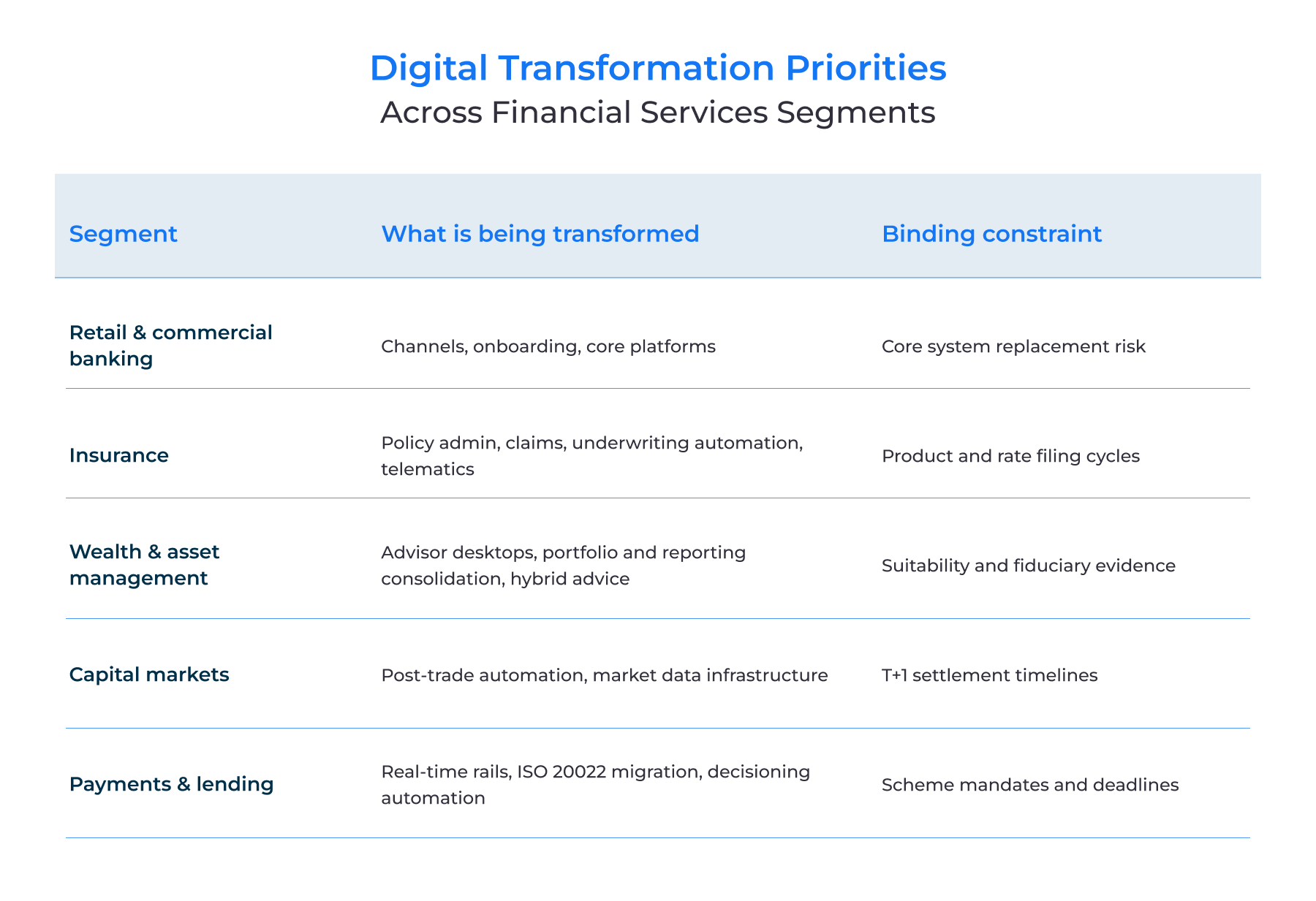 Sequencing differs by segment because the binding constraint differs.
Banking
Digital transformation in banking prioritize the investment into the core ledger, the customer record sitting across product silos, and the channel layer on top of both. The binding constraint is the core. Most migrations fail on the reconciliation between old and new balances rather than on the new platform itself. Progressive strangling of the monolith, product line by product line, has largely replaced the single-cutover replacement.
A specific pattern for these financial services: a bank moves savings accounts to a new core. Mortgages stay on the mainframe, running dual ledgers with automated end-of-day reconciliation for eighteen months. The commercial payoff arrives before the migration finishes. We cover the sequencing decisions, vendor trade-offs, and failure modes in more depth in our guide to
Insurance
Insurance software solutions are transforming underwriting, claims, and the policy administration system that both depend on. The binding constraint is document-shaped. A motor claim arrives as a photograph, a repair estimate in PDF, a police reference number, and a phone call transcribed by an adjuster. None of it enters a structured field without a human reading it first. Automating the decision does nothing while intake stays manual, and modernizing legacy insurance systems becomes a priority.
One pattern in first-notification-of-loss: a document model extracts damage location, vehicle details, and estimate totals from the intake bundle. Anything below a value threshold routes straight to settlement, and the rest escalates with the fields already populated. The adjuster stops typing and starts adjudicating. Cycle time falls on the simple majority of claims while complex ones get more attention.
Policy administration is the harder half for an investment. Many carriers run products written decades ago whose rules exist only in codeю So, the rewrite cannot begin until those rules are extracted and validated against historical policies. That extraction is a deliverable in its own right.
Wealth and Asset Management
Wealth managers are transforming client reporting, onboarding, and the advisor's view of the household. The binding constraint is fragmentation of the client record. A single household may hold assets across three custodians, two legal entities, and a legacy platform acquired with a smaller firm. No system presents the whole picture without an overnight batch.
Advisor productivity is the metric that moves investment. An advisor covering 180 households cannot prepare for a review meeting when position, suitability, and last-contact information live in separate places. Firms addressing this consolidate the client record first and rebuild reporting on top of it. The order matters: a new reporting front end over a fragmented record produces faster access to the same incomplete picture. Suitability and appropriateness obligations make this more than a convenience question. An advisor cannot evidence a recommendation against holdings the system does not show.
Consolidation usually runs through the advisory platform rather than a separate warehouse, which is why CRM software for financial services is the center of most wealth roadmaps.
Capital Markets
Sell-side and buy-side firms are transforming post-trade processing, collateral management, and the reference data underneath both. The binding constraint is settlement timing. Compression to T+1 in the United States removed most of the overnight window that manual exception handling relied on, and affirmation now has to happen on trade date.
The operational consequence is specific. A firm processing 12,400 trades a day with a 3 percent exception rate handles roughly 372 breaks, and under the old cycle those breaks could be worked the following morning. Under T+1 they compete for the same evening hours as everything else. Firms respond by automating exception classification. So that only genuinely ambiguous breaks reach a person, and by fixing the standing settlement instructions that generate a disproportionate share of them.
Reference data quality is the unglamorous prerequisite. An instrument identifier that differs between the order management system and the settlement platform creates a break every time that instrument trades. No amount of downstream automation removes it.
Payments
Payment providers and the banks competing with them are transforming authorization, reconciliation, and the interfaces through which third parties reach both. The binding constraint is external. Distribution has moved to platforms the institution does not own, and access to those platforms runs entirely through interface quality.
Reliability is the product here. A merchant platform choosing an acquirer looks at uptime, at latency under load, and at how quickly a sandbox integration reaches production. A documented API with predictable versioning beats a better underlying rail with unpredictable release notes. Reconciliation is where the operational cost sits. A provider settling to 4,000 merchants across three schemes generates matching work that grows with volume, unless it is automated at the point of capture.
Regulatory access requirements set the floor rather than the ceiling. Mandated interfaces produce a compliance-grade endpoint. Commercial distribution needs one that a partner's engineering team will choose voluntarily. The gap between those two is where competitive position is decided, and it is why open banking APIs function as a commercial asset rather than a compliance deliverable.
Core Technologies Behind the Shift
No single technology carries a digital transformation. A functional core is key to the operational success of a company. The order of operations matters as the data stack should flow in accordance to the result not the other way around.
Cloud and Core Modernization
Moving off a monolithic core changes release cadence more than it changes cost. When financial services changes no longer require a full-core regression cycle, launches move from quarterly to weekly. Pricing or fee logic can be adjusted without a code freeze. Capacity stops being a procurement decision. So, seasonal load — tax season, payroll days, holiday spend — is absorbed rather than planned for months ahead. The harder work is deciding which functions stay on the core and which get carved out first.
AI and Machine Learning
The operational change is where decisions happen. Fraud scoring moves from overnight batch to the authorization moment, so declines happen before the money leaves. Credit decisions that took an underwriter a day resolve in minutes for the standard band, leaving humans on the exceptions. In servicing, models handle intent routing and first-response drafting, which shortens queues without adding headcount. What this demands in return is explainability: every automated decision needs a reason code a regulator can read.
Data Platforms and Governance
Most banks have a reconciliation problem — the same customer exists differently in the core, the CRM, and the risk system. A unified platform removes the argument about which number is right. This is what makes reporting faster and models usable at all. Lineage tracking means you can show where a figure came from when an examiner asks. Without defined ownership and quality thresholds, every downstream AI project inherits the same bad inputs.
APIs and Open Finance
APIs turn product distribution into a configuration task. A lending product can be placed inside a marketplace, an accounting tool, or a partner's checkout without rebuilding it for each channel. Internally, the same interfaces let teams ship against the core without waiting on it. Under open banking rules, third parties get customer-permissioned access to accounts and payments. It means competing on the experience layer.
Blockchain and Tokenization
Tokenized bonds, funds, and money market instruments settle atomically, so delivery and payment happen in one step instead of clearing over days. That releases collateral and working capital that currently sits idle in the settlement window, and it shortens the reconciliation chain between counterparties. Cross-border transfers see the same effect. The constraint is legal: tokenized assets need a jurisdiction that recognizes the token as the record of ownership.
RegTech and Compliance Automation
Digitalization utilizes technology to improve an existing process, making it faster or cheaper. For example, we might route that mortgage file through an automated document-checking step, while the approval workflow stays the same. Digital transformation may not simply involve changing the technology stack and workflow and adapting existing data by enhancing the analytics. It changes the operating model itself. So the underwriting decision along with the information it draws on, the controls around it and the team accountable for it are all redesigned together. The change worth naming for a board: audit evidence becomes a query.
Where AI Delivers Measurable Value in Financial Services
Value shows up where a process has high volume, a stable definition of a correct outcome, and an audit requirement that made full automation impossible before. Five areas explain how AI is applied in fintech.
Document and claims processing
Intake is the bottleneck in most back-office work, and it is where extraction models earn their keep. A claims file, a mortgage pack, or a corporate onboarding bundle arrives as scanned pages, photographs, and free text. A person has to read all of it before any downstream system can act. Models that pull structured fields from those artifacts move the constraint rather than decorate it. The gains are measurable because the baseline is measurable. There are touches per file, straight-through rate, and the share of exceptions that reach a person with fields already populated.
Fraud detection and AML monitoring
False positive volume is the interesting number here. An AML alert queue where nine in ten alerts close as no further action consumes analyst capacity that regulators expect to be spent on genuine investigation. Models that rank and triage alerts change the economics of the second line without changing the obligation. Explainability is the constraint: an alert disposition has to be defensible to a supervisor. So, the architecture needs to retain the reasoning.
Credit and underwriting decisioning
Decisioning is where model governance is heaviest and where the return is clearest. Faster time to decision has direct commercial value in lending, and consistency has direct regulatory value. The binding constraint is evidencing that the model does not produce disparate outcomes across protected characteristics. It means the monitoring apparatus has to exist before production, not after the first supervisory question. Firms that build the challenger model and the fairness monitoring alongside the primary model ship faster overall. The approval conversation has answers in it.
Client servicing and advisor support
Retrieval over a firm's own documentation is the durable use case. An advisor or a service agent needs the current answer about a specific product held by a specific customer. Most of the delay is search rather than judgment. Assistants that surface the answer with its source attached remove the search without removing the accountable human. The failure pattern is deploying a general assistant across the enterprise and measuring nothing. The working pattern is a narrow tool inside one workflow with a before-and-after on handle time.
Regulatory reporting
Reporting consumes analyst hours that are almost entirely reconciliation. Models help with lineage documentation and with classifying transactions against a reporting taxonomy. They also flag where two systems disagree before a submission goes out. Automation of the submission itself is rare and should stay rare. What moves is the preparation cycle, and the value is measured in reduced manual adjustment volume rather than in headcount.
Agentic AI in back-office operations
Agentic systems execute multi-step workflows rather than answering a single query. In practice that means a system that reads an exception, retrieves the related records across two platforms, applies a documented rule, drafts the correction, and routes it for approval. The step that distinguishes it from earlier automation is that the sequence is not hard-coded.
AI software development moved quickly. Evident's use case tracker recorded that agentic applications reached 31 percent of new banking AI use cases in the first quarter of 2026, up from 15 percent in the previous quarter. Most cluster in product and service operations, as banks shift away from enterprise-wide copilots toward workflow-embedded tools. An earlier Evident analysis found that only nine of the 50 banks it tracks had documented an agentic use case in production or pilot, and three had published the supporting architecture.
That gap is the whole story for a regulated operator. An agent that can act needs a defined scope of authority, a durable record of what it did and why, a rule about which actions require human approval, and a mechanism to stop it. Building those controls after the pilot works is how a promising result stalls at the risk committee. Deciding what the system is permitted to do, before deciding what it runs on.
The failure mode worth stating plainly
Programs do not usually fail at the model. They fail because nobody established what condition the underlying records were in before the work was scoped. The twelve to eighteen months that follow get spent discovering it. An initiative launched without that assessment tends to run out of sponsor patience around the point where the team is still writing extraction logic and has no outcome to report.
The assessment itself is unremarkable work — field-level completeness, duplication across systems, lineage for anything a supervisor might ask about — and it takes weeks. Skipping it relocates them into the delivery phase, where they cost more and are visible to the steering committee. The pattern repeats across sectors, and we have written up the variations in
Regulatory and Compliance Constraints
Regulation in determines
- what the architecture has to expose,
- what evidence the team produces as a work product
- which sequence of releases is defensible.
Treating it as a review gate at the end is the most reliable way to lose a quarter.
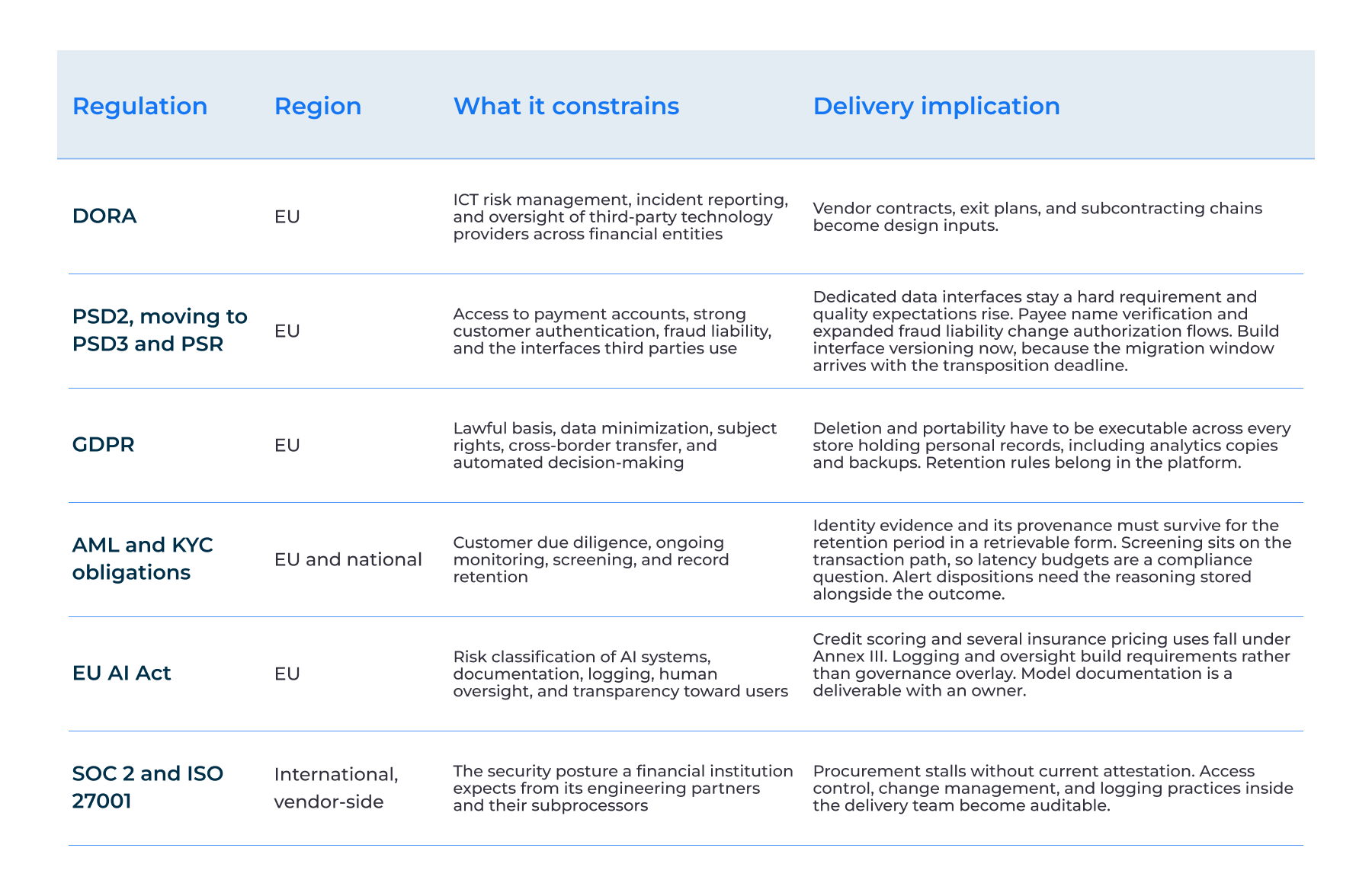
Two timing points matter more than the rest for anyone planning a 2026 build.
The AI Act's high-risk obligations moved. Regulation (EU) 2026/1744, the Digital Omnibus on AI, was published in the Official Journal on July 24, 2026 and entered into force on July 27, deferring standalone Annex III systems to December 2, 2027 and AI embedded in regulated products to August 2, 2028. The relief is narrower than it reads. Article 50 transparency rules and the Article 4 AI literacy duty stay on their original timeline, and a credit scoring model still lands in Annex III when the deferral expires. Eighteen additional months is roughly one honest build cycle for logging, oversight, and documentation on a model already in production.
The payments package is close but not yet applicable. The provisional political agreement was reached in November 2025, with the final compromise texts published on 23 April 2026, and Official Journal publication is expected around the end of the second quarter of 2026, with the PSR applying 18 months after entry into force and payee-name verification at 24 months. Firms building payment technology now are building against a specification whose content is settled and whose date is not. That argues for interface abstraction over hard-coded flows.
Every one of these obligations converts into an artifact the delivery team produces, and the artifacts are cheaper to generate during the build than to reconstruct afterward. Lineage documentation written while the pipeline is being built takes hours. The same document reconstructed two years later from undocumented transformations takes a team.
Common Barriers and How Firms Address Them
Fragmented data ownership across business lines
The customer record exists in five places and no one owns the definition. Each business line built its version to answer its own question, and each version is correct for that purpose. Consolidation attempts fail when they are framed as a technical merge rather than a decision about whose definition wins. Firms that get through this appoint a single accountable owner per domain — customer, product, position — with authority to rule on conflicts. Reconciling the competing definitions becomes a scoped deliverable rather than a discovery activity.
Programs scoped around systems rather than customer journeys
A program named after a platform produces a platform, and the business case that funded it was written about a cycle time. Scoping by system persists because it maps cleanly onto budget lines, vendor contracts, and existing team boundaries. That makes it the path of least organizational resistance. The correction is to scope around a journey that crosses systems — a claim from notification to payment, an onboarding from application to first transaction. Funding covers the whole path, even where three teams end up sharing one measure of success.
Vendor lock-in inherited from earlier modernization rounds
Each previous digital transformation round solved a real problem and left behind a dependency. The current estate is the accumulated sediment of those decisions. Lock-in persists because the exit cost is always higher than the annual license, and the comparison is never made explicitly. Firms address this by pricing the exit before the renewal rather than after. By insisting that new components expose their data through interfaces the institution controls. That second condition is what separates legacy system modernization from replacing one dependency with a newer one.
Parallel-run costs during core replacement
Running the old core and the new one simultaneously doubles the operating cost of the most expensive technology a financial institution owns, and the overlap always lasts longer than the plan says. The cost persists because reconciliation between two ledgers surfaces discrepancies that nobody knew existed. Firms that manage this migrate by product line rather than by wholesale cutover, decommissioning aggressively as each line clears reconciliation. The parallel-run budget sits as a named investment line with an owner, not as contingency.
Unclear accountability between business and technology functions
When a program underdelivers, the business says the platform did not do what was asked and technology says the requirements changed. Both are usually telling the truth. The ambiguity exists because delivery and outcome owners are different, and there is no forum for their joint decision-making. The fix is a single named owner of the outcome, with authority over both the build and the operational change around it. The steering rhythm matters as much: the metric under review has to be the business one, not the delivery milestone.
How to Build a Financial Services Transformation Roadmap
Sequencing decides the outcome more often than technology selection does. A roadmap that ships foundation work before it has an owner for the target architecture produces infrastructure nobody has committed to using. The five phases below assume a program of meaningful digital transformation consulting.
1. Discovery and readiness assessment
Four to six weeks spent establishing what is actually there. The audit covers system inventory and interfaces, the condition of the records the program will depend on, and the compliance posture that constrains sequencing. Use cases get shortlisted against two axes that are usually confused with each other: business value, and whether the underlying records can support the use case at all. Firms that skip the second axis fund initiatives that cannot start.
Key decision: which use cases are deferred because the record estate cannot support them yet. Naming the deferrals is more valuable than naming the priorities, because deferrals are what the foundation phase is scoped against. This is where independent IT consulting services earn their fee, since the assessment has to be uncomfortable to be useful.
Deliverable: readiness report with prioritized use cases.
2. Target architecture and business case
Six to ten weeks defining the target state and how the estate gets there. Integration approach is the substance of this phase: whether the core is strangled progressively, wrapped behind an abstraction layer, or replaced. The interface contract looks different in each case, and defining it is part of the same decision. The business case is built per initiative rather than for the program as a whole, so that a stalled workstream can be stopped without renegotiating the whole investment.
Key decision: whether the core is replaced, wrapped, or strangled by product line. Every downstream cost in the program follows from this, and reversing it in year two costs more than the original build. The decision belongs to a named architect with authority.
Deliverable: architecture blueprint and business case.
3. Foundation build
Three to six months building what everything else depends on. The data platform, the integration layer, and the security and compliance controls go in together. Retrofitting controls onto a platform already in production is how a program acquires an eighteen-month remediation phase. This is the least visible phase to a steering committee and the one most often compressed under pressure to show progress.
Key decision: how much foundation is enough before the first journey ships. Building all of it delays value past the point where sponsorship survives. Building none of it means the first journey carries the full cost of the platform. The workable answer is usually the foundation required by the first two journeys, with the extension path designed in.
Deliverable: production-ready platform foundation.
4. Segment rollout
Six to twelve months delivering journeys in sequence. Each journey crosses systems, so the rollout unit is the customer path rather than the platform. Parallel-run applies wherever a core system is affected. Measurement is built into each journey at release rather than retrofitted, which means the baseline has to be captured before the change goes live.
Key decision: journey order, and what evidence closes each parallel run. Sequencing by commercial value alone produces a first release that touches the hardest system. Defining the reconciliation threshold that permits decommissioning is what stops parallel runs from becoming permanent.
Deliverable: live journeys with measured outcomes.
5. Scale and optimize
Extension to the remaining lines of business, with monitoring and retraining established wherever a model is in production. The operating model is the real output here — who owns each domain, how change is approved, and what the standing measurement rhythm looks like. Programs that treat this as a wind-down phase hand back a platform without the accountability structure to keep it current.
Key decision: what moves into run and what stays under program governance. Moving too early leaves undocumented dependencies with a team that did not build them. The handover point is where digital transformation services either hold their value or quietly lose it, because everything delivered in phase four depends on someone owning it afterwards.
Deliverable: operating model and monitoring in place.
Measuring ROI on Financial Services Transformation
Measurement is where most programs are weakest, and the weakness is structural rather than analytical. Evident's tracking of insurers found that only 18 percent of new AI use cases in the first quarter of 2026 reported an outcome at all, down from 38 percent the previous quarter. Four in five of those reported productivity gains rather than revenue, customer, or risk figures. Firms are shipping faster than they are measuring.
Why ROI is measured per initiative, not per program
A transformation program is a portfolio of unrelated bets sharing a budget line. Claims automation, core migration, and an advisor platform have different payback profiles risk of failure, and owners. Rolling them into a single return figure produces a number that cannot be acted on. It hides the initiative that is working alongside the one that should be stopped.
Aggregation also invites attribution error. A PMO tracking eleven parallel workstreams, four of which touch the same policy administration system, cannot say which one moved the quote-to-bind time. Per-initiative measurement forces a baseline and a boundary before the work starts. This is the only point at which either can be defined honestly.
Foundation work is the exception that proves the rule. A data platform has no standalone return, so it is funded as a dependency of the initiatives it enables and measured through them.
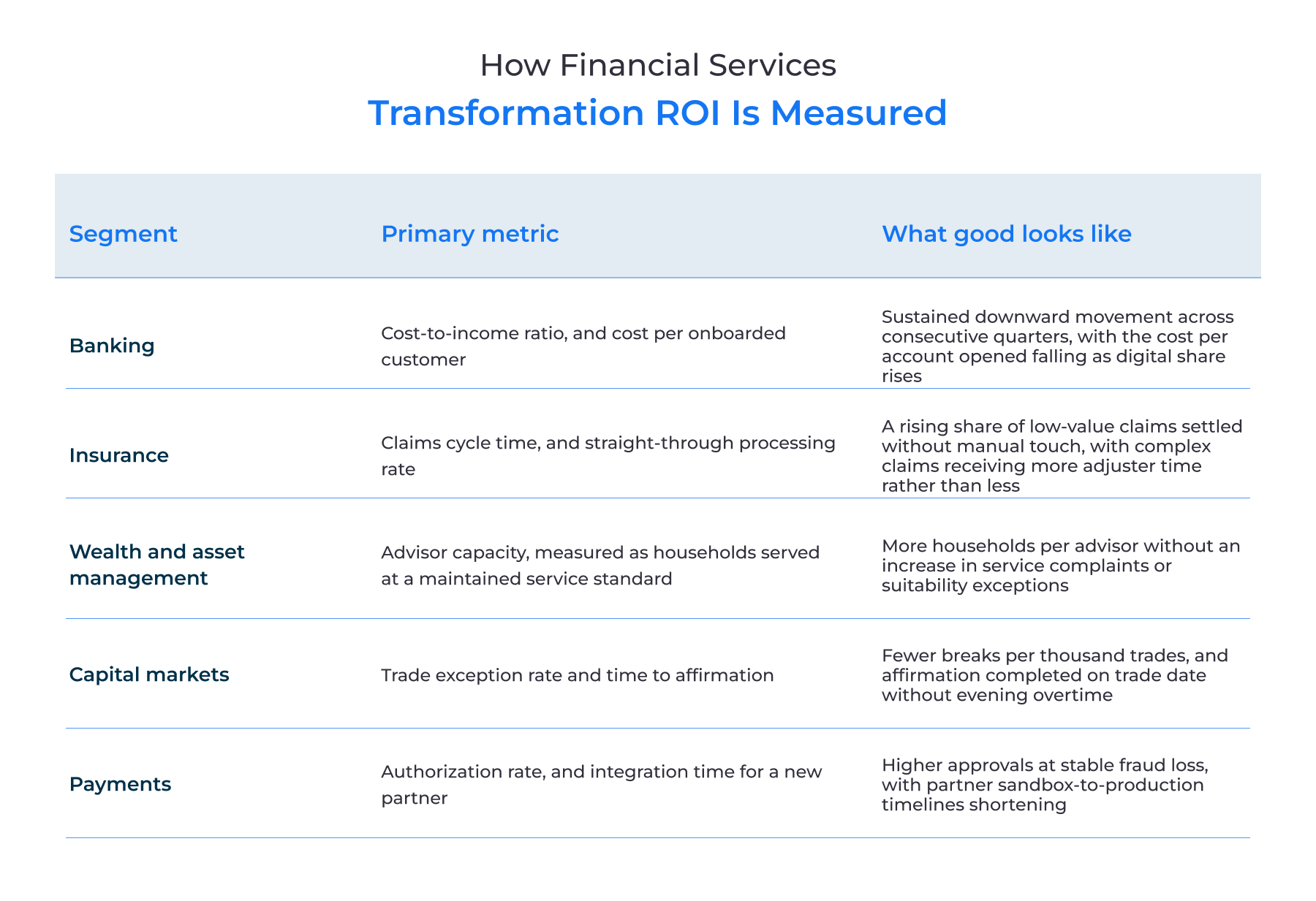
Realistic payback windows
Process automation inside a single function pays back fastest, because the baseline is well defined and the change touches one team. Journey-level work that crosses systems takes longer, usually eighteen months to three years, and the delay is mostly integration rather than build. Core replacement rarely shows positive return inside five years: it is funded on risk reduction, unit cost of change, and the products the current core makes impossible.
A worked example makes the shape clearer. An insurer processing 312,400 motor claims a year, with 61 percent currently requiring manual intake at an average of 22 minutes each, spends roughly 69,900 hours on intake alone. Automating intake on the 40 percent of those claims that are documentary and low-value removes about 27,900 hours. At a loaded cost of 34 euros an hour, that is 948,600 euros a year against a build that is unlikely to exceed a year's saving. The same arithmetic applied to complex claims returns almost nothing. This is why scoping the automation boundary correctly matters more than the model.
Digital Transformation in Practice
Ernst & Young provides assurance, tax, consulting, and advisory services worldwide, and its standing depends on the quality of what its specialists publish. The firm wanted to reach financial professionals with a steady stream of expert analysis, in a form that stayed readable against competing publishers. The constraint was editorial rather than technical. The publishing cycle had to be fast enough that market commentary reached readers while it still mattered.
As the solution, Intellectsoft built Forecasts in Focus, a mobile application designed around both ends of that process. Editors work in their existing CMS and push copy, graphics, and other media directly into the app, which removed the handoff that normally sits between an editorial team and a mobile release. On the reader's side, financial professionals assemble their own view from selected webcasts, industry reports, and geo-located updates.
The innovation that matters here is a shortened path from editorial decision to published content, with a consistent brand voice maintained across it. Publishing became a routine operation rather than a release event.
The project illustrates a point that recurs across the financial services. The binding constraint was not the mobile front end, which is the visible part, but the pipeline behind it — where content originated, who touched it, and how many steps stood between a finished analysis and a reader. Transformation work in financial organizations follows the same shape more often than not: the interface is what gets discussed, and the system feeding it is what determines whether the interface is worth building. Further examples are collected in our client case studies.
Why Intellectsoft for Financial Services Transformation
Eighteen years of engineering delivery, and 35 Fortune 1000 companies among the organizations we have built for. We rely on our principles:
- Full-cycle delivery, one accountable team. Discovery and strategy, architecture, build, integration, and post-deployment support sit with the same people. Programs fragment when the firm that wrote the architecture hands over to a delivery vendor who inherits none of the reasoning. Closing that gap consumes the first quarter of the build.
- Compliance-aware engineering. Logging, lineage, access control, and model documentation are produced as the work proceeds rather than assembled before an audit. This is the practical difference in digital transformation in financial services compared with other sectors.
- Legacy digital transformation and AI integration in the same practice. Most financial companies need both, and the two interact. A model is only as useful as the records feeding it, and those records usually sit in a system written before the model's architecture existed. Separating the two workstreams across two vendors is how the dependency between them becomes nobody's problem.
- Industry depth across fintech, insurance, healthcare, construction, and logistics. Regulated records and legacy estates recur across all five. So does the integration problem of systems that were never designed to talk to each other. Technology decisions made in one sector transfer more often than the sector labels suggest.
Our enterprise software development practice covers the delivery model in detail and shows the technology decisions behind specific programs rather than the outcomes alone.
FAQ
What does digital transformation in financial services involve?
Digital transformation in financial services involves modernizing technology and operating models across regulated financial businesses. The sequence follows the regulatory perimeter rather than the technology roadmap. The work spans the core systems of record and the integration and data layer above them. An innovation also covers the operating model that determines who owns each decision. Compliance evidence is produced as a build artifact throughout, not assembled at the end.
How does digital transformation differ across banking, insurance, and asset management?
Banking transformation centres on the core ledger and the customer record fragmented across product silos. Its hardest problem is reconciliation between old and new balances during migration. Insurance turns on document-heavy intake in claims and underwriting, where automating the decision achieves nothing while intake stays manual. Asset and wealth management face fragmentation of the client record across custodians and legal entities. Advisor capacity is the metric that moves once consolidation happens.
How long does a financial services transformation take?
Foundation work — the data platform, integration layer, and controls — typically takes three to six months. First live journeys follow at six to twelve months, and a full program is measured in years rather than quarters. The largest variable is the condition of the underlying records, which determines whether the first initiative can start at all.
How much does digital transformation in financial services cost?
Cost is driven by four things:
- the number of systems in scope;
- the state of the records feeding them;
- the integration surface between old and new components;
- the length of any parallel run during core replacement.
Process automation inside a single function sits at the low end and generally pays back within a year. Core replacement sits at the opposite extreme and is funded on risk reduction and unit cost of change rather than on a payback calculation.
Which regulations affect financial services transformation programmes?
DORA constrains ICT risk management and third-party oversight, making vendor exit plans a design input. PSD2 and the incoming PSD3 and PSR govern account access, authentication, and fraud liability, which shapes interface design in payments. GDPR determines how personal records are stored, deleted, and used in automated decisions. AML and KYC obligations place screening on the transaction path with retention requirements attached. The EU AI Act sets classification, logging, and oversight duties that apply directly to credit scoring and several insurance pricing uses.
How is ROI measured on a transformation programme?
Per initiative because a program is a portfolio of bets with different payback profiles. Metrics differ by segment:
- cost-to-income and cost per onboarded customer in banking;
- claims cycle time and straight-through rate in insurance;
- advisor capacity in wealth;
- trade exception rate in capital markets;
- authorization rate in payments.
Foundation work is the exception, funded as a dependency and measured through the initiatives it enables.
Why do financial services transformation programmes fail?
Two causes account for most of it. Programs scoped around systems rather than customer journeys deliver a platform when the business case promised a cycle time. System-shaped scope maps onto budget lines and team boundaries more easily than a journey does. AI initiatives launched before anyone assessed the state of the underlying records spend their first two quarters on extraction work with no outcome to report. That is usually longer than sponsor patience lasts.
Should firms modernize core systems or build around them?
Full replacement fits where the core blocks products the firm needs to sell and the institution can fund a multi-year program with a parallel run. It carries the highest reconciliation risk of any option. A progressive strangler approach — moving one product line at a time behind a stable interface — fits most firms. Commercial value arrives before the migration finishes, and the blast radius of any single cutover stays contained.