Key Takeaways
- Enterprise AI lives inside your identity model, your governed data, and your systems of record.
- Three routes exist — features in software you already own, a configurable platform, or a build. Most enterprises run all three.
- Building pays off when your process, rather than your data alone, is the advantage.
- Pricing on a per-seat basis appears to be inexpensive at 200 users and 9,000 at a board-level line item.
- A decision with no owner and no baseline or unassessed data will lead to most failures before code.
- A four-to-six-week proof of concept on real data answers more than a strategy deck.
Most enterprises evaluating enterprise AI solutions already have AI running somewhere. A copilot license that arrived with the productivity suite. A chatbot on the support site. A pilot that impressed everyone in March and quietly stalled by August. The open question is no longer adoption. It's what the next step should be — another subscription, or something built around your own data, systems, and workflows.
This guide works through that decision: when buying wins, when a build is justified, what production-grade really requires, and how to run a project without joining the pilots that never shipped. It also draws on how Intellectsoft's AI services and solutions practice scopes these engagements.
What Are Enterprise AI Solutions?
Enterprise AI solutions are AI systems that run inside your actual operations. So, there are your data, your permissions, and your systems of record. The category spans machine learning models, generative AI applications built on LLMs, and AI agents. A tool qualifies once it reads from the data warehouse, writes to the CRM, and answers to the same access controls as the person using it.
Most vendor pages define the category by size — bigger models, more data, wider deployment. That describes the easy part.
The hard part was never intelligence but the context. A public chatbot can summarize a contract you paste into it. It cannot tell you which of your 4,000 active contracts carry a conflicting renewal clause.
So the working definition is narrow. AI solutions for enterprises run under your identity model, on governed data, inside your systems, and every action leaves an audit trail. Companies that came through a wave of digital transformation services hit this boundary first, because their data is finally reachable enough for AI to matter.
Agentic AI raises the stakes. Ask a model a question and the worst case is a bad answer. Give an AI agent write access and a bad answer becomes a wrong record, a filed ticket, a workflow firing downstream.
How enterprise AI differs from consumer and SMB AI
Consumer AI assumes one person with one set of files. Small-business AI assumes a dozen people who mostly trust each other. Neither assumption survives an enterprise.
Permissions come first. The CFO and a student intern can ask the same question but must not get the same answer. So you filter every retrieval by who is asking you. Next comes auditability: if an AI system recommends denying a claim, someone will want to know the reason months later; that means keeping inputs, model version, and reasoning path.
Connection depth is where most pilots quietly die. A consumer tool needs an upload button. Enterprise AI reads from SAP, writes to ServiceNow, and stays in sync with a warehouse that changes hourly.
Volume rewrites the engineering. Twelve people querying a model at lunchtime need no planning. Nine thousand across three time zones means queueing, caching, and a real inference budget. Then there's procurement, which signs nothing without a security review and a straight answer on data residency.
The three ways enterprises actually get AI
Three routes bring enterprise AI inside a large company, and most organizations run all of them.
AI features inside software you already own. Your CRM, ITSM, and productivity suite ship generative AI capabilities, usually bundled into a tier you already pay for. Adoption effort is close to zero. So is your control over how they behave.
An enterprise AI platform you configure. Bedrock, Vertex AI, watsonx, and the agentic platforms work here, each fronting a catalog of LLMs through one API. You bring your data, connect your systems, and set the rules. The vendor owns the runtime, the model catalog, and the roadmap.
A custom AI solution built on your data and processes. Generative AI models, retrieval, and orchestration assembled around how your business works. You own the architecture and the behavior, along with the maintenance.
None of the three is the mature choice on its own. The mature choice is knowing which of your problems belongs in which bucket.
Off-the-Shelf vs. Custom Enterprise AI Solutions
Here's how the three routes compare on the criteria that decide the outcome.
Off-the-shelf vs. platform vs. custom
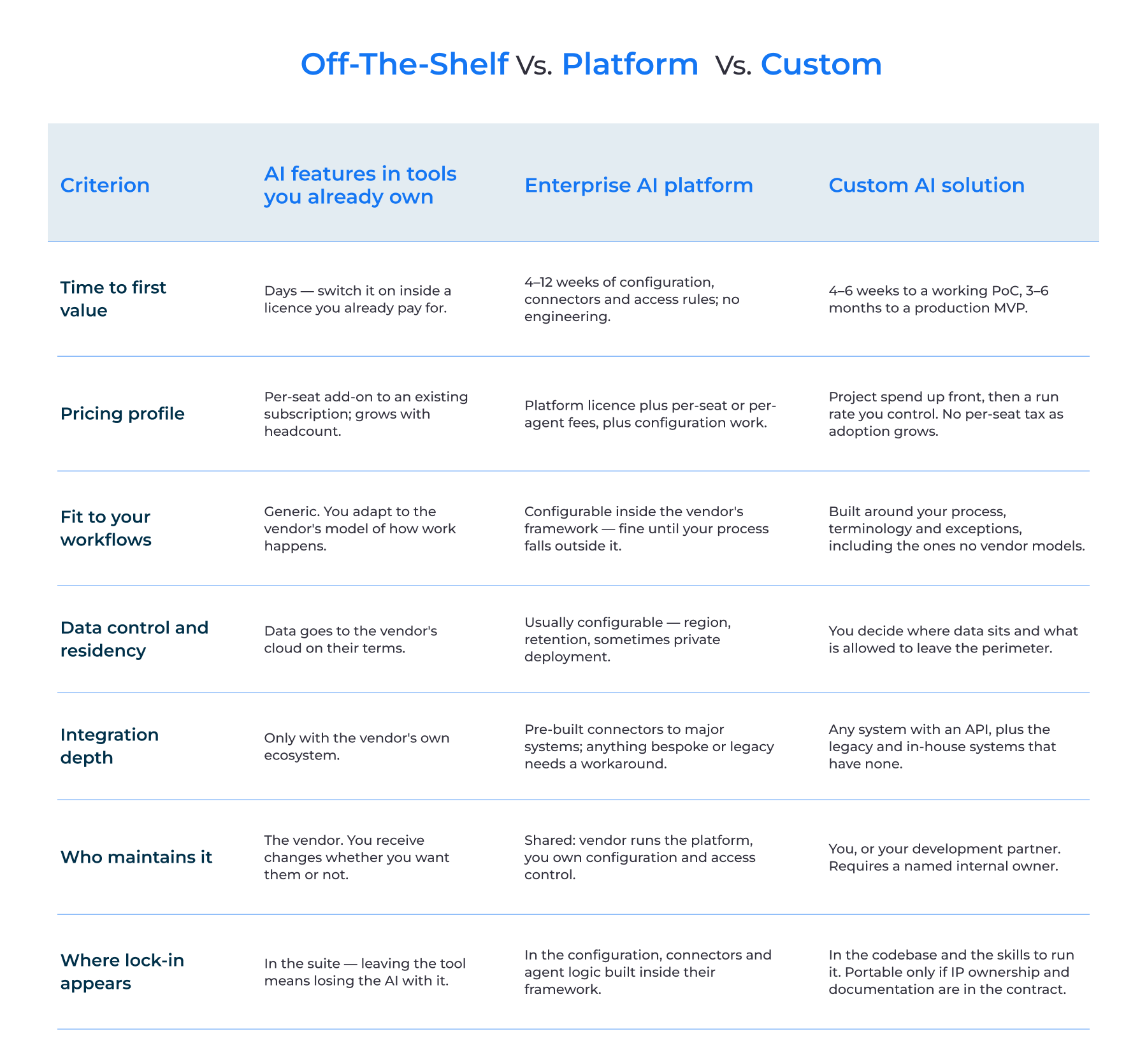
No column wins outright, so most enterprises read the table row by row. Meeting summaries belong in a suite that already ships them. A support agent handling uncountable tickets a month usually needs something built. The platform route melds into AI as a Service, where the vendor runs the models, and you consume them via API.
The time-to-value row is where good decisions go wrong. The catch is what arrives that fast: the same capability your competitors switched on the same week. Teams that confuse speed to first value with speed to differentiated value spend two years wondering why the AI program changed nothing.
The pricing row rewards arithmetic. The per-seat fees appear to be reasonable regarding a pilot with 200 people. If you were to divide that among 6,000 people and charge them $30 a month, that’s a $2.16 million annual bill. And it will keep rising as the adoption reaches success. A build inverts the shape: weight at the start, then an inference and maintenance spend your team can engineer down.
The final row gets skipped in most vendor comparisons. Building does not remove lock-in but moves lock-in into your codebase and your team's skills, which counts as progress under two conditions. The contract names you as the IP owner, and the documentation outlives the people who wrote it.
When a Custom Enterprise AI Solution Is the Right Call
Five conditions justify a build. If there are fewer than three, then a platform or a license will serve you better.
Your process — not your data alone — is the differentiator
Every company in your sector can reach the same foundation models. What differs is how the work gets done inside your walls. A specialty insurer prices marine risk in eleven steps. Step seven is where an underwriter overrides the score for repeat customers with clean loss histories, and that override is where the margin lives. A tool trained on industry averages flattens it straight back out.
Your systems are too fragmented for an off-the-shelf connector
Connector catalogues cover the top of the market — Salesforce, SAP, Workday, ServiceNow, Microsoft 365 — and end around there. Post-merger enterprises rarely resemble that list: two CRMs from an acquisition, a warehouse system written in 2003, a document store nobody has migrated. Purpose-built work reaches anything with an API, and anything without one through an adapter, which sits among the familiar enterprise application development challenges.
Regulated or sensitive data cannot leave your perimeter
Some data has a legal address: patient records under HIPAA, personal data under GDPR, cardholder data under PCI DSS. Standard vendor terms often route inference through a region you did not choose. A build lets you run inference inside your own VPC, or on-premises with open-weight models, and the evidence auditors ask for stays yours.
Per-seat pricing stops making sense at your headcount
Per-seat pricing was designed for software that people open. Agentic AI sits as a different player to whatever the going assumption was in multi-agent systems, which is that a person can only run a single agent. With the addition of 500 seats, we see this as a rounding error. However, with the addition of 9,000 seats, it becomes a line item that a CFO might read aloud in a board meeting.
You need the model behavior to be auditable and explainable
Vendors publish audit logs, and a log records what happened with no account of why. High-risk systems under the EU AI Act require documented evaluation, not usage history alone. Reconstructing an adverse credit decision for an ombudsman means owning the eval suite, the prompt versions, and the retrieval traces.
When buying beats building
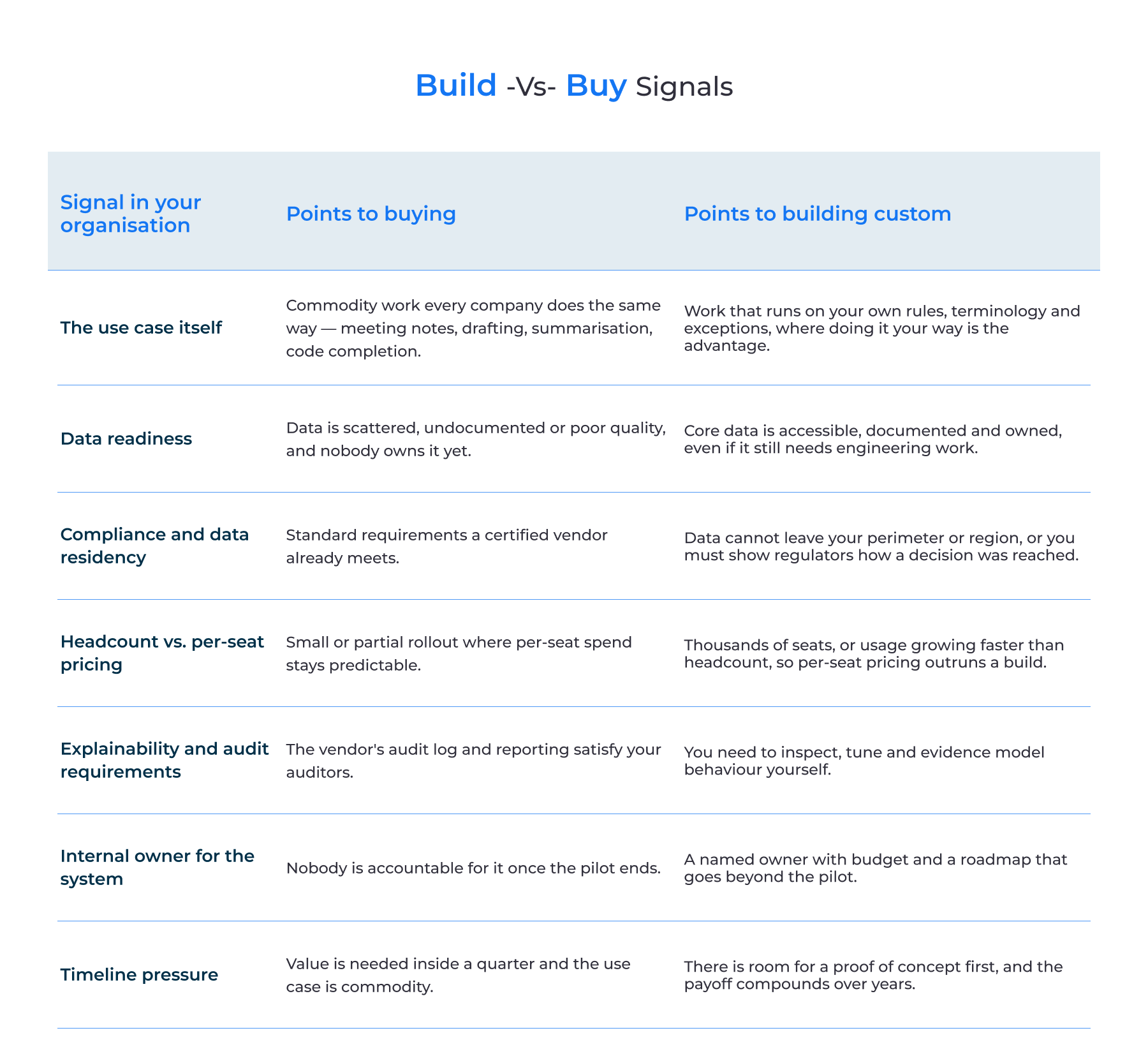
Most AI work should be bought. Meeting notes, transcript summaries, first-draft copy, code completion — commodity capabilities that every serious vendor handles well enough. Commodity automation of this kind is what AI as a Service was built for.
Three other situations point the same way. Data that is scattered, undocumented, and unowned will sink a project before the first model runs. A pilot with nobody accountable after go-live becomes shelfware inside two quarters. And a hard commitment inside a single quarter rules out a real build, because a four-week PoC plus a three-month MVP does not compress.
An enterprise AI solutions provider that never recommends buying is selling hours.
Build-vs-buy signals
Core Capabilities of Enterprise-Grade AI Solutions
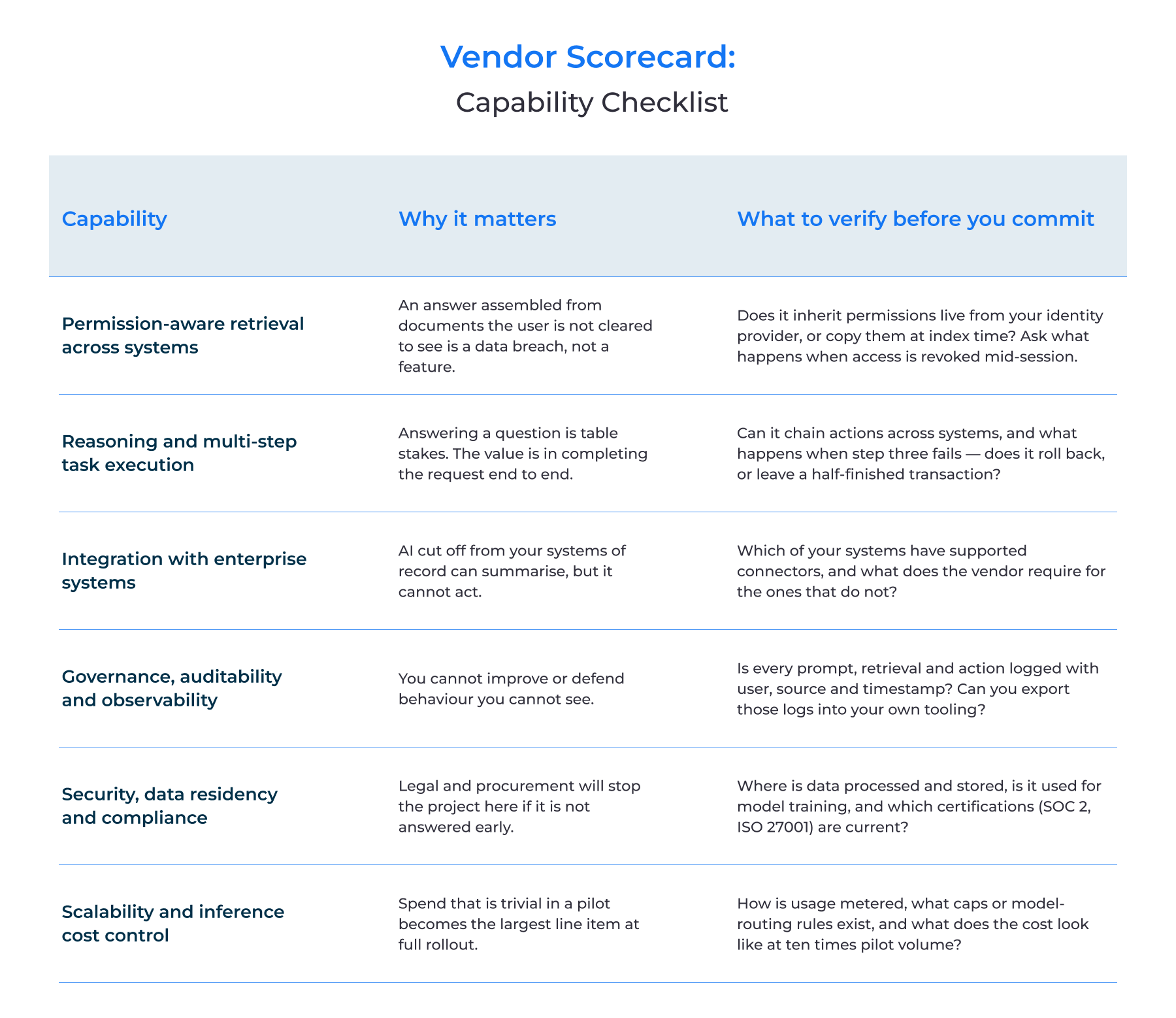
Six capabilities separate enterprise-grade AI solutions from tools that demo well. The checklist works as a vendor scorecard, and the same questions apply to anything you build.
Vendor scorecard: capability checklist
Permission-aware retrieval across systems
Retrieval decides what the model can see. The common failure is subtle: many systems copy access rights into the index at crawl time, then refresh nightly, so someone who rolls off an acquisition project on Friday still gets answers from its deal room on Monday. Ask any vendor how long revocation takes to propagate.
Reasoning and multi-step task execution
AI agents earn their keep by finishing work. An expense exception means reading the travel policy, checking the budget in your ERP, looking up the approval threshold, then posting the result — four systems, four chances to fail. Vendors demo the happy path, so ask to see step three break live.
Integration with enterprise systems (ERP, CRM, ITSM, data warehouse, identity)
Reading and writing are different problems. Pulling from Snowflake is straightforward; writing back into a twenty-year-old ERP with a nightly batch window is ordinary enterprise software development work. So, sort your systems into three buckets before any procurement conversation: supported connectors, a usable API, or neither.
Governance, auditability, and AI observability
Every prompt, retrieval, tool call, and action needs a record with the user. The source documents and a timestamp, exportable to Splunk or Datadog rather than trapped in a vendor dashboard. Quality also drifts as documents change and models get updated underneath you. A regression suite on fixed test cases catches that before your users report it.
Security, data residency and compliance
Procurement will ask three questions: where data gets processed and stored, whether any of it trains shared models, and which certifications are current. SOC 2 Type II carries weight; Type I means the controls existed on one day. Request the subprocessor list, because a vendor inherits every gap in theirs. Security review kills more AI projects than engineering does.
Scalability and inference cost control
Pilot economics mislead almost everyone. Two hundred users generate a bill nobody notices; the same architecture at 9,000 produces a different conversation. Scalable AI solutions for enterprises route work by difficulty, cache repeated retrievals, and meter token spend per team from day one.
The Enterprise AI Technology Stack
Most stalled enterprise AI programs trace back to a layer nobody assigned an owner.
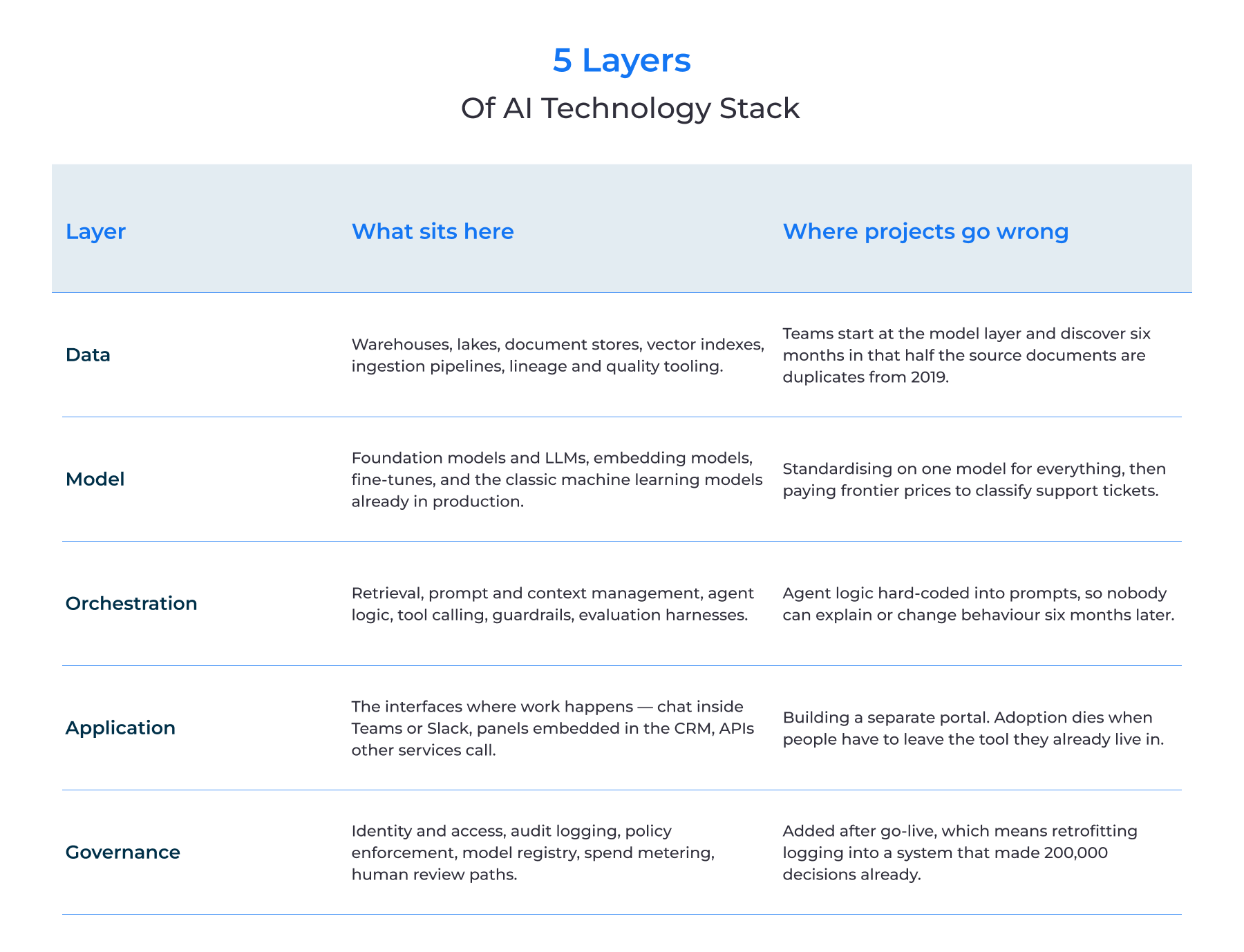
The model layer mixes generative AI with machine learning models already scoring your transactions, and the two need different evaluation and retraining workflows. Access rules mean nothing at the application layer if the vector index ignores them.
Two decisions shape the stack. The first is where your context lives, since retrieval quality caps everything built on top. The second is whether orchestration stays portable: agent logic written into a vendor's framework moves nowhere. Even strong enterprise BI fails without a solid data architecture underneath it, and AI is less forgiving.
Enterprise AI Use Cases Worth Building Custom
These use cases appear on every vendor list. What follows is the part those lists leave out — the reason the bought version stops short.
Use cases worth building custom
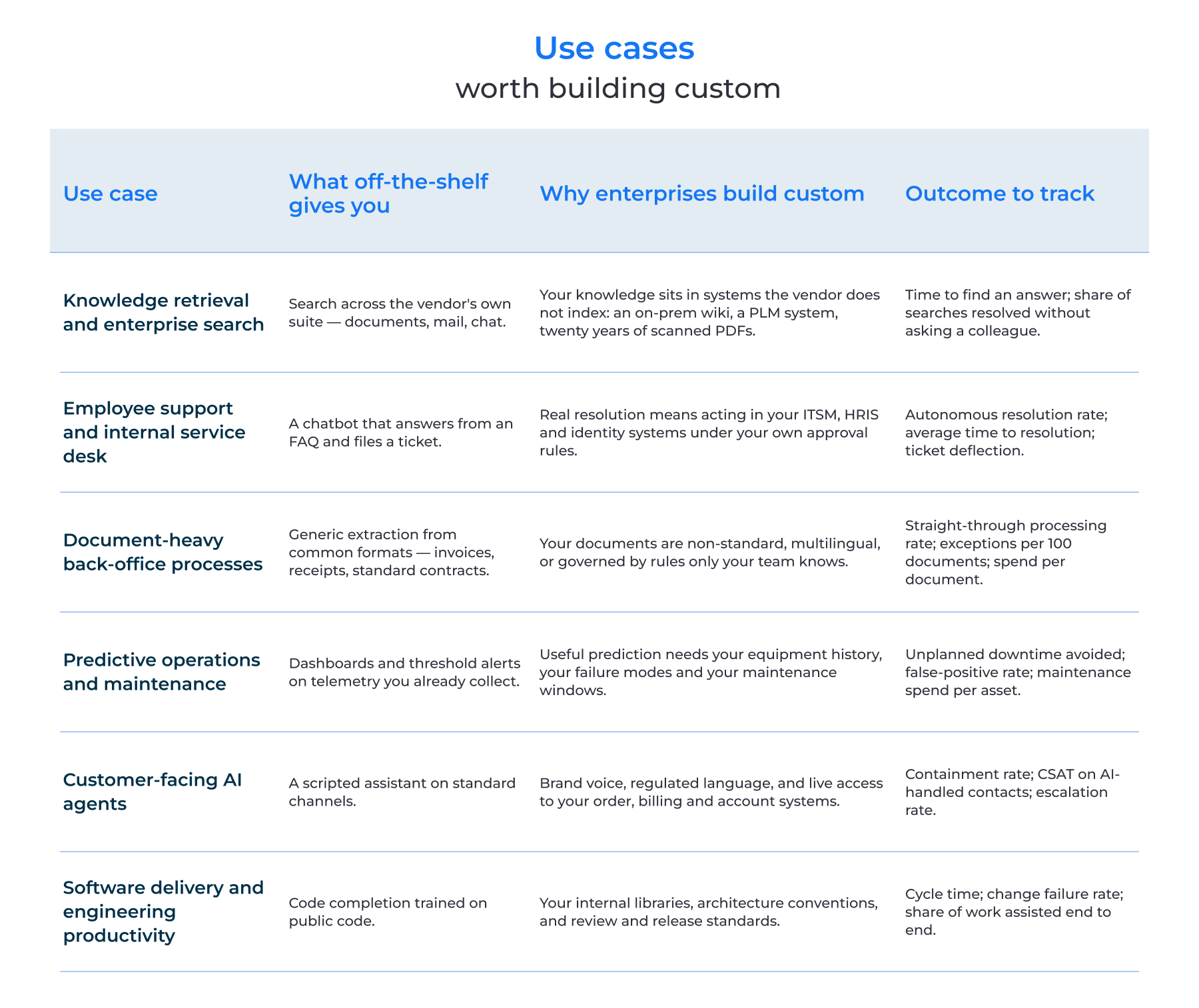
Knowledge retrieval and enterprise search
Suite search covers the suite. That works until an engineer needs the as-built drawing for a 2011 substation, which lives in a PLM system nobody has connected. A build indexes what the vendor skips — on-prem wikis, scanned archives behind OCR, the shared drive everyone pretends is decommissioned.
Employee support and internal service desk
An FAQ bot answers, then files a ticket for a human, and the queue barely moves — automation that stops short of the system of record. Built versions act instead: reset the entitlement in Entra ID, check the license pool, route the manager approval, close the request in ServiceNow. Approval rules are the hard part, because yours are specific.
Document-heavy back-office processes
Generic extraction handles a standard invoice well. It struggles with a bill of lading annotated by hand in Portuguese, or a reinsurance treaty where clause 14 changes how everything above it reads. Straight-through processing, the real automation rate, is the measure that matters: moving from 60% to 85% removes real headcount from the queue.
Predictive operations and maintenance
Threshold alerts fire when a reading crosses a line, which is often too late. Prediction needs history — every failure this asset class has had, the conditions preceding it, the repairs that followed — and most of that lives in a maintenance system nobody joined to the telemetry. A warning also earns its place only when the next shutdown window is Sunday.
Customer-facing AI agents
Scripted assistants answer questions, while customers arrive with account-specific problems. Handling those means live reads from billing, orders, and entitlements, plus write access to make the correction. Regulated sectors add a layer: certain phrasings are mandatory, others prohibited, and every exchange has to be retained.
Software delivery and engineering productivity
Public-trained completion suggests public patterns. It recommends the library your architecture board banned last year, and it has never seen your internal SDK. Setups built on your own repositories and review standards also generate tests that respect your fixtures and review comments that cite your guidelines.
How to Build a Custom Enterprise AI Solution: Six Steps
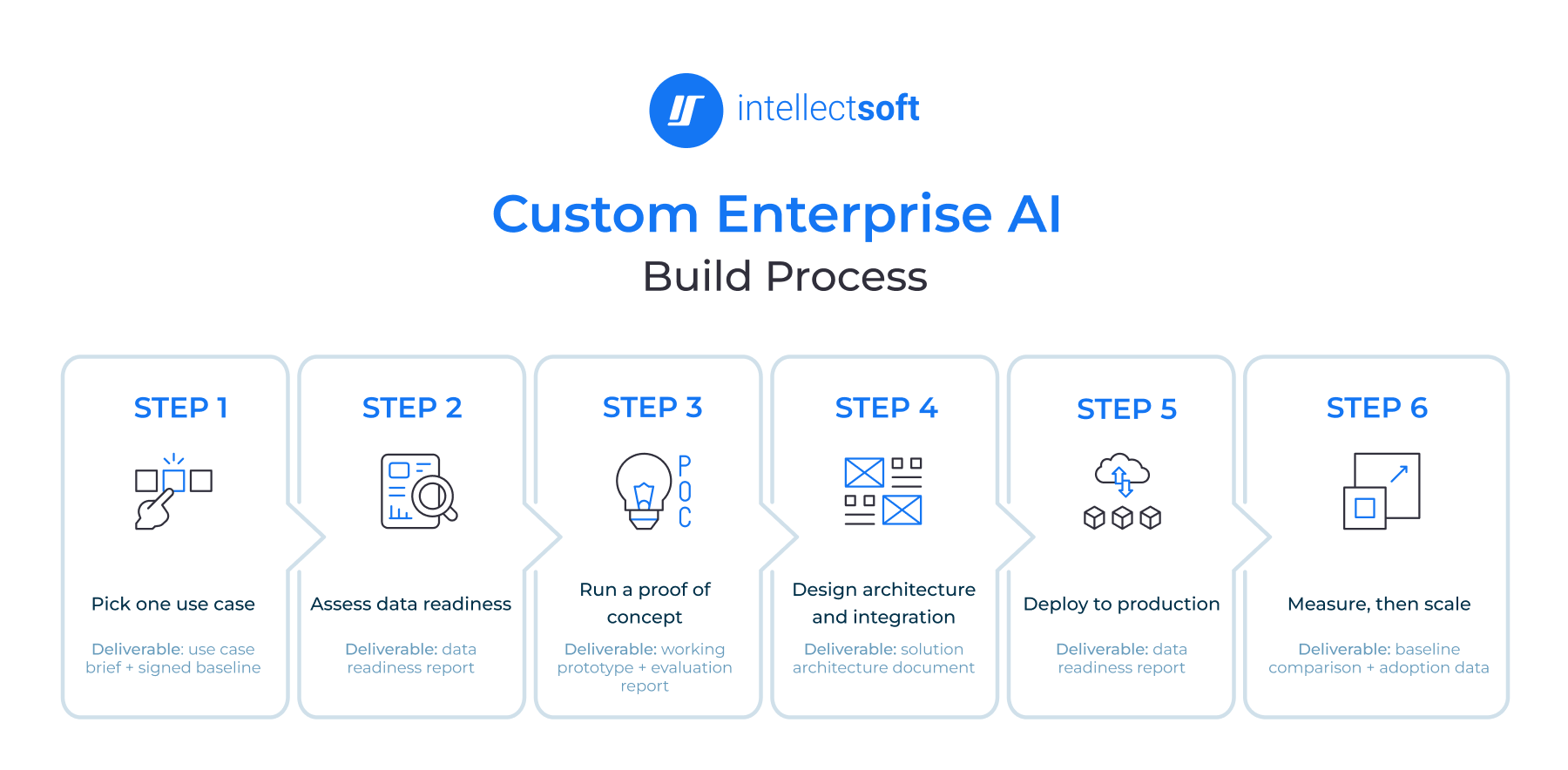
Step 1 — Pick one use case and set a measurable baseline
Programs that start with three use cases usually finish none. Pick the one where impact is largest and the data is reachable, then measure the current state first. How long does a claim take today, at the median and the 95th percentile? Without that number, the budget conversation twelve months later becomes a matter of opinion.
Step 2 — Assess data readiness before anything else
Data decides feasibility, so audit it early enough to change the plan. A knowledge base where 30% of articles contradict one another produces an assistant that contradicts itself. Check access paths too, since an API capped at 100 calls a minute caps what you can build on it.
Step 3 — Run a proof of concept (4–6 weeks)
Four to six weeks answers one question: does this work on your real data? Use the production data set, or a representative slice, and define pass criteria upfront — accuracy above a stated threshold, latency under a stated ceiling, and a positive verdict from the people who do the work today. A negative verdict here is the cheapest one you will ever get, because teams that skip this step end up learning how to build AI software in production instead.
Step 4 — Design the architecture and integration model
Architecture comes before rollout, because retrofitting it takes more than doing it first. This step settles where inference runs, how retrieval is structured, which systems get read access and which get write access, and where human approval points sit. The deliverable is a solution architecture document a review board can approve.
Step 5 — Deploy to production with governance in place
Production means the controls arrive with the system. Logging captures every prompt, retrieval, and action from day one, access follows your identity provider, and the evaluation suite runs on a schedule. Roll out to a defined group first, then widen once the numbers hold.
Step 6 — Measure, then scale to the next use case
Compare against the Step 1 baseline, using the same definitions, and include adoption — a system with excellent accuracy and 8% usage has failed. Retrieval, identity plumbing, logging, and evaluation infrastructure are reusable, so the second use case should take noticeably less than the first. Agreeing on what counts as a return before that second project starts is most of measuring AI ROI; doing it afterward is guesswork dressed as reporting.
What Custom Enterprise AI Solutions Cost — and How Long They Take
No vendor can quote your project from an article. What follows is the shape of the number, and the parts buyers routinely leave out of the business case. Note that figures here are indicative ranges based on typical enterprise engagements. Actual pricing depends on your data, your systems, and your compliance requirements, and can only be fixed after a discovery phase.
Five factors move the total. Data preparation comes first and gets underestimated most — budget 15–25% of the project for preparation and labeling alone. The number of systems you read from or write into comes next, because each carries its own auth, rate limits, and edge cases. Model strategy matters less than people expect, while review cycles and expected load set the rest.
Rates set the rest. Senior AI engineers in Eastern Europe run roughly $50 to $95 an hour, against $180,000 to $250,000 fully loaded for an equivalent in-house hire in the US. Which of those two baselines you budget against moves the cost of an AI development team further than any technical decision in the project.
Cost and timeline by stage
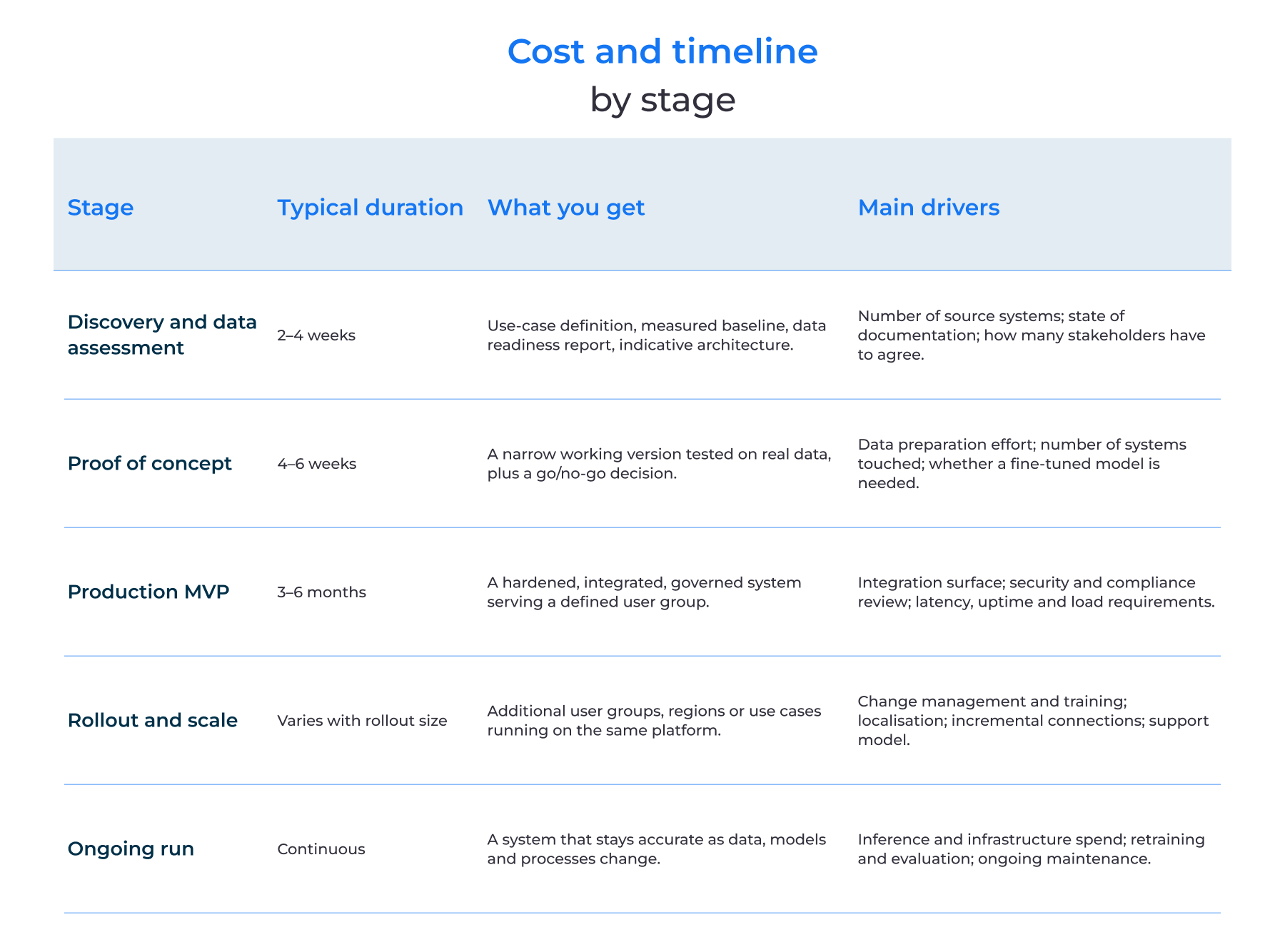
Then there are the line items that never make it into the first spreadsheet. Data engineering keeps running after launch, because pipelines break when source systems change. Connector maintenance follows every vendor API update on someone else's schedule, MLOps needs real capacity, and inference spend grows with adoption, so success raises the bill. The offsetting side of the ledger — how AI reduces costs in practice — belongs in the same business case.
A useful budgeting rule is to add 10–15% contingency for scope changes, then treat year-one run spend as a separate line.
Why Enterprise AI Projects Fail
Roughly 42% of companies abandoned most of their AI initiatives in 2025, up from 17% a year earlier. Whatever the precise figure, enterprise AI failure patterns repeat, and all six are visible early.
The pilot never had a production owner. Watch for a project sponsored by an innovation team with no named owner in the business unit that will run it. Before the PoC starts, name the person who will own it in production, with budget lines and a roadmap past go-live.
Data readiness was assumed rather than assessed. The signal appears in week three, when someone asks which of two conflicting fields is authoritative and nobody knows. Prevent it with a real assessment before commitment — sources, owners, sample quality, refresh rates, access limits.
No baseline, so ROI can never be proven. Listen for goals phrased as “improve efficiency” without a current number attached. A year later, the system works and finance still cannot approve phase two, because nothing measurable changed on paper.
Tool-first instead of process-first. The warning sign is procurement that starts with a vendor shortlist. Teams select a platform, then hunt for problems it fits, and the problems that matter stay untouched. Map where the time and money actually sit before evaluating anything.
Governance retrofitted after launch. The signal is a production system with no export path for its logs, or an access model living in a spreadsheet. It stays invisible until the first audit request arrives, and retrofitting logging into a system that already made 200,000 decisions is expensive and incomplete.
Scaling a pilot metric that stops being the right metric. A pilot optimizes accuracy on a curated test set, hits 94%, and gets approved. In production, the distribution shifts, and what mattered turns out to be resolution rate or escalation volume.
Each failure is an organizational decision made before any code exists, which is why more engineering rarely rescues a program that started wrong.
How Intellectsoft Builds Custom Enterprise AI Solutions
Every engagement opens with a systems-design sprint, before anyone writes code, because AI programs accumulate technical debt faster than most software. A principal architect is assigned to each active engagement and stays through delivery, and customers reach the CEO or CTO within 24 hours when a security review stalls or a scope decision needs settling this week.
Delivery follows the six steps above: a proof of concept in four to six weeks tested on real data, then a production MVP in three to six months, connected to the enterprise systems already running the business. Nobody is asked to replace a working ERP or adopt a portal their people will avoid.
Recent AI engagements report 30–50% lower operational spend, 80% of business requests handled without developer involvement, and 70% less developer time servicing data requests, with business data reaching people three to five times faster.
Intellectsoft runs 200 to 300 engineers by design. That size permits selectivity, including telling a prospective customer that a license solves their problem better than a build would. An enterprise AI solutions provider that only ever recommends building is selling hours. Delivery spans Eastern Europe, LATAM, and India, and AI runs inside the engineering workflow itself — code review, test generation, architecture-risk scanning — contributing to 30–50% faster time-to-production.
A useful first step is an AI assessment: two to four weeks producing a use-case shortlist, a measured baseline, a data readiness report, and an indicative architecture. That output holds its value whichever direction the decision takes, buying included. Choosing an AI development company comes down to whether they will tell you not to build. That is why Intellectsoft's AI services and solutions practice takes scoping conversations without a commitment attached.
FAQ
What is the difference between enterprise AI and custom AI solutions?
Enterprise AI describes the category — any AI running inside a large organization under its permissions, data rules, and audit trail. Custom AI solutions are one route into it, alongside buying features in software you already license and configuring a vendor platform. The distinction is ownership: a build gives you the architecture and the maintenance burden, while a platform leaves the runtime and roadmap with the vendor.
How much does a custom enterprise AI solution cost?
Pricing follows five drivers: data preparation, the number of systems involved, model strategy, regulatory requirements, and expected load. Data preparation alone typically takes 15–25% of a project budget. Senior AI engineers in Eastern Europe run roughly $50 to $95 an hour, against $180,000 to $250,000 fully loaded for a comparable US hire. A two-to-four-week discovery phase turns those ranges into a real number.
How long does it take to build enterprise AI solutions?
A proof of concept on real data takes four to six weeks and ends in a go/no-go decision. A production MVP — connected, governed, serving a defined group — takes three to six months after that, with discovery adding two to four weeks at the front. Timelines stretch when compliance review, legacy systems, or multiple user roles enter the picture.
When should an enterprise build custom AI instead of buying a platform?
Five conditions justify building. Your process, rather than your data alone, is the differentiator. Your systems are too fragmented for vendor connectors. Regulated data cannot leave your perimeter. Per-seat pricing outruns a build at your headcount. You need model behavior you can inspect, tune, and provide evidence to an auditor. Fewer than three of those, and a platform usually serves better.
What makes an AI solution enterprise-grade?
Six capabilities. Permission-aware retrieval that inherits access rules live from your identity provider. Multi-step execution that recovers from a failure midway through a transaction. Reads and writes against your ERP, CRM, ITSM, warehouse, and identity systems. Logging of every prompt, retrieval, and action, exportable into your own tooling. Security answers ready for procurement on data residency. And inference spend control that survives ten times pilot volume.
How do custom AI solutions integrate with existing enterprise systems like ERP and CRM?
Through APIs where they exist, and through purpose-built adapters where they do not. Identity comes first — Okta, Entra ID, or whatever holds your groups — because retrieval and actions both depend on knowing who is asking. Read paths pull context from the warehouse and document stores, while write paths need more care, since a batch-window ERP behaves differently from a modern API.