Key Takeaways
- From reviewing your IT landscape to building a roadmap around your needs related to cloud, AI, and automation – this is what a digital transformation consultant does to bridge the gap between your technology and business goals.
- Only 30% of digital transformation initiatives succeed, while others fail due to a lack of tech strategy – something a digital transformation consultancy partner helps build.
- The best digital transformation consulting services are more than a strategy document – they deliver a clear roadmap with priorities, ROI metrics, and execution support.
- The choice between a digital transformation consulting agency, a boutique consultancy, and an engineering-led firm is a strategic decision – each model has its strengths across strategy, speed, and ownership.
- AI integration is one of the core aspects of enterprise digital transformation advisory services, and companies that skip AI readiness audits often see their AI initiatives slow down or fail within 12-18 months.
- With 18+ years of experience and 35 Fortune 1000 clients, Intellectsoft offers digital transformation consulting as a full-cycle advisory service – from tech strategy and architecture through development, implementation, and modernization.
Hate to sound pessimistic, but only 30% of digital transformations help achieve set business goals, reports McKinsey. Why do not all companies gain from digital technologies? At the same time, IDC forecasts that businesses will spend up to $ 3.9 trillion on digitalization by 2027. So, see, they don’t lose faith in tech initiatives?
You decide to migrate your system to the cloud to prevent crashes. Soon, you invest in AI and automation because your competitors are doing this. And it seems, what could possibly go wrong? In fact, the problem isn't the choice of technologies. It’s the lack of qualified digital transformation consulting and a clear tech strategy.
Instead of chaotic tech initiatives that don’t deliver returns, a digital transformation consultant connects technology investments to real business objectives. And in our article, we reveal the meaning of digital transformation consulting services and explain why they’re vital for your company.
What Is a Digital Transformation Consultant?
A digital transformation consultant is both a tech and business professional who builds a digitalization strategy that helps companies refine their business operations, tech stack, and client experience.
What are their roles?
- Review your IT landscape and find weak points
- Assess tech maturity, processes, and data infrastructure
- Evaluate the company’s readiness for new technologies
- Find gaps between your goals and existing systems
- Pick up digital tools that address business challenges
- Create a strategic roadmap with priorities, KPIs, and execution phases
- Plan how to move your system and data to the cloud, integrate AI, or upgrade it if needed
- Match tech choices with sustained business strategy
- Lead the transformation process and keep stakeholders involved
Their role is often confused with IT strategy consulting or management consulting. They aren't the same.
An IT consultant is responsible for addressing technical problems. A management consultant works on business strategy. A digital transformation consultant connects both. They develop a tailored tech strategy and lead the transformation from planning to execution.
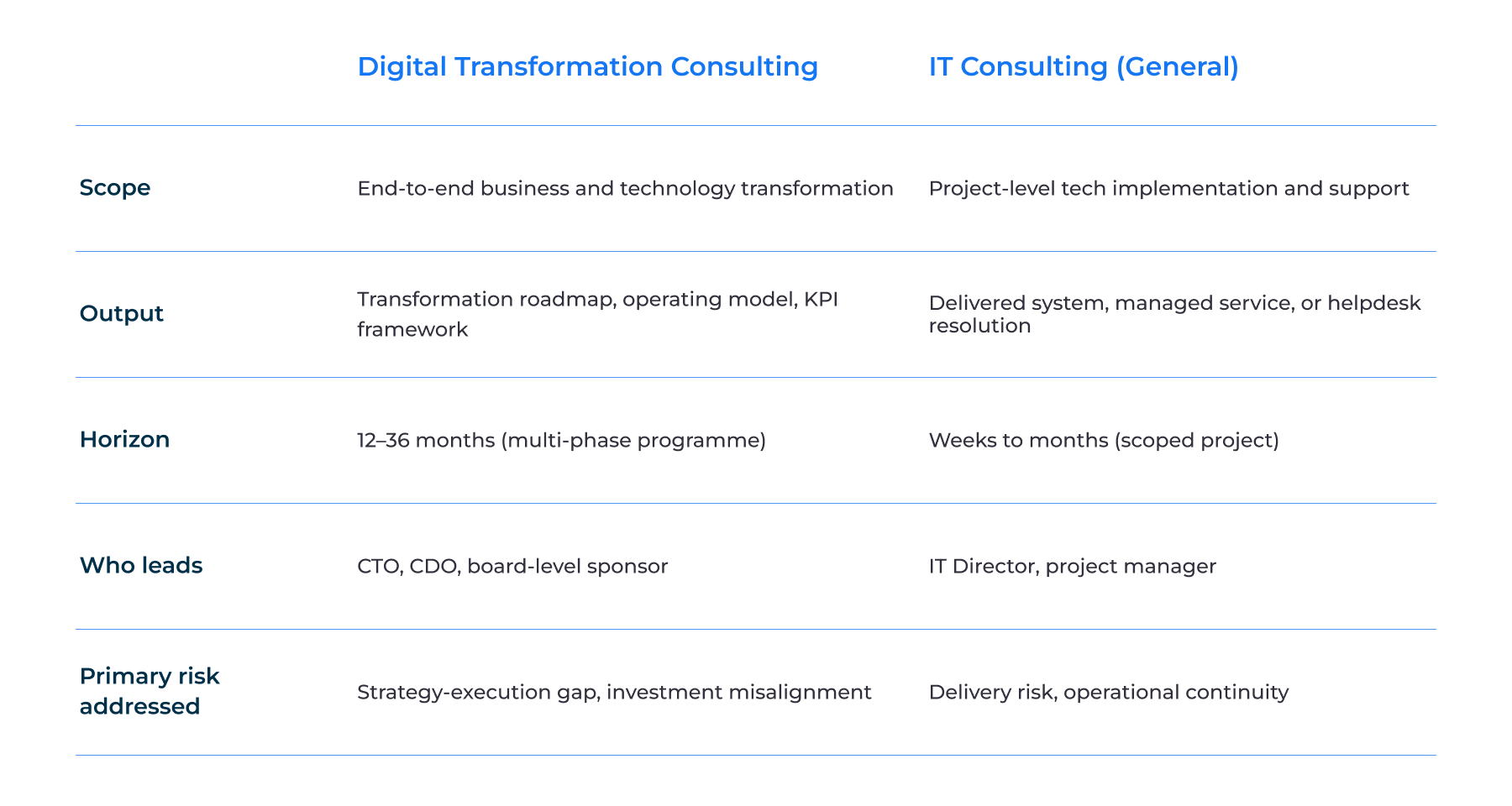
Digital transformation consulting vs. IT consulting: What’s the difference?
As we already mentioned above, not all companies are aware of the differences between digital transformation consulting and IT counseling.
IT counseling helps you implement, manage, and back up specific technologies. Digital transformation consulting helps you decide what to digitize, why it’s vital, and where to start. So you get a clear transformation roadmap with priorities, goals, and business outcomes. IT counseling builds the solution. Digital transformation consulting builds the strategy behind it.
So we want to break down the distinctions between them to help you make the right choice for your company.
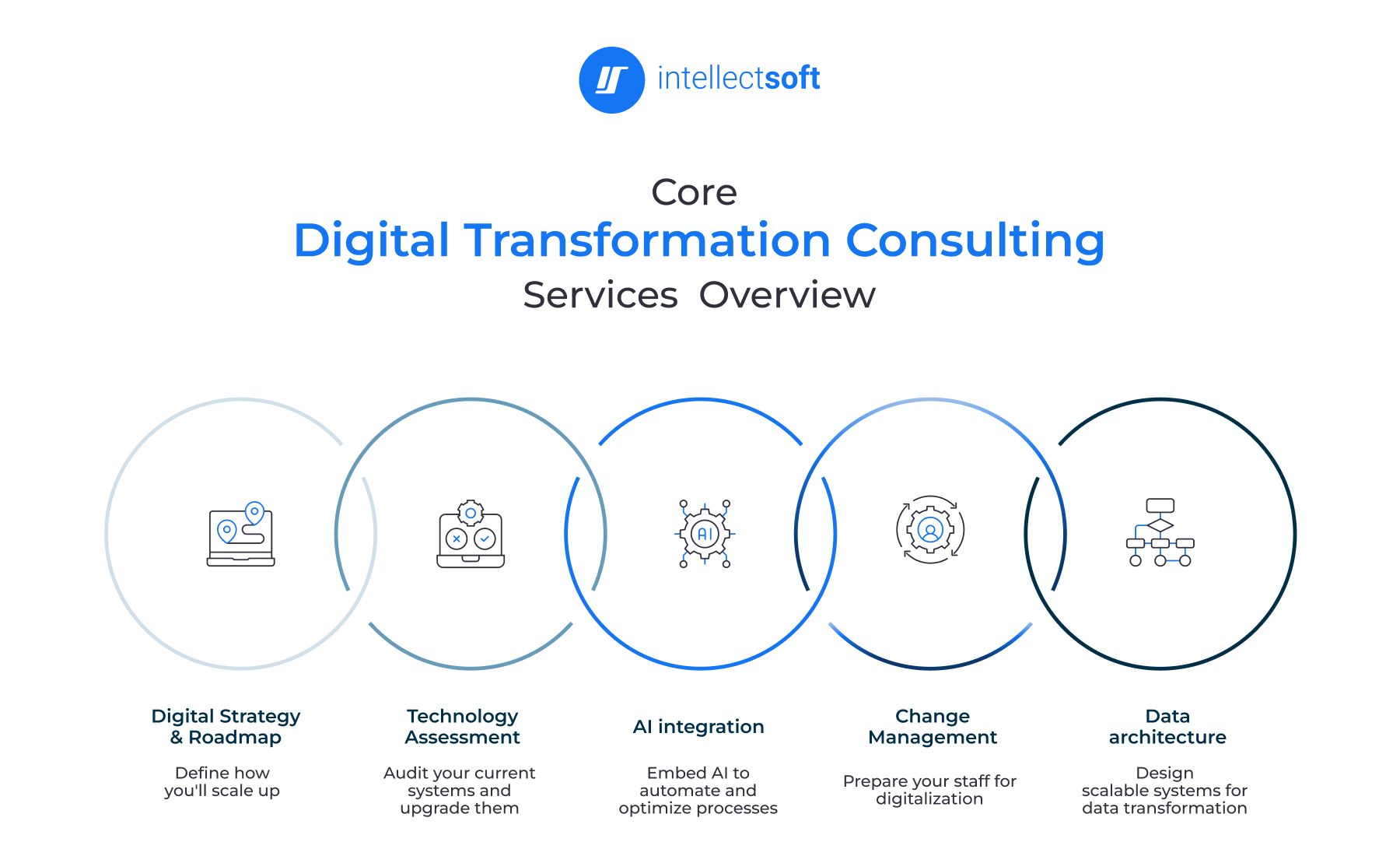
Core Digital Transformation Consulting Services – What's Included
Companies used to think that a digital transformation consultancy engagement starts with technology. But indeed, it begins with deciding what you should change first. That's exactly what digital transformation consulting helps you do. Let’s break down what services it includes and how you can benefit from them.
Digital strategy and transformation roadmap
We can’t hide the fact that many digital transformation projects fail before implementation even starts. And one of the reasons is the lack of a digital transformation roadmap to guide you towards your business goals.
A digital strategy and transformation roadmap defines how your company will scale up over the next 12–36 months. First, with digital transformation consultancy services, consultants evaluate your IT landscape, operations, and needs. Second, they compare the current state of infrastructure with your target state, considering business value and risks, and build a phased roadmap.
Take, for instance, a financial services company that scales nationwide. Should it integrate AI to automate operations and speed up their work? Of course, no. First of all, it should upgrade its core banking platform and establish data governance. If your data isn’t prepared, AI doesn’t bring any value.
Technology assessment and legacy modernization
Legacy systems slow projects down. Not because they're outdated, but because no one has a clear picture of how they affect current processes.
A tech assessment clarifies the situation: it reviews your systems and integrations, analyzes data flows and infrastructure, and checks out security. As a result, you see technical debt and cloud readiness gaps. So after audits, you can start the transformation.
According to Gartner, technical debt consumes 20-40% of the average enterprise IT budget every year. Without a detailed assessment, companies continue throwing money away. At Intellectsoft, our IT consulting services start with a tech assessment to find out what needs to be fixed first and where to move next.
AI integration and intelligent automation
AI is on heavy rotation right now. But many organizations invest in AI too early without checking whether they are ready for it. So, no surprise, their project can slow down or even fail.
You can build a successful AI strategy only if you assess your AI readiness. You need to evaluate your data quality and governance. Plus, you should check out your integration capabilities and whether your systems can support AI. Where does AI bring real value? What workflows can become more efficient? All these points should be clarified, and only then can you invest in AI.
After this, you can start building an AI integration strategy that fits your firm. At this stage, you define how AI models, ML, and automation work with your current tools and business processes. Keep in mind, please, strategy alone isn't enough, though. You also need a reliable digital transformation partner that builds and deploys AI solutions, helping you move from roadmap to production.
Change management and organizational enablement
Technology doesn't drive digital transformation – people do. This is the reason why change management strategies are included in every successful digitalization. With it, you align tech and business teams and prepare your staff. Plus, you need to conduct training, assess the impact of change, and communicate all of this to stakeholders.
Many digital transformation projects will never fly because companies integrate new technologies before preparing people for them. So first of all, start the transformation with people. And only after that, focus on technologies. And this order helps you achieve your set goals.
Data architecture and data analytics infrastructure
AI models are only as good as your data. That makes perfect sense to start digital transformation with data. How does a data strategy help? First, you understand what data you have. Second, you see where it is stored and how it moves across your departments. Finally, you’re aware of what needs to change. As a result, you can set up governance rules, cloud data architecture, and the analytics foundation needed if you opt for business intelligence services and AI.
According to Deloitte, 40% of organizations put data architecture first before integrating AI. In fact, this is the right decision. Companies that skip this step deal with slow AI initiatives. And the reasons are pretty simple: poor data quality and disconnected systems.
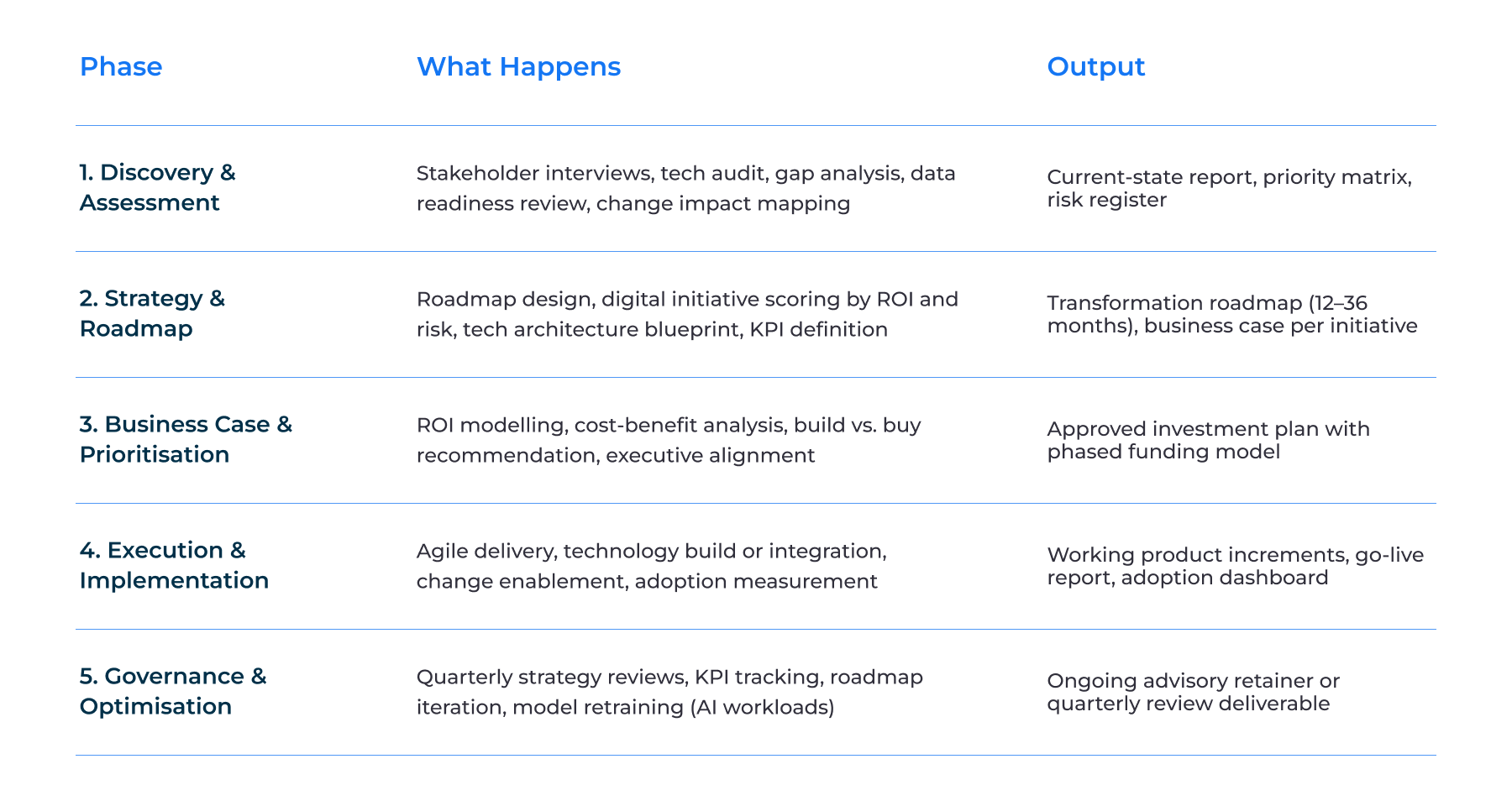
What Does a Digital Transformation Consultant Do – The Engagement Process
Successful digital transformation isn’t an accident. This is a structured process that turns your business goals into visible results. At Intellectsoft, we follow the same proven approach: we audit your landscape and then optimize after release.
Cost factors and budget signals
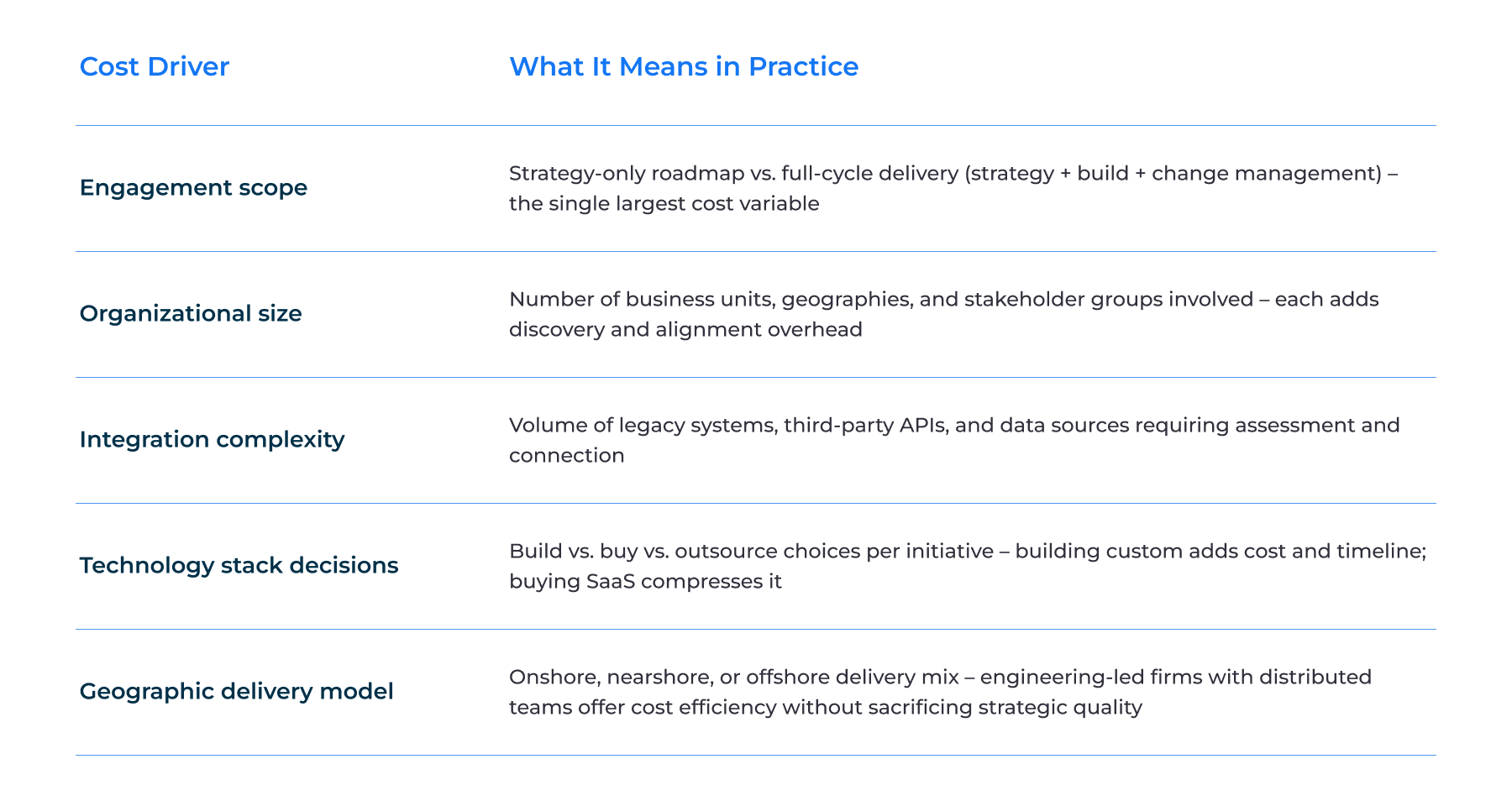
Digital transformation is a long-term investment. According to Deloitte, organizations contribute an average of 7,5% of their annual revenue in digitalization. With investments of this size, companies need a clear strategy to maximize ROI and avoid costly mistakes.
The faster you turn your roadmap into implementation, the faster you see business results. That's why Intellectsoft combines consulting and engineering in one engagement. We want to protect firms from costly rework and delays between planning and execution. So we’ve prepared the table with cost factors for you to understand what influences your budget:
Digital Transformation Consulting in Practice — Digital Transformation for IAATO
At Intellectsoft, we have a related story to share. We helped the International Association of Antarctica Tour Operators (IAATO) improve user experience through digital transformation.
Our client came to us to make important environmental guidelines available to travelers and expedition teams anywhere in Antarctica.
Until then, these guidelines were available only in paper documents that were difficult to use. Finding the right information took time, and without an internet connection, accessing updates was almost impossible. IAATO needed a simple digital solution that would give people fast, reliable access to critical information wherever their expedition took them.
To solve this challenge, we started with the people who would use the app every day. Our goal was simple: help travelers and expedition teams find important information in seconds, even without an internet connection.
We built a mobile application with:
- A simple, intuitive interface that is easy to navigate
- A tag-based structure to quickly find the right guidelines
- Favorites for instant access to frequently used documents
- Full offline access to make critical information always available
Intellectsoft helped the client with digital transformation by developing a mobile app for travelers and expedition teams. This solution makes environmental guidelines easier to access, understand, and use in Antarctica.
With easy access to environmental guidelines, travelers and expedition teams can better understand each location, follow conservation rules, and make informed decisions in the field. All this has contributed to the modernization of IAATO’s operations and to more responsible tourism.
Digital Transformation Consulting by Industry
Digital transformation unfolds differently in each vertical. Business goals, compliance regulations, customer expectations, and tech challenges – all these shape digitalization strategy. Hence, every industry requires its own priorities, roadmap, and success metrics.
Fintech and financial services
Financial organizations decide to modernize to comply with legal regulations, enhance customer experience, and offer new digital services. Their key requests to us are the following:
- Automate AML and KYC
- Upgrade core banking systems
- Enable real-time payments
- Integrate open banking APIs
- Use AI to detect fraud
Many banks make the same mistake. They launch AI before preparing their data. Without reliable data infrastructure and modern systems, AI projects often face delays or fail. For that reason, successful transformation should start with upgrading the core banking platform. Once the foundation is ready, banks can introduce embedded finance, AI, and personalized customer services.
Healthcare and life sciences
Why do healthcare organizations invest in digital transformation? First, they want to improve patient care and patient outcomes. Second, healthcare providers strive to cut administrative work, and AI does a good job at this. Finally, they are interested in meeting compliance and industry regulations. Here's what our clients typically need help with:
- Connect EHR systems
- Launch telemedicine services
- Securely manage patient data
- Integrate AI to support doctors
- Automate paperwork
In healthcare, digital transformation starts with a secure, connected foundation that complies with HIPAA and other legal regulations. And when you’re sure that you have a reliable backbone, you can develop patient portals, connect systems, and personalize care delivery.
Logistics and supply chain
Every delay costs money and affects customer trust. This is why logistics companies invest in digitalization and seek to incorporate more technologies.
First, businesses want to track shipments in real time to share updates and cut delays. They automate warehouses to speed up order processing and minimize manual work. They also improve demand planning and gain better visibility across the entire supply chain.
Many companies think AI is the first step. It isn't. AI only works when your data works. That’s why, first of all, you should sync your shipment, warehouse, and carrier systems. Once they interact, AI can predict delays, optimize routes, and improve planning. All this helps reduce delays by up to 25% and improve business outcomes.
Retail and e-commerce
Customers expect the same experience wherever they shop. This is the reason why retailers digitize their operations.
First, they connect online and in-store sales channels. Then they create a single system by merging customer, inventory, and POS data so the data can interact. All this leads to effective inventory management, personalization, and delivery of a consistent shopping experience across all channels.
Manufacturing and industrial
Higher productivity, less downtime, and more efficient production – all these incite manufacturers to invest in digital transformation. Digital transformation of manufacturing can be achieved in the following ways:
- Modernizing ERP systems
- Connecting production equipment
- Using IoT sensors
- Integrating predictive analytics
To succeed in manufacturing digitalization, you need to analyze how you work and identify your pain points. And only after that, you can decide what technology to integrate to boost your productivity. At Intellectsoft, we first identify what needs to be modernized. Then you can confidently embed AI, cut downtime, improve production planning, and make better decisions with real-time data.
Digital Transformation Consulting With Intellectsoft – How We Work
The truth vendors don't always tell you: digital transformation only delivers results when strategy and execution work in sync. And our digital transformation consulting services can create this harmony.
For more than 18 years, Intellectsoft has helped organizations modernize their operations, tech stack, and customer experience. We've teamed up with 35 Fortune 1000 companies. With our clients, mid-sized and enterprise-level businesses, we deliver transformation from strategy through implementation. We don't stop at building a roadmap. We help you put it into practice with our development services.
Our approach follows the five-phase engagement model described above:
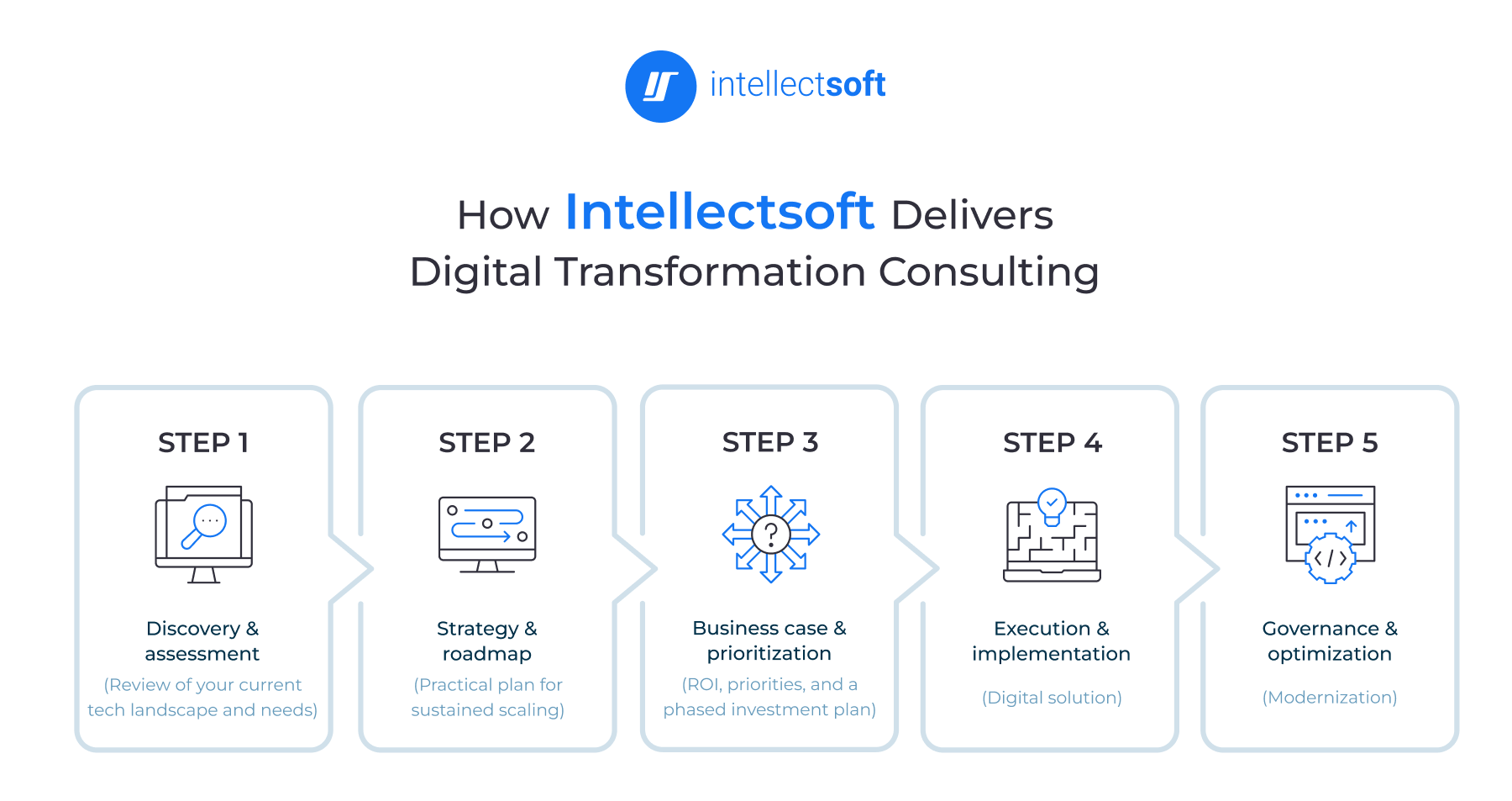
- Step 1. Discovery & assessment – build a clear understanding of your current tech landscape and needs. We audit your company, technology, data, and processes to identify risks, opportunities, and focus areas.
- Step 2. Strategy & roadmap – create a practical plan for sustained scaling. We build a transformation roadmap that includes goals, tech architecture, AI opportunities, and clear KPIs.
- Step 3. Business case & prioritization – invest in the initiatives that bring the highest returns. We calculate ROI, prioritize projects, and build a phased investment plan.
- Step 4. Execution & implementation – turn your strategy into an innovative solution. Our engineering teams build custom software tailored to your needs and goals, modernize legacy systems to improve performance, integrate AI, and deliver cloud solutions with an agile approach.
- Step 5. Governance & optimization – keep upgrading as your company scales up. We measure business outcomes, optimize performance, support adoption, and regularly refine your roadmap.
Our approach helps clients cut legacy system costs, speed up product delivery, and achieve up to 4× ROI through tech modernization and AI-backed business transformation. Our client case studies prove this. If you strive for the same results, contact our team for a free consultation.
FAQ
What does a digital transformation consultant do?
Digital transformation consultants review your IT environment and find gaps between your business needs and existing tech stack. Then they create a transformation roadmap. It defines your objectives, KPIs, implementation steps, and the right tech stack. In other words, it gives you a clear plan for digital transformation. So every digital investment supports your business goals.
What is the difference between digital transformation consulting and IT consulting?
Digital transformation consulting helps companies decide on digitalization and understand why it’s vital to achieve business goals. IT advisory is responsible for integrating and upgrading specific technologies and systems. In short, digital transformation consulting develops the tech strategy, while IT consulting helps implement it.
How much does digital transformation consulting cost?
A focused strategy engagement for a mid-sized company – from $40,000 to $150,000
Large, complex transformation programs require a higher investment
Companies spend an average of 7,5% of their annual revenue on digital transformation
Advisory represents 10–20% of the total program cost
Your company’s size, project scope, existing systems, and the complexity of the transformation are the factors that affect the price of digital transformation consulting. As a digital transformation consulting company, we offer a tailored estimate after assessing your business needs.
How long does a digital transformation consulting engagement take?
A focused discovery and roadmap for a mid-sized company – 6-12 weeks
A full enterprise transformation with modernization and AI integration – 12-36 months
AI-assisted consulting, activities like requirements gathering and prototype development can be done 30-50% faster
In fact, the timeline depends on the size and complexity of the transformation your business needs.
Why do digital transformation programs fail?
Many companies prioritize technology over strategy, which is the main reason most digital transformation initiatives fail. But you should also add other factors here: a gap between planning and execution, poorly estimated technical debt, weak support, resistance to transformation, and, of course, unclear business goals. According to McKinsey, only 30% of digital transformations achieve the established objectives. So, we recommend choosing a partner that offers both digital transformation strategy consulting and implementation, as this guarantees successful digitalization.
When should a company hire a digital transformation consulting agency?
You should hire a digital transformation consulting agency in the following situations:
Before a major technology or business change begins
When you start a consultant digital transformation, plan a cloud migration, and integrate systems
If your company strives for operational efficiency and sustainable growth
When you’re preparing for compliance requirements like HIPAA or GDPR
If you are planning AI integration
If you want to stand out from your rivals and reinforce a competitive advantage
Successful organizations don't wait for challenges. They team up with a digital transformation consulting provider regularly to be sure that their tech investments support their business goals.
What should I expect as deliverables from a digital transformation consulting engagement?
From a digital transformation consulting engagement, you can expect the following outcomes:
A detailed assessment of your current IT landscape
Transformation roadmap with clear priorities
ROI estimates for key initiatives
Build vs. buy vs. outsource recommendations
An AI readiness assessment (if needed)
A change management plan
A governance framework
All of this is needed to provide you with the tech strategy to implement and manage digitalization.
