At least 40% of all businesses will die in the next 10 years… if they don’t figure out how to change their entire company to accommodate new technologies.
(John Chambers, CEO of Cisco)
Manufacturing is a conservative industry that relies on old-fashioned, traditional tools and practices – believe it or not, people still have this stereotype. But indeed, today, this is a dynamic vertical based on AI, big data, robotics, and 3D printing. We’re observing the transformation of plants and factories from dirty, old, and dusty locations into spaces where human expertise plus the latest technologies drive production.
Reducing manual work and automating processes decreases staff workload, speeds new product development, and distributes costs more rationally . To be continued (?). According to Gartner, by 2030, manufacturing is projected to be transformed by digital twins, software-defined products, and semi-autonomous AI agents.
Digitalization of manufacturing paves the way for sustainability, which is a top priority in the industry. Bloomberg reports, “Digital and sustainability can go hand in hand and deliver concrete business with environmental benefits.”
Of course, digital transformation in manufacturing is a path full of roadblocks: big investments, legacy system integrations, and workers’ resistance to innovations.
In this article, we’ll reveal the benefits and challenges of your decision to robotize your factories and share how we help our clients operate more efficiently with our software solutions.
What Technologies Drive Digital Transformation in Manufacturing
As we mentioned above, digital transformation in manufacturing has come a long way despite the industry's conservatism . But today’s technologies are penetrating into different industries so fast that manufacturing can’t stand apart. We’ll share what technologies contribute to a swift digitalization of the vertical and encourage industrial companies to innovate:
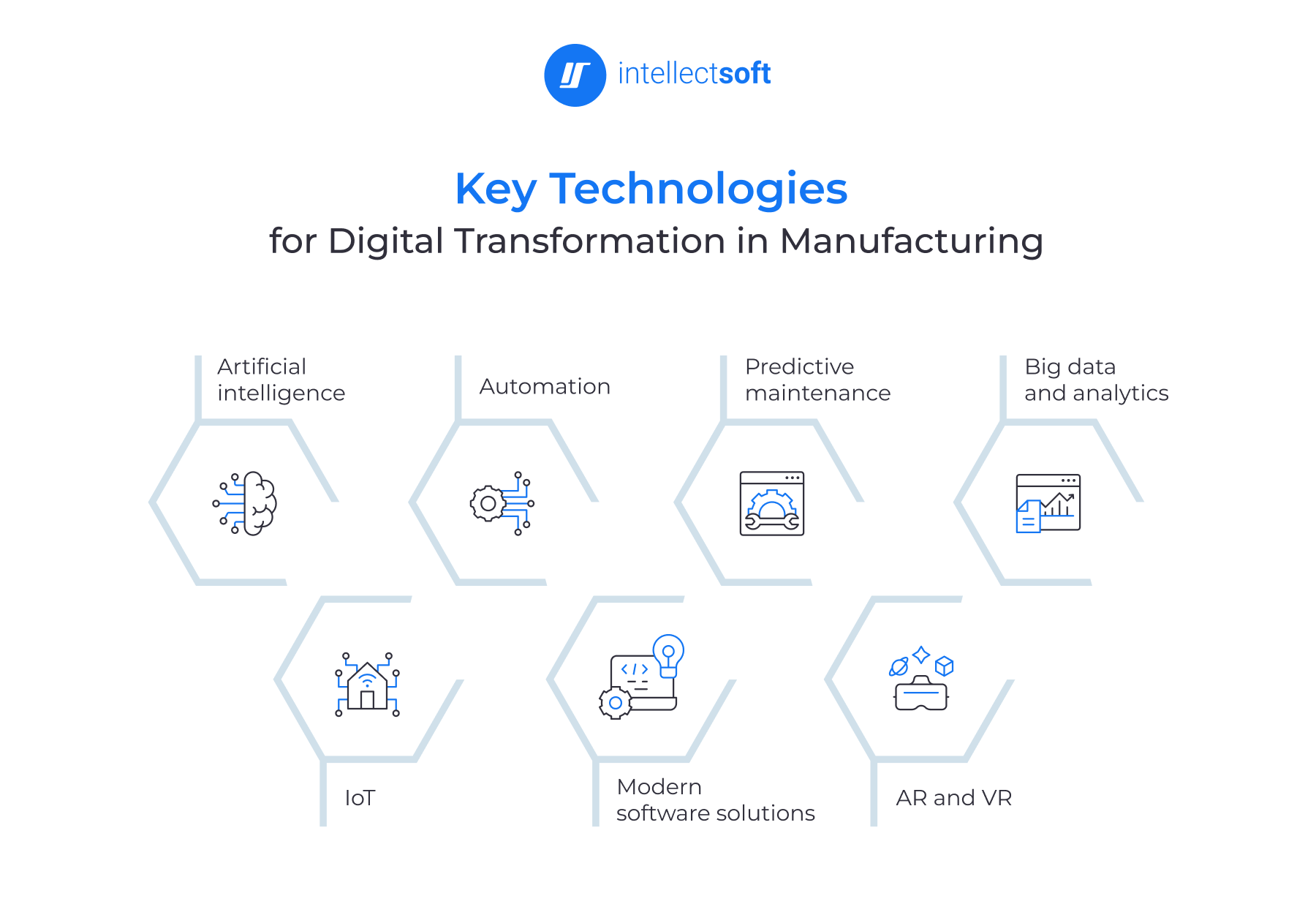
- Artificial intelligence: Thanks to AI automation and advanced analytics, plants and factories can benefit from their data and robotize operations to become more productive l. As a result, they transform how they approach their production and product quality monitoring. BMW and its Regensburg plant are a fitting example as they use AI to detect deviations in machinery in advance to prevent serious losses.
- Automation: To automate routine tasks and reduce the risk of errors, manufacturing companies use intelligent software. Plus, they can robotize packaging, data entry, and quality checks to free their workers from these tasks. At many of its sorting centers, DHL uses automated cross-belt sorters and robotic arms to sort thousands of packages per hour into the correct shipping bins.
- Predictive maintenance: To prevent machine failures and monitor performance in real time, manufacturers use predictive models. This is a good way to avoid financial losses that arise from production issues and equipment failures. In this case, Rolls-Royce has created an "IntelligentEngine" program that encourages placing sensors on jet engines to measure how they work in real-time and see what needs to be repaired or replaced.
- Big data and analytics: To refine operations and processes and identify patterns for further insights, manufacturers involve advanced analytics. Advanced analytics contributes to the optimization of tool and equipment use and production. Plus, with this technology, manufacturing businesses can process and analyze customer data to understand their needs and build products accordingly.
- Modern software solutions: To collect data from different channels and store it in one place, manufacturers can use ERP systems and migrate from traditional on-premises systems to cloud services.
- IoT: Manufacturers also place sensors on machines to collect data related to quality, productivity, and performance gaps in real time. For example, IoT in the automotive industry monitors whether vehicles work safely and meet clients’ needs.
- Augmented reality (AR) and virtual reality (VR): To improve how workers approach production and broaden their expertise, industrial businesses involve AR and VR. Virtual reality guides how to put together a product step by step or speeds up finding items in a warehouse with the help of virtual guidance. Augmented reality in manufacturing adds digital instructions to real objects through a phone or smart glasses.
The emergence of these technologies in manufacturing brings more advances and innovations in this industry and allows companies to shift from traditional business models and grow rapidly.
Why Digital Transformation Pays Off in Manufacturing
As there are still manufacturers who are skeptical about digital transformation and those still committed to their legacy system, we feel the need to explain why IT modernization matters. So here is what it can bring to the table:
Higher performance and production optimization
Digital transformation paves the way for intelligent, advanced manufacturing, where people work with minimal errors and material loss and where rework is rarely needed. Take, for instance, AI visual inspection tools! You can integrate them into your production system to detect defects in real time, fix them, and prevent more serious consequences.
How can you benefit from this? First, you can improve your industrial business's performance through production optimization and automation. Second, you can minimize operational disruptions by keeping your production flows predictable and stable and supporting your staff with digital technology.
Financial efficiency
Of course, digital transformation in manufacturing is costly, but anyway, this investment pays off in the long-term perspective. With advanced innovations, you’ll better use resources, boost performance, and predict risks – this is a shift from significant spending to rational cost optimization.
Let us take, for example, sensors with built-in intelligence! You integrate sensors into production equipment to see how much energy it consumes in real time and detect gaps in its work.
Safe manufacturing environment
No doubt, manufacturing digital transformation increases the safety and reliability of operations and processes. Automation with AI, immersive training for workers, real-time monitoring, and predictive analytics enable manufacturers to operate not only with benefits but also with minimal risk and accidents.
Artificial intelligence does a good job at making predictions about possible risks using historical and real-time data. When it comes to AR and VR, these technologies allow your workers to practice in a virtual production environment and improve their skills. The problem of real-time machine monitoring can also be solved with IoT sensors.
Strategic decision-making process
To properly handle their data and extract insights, manufacturers rely on advanced analytics. Of course, this is a way to swiftly make strategic decisions and further digital transformations at plants and factories. You can use your historical and current datasets to compare and analyze, and with these conclusions, you’ll operate more efficiently .
As you can see, data science matters for the manufacturing business, as it turns hypothetical decisions into fact-based, strategic ones that will work with benefits for industrial leaders. In addition, be ready that such a decision-making process will scale up your company to an enterprise-wide scope and increase your competitiveness in the market.
Competitive edge
A digital transformation in smart manufacturing is a way for industrial businesses to create tailored products, better respond to market needs, and outpace their conservative rivals. With technologies, you can offer remote technical support, so your clients don’t need to go on-site to fix their issues
Rise in performance and high-quality products allow companies to strengthen their market position and increase customer databases. Plus, with tech advances, manufacturers are more confident and gain a competitive advantage through their digital approach .
Sustainability and eco-friendliness
Manufacturing companies are frequently accused of harming the environment through their production operations. Of course, many companies are committed to their sustainability, but with digitalization, they can reduce environmental impact with ease.
Artificial intelligence, real-time data analytics, and sensors help manufacturers reduce their ecological footprint and use resources more rationally to reduce energy consumption responsibly. All this should be done to remain compliant with legal regulations and to protect the environment.
All these benefits of digital transformation in manufacturing prove that industrial businesses can gain a lot from advanced technologies. Even if they opt for legacy system modernization, they will see significant improvements in their production operations and enhance workers’ performance.
5 Challenges Holding Companies Back from Digital Transformation and How to Fix Them
The manufacturing industry is a domain full of obstacles for successful digital transformation efforts. That’s why not all companies decide to implement technologies because of existing barriers. Let’s review these challenges of digital transformation in manufacturing and see how to fix them to prepare you for technological advances.
High costs
Of course, some manufacturing companies refuse to pursue digital transformation initiatives due to the need for significant investments. Not all businesses can afford to set up an extra budget for the integration of the latest technologies, as they spend a lot on equipment and software. Plus, they need to hire technically skilled workers, which also increases expenses.
If you feel you can’t afford digital transformation in industrial manufacturing, we advise a phased approach to modify your business without disrupting your current operations. We recommend cloud services and SaaS solutions, as you’ll avoid investing in building an IT infrastructure. Finally, you can train your internal staff and outsource a few developers to support your in-house employees rather than hiring a new team.
Resistance to change
The reality is that not all workers are open to manufacturers’ initiatives to adopt new technologies, as they have relied on traditional approaches and feel resistant to change. As a result, this also restrains digital transformation, leading to the postponement of innovations.
To avoid these complications, you need to focus on change management from the beginning and communicate the business value of technologies with employees. Plus, you should conduct hands-on training and support to reduce resistance to change.
A lack of digital workforce
A lack of a digital workforce: Another challenge you can face is finding a software development company that can carry out digital transformation for your manufacturing business. Plus, you should also decide whether you need the assistance of a dedicated team or scale your internal team with tech experts who can handle integration.
In this case, we advise you to train your in-house team as they need digital skills to accept digital transformation and become more proficient and confident in using new systems and digital tools. Another option is to recruit outsourced developers who can help with innovation and integrate technologies into your system in a compliant and secure manner.
Disruption in workflows
Introducing new technologies can temporarily break your operations and production process, as not all integrations go smoothly. In this case, we recommend implementing digital solutions gradually to ensure parallel work of legacy and new systems with minimal downtime.
Starting Digital Transformation of Your Manufacturing Business?
If you're thinking about bringing more technologies into your industrial company and trying to find a custom software development team that can assist – Intellectsoft is at your service.
With 600+ projects under our belt, we know how to build a software solution that's right for your business, tailored to your needs and goals. With our architecture-first delivery model, we engineer for the future to scale up. That’s why we start with system design before any code is written. We’re the team that builds for scale, resilience, and long-term value.
Share your manufacturing challenge, and we’ll show you how to solve it with the right technology approach.
FAQ
What is digital transformation in the manufacturing industry?
Digital transformation in the manufacturing vertical is the use of the latest technologies and tools in manufacturing processes, from production to supply chain management. AI, automation, IoT, data analytics, AR, and VR are used to transform manufacturing businesses and make them more efficient.
What is the primary goal of digital transformation in manufacturing industry?
For manufacturing companies, digital transformation is a business strategy that helps them involve the latest technologies to modernize production to make it more efficient and better able to meet clients' needs . As a result, this helps them increase product quality, cut expenses, and boost competitiveness.
What are the 5Ps of digital transformation in manufacturing industry?
Purpose, people, process, platform, and project are the five keys to successful industry 4.0 digital transformation in manufacturing. An industrial business needs to decide what and why to change, who will make the transformation happen, and what tools to use to improve workflows. The final step is to decide how changes will be executed.
How can I use smart technology for my manufacturing company?
You can adopt smart technology, including AI and automation, big data, and cloud computing, to differentiate yourself from your rivals and manufacture more efficiently. All this can lead to higher product quality, lower expenses, and higher revenue.
What are digital transformation examples in manufacturing?
Predictive maintenance to forecast failures and avoid downtime
Smart factories to connect machinery and digital systems for real-time tracking
Digital twins to test and optimize production lines
Robotic automation to automate repetitive tasks
Cloud-based ERP to connect suppliers, production, and logistics
