Key Takeaways
- Blockchain in business has moved from pilot to production: comparable systems now run across logistics, healthcare, insurance, and the public sector.
- Blockchain reduces reconciliation costs in multi-party processes, settles cross-border payments in minutes, reduces fraud and counterfeiting, and opens new revenue streams through tokenization.
- Most enterprise blockchain projects fail due to foundational issues such as regulatory ambiguity, partner governance, and legacy integration.
- Cost and timeline scale with scope: a Proof of Concept runs $25K to $80K over six to ten weeks, a full enterprise rollout $250K to $2M and up, with a typical path to production of nine to eighteen months.
When Walmart needs to trace a bag of contaminated spinach back to its farm, it takes 2.2 seconds, a check that once took nearly seven days. That gap is what blockchain in business closes.
Businesses lose time and money when separate companies use different versions of the same data. Payments take days, supply chains are hard to trace, and teams burn hours reconciling records. Blockchain fixes that by providing a shared source of truth: instead of checking and comparing separate ledgers, every participant works from a single version that updates for everyone at once.
This guide to blockchain in business walks through the top 10 use cases, an honest look at the benefits and risks, real cost ranges, and a six-phase implementation roadmap.
How Does Blockchain in Business Work?
Blockchain for business uses a distributed ledger to record and verify transactions across a network of participants. Instead of each company keeping its own private copy and reconciling differences later, every party works from a shared, tamper-evident record. A transaction moves through four steps:
- Block. The network records who's involved and what changed, then groups it with other recent transactions.
- Chain. Each block references the previous one by its cryptographic hash, so tampering with any record breaks the chain and exposes the edit.
- Consensus. Nodes check the block independently and must agree before the network accepts it, without any central administrator waving entries through.
- Finalization. Once confirmed, a block can't be edited. You can only add a new transaction, even one that reverses an earlier entry.
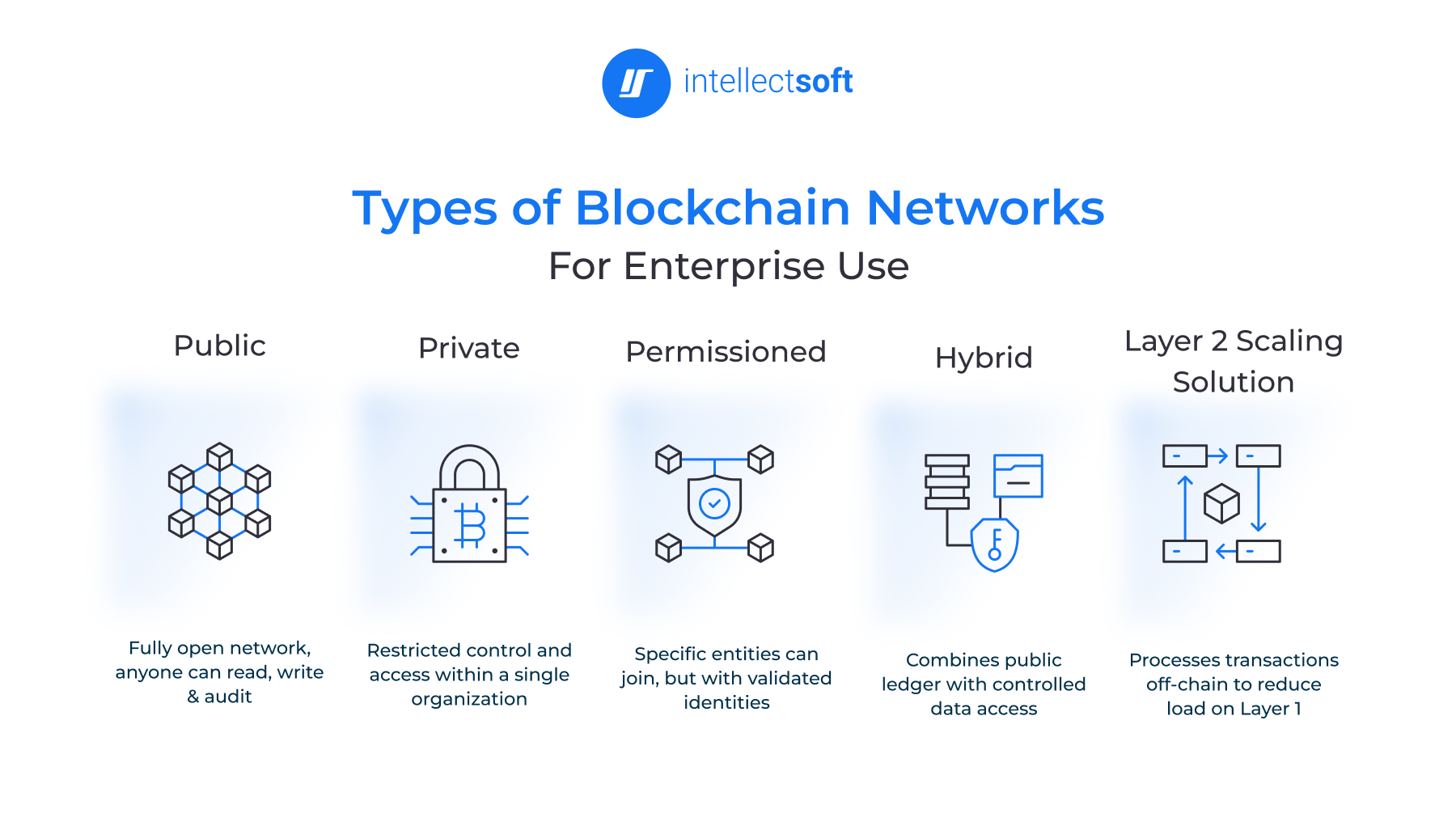
Top 10 Use Cases of Blockchain in Business
In 2026, blockchain technology is used in areas beyond finance. These areas include logistics, healthcare, insurance, energy, and government.
Blockchain helps to speed up processes that used to take days, now taking hours or seconds. It also keeps a shared record that cannot be changed by one person.
Here are 10 use cases in big industries that show how blockchain technology makes a difference.
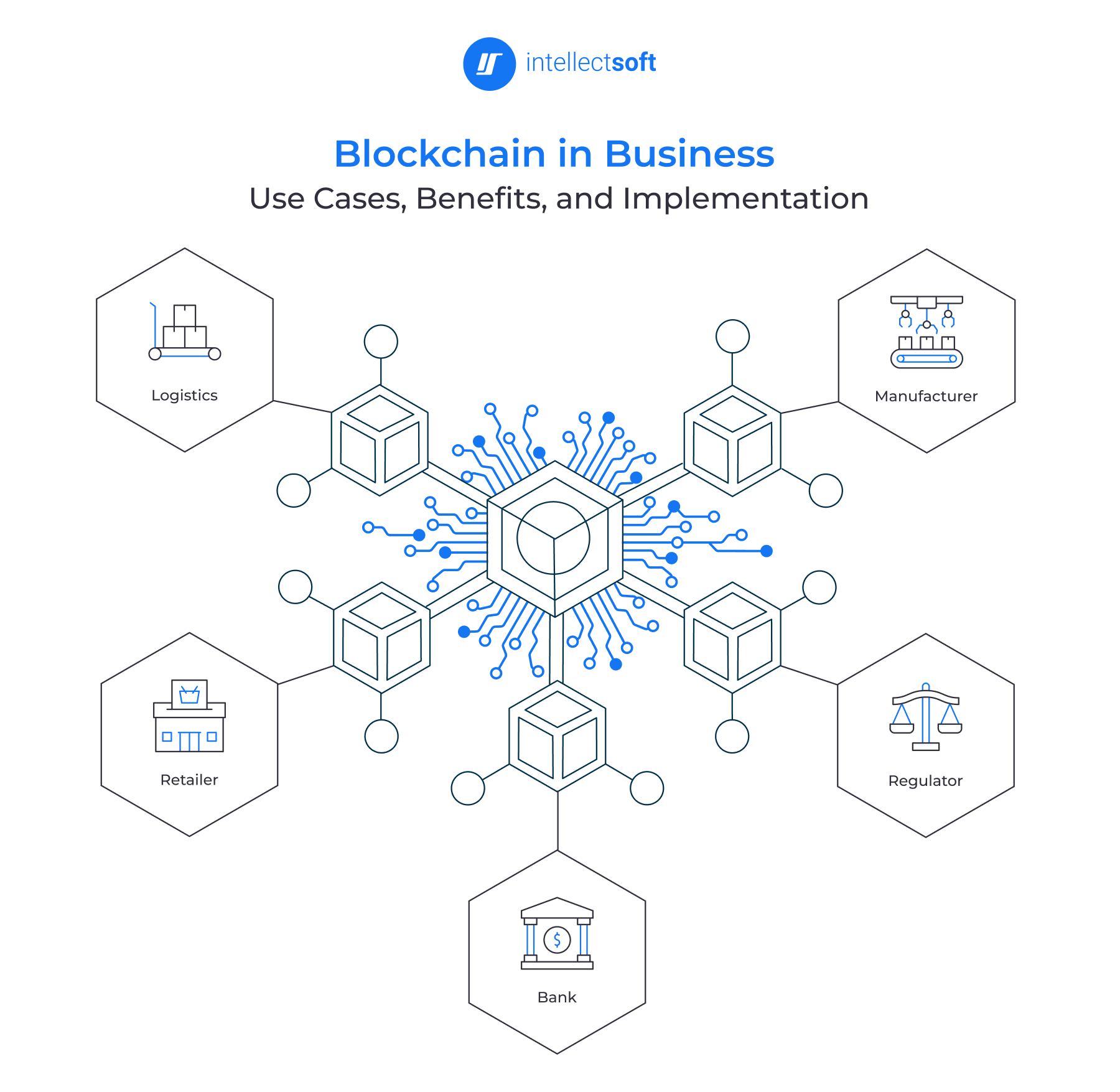
1. Supply Chain Traceability and Provenance
When companies share a supply chain, each keeps its own records, which can cause delays and losses. For example, if a batch of goods is contaminated or counterfeit, tracing where it came from can take days.
Blockchain enables easier traceability because it keeps a single shared record of everything that happens to a product: where it was grown, processed, shipped, and delivered. Every party involved, from suppliers to manufacturers to regulators, sees that record at the same time, so no one works from a stale copy. That shared source of truth is what powers modern retail software development: it gives everyone the same view of where a product has been. It also underpins the transportation and logistics software that keeps you audit-ready as rules tighten, like FSMA 204 food traceability and DSCSA drug serialization.
A practical example is Carrefour, which put food products on IBM Food Trust, letting a shopper scan a QR code to trace an item's origin in seconds instead of days. The company reported higher sales on the traceable lines.
2. Cross-Border Payments and Stablecoin Settlement
A cross-border payment can take days to clear, and to move money on time, treasury teams prefund accounts in each country. Correspondent bank fees and manual reconciliation add to the cost. Settling in stablecoins clears the same payment in minutes. That frees the cash tied up in prefunded accounts and cuts the fees and reconciliation work that came with every transfer. Santander's One Pay FX runs cross-border transfers on blockchain rails, cutting delivery from the usual three to five days to same-day or instant. The bank has said the app can now handle about half its annual international transfers.
3. Smart Contracts for Procurement, Insurance, and Trade Finance
Multi-party agreements, such as procurement, insurance claims, and trade finance, stall on manual matching. Each side confirms its own paperwork, an intermediary checks that everyone did what they promised, and payment waits days for sign-off. A smart contract holds the agreed terms as code and releases payment automatically when the conditions are met. Everyone sees the same rules and the same record, so those disputes largely disappear. That means cash moves in minutes instead of days, fewer disputes, and lower administrative costs on every multi-party deal.
A well-known example is Home Depot. It put vendor invoicing on a shared blockchain with IBM, using smart contracts to flag discrepancies in real time. Disputes fell by 65 percent, and cases that once took weeks or months now resolve in days. Deloitte estimates that smart contracts in finance provide global infrastructure operating cost savings of approximately $15–20 billion per year.
4. Tokenization of Real-World Assets (RWAs)
Valuable assets, like a treasury fund, a building, an invoice, a share of fine art, sit locked in paperwork, brokers, and settlement cycles that make them slow and expensive to sell. Tokenization of real-world assets puts the asset on a blockchain as a token, so ownership can be divided, traded, and settled in minutes rather than weeks. Behind that shift is a purpose-built financial software development service that handles on-chain issuance, compliance, and settlement.
That changes the economics in two ways. Tokens trade at any hour, creating a market for assets that were near-impossible to sell quickly. And fractions put high-value assets within reach of buyers who could never afford a whole unit, which widens the buyer pool. Tokenization turns a static balance-sheet asset into one that earns, moves, and reaches new buyers.
In this case, KKR tokenized exposure to its Health Care Strategic Growth Fund II on the public Avalanche blockchain with Securitize. The first time one of KKR's strategies was offered in digital form in the US, using tokenization to lower investment minimums and open a private-market fund to a broader set of investors. Boston Consulting Group and ADDX project tokenized real-world assets will reach $16 trillion by 2030.
5. Digital Identity and Verifiable Credentials
Every bank, employer, and service collects the same identity documents, verifies them, and stores them again. That's slow, duplicated, and leaves personal data in one more database that can be breached. With blockchain, people and organizations hold their own credentials in a digital wallet. It’s a reusable proof that a verifier can confirm as genuine and up to date without contacting the issuer or handling the original document.
For a compliance or risk officer, reusable credentials cut KYC cost and onboarding time, lower identity fraud, and remove the central store of personal data that attackers target. A customer verifies once and presents that proof everywhere else, without duplication across banks and fintechs.
That’s why Estonia gives every citizen a single digital ID that unlocks more than a thousand public services, with the blockchain holding only the proof of integrity while personal data stays off-chain.
6. Healthcare Records and Pharma Supply Chain
Patient records usually sit in separate systems, and a drug changes hands many times between the factory and the pharmacy. Healthcare IT solutions built on blockchain write each medical entry to the ledger, encrypt it so only authorized parties can access it, and assign every drug batch a unique ID logged at each handoff under a timestamp that no one can rewrite.
For a healthcare provider, that means fewer counterfeit drugs reaching patients, faster audits, and patient data that moves between providers without breaking HIPAA. Reaching that outcome takes healthcare software development that treats compliance and patient privacy as design requirements, not afterthoughts.
Estonia is again the reference case. The same digital-state model also secured more than one million patient health records on a Guardtime blockchain, every access and change logged on a tamper-proof trail, patient data off-chain.
7. Intellectual Property, Royalties, and Provenance for AI Content
When a creative work earns, collaborators wait months for a label or platform to reconcile statements and pay out. Registered on-chain as a token, a work carries a tamper-evident record of ownership and every transfer since. A smart contract splits each payment the moment it arrives, without any reconciliation or waiting.
The bigger pull now is AI. Enterprises running generative AI carry copyright and regulatory exposure they didn't face two years ago. For example, Article 50 of the EU AI Act requires them to disclose when content is generated by AI. But a blockchain record of where training data is kept prevents a copyright claim or a regulator's question from becoming a liability.
This technology was used by the Royal platform. The startup lets fans buy tokenized shares of a song's royalties and get paid automatically by smart contract as it earns. The model raised $16 million for the platform.
8. Energy Trading and Carbon Credit Markets
Carbon markets run on trust that's easy to abuse. The same credit is counted or sold twice, and a buyer often can't prove that an offset was real or has been retired. Peer-to-peer energy trading faces a similar gap: a household with solar panels has no simple way to sell surplus power directly to a neighbor.
But a shared ledger lets that household trade power directly and records every carbon credit as it's issued, traded, and retired. Blockchain gives you a record of every credit, where it came from, and when it was retired. For example, Powerledger runs peer-to-peer solar trading within local communities: in one Australian project it saved households about $540 a year, and in another it cut grid-energy use by 80 percent.
9. Insurance Claims Automation and Fraud Detection
Insurance loses money in two ways: claims take too long to settle, and fraud slips through because insurers can't share data safely. With predictive analytics services, blockchain fixes both. Simple claims pay out automatically the moment a verifiable event occurs, and duplicate claims are caught across companies without anyone exposing customer data.
Parametric policies pay out on a clear trigger, such as a flight delayed past a set time or rainfall below a threshold under a crop policy, with no adjuster or paperwork. For fraud, custom insurance software development turns each application into code that reveals nothing on its own. A company checks only whether that same code already exists elsewhere, so a claim filed twice across two insurers shows up without either side sharing files. That means lower fraud losses, faster payouts, and lower processing costs — from one system instead of three.
Thanks to the technology, Etherisc, with ACRE Africa, built parametric crop insurance for Kenyan farmers that pays out automatically on weather data, cutting policy-issuance costs by up to 41 percent and farmer premiums by up to 30 percent, with no adjuster or paperwork.
10. Public Sector — Voting, Land Registry, and Aid Distribution
Some government jobs come down to one thing: proving to a doubtful public that the record is honest. Blockchain fits three of them. Votes are recorded so no one can alter them, and results are returned quickly and are open to inspection. Land titles are recorded permanently and can't be forged or quietly reassigned, which matters most where paper titles invite dispute or bribery. Aid goes straight to a recipient's verified identity, so money reaches people without bank accounts, while every payment stays logged for donors to check.
For example, the Republic of Georgia became the first national government to put land titles on a blockchain, registering more than 100,000 property titles with Bitfury so ownership can't be quietly altered
Benefits of Blockchain for Business
There are five standouts that a CFO, CTO, or operations lead can take into a budget conversation.
Reduced Transaction Costs and Reconciliation Overhead
Blockchain provides every party with the same record, so there's nothing to reconcile, and no third party to pay to verify a transaction that the network has already validated. That means fewer people tied up in manual matching and faster close cycles. After Walmart Canada moved freight invoicing with its carriers onto a shared blockchain built by DLT Labs, invoice disputes fell from around 70 percent to roughly 1.5 percent, reconciliation dropped out of the process entirely, and invoice approval went from six to eight weeks down to under one week.
Faster Settlement and Working Capital Release
Traditional cross-border B2B payments take three to five days through correspondent banking. Blockchain settles in seconds to minutes, and the network never closes for nights, weekends, or holidays. Instead of prefunding, you send funds just in time and put idle cash back to work. A multinational moving $500 million a year in cross-border payables could free several million in working capital by switching to instant settlement. For example, HSBC’s FX Everywhere platform has settled more than $2.5 trillion in foreign-exchange trades since 2018.
Stronger Auditability and Regulatory Reporting
Audits eat time because the data lives in different systems, formats, and with different owners. A blockchain records every entry as immutable, timestamped, and cryptographically signed, so the audit trail is one that a regulator can verify directly in real time, rather than one that an accountant reconstructs. De Beers’ Tracr platform has registered more than three million diamonds with a tamper-proof, mine-to-market record, giving each stone an auditable country-of-origin trail that meets G7 sanctions and Kimberley Process requirements.
Lower Fraud and Counterfeiting Risk
Fraud and counterfeiting thrive in the same gap: records can be changed after the fact, and no single party sees the whole picture. So there are fake slips in because their history can't be checked against everyone else's. But cryptographic linking makes any tampering with a past record detectable. If a counterfeit batch has no valid history in the ledger, the mismatch is immediately apparent. The OECD and EUIPO put global trade in counterfeit goods at around $467 billion a year. That's why rival luxury houses LVMH, Prada, and Cartier built the shared Aura Blockchain Consortium to give products a verifiable record of authenticity from raw material to resale.
New Revenue Models — Tokenization, Programmable Money, Data Marketplaces
When existing revenue lines flatten, blockchain opens ones that didn't exist before. Tokenization turns illiquid assets into tradable, fractional ones, like fractional real estate or tokenized invoices that give a small business working capital against its receivables. Programmable money lets payments run themselves, from AI agents settling B2B transactions in stablecoins to loyalty points that move and redeem as code. Data marketplaces pay contributors automatically when their data trains a model, opening data economies in healthcare, finance, and IoT. Siemens issued a €60 million digital bond directly to investors on a public blockchain, skipping the paperwork and central clearing a traditional issuance needs. Then it followed with a €300 million bond that settled in minutes.
Where AI and Blockchain Converge in 2026
AI and blockchain solve opposite halves of the same problem. AI generates outputs at scale but can't prove where they came from. Blockchain proves provenance but generates nothing. Put together, they enable verifiable AI: agents that transact on their own, training data with on-chain provenance, and programmable payment for AI services. For enterprises already running AI, that combination is where the next set of decisions sits:
- AI agents with on-chain wallets. They can run procurement and treasury workflows end to end: comparing quotes, placing an order, and settling it in stablecoins without a person signing off on each transaction. The blockchain gives the agent an account it controls and a record of every payment it makes. For finance teams, artificial intelligence solutions turn routine, high-volume purchasing into something that runs on its own.
- On-chain provenance for AI training data and outputs. A blockchain record of where training data came from, and what a model produced, gives enterprises a defensible answer when a copyright claim or a regulator's question lands. This matters most under the EU AI Act's Article 50, which adds transparency duties around AI-generated content. Instead of reconstructing after the fact where a dataset or an output originated, you have a trail that was recorded as it happened.
- Tokenized data marketplaces feeding ML models. When data trains a model, a smart contract can pay each contributor automatically for that use. That opens data economies in healthcare, financial services, and IoT, where owners have been reluctant to share valuable data without a clear way to track and get paid for it.
- Smart-contract billing for AI-as-a-service. AI development services priced per inference are hard to reconcile: the provider meters usage, the customer disputes the count, and finance teams settle up later. A smart contract meters and settles each call on-chain, so pay-per-inference billing clears automatically, with no monthly reconciliation between an AI provider and its enterprise customers.
Challenges and Risks of Blockchain in Business
Blockchain isn't the right fit for every problem, and the projects usually fail on the groundwork in regulatory, operational, and organizational aspects. Here are the seven risks worth weighing before you invest in.
Regulatory and Compliance Uncertainty
The rules are still moving, which is a real risk when you're committing budget to a multi-year build. By 2026, the EU MiCA will be in effect, the US GENIUS Act will cover stablecoins, and FASB ASU 2023-08 will set the rules for accounting for assets. But the biggest problem is still the conflict between the GDPR's right to be forgotten and the fact that blockchain is permanent: you cannot delete something from a ledger that cannot be changed.
Scalability, Throughput, and Latency Trade-offs
Public blockchain systems are too slow for companies: Ethereum can handle about 15 transactions per second, and Bitcoin can handle about 7. For a business that needs to process thousands of transactions every minute, this is a limitation. Some solutions, like Layer 2 rollups (Arbitrum and Polygon zkEVM) and app-chains (Avalanche Subnets), can handle transactions. Layer 2 rollups and app-chains raise throughput materially, but with a smaller validator set — a scalability-for-decentralization trade-off.
Integration with Legacy Systems (ERP, CRM, Payment Rails)
Blockchain usually does not work on its own because it needs to integrate with the systems the business already uses, such as SAP, Oracle, Salesforce, and payment systems. Making blockchain work with these systems is the most expensive part of most projects after choosing the platform, and it is where things often take longer than expected.
Talent Scarcity and Cost
A dedicated team of developers skilled in blockchain is hard to find, and that scarcity shows up in their salaries. The 2026 US average for a blockchain developer is around $140,000, and specialized skills — Hyperledger Fabric, Solidity, Rust for Solana, and the Cosmos SDK — are scarcer still. Hiring a full in-house team for a single initiative can be too expensive, and the people you'd need are hard to find and harder to keep, which is a case where IT staff augmentation services are often a better alternative.
Governance, Consensus, and Multi-Party Coordination
A shared blockchain raises questions a single database never does: who's allowed to join, how upgrades get approved, how disputes are settled between the parties sharing the ledger. These are questions about getting competitors to agree on rules and share control, and that's where consortium projects most often stall.
Energy Consumption and ESG Reporting
Blockchain's energy reputation can stall a project for the wrong reason. Proof-of-Work chains like Bitcoin are genuinely energy-intensive. But Proof-of-Stake chains like Ethereum cut energy use by about 99.95 percent after the Merge. The permissioned chains most enterprise blockchains actually run on — Hyperledger Fabric and R3 Corda — use negligible energy because there's no mining.
How to Implement Blockchain in Your Business: A 6-Phase Roadmap
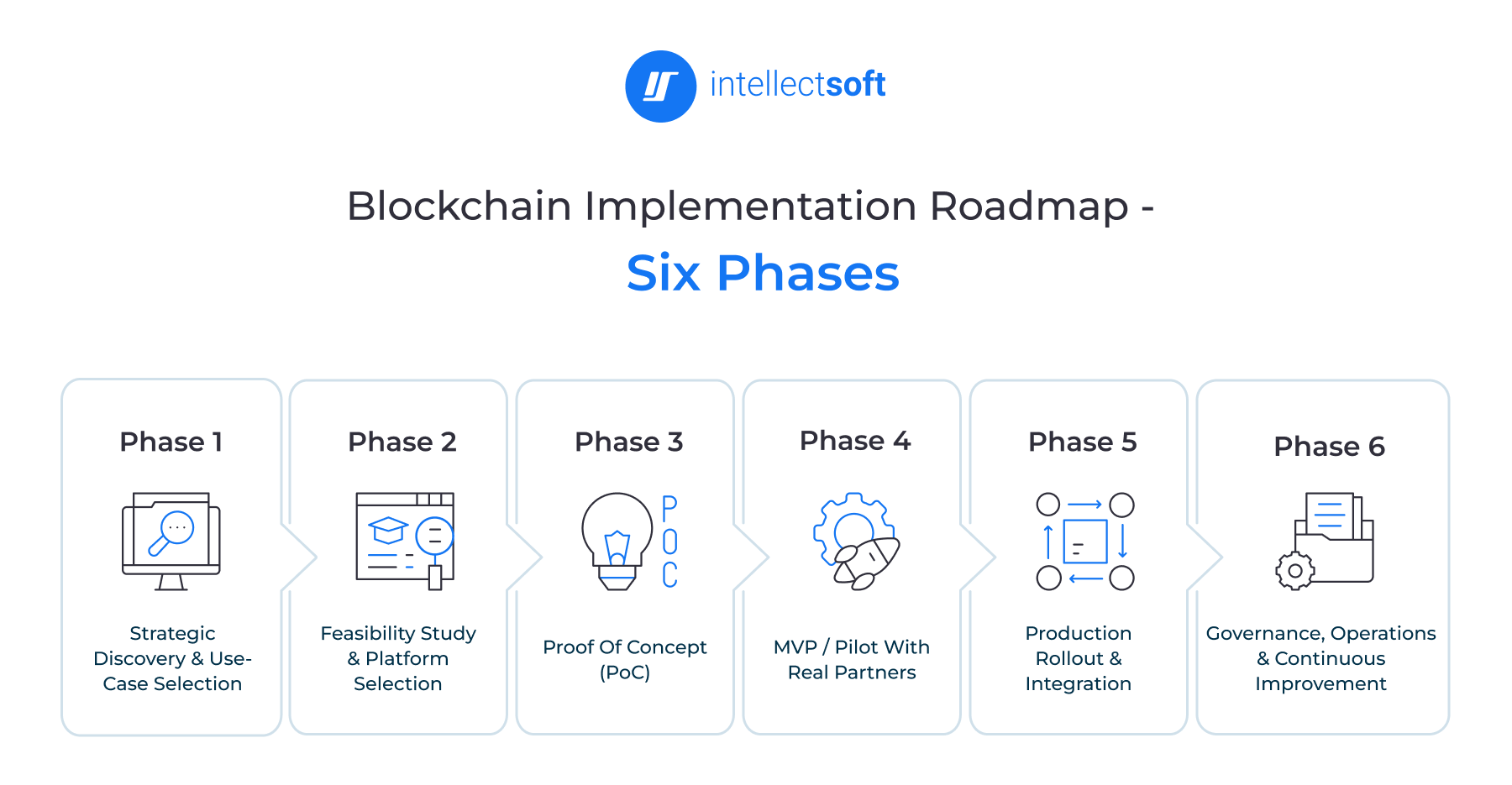
Structured business technology consulting is what separates a blockchain project that reaches production from one that dies as an interesting pilot. Here's how Intellectsoft's product engineering services take a blockchain project from pilot to production in 6 steps.
How Much Does Blockchain Implementation Cost?
Costs fall into four tiers:
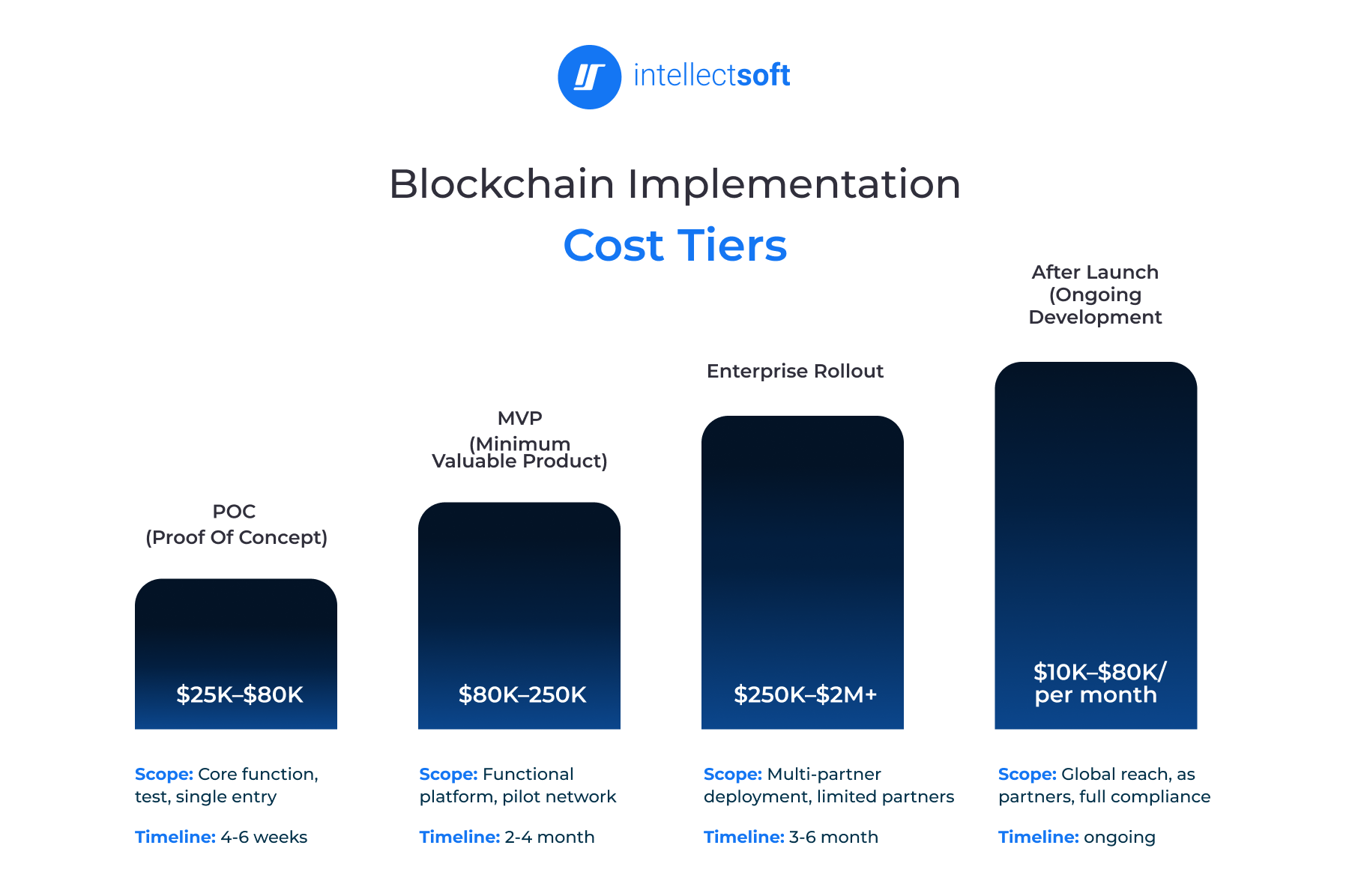
- A Proof of Concept runs $25K to $80K over six to ten weeks and covers a single-use-case build on a chosen platform with one or two partners, basic smart contracts, and a demonstration UI.
- An MVP or pilot runs $80K to $250K over three to five months, adding a production-grade build, a partner-onboarding portal, a security audit, and limited integration.
- A full enterprise rollout costs $250K to $2M over six to twelve months. There are costs for full integration with ERP, CRM, and payment systems, multi-party governance, compliance review, and production support.
- After launch, ongoing operations and governance typically run $10K to $80K per month.
Actual cost shifts with platform choice because Hyperledger Fabric, Ethereum, or Polygon each carry different build and running costs. Also, it depends on integration complexity, regulatory scope, the geography of your delivery team, and its composition. The number of parties on the network matters too — each one adds onboarding and governance work.
Build, Buy, or Partner — How to Choose a Blockchain Development Partner
Most enterprises don't need a permanent in-house blockchain team: a project is intense at the start, then settles into steady operation, so hiring scarce Solidity or Hyperledger Fabric specialists for one initiative rarely pays off. What matters is choosing the right development partner: technical depth for your platform, regulatory experience for your industry, and the ability to integrate with the systems you already run. Four criteria determine the partner you can rely on to develop a blockchain system for business:
- Security audit capability. The right partner engages third-party auditors (Trail of Bits, CertiK, OpenZeppelin) for every smart contract and can produce a post-deployment incident response plan.
- Regulated-industry experience. Fintech, healthcare, and pharma blockchain projects carry non-negotiable compliance requirements that generalist firms routinely underestimate.
- Full-cycle capability. Strategy, smart contract development, legacy integration, security audit, and ongoing operations are handled by one accountable partner that provides custom software development services. It closes the gap between a strategy deck and a running system.
- AI + blockchain capability. When outsourcing software development services, look for a partner that already delivers AI integrations. They're better placed to design a roadmap that still makes sense in 24 months, when provenance and on-chain AI move from edge case to expectation.
Blockchain Trends Shaping Business in 2026 and Beyond
There are some changes business leaders should pay attention to as they plan for the next few years.
- AI agents are moving onto blockchain rails to handle their own payments. With their own wallets, they can settle business-to-business transactions in stablecoins without a person approving each one, and billing happens automatically; customers pay only for what they use.
- Data-tokenization markets are growing. People who contribute data are automatically paid when their data trains a model, opening new data economies in healthcare, finance, and retail.
- Tokenizing real-world assets is becoming standard practice. Asset managers like BlackRock and Franklin Templeton already issue on-chain funds.
- New payment rails are replacing the old SWIFT system. JPMorgan Kinexys has already processed over $4 trillion in payments this way, and laws like the US GENIUS Act and the EU MiCA are making adoption clearer for companies.
- Zero-knowledge proofs. Now they let companies keep transactions private while still meeting compliance rules, opening blockchain up to cases where privacy used to be a blocker.
How Intellectsoft Delivers Blockchain Development — From Pilot to Production
Most blockchain projects that reach production share the same discipline: validate the use case first, design governance before you pick a platform, and treat regulatory readiness as a Phase 1 task. That's how Intellectsoft runs a blockchain engagement — and why our IT consulting services clear the groundwork that stalls most others. Here's what sets the work apart:
- Architecture before code. Every engagement starts with a systems design sprint, so you don't spend years paying off the technical debt that skipping it creates.
- A principal architect who stays. One senior architect owns your build from Discovery through operations. When it needs to change direction, you're talking to the person who understands the system and can make the call.
- One accountable partner in the full-cycle process. Strategy, smart contract development, security audit, integration, and operations sit under one roof as part of our enterprise software development services.
- Regulated-industry experience. We build where blockchain has to clear a compliance bar, so the requirements that generalist firms underestimate are designed in from Phase 1.
- Scarce skills without a permanent team. A hybrid model puts blockchain engineers on your project and keeps senior architects in your time zone for real-time work.
We've shipped blockchain wallet apps for iOS and Android with the simplicity of any everyday payments app, and built a blockchain-based cross-border transfer and lending platform for a global fintech — from a discovery workshop through MVP to an ongoing partnership with a dedicated blockchain lab. It's backed by 18+ years of software development service for enterprises and 35 Fortune 1000 clients. If you're weighing where blockchain fits and how to build it, book a consultation with one of our architects.
FAQ
What is blockchain in business?
Blockchain in business is the use of distributed ledger technology to record, verify, and automate transactions across multiple parties without a central intermediary. It's applied today in supply-chain traceability, cross-border payments, smart-contract automation, asset tokenization, and digital identity.
What are the main benefits of blockchain for businesses?
Blockchain cuts reconciliation costs in multi-party processes and settles cross-border payments in minutes rather than days. It also lowers fraud and counterfeiting risk and enables new revenue models through tokenization.
Which industries benefit most from blockchain?
Financial services, supply chain and logistics, healthcare and pharma, insurance, energy, and the public sector will see the greatest impact by 2026.
How is blockchain different from a traditional database?
A traditional database is controlled by one organization and can be edited at any time. A blockchain is replicated across many participants, updated only by consensus, and immutable once confirmed, which removes the need to trust any single party with the source of truth.
What is the difference between a public and a private blockchain?
A public blockchain like Ethereum or Bitcoin is open to anyone to read, transact, and validate. A private or permissioned blockchain restricts access to approved participants.
How much does it cost to implement blockchain in a business?
A Proof of Concept typically costs $25K to $80K over six to ten weeks, an MVP $80K to $250K over three to five months, and a full enterprise rollout $250K to $2M and up over six to twelve months. Ongoing operations and governance usually run $10K to $80K per month.
How long does a blockchain project take from PoC to production?
A typical engagement runs 9 to 18 months from Strategic Discovery to production: two to four weeks for Discovery, three to six for Feasibility, six to ten for the PoC, three to five months for the MVP, and four to nine months for rollout.
