Key Takeaways
- Full control over architecture, security, and integrations is what enterprise web application development offers you, unlike low-code platforms that limit flexibility but provide higher speed.
- For enterprise applications, your budget should be $150,000-$500,000+, but if you need a complex, multi-module platform, be ready for the price to surpass $1 million – project complexity, integrations, and compliance add up to your budget.
- The right approach depends on your business needs: low-code can be used for simple internal tools, while custom development works best for complex, regulated systems.
- Security and compliance are among the most important requirements for enterprise web applications – they’re vital for protecting data, meeting regulations, and ensuring secure access.
- Starting with a discovery phase helps businesses plan the architecture, pick the right technologies, find out risks early, and avoid irrelevant expenses later.
The red flags usually appear long before you realize your platform is holding your business back. At first, it slows down during peak hours. Then, you decide to integrate it with other tools, and this takes months instead of weeks. Next, your platform can't keep up with security updates. And finally, your IT team is busy fixing problems and has no time to build features.
Sounds not very promising, right? But congratulations: your business has outgrown the software it relies on. And you’re ready to move to the next level: that is, enterprise web application development. This is a tech and strategic initiative that influences how your company scales, adopts new technologies, and uses data.
In this guide, we’ll tell you about enterprise web app development: why to start it, how much it costs, and how to pick the right solution for your business. Plus, we’ll share how Intellectsoft, as a custom development partner, helps develop reliable, enterprise applications.
What Is Enterprise Web Application Development, and How Does It Differ?
Enterprise web application development is building tailored, advanced systems that can manage complex business operations. Unlike desktop or on-premises software, they run in a browser. But this doesn’t prevent them from being scalable, secure, and capable of integrations. Enterprise web apps can handle many users, big data, and workflows even during peak times while remaining reliable and fast.
CRM and ERP systems, customer and employee portals, internal business tools, and other mission-critical software are built with the help of enterprise web development. Compared with standard consumer web applications, they can handle larger workloads, meet stricter security requirements, and perform more sophisticated tasks.
Enterprise web application vs. standard web app vs. enterprise application — Quick comparison
Enterprise web apps are often confused with standard web applications and enterprise applications. Yes, these types of software are related. But, indeed, they have different purposes, architectures, and levels of complexity. The table below shows distinctions between them.
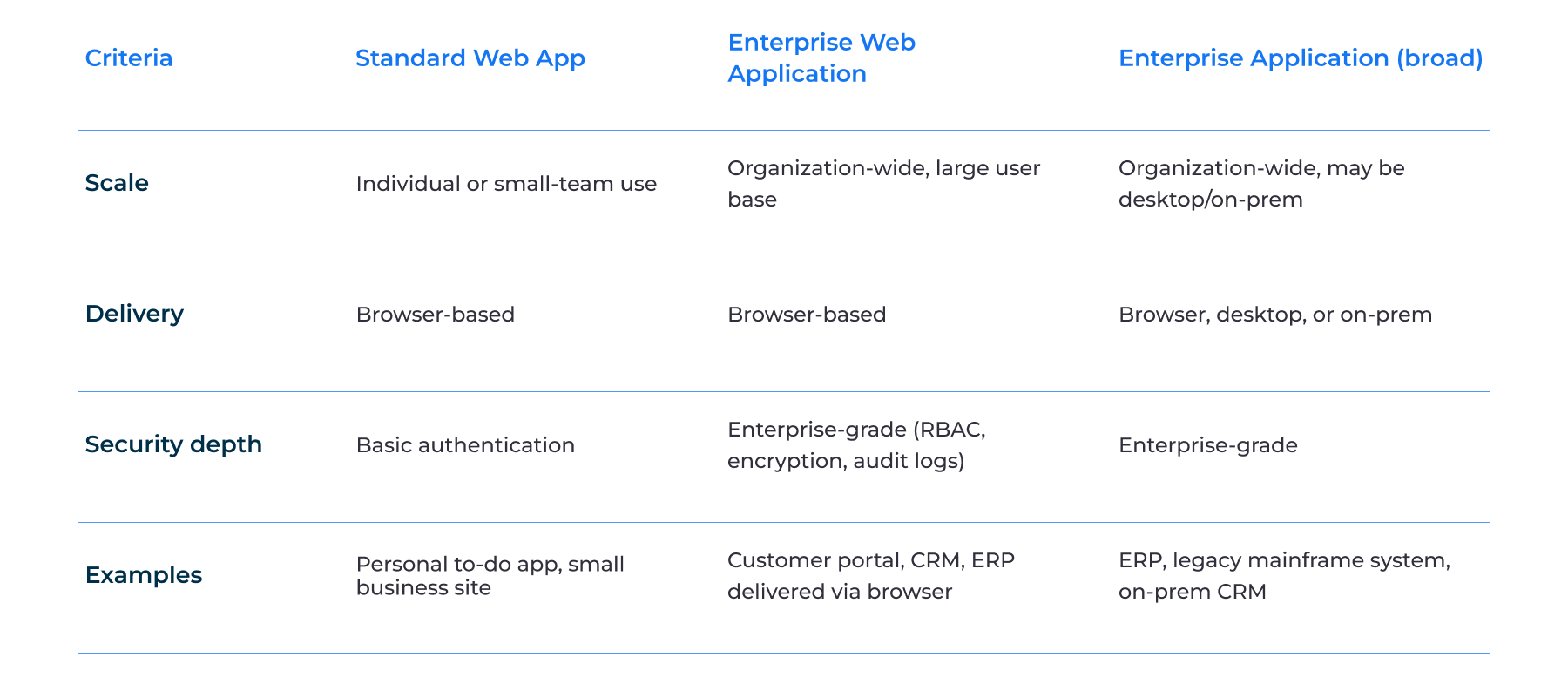
Enterprise IT consulting can help you clarify what type of enterprise solution works best for your business, including web portal development, works best for your business. The main thing is to understand your needs and share what you expect from your vendor.
Custom Development vs. Low-Code Platforms: Which Fits Your Enterprise?
The choice many businesses face is: custom development vs. low-code platforms. In fact, they choose the option that launches faster. But we recommend considering your business needs, compliance requirements, and app complexity. Here’s the table that can be helpful when you’re still uncertain.
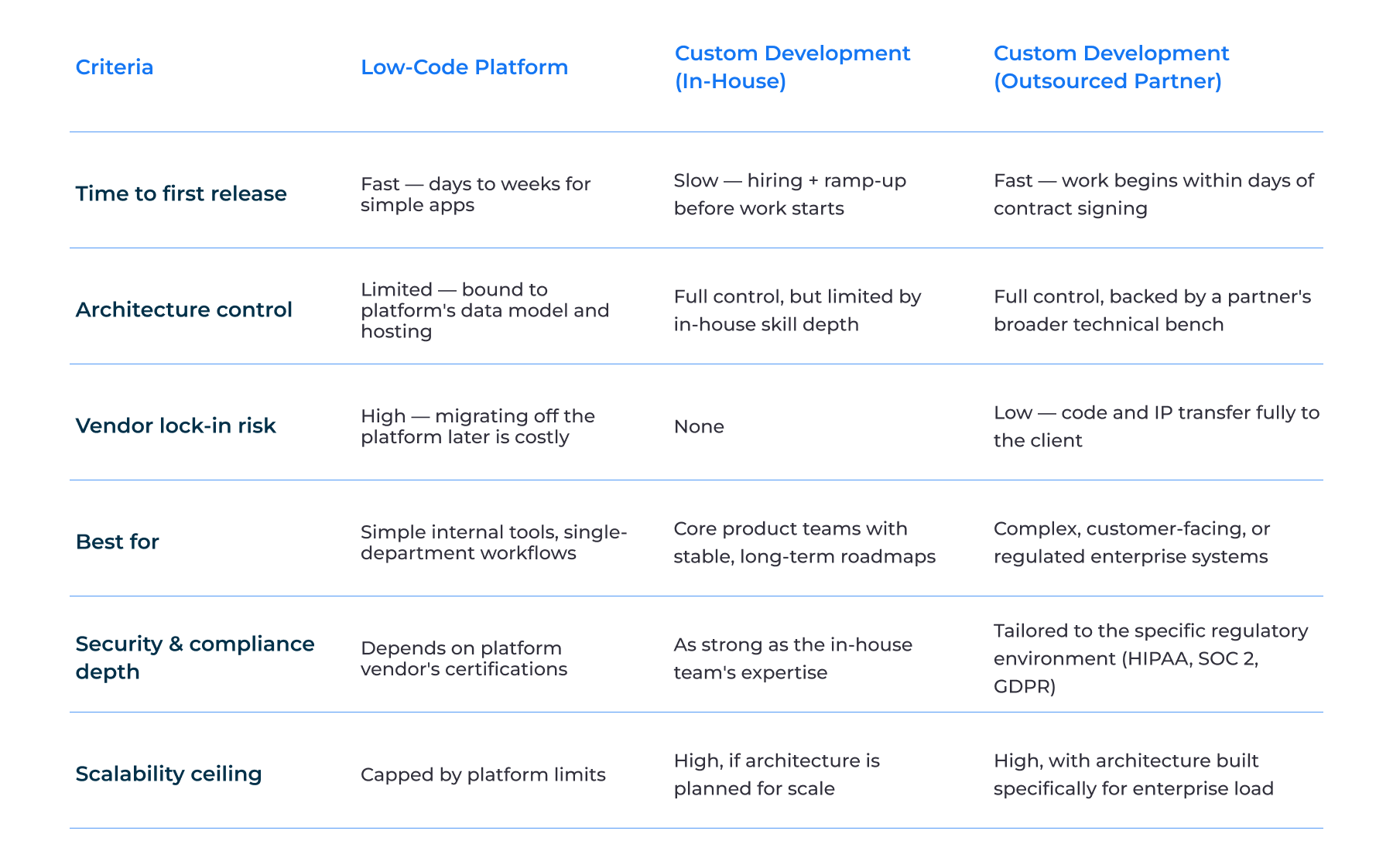
Seeking to launch simple internal applications quickly? Opt for low-code platforms as their strength is speed. Need business-critical software that scales up and keeps security updates? Your choice should be custom enterprise web app development.
But if you need to speed up delivery without investing in your internal team, we recommend finding an experienced development partner. With enterprise web app development services, they will assume full responsibility for app production and release your solution faster.
Key Features of Enterprise-Grade Web Applications
Can all web applications serve enterprise-level companies’ needs? Indeed, nope. Not all of them can manage sophisticated workflows, tons of data, and business-critical operations. Plus, not all of them can scale up and safeguard your sensitive data. That’s why we’ve prepared the list of features that a web app should have to bring benefits to your enterprise.
- Scalability: Your enterprise application should scale up together with your business, not hold it back. It can grow vertically by increasing the capacity of a single server. Or it can extend horizontally to handle high traffic and workloads during peak times. A well-designed architecture supports the speed, stability, and performance of your app.
- Security and compliance: Believe it or not, even a single security breach can disrupt your operations and lead to the loss of customer trust. RBAC, SSO, encryption, audit logs, and regular security testing – all these enterprise web applications cover to protect private data. They’re also compliant as they follow GDPR, HIPAA, and SOC 2 where required.
- Integration capabilities: If your systems don’t interact, your business operations will slow down. CRM, ERP, data warehouses, payment systems, and other tools — all of them can be connected if your web app has API-first architecture. So, this reduces manual work and syncs your data.
- Performance and availability: Slow apps take time and cost and irritate your users. But this isn’t about enterprise web applications built to stay fast and available, even during peak hours, with 99.9% uptime. The result? Despite the extra workload, your system is rapid and stable. And your clients don’t notice changes in performance.
- Multi-user concurrency: No matter whether your app has 20 or 20,000 users, it should remain speedy and reliable in any conditions. Traffic spikes and performance drops don’t threaten enterprise web apps, which can handle a boom in users, data, and workloads. Load balancing, database optimization, and smart resource management – all these keep you efficient.
- Extensibility and customization: Your business can’t stand still, and neither can your system. With a modular architecture, you can tailor your enterprise web application according to your business goals. So, you can easily add new features, workflows, user roles, and integrations — everything to improve your processes. And all this is without rebuilding the entire system. You save time and costs and keep further updates simple.
- Observability and monitoring: In fact, it's easier to fix a problem if you see it before your users notice it. Logging, performance monitoring, and automated alerts – all these features are in enterprise web applications. They help your team spot issues, respond swiftly, and keep business operations efficient.
Benefits of Enterprise Web Application Development
Now, when you’re aware of the core features that an enterprise web app should have, it’s high time to clarify what it can bring to the table. As a rule, businesses view it as an instrument for automation. But its benefits are broader.
Faster innovation – new features reach the market quicker
If you use a generic web app, you depend on a vendor. So building the simplest feature takes a long time. But you can change this by opting for a custom solution. So, you decide when to add new features to your system and how to speed up the process.
You can launch a new customer portal, automate workflows, or integrate new technology in weeks, not wait months for a release. Plus, you see what your rivals do and what your clients need and respond swiftly to market conditions and your audience’s demands.
Higher operational efficiency – you serve more users
Applications built around your team's duties help them work faster and bring more value to your company. Plus, these web apps automate repetitive tasks and root out reliance on spreadsheets and tools that don't sync.
As a result, you serve your team's needs, making them more fruitful. And this also affects your business efficiency and how you treat your clients.
Better visibility through data – your decisions are more informed
Data-driven decisions are what many businesses lack. And the reason is pretty simple: chaotic and messy data that is difficult to rely on.
A custom application transforms data based on how your business operates. So you have access to the reports, dashboards, and KPIs, instead of rigid metrics offered by off-the-shelf software.
Greater competitive differentiation – you offer more value to clients
Today, you won't find a company that fails to bend over backward to prove that their products and services are unique. But the bitter truth is: the market is oversaturated with similar businesses. They are like twins, but still trying to demonstrate their differences.
You can outperform your competitors with custom enterprise web application development. See how you can do this. First, tailored solutions will make your business processes and custom experiences unique. Second, you’ll improve services and operate more efficiently. So this is the way to the competitive advantage your rivals can’t beat.
Lower long-term costs – you optimize your budget
Yes, building an enterprise web application requires heavy investments at the start. But over time, this solution cuts costs. “In what way?” – you can ask.
First, you save on recurring licensing fees. Second, you avoid expensive customizations. Third, you get autonomy from a single vendor, secure long-term budget, and see ROI within two to three years, depending on adoption.
What Drives the Cost of Enterprise Web Application Development?
If a vendor promises you a single fixed price for enterprise web software, be prepared for unpleasant surprises, such as hidden costs. The price of such a solution depends on many aspects – project scope, complexity, integrations, compliance, and delivery timeline. Here’s the list of factors that can affect your budget.
- Integration complexity: Thinking about connecting your app to legacy systems, CRMs, ERPs, payment gateways, and other third-party tools? That’s a great idea but costly enough. The more integrations you need, the more resources you should involve for development, testing, and ongoing support.
- Compliance and security scope: If you operate in a regulated environment such as healthcare, finance, or insurance, you should consider compliance and security practices. Audit trails, encryption, role-based access control, compliance documentation, and penetration testing – all this adds up to your budget.
- Team size and specialization: The number of your investments also depends on the team composition and their skills. A small cross-functional crew is cheaper, but it's better suited to simple projects. But if you need a more advanced enterprise platform, you should involve a dedicated team that requires higher investments.
- Timeline: Delivery speed also affects project cost. When businesses ask to speed up and release faster, we need to involve more people in the development process. Yes, this shortens delivery time, but this also adds to your budget.
- Scale and geography: If you need an app for multiple business departments, countries, or regions, be ready to pay extra for extra planning, coordination, localization, and infrastructure. The project becomes more complex if you need to support distributed users and teams.
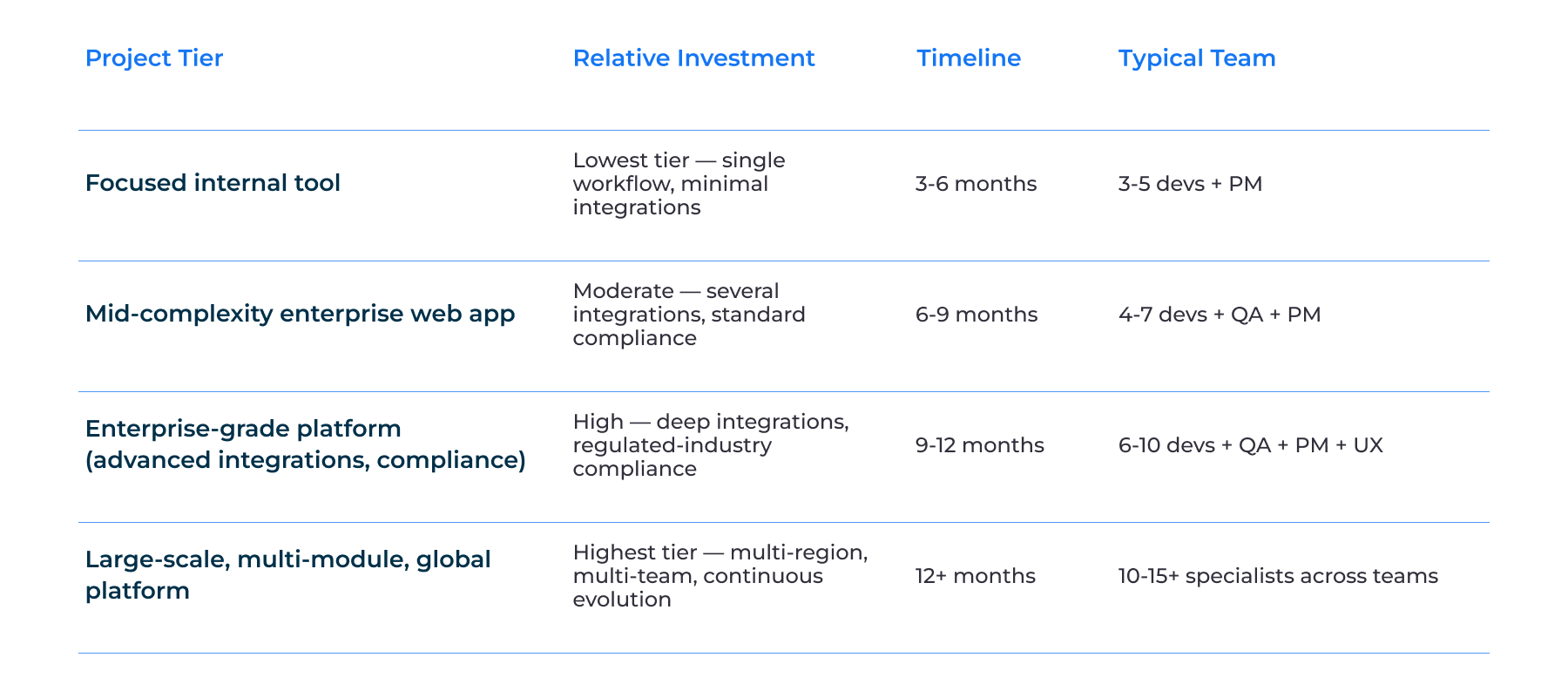
Building the application is only a single aspect of the investment. After release, you’ll also need costs to keep it safe, stable, and up to date.
- Maintenance: You should add 15–25% of the original development effort per year. But keep in mind that the larger and more complex your system is, the more you’ll pay.
- Cloud infrastructure: The number of users, data volume, and security requirements affect hosting costs. In this case, you don’t have a fixed monthly fee; you pay for usage.
- Security and compliance: This will increase the base development effort by up to 15–25% for encryption, role-based access control (RBAC), audit logging, and regular security testing. But your budget can vary depending on your industry.
Enterprise Web Application Architecture
The secret sauce of an enterprise web application is its architecture. Indeed, it defines whether your system scales up with your business or holds it back. Architecture affects how easily your system can extend, integrate with other tools, and support transformations. It also reduces technical debt and expensive rework as the application improves.
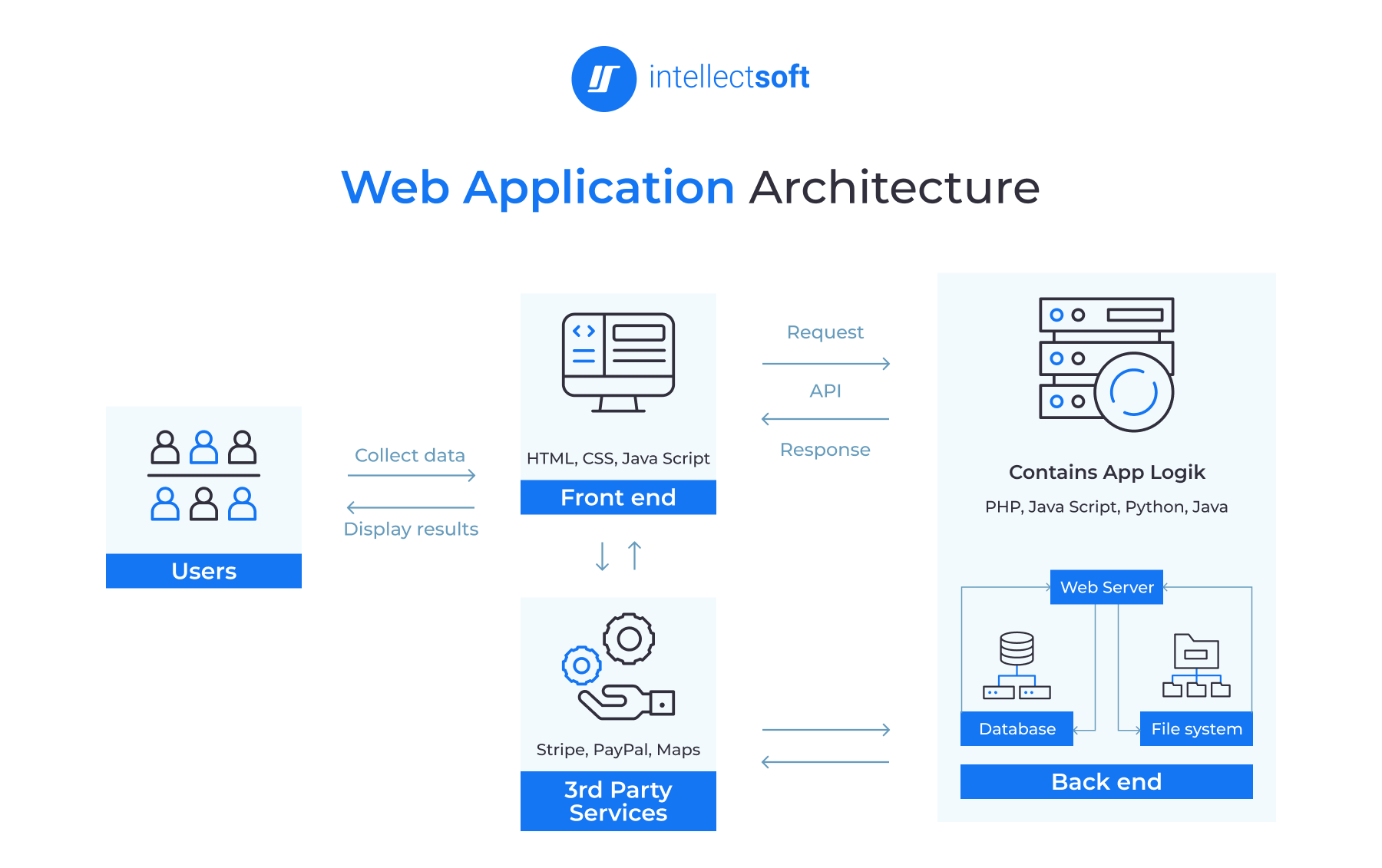
Front end vs. back end
Front end and back end are the two main layers of enterprise web systems. The front end includes dashboards, forms, and navigation – everything users see and interact with. The back end is responsible for the business logic, data management, and user access, connecting your app with databases and other business apps. A typical enterprise web app consists of both front end and back end.
Monolith vs. microservices
In a monolithic architecture, all software is in a single codebase — it’s easy to build, test, and deploy but difficult to scale. You can use it to develop smaller apps or products at the initial stages.
In a microservices architecture, the system is broken into smaller, autonomous services — so you can develop, deploy, and scale them if needed. Plus, your teams can work independently on each unit. This variant is suitable for building large enterprise platforms. But you need to put in a lot of effort to monitor and deploy across services.
Cloud-native and containerized deployment
With Docker and Kubernetes, we build enterprise apps packaged in containers for the cloud. What does this give you? In containers, your application performs consistently across development, testing, and production environments. Plus, they make it easier to scale separate services and allow you to recover your app quickly from failures.
API-first integration
Most enterprise apps depend strongly on other systems. With an API-first approach, integrations are built into the architecture from the start – an app can directly connect to ERP, CRM, data warehouses, payment systems, and third-party services. So future integrations are faster and easier.
Why Choose Intellectsoft as Your Enterprise Web Application Development Partner
18+ years in custom software development and clients ranging from fast-growing companies to 35+ Fortune 1000 businesses – all this is about Intellectsoft and our enterprise-grade expertise. We offer enterprise web application development across fintech, healthcare, insurance, logistics, manufacturing, and retail.
If you need complex solutions with reliable and scalable architecture, Intellectsoft is at your disposal. This is what Intellectsoft has been doing since 2006:
- Fast and reliable delivery thanks to senior engineers and AI-assisted development
- Architecture expertise backed by 600+ client success stories
- Experience in building HIPAA and GDPR compliant solutions
- Long-term client partnership with an engagement of 7 years
- Stable team with 98+ retention rate
Intellectsoft's enterprise web application development process
At Intellectsoft, our enterprise web application development process is structured, with deliverables at every phase. So we can minimize risks, stay transparent, and deliver business value at every stage. Here are the main stages you’ll complete with us.
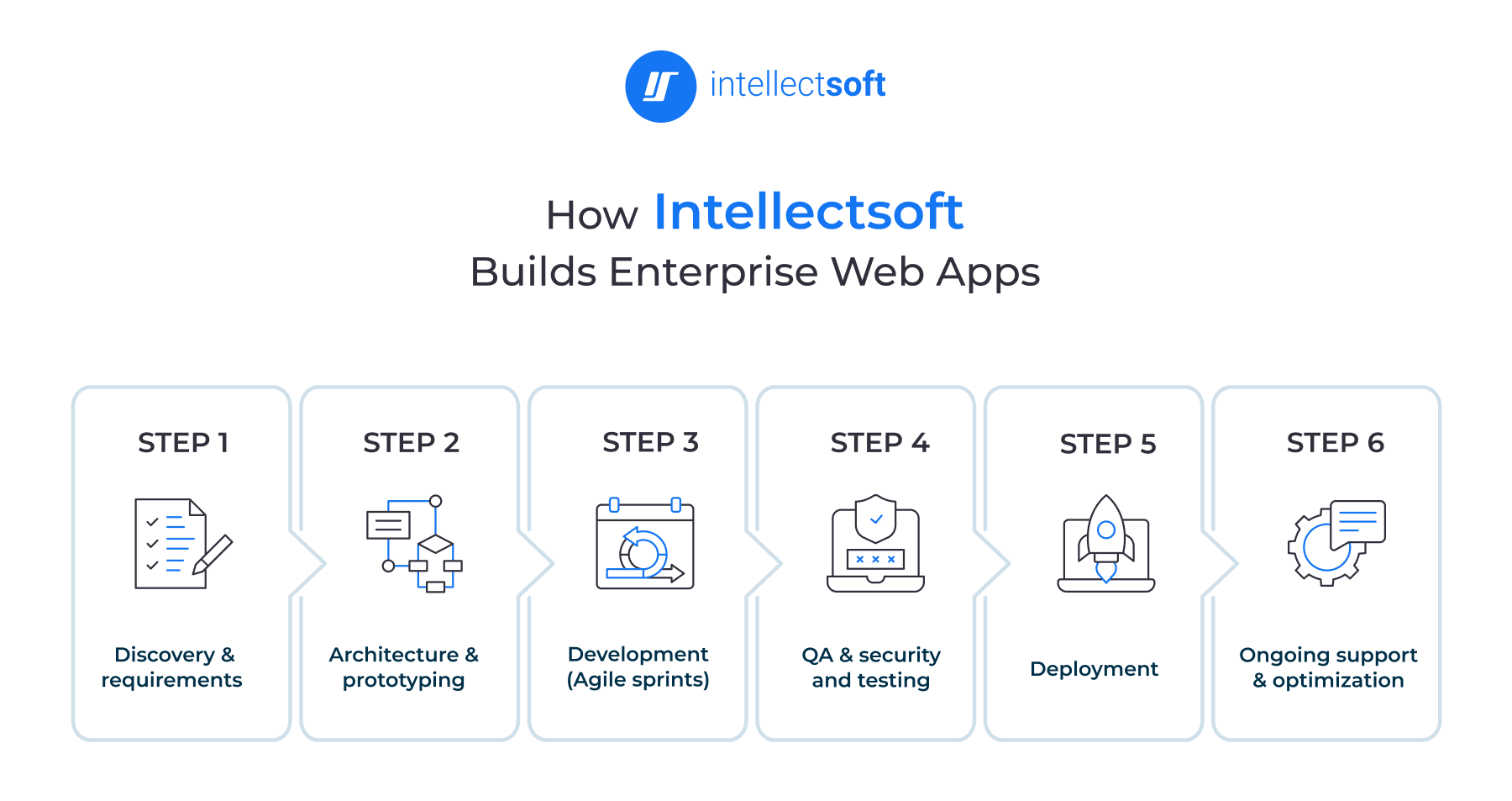
Step 1. Discovery & requirements
We start our projects with discovery to explore your business needs, tech landscape, and user needs. We focus on your business and technical requirements and potential risks to pick the best tech approach for building your enterprise app with our IT consulting services. With a signed-off requirements document as your roadmap, you can move on to architectural design.
Step 2: Architecture & prototyping
Before enterprise software development starts, our solution architects design a scalable system architecture and integration strategy. At the same time, our designers build a clickable prototype. So, you can test the user experience before engineering starts. Instead, the architecture diagram offers a clear technical blueprint for your staff.
Step 3: Development (Agile sprints)
Intellectsoft delivers development in Agile sprints. So you get a working solution at the end of every iteration and don’t need to wait for the project to finish. You can choose a dedicated development team or full-cycle delivery; either works. You can review progress regularly and adjust priorities to your business needs.
Step 4: QA & security and testing
Our experts conduct testing throughout all stages of development to spot issues early and keep high quality. Before your product release, we provide you with a test coverage report and a security audit. They confirm that your software is stable, secure, and market-ready.
Step 5: Deployment
Once your application is ready, our DevOps engineers deploy it to production — the release process is controlled. Plus, we prepare rollout and rollback plans to minimize risks and guarantee a smooth launch.
Step 6: Ongoing support & optimization
After launch, we’re still monitoring, supporting, and upgrading your app – all of which is done to keep it secure and performing. SLA-backed support and a performance roadmap are our ongoing services. They help your app scale as your company extends.
Ready to build a secure, scalable enterprise web application? Book a free consultation with Intellectsoft and let's discuss your project.
How Intellectsoft Built an Enterprise Data Warehouse to Help a Financial Organization Scale
Every day, a global financial services company produces massive amounts of data, which are stored across different systems. And that’s the reason why decisions are slow, teams are overloaded with tasks, and operations aren’t efficient.
With our enterprise web application development services, our team helped a financial services provider process data in real time and scale up based on the insights extracted. Based on AWS, Kafka, Amazon S3, and Apache Spark, Intellectsoft built an advanced Enterprise Financial Data Warehouse. The goal here was to centralize financial data and automate analysis — all to derive value from the data and convert it into insights. And the main thing is that all this can be done in real time.
The results of our cooperation: our client has minimized manual work and automated routine tasks. They improved the quality of reporting, making it faster and more accurate. Plus, the organization has gained access to reliable business insights in real time. Finally, this platform has become a solid foundation for future business intelligence and AI initiatives.
FAQ
What is enterprise web application development?
Enterprise app development is the process of designing, building, and supporting custom web apps for sophisticated business operations. Enterprise web software differs from ERP or CRM systems as they are built around your business needs, workflows, integrations, and security requirements.
How much does enterprise web application development cost?
Simple enterprise apps – $100,000–$150,000
Complex business platforms – $150,000-$500,000+
Large, advanced, multi-module systems – over $1 million
These are the average market rates. Frankly speaking, we don’t dare to announce the final price of your solution. Enterprise web development costs depend on your project's complexity, integrations, security and compliance requirements, and team size.
How long does it take to build an enterprise web application?
A focused business app typically takes 3-6 months
A mid-complexity enterprise platform – 6-9 months
Large-scale enterprise systems with complex integrations – 9-12 months
N.B. The timeline depends on the project's complexity, features, integrations, and compliance requirements.
How do you ensure security and compliance in enterprise web applications?
As an enterprise web application development company, we build security and compliance into your application from the start. Secure architecture, role-based access control, data encryption, regular security testing, audit logs, and secure API integrations – we apply all of this to your solution. Depending on your industry, we follow GDPR, HIPAA, or SOC 2 to protect data and support regulatory compliance.
What industries benefit most from custom enterprise web applications?
Healthcare, financial services, manufacturing, retail and eCommerce, transportation and logistics, travel and hospitality, insurance, and automotive — all these industries gain the most value from custom enterprise apps. They rely on them to automate workflows, connect tools, secure data, and foster future scaling. But if your organization has complex operations, multiple systems, and big data, a custom enterprise web app will serve your needs.
