Key Takeaways
- Business technology consulting is a service we deliver to help companies build their IT infrastructure, systems, and technology strategy around their business needs.
- Business technology consulting involves IT strategy and roadmapping, cloud migration, cybersecurity, AI integration, legacy system modernization, and compliance – all of which help build a secure, scalable technology foundation.
- A systematic business consulting can bring ROI within 12-24 months, mainly through cutting unnecessary expenses, automating tasks, and minimizing compliance risks.
- The main reason consulting projects don’t bring results is skipping the discovery phase and, as a result, focusing on the wrong problem.
- Enterprise consulting helps upgrade complex systems and meet compliance regulations, while SMB consulting supports cloud adoption, better tool choice, and lower IT costs.
A company spends years integrating new software to support their scaling. Their sales team uses one CRM, marketing uses another, and finance works in the ERP. And every department has its own tools and spreadsheets.
On the one hand – that’s great; they use technologies to work better. But reality is totally different. Data is scattered across systems that don’t interact with each other. IT costs are skyrocketing. And simple tasks take a lot of time and effort.
This is a typical scenario in which companies decide to digitize their processes on their own, without business technology consulting services. Yes, they try to save costs, but they indeed pay more because they don’t know how to align technology with business goals.
In this article, we’ll explain what IT consulting services are, when companies need it, and how it helps build the right tech strategy for your business.
What Is Business Technology Consulting?
Business technology consulting is a professional service that software companies offer to help balance your tech strategy with your business goals. How do they do this? First, tech experts assess your current IT environment. Then, they build a robust technology strategy. Finally, they match your systems with the strategic goals they pursue.
Business and technology consulting typically covers:
- Strategic planning
- IT roadmapping
- Digital transformation consulting services
- Cloud migration
- System integration
- AI adoption
- Legacy system modernization
The faster you’re growing, the more complex your technologies are becoming. You add new systems. Your existing ones become obsolete and slow down processes. Plus, AI barges in with its capabilities. How to arrange all this into a clear strategy?
Where does your business stand today? What are your technology gaps? How to create a practical plan that drives you forward? IT consulting services help you understand all these points and build the strategy that helps achieve lower costs, stronger safety, and better performance.
Business technology consulting vs. IT support: key differences
The technology consulting business is proactive and strategic. It defines how technology should be structured, chosen, and agile to meet long-term business goals. IT support is reactive and operational. It emphasizes fixing issues and maintaining robust, stable systems.
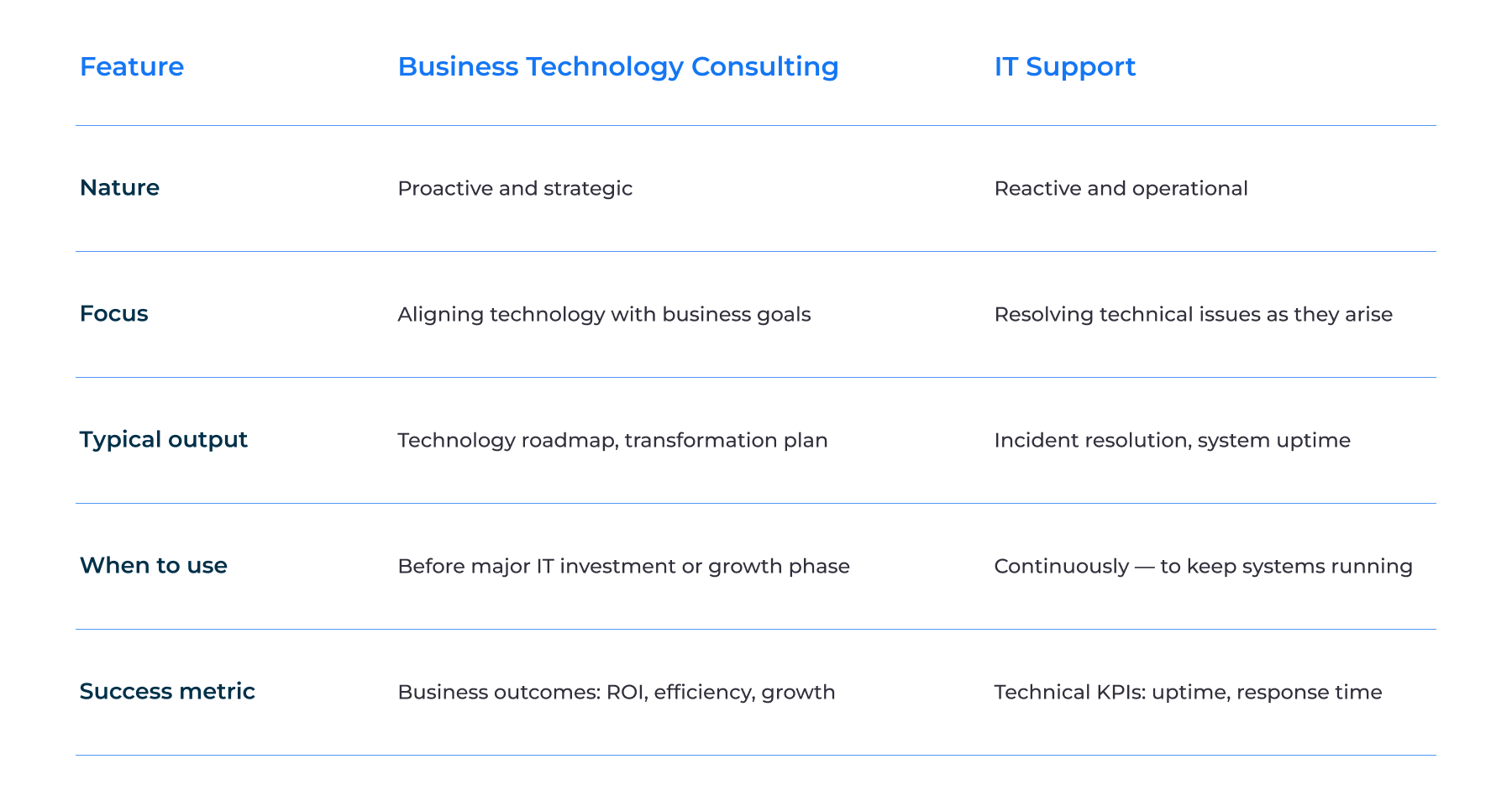
Most organizations need both technology consulting and IT support. They need technology consulting to define the right technology direction first. And IT support is requested to keep systems stable and running day to day.
What Services Does a Business Technology Consultant Provide?
Technology consulting for business is more than technology recommendations, as many companies used to think. Consultants help companies build a sustained tech strategy, upgrade existing systems, adopt AI, and more. So let’s review their services in detail!
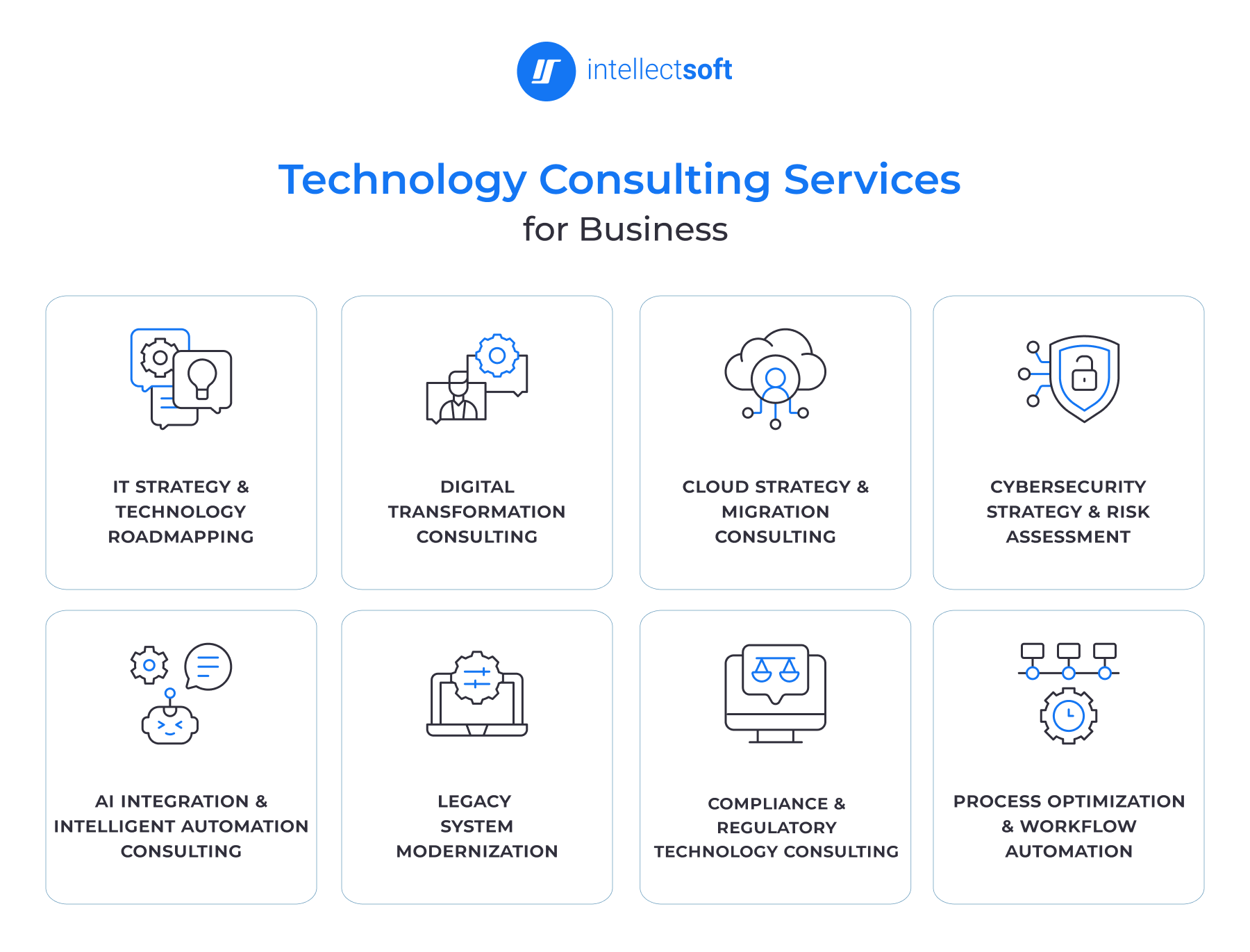
- IT Strategy & Technology Roadmapping: Consultants assess your current IT environment to detect vulnerabilities and gaps. And based on this, they create a strategic 3–5-year technology roadmap. So you can define your budget, improve your architecture, and make more informed technology decisions.
- Digital Transformation Consulting: This service helps you understand how your company operates day to day. Consultants identify what should be automated and upgraded. And only then, you receive recommendations on what digital transformation solutions to implement to boost productivity and customer experience.
- Cloud Strategy & Migration Consulting: If you decide to migrate your system to the cloud, consultants will help you choose the right cloud platform and prepare your infrastructure to transfer with minimal risks and expenses. For this, you may need solution architecture consulting to ensure your solution is stable. Cloud-based software development creates a secure, scalable environment that drives your growth.
- Cybersecurity Strategy & Risk Assessment: This service aims to detect possible risks and protect your infrastructure from them. So consultants assess your safety level, identify gaps, and recommend improvements. The goal here is to strengthen protection and stay compliant.
- AI Integration & Intelligent Automation Consulting: AI consultants help businesses find out where artificial intelligence delivers value. So they pick the right AI solution, define how to implement it, and integrate AI into your system. With consulting, you’ll take the first step to automating repetitive duties and becoming more efficient.
- Legacy System Modernization: IT consultants assess your current systems to see whether you need to upgrade it. So they pick the right modernization approach and revamp your system without harm to your business operations.
- Compliance & Regulatory Technology Consulting: If you operate in a regulated environment, you need to comply with legal regulations when integrating new technologies. Consultants help you develop reliable systems compliant with GDPR, HIPAA, PCI DSS, and other industry requirements.
- Process Optimization & Workflow Automation: Consultants evaluate existing processes to find out gaps and bottlenecks that restrain you. Then you’ll get recommendations on how to automate repetitive work and optimize workflows to make your team more fruitful.
Why Businesses Invest in Technology Consulting: Key Benefits
Today, business consulting is picking up steam, becoming a bridge between the tech world, full of innovation, and a business environment focused on returns and strategies. But before making the choice: to invest or not to invest in technology consulting, it is important to understand what it can bring to the table.
Aligning IT strategy with business objectives
According to Gartner (2026), only 47% of enterprises can meet strategy objectives. What does this mean? The one thing is to build an IT strategy, but the other is to align it with your business goals.
In this case, technology consulting does a good job, helping companies create long-term tech roadmaps and make wise investment choices. As a result, your business strategy and technology executions are in harmony, cutting costly mismatches.
Speeding up digital transformation
How to digitize your business faster if you have many systems that work separately? Of course, you need a strategy built by technology consultants. Yes, this will add to your budget.
But if you do this in a well-planned way through modernization, cloud migration, and IT implementation, you’ll receive the benefits of this investment. McKinsey (2024) confirms this, stating that a clear digital transformation strategy brings more returns than an ad hoc approach.
Cutting technology costs software waste
Some businesses pay for obsolete software they don’t use or keep systems that don’t create value. It’s high time to hire business technology consultants.
They’ll review existing IT investments, get rid of duplicate tools, and optimize the tech budget. Gartner (2024) reports that enterprises waste around 30% of their SaaS spending on unused licenses. So, IT cost optimization is one of the fastest ways to improve ROI.
Improving cybersecurity and risk control
Security is a vital part of every technology decision, as IT environments are becoming more complex and harder to protect. With business and technology consulting services, you’ll improve how you approach your systems’ safety.
First, they evaluate existing vulnerabilities that could become direct risks. Second, they advise how to make IT architecture more reliable and robust. Finally, they check whether you comply with the industry-specific regulations. So see, it’s possible to improve resilience against cyber threats.
Supporting secure, compliant scaling
The mistake companies make when growing is staying committed to legacy systems and obsolete technologies. This step can cost them a lot of money and effort in the end.
Business technology consultants will drive you to move forward. They’ll help build scalable, robust architectures that can withstand heavy workloads. They encourage upgrading legacy systems to enable multiple integrations. Business consulting provides a strong foundation for migrating to the cloud. As a result, all these solutions will be compliant with GDPR, HIPAA, and PCI DSS. That’s why your business will scale up in a reliable and law-abiding way.
Business Technology Consulting for Enterprise vs. SMB
The general truth: every business can benefit from technology consulting. The difference lies in the priorities of enterprise companies and SMBs. Enterprises request tech advisory when they need to upgrade their complex systems. Mid-sized companies ask for consulting to build the right technology foundation.
Technology consulting for large enterprises
Even today, there are enterprise-level companies that still rely on outdated systems that work but don’t really help. And the problem is that they can’t be rebuilt overnight because they support vital processes. In this case, business technology consulting is used to gradually upgrade these systems by adding integrations and improving architecture.
Cybersecurity and compliance are other areas of focus for tech consultants. First, they pick up safety practices. Second, they make tech solutions comply with HIPAA, GDPR, PCI DSS, and SOC 2. In the end, they help business teams adopt new tools and use them to achieve business objectives.
Technology consulting for mid-sized businesses
SMBs usually face different dilemmas. They need help choosing the right technology for their business. That’s why the role of technology consultants here is to recommend relevant software, remove tools that fail to work, and optimize IT spending. They also assist with migrating to the cloud, scaling, and automating routine tasks.
An SMB consultant serves as a builder, creating IT infrastructure in the business environment. They help digitize processes and operations.
What Does Business Technology Consulting Cost?
Businesses expect to hear a specific number when it comes to consulting costs. But indeed, it varies strongly, depending on your project scope, business goals, and engagement model you choose. Plus, add your outdated systems, poor processes, and safety risks here, and this number will be higher. Below is the table with engagement models that can suit your business.
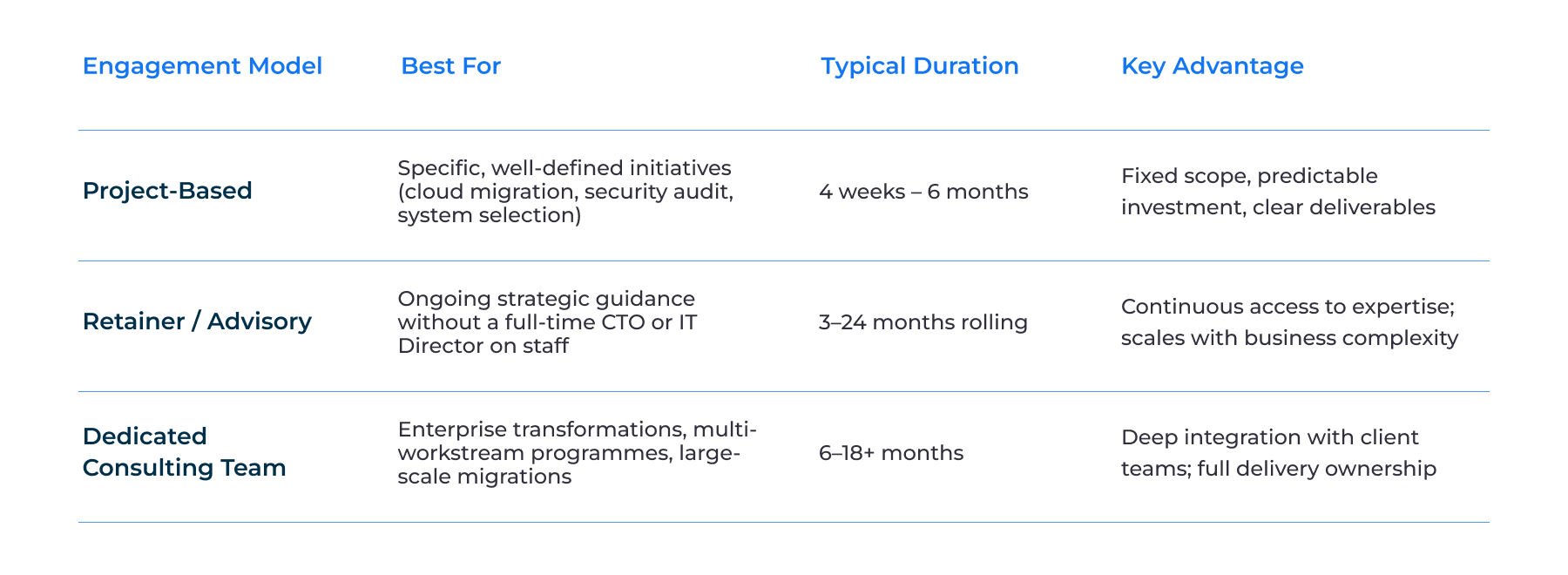
- Project-based: If you have well-defined objectives, this model is best suited to you. As it offers a fixed scope, predictable costs, and clear outcomes, it’s perfect for one-time consulting.
- Retainer/advisory: This model provides continuous access to experienced technology consultants. If you expect continued guidance and don’t want to hire a full-time tech team, this is the best option.
- Dedicated consulting team: If you’re planning a full digitalization, you should focus on a dedicated team. They will collaborate with your internal crew and manage complex tasks from strategy to launch.
How to Choose a Business Technology Consulting Partner
Choosing the right consulting partner leaves its mark on your business. The reason is pretty simple: business technology consultants understand your needs, spot issues, and only then create a tech strategy that can solve them. But how to choose a reliable consulting partner? Here is our list of criteria that can help you.
- Industry-specific expertise: You need a vendor with experience in your vertical: success stories and clients from your domain. Why does this matter? Every industry has its challenges. And if it’s regulated, you need a partner who will care about your compliance.
- AI and cloud success stories: Pay attention to whether a vendor can migrate to the cloud and integrate AI. But the use of AI should be business-justified, not an application for hype, but with practical use cases. Better ask for real case studies to see how this works.
- Compliance and security credentials: If you operate in a regulated environment, you can’t move further without compliance. Holding HIPAA, GDPR, PCI DSS, or SOC 2 is vital for building compliant, reliable solutions.
- A structured consulting process: The best consultants start with discovery: auditing your current IT infrastructure, spotting issues, and learning your needs. And only after that can they offer a relevant solution.
- Proven track record: Check whether your potential vendor can prove their expertise with client case studies and examples of real impact. Higher operational efficiency, faster processes, or reduced costs — all these are about measurable results from cooperation with this provider.
- Flexible engagement models: Choose a consulting partner that can scale the engagement up or down. For example, you may first request a small audit of your IT environment. But soon you may need continuous advisory services or a dedicated consulting team.
Red flags to avoid when hiring a technology consultant
Now it’s high time to choose a technology consultant. But before making your choice, evaluate your candidate based on these red flag markers:
- Generic proposals that skip a discovery phase or technology audit
- Lack of case studies with measurable business results
- Absence of a change management plan to support your employees
- Universal recommendations for all industries
- Lack of clear success metrics set before the project began
- Surface expertise in AI, cloud, or industry-specific compliance
How Intellectsoft Delivers Business Strategy & Technology Consulting
18+ years in software development, 600+ brilliant solutions, custom software development and clients ranging from fast-growing companies to the Fortune 500 — all this is about Intellectsoft and our consulting services. We offer advisory across fintech, healthcare, insurance, logistics, manufacturing, and retail. With a robust tech strategy and applicable engineering, our consultants help digitize business processes, integrate AI into workflows, and upgrade outdated systems.
We have an on-point store to share how we worked with Eurostar. The client had fragmented passenger processes that were difficult to manage. Our consulting team created a roadmap for a unified passenger experience platform, a centralized solution that kept all processes in one place. With our consulting services, we helped our client perform better and enable real-time passenger communication. All was done for the convenience of Eurostar and their audience.
How we deliver our consulting services
We use a gradual approach in our work, so we do when we conduct technology consulting for our clients. Here are four main steps we follow.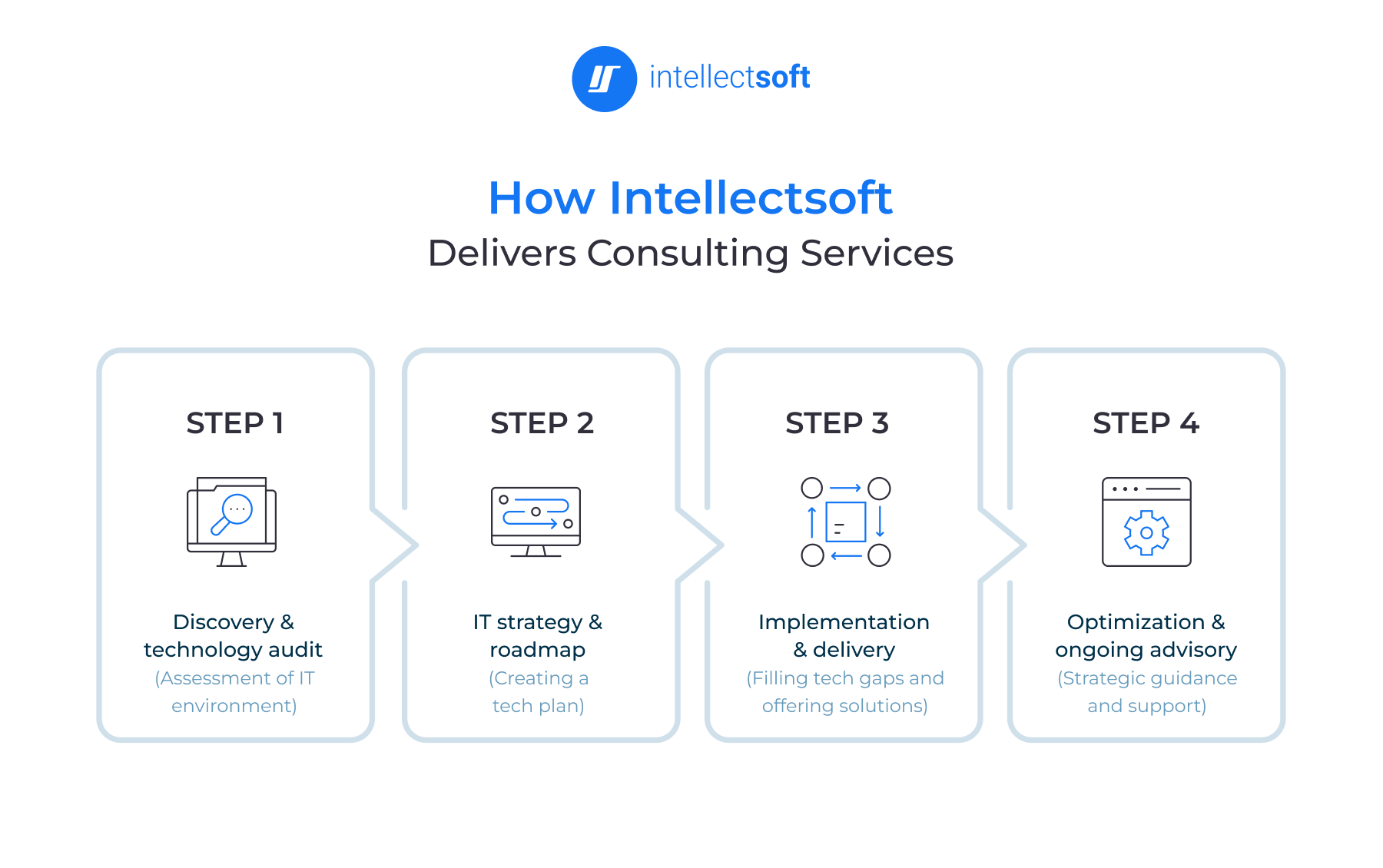
Step 1. Discovery & technology audit
We start the first engagement with our client with discovery. Our tech consultants assess your technology environment and spot gaps. Plus, they pay attention to safety and compliance to see whether there are any issues to be fixed. After all audits are conducted, we’re ready to define a business problem and recommend a tech solution.
Step 2: IT strategy & roadmap
Next, we create a practical technology plan that matches your business goals, funding, and legal regulations. It includes focus areas, investments, integration phases, and business outcomes.
Step 3: Implementation & delivery
Our IT consultants and engineers work as a team to develop a robust tech strategy that will speed up the digitalization of your business. Need to build software from scratch? Thinking about migrating to the cloud? Want to integrate AI? Planning to upgrade your legacy application? With our team, you can be sure you will fill tech gaps and reveal new capabilities that enable steady scaling.
Step 4: Optimization & ongoing advisory
We don’t stop collaboration after product release. We continue to work on performance, add new technologies, and refine AI solutions where needed. Our continued strategic guidance helps your business scale.
FAQ
What is business technology consulting?
Technology business consulting is a service where experienced technology experts assess your current IT infrastructure, identify what holds your business back, and create a tech strategy for future scaling. Our IT consultants help you match your technology with your business needs. As a result, you’ll optimize your budget, perform better, and expand your processes.
What does a business technology consultant do?
A business technology consultant is a business strategist who fills the gap between technology and business needs. First, they assess your current IT infrastructure and develop a tech plan to lay the foundation for further growth. Second, they help you choose the right solution for your company and a vendor who can build it. Finally, they offer continued strategic guidance to keep your technology in harmony with your business goals.
What is the difference between IT support and business technology consulting?
IT support is reactive as it fixes issues and keeps systems and its operations stable and productive. Business technology consulting is proactive and strategic, as it defines how technology should be chosen and used to achieve long-term business goals. Both are vital, but consulting usually comes first to set the right tech direction.
How much does business technology consulting cost?
The cost of consulting depends on your project scope and the engagement model with the team. Project-based, a monthly advisory, or a dedicated consulting team – your choice will influence your budget. As a business and technology consulting firm with expertise in IT advisory, we can offer scoped estimates after the first discovery session. Contact our team and get a free consultation to discuss your business needs.
What industries benefit most from business technology consulting?
Businesses operating in fintech, healthcare, insurance, logistics, manufacturing, and retail can benefit most from technology consulting. Companies that strive for system upgrades, swift digitalization, and compliance with HIPAA, GDPR, SOC 2, PCI DSS, and CMMC will achieve faster returns than others.
Can technology consulting help with AI adoption?
Yes, business technology consulting helps companies assess AI readiness and build a data strategy. After this, consultants select the right AI solutions and create a practical adoption roadmap. At Intellectsoft, our advisors help businesses integrate AI into existing systems and develop AI strategies for fintech, logistics, and healthcare.
