SOLUTION
Intellectsoft used Claude across the engineering workflow, from the initial architecture audit to documentation, making it central to the team's development process. The team included a solution architect, four developers, a full-stack developer, a business analyst, and a DevOps engineer. AI adoption started with chat assistance and moved to agentic development within weeks, with Claude Code becoming the team's primary coding tool.
Architecture and analysis. Before designing each new service, the architect pointed an agent at every repository in the system. Each collected findings against a checklist, and a separate agent merged the results into one analysis. The team mapped the legacy system in about an hour. The architect then reviewed the findings by hand.
Code. Developers used Claude Code for agentic development, and most pull requests across the team were AI-assisted. The team had one rule: if you don't understand what the agent wrote, it doesn't go in. To keep pull requests reviewable, the team split tasks into smaller pieces.
Workflow automation. Through MCP servers, agents connected to Jira, GitHub, Slack, and the databases. They created and closed tasks, wrote task descriptions, and opened pull requests with a Slack message that tagged the reviewer. Each automation saved a little time, adding up to roughly half an hour per person per day.
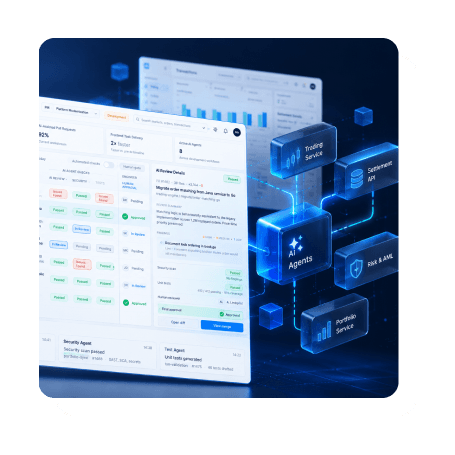
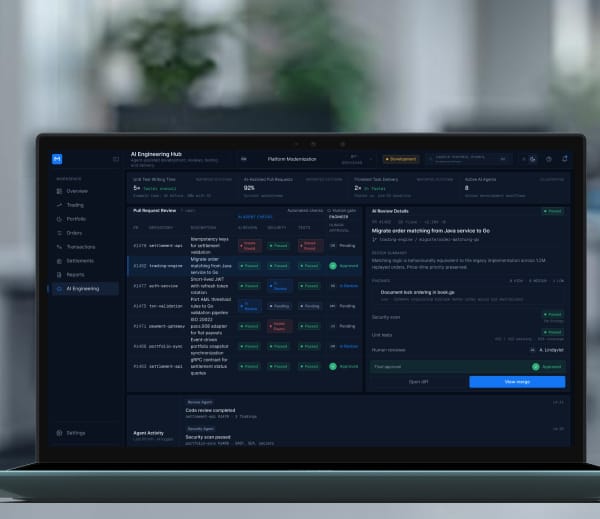
Review and security. Every engineer configured agents differently, but the team shared two: one for code review and one for security review, alongside a coding agent built around a skill for the team's programming language. The architect ran a larger set on top of that — including agents for system design, documentation, and requirements analysis — used to draft user stories and use cases. Custom agents reviewed every pull request and ranked findings from blocker to low priority. Frontend and backend changes each passed a dedicated reviewer, and a security agent checked every change. Another security agent in the CI/CD pipeline looked for leaked secrets. Engineers made the final decision.
Testing. Agents wrote unit tests and helped draft test cases and test plans for integration and end-to-end testing.
Documentation. Agents produced Mermaid diagrams, drafted ADRs from meeting notes, and updated architecture documents when a task closed. The business analyst also maintained a Markdown documentation repository with a dependency graph that agents used as a project knowledge base. When a new feature conflicted with an earlier decision, they flagged it.
Process. The team built a shared AI hub and tracked how each person used AI: pull requests, reviews, tests, defects, and which model handled which task. Heavier models went to architecture work, lighter ones to routine documentation — Claude Opus for complex design decisions, lighter Claude models for routine writing.